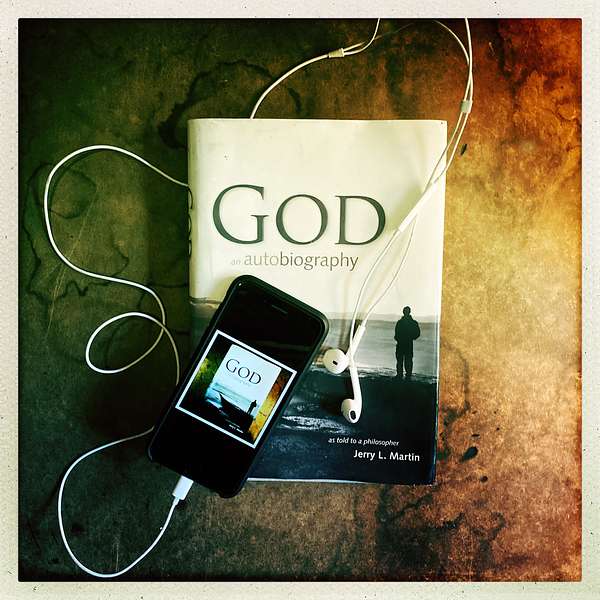
GOD: An Autobiography, As Told to a Philosopher - The Podcast
GOD: An Autobiography, As Told to a Philosopher - The Podcast
260. Radically Personal: A New Philosophy of God — Life Seeking Understanding
What if theology is not a set of inherited doctrines, but life seeking understanding?
Learn more in Jerry’s latest book, Radically Personal: God and Ourselves in the New Axial Age, and subscribe for weekly episodes that explore God, spiritual experience, and the ongoing journey of the soul.
In this second installment of Radically Personal, philosopher Dr. Jerry L. Martin explores what he calls Theology Without Walls — a seeker-centered approach that begins with direct experience rather than boundaries set by any single tradition.
Jerry reflects on the challenge of religious exclusivism, the belief that only one religion is true while others must be rejected, engaging the influential argument by Christian philosopher Alvin Plantinga. Plantinga contends that simple logic requires believers to view other religions as false. Jerry examines this claim carefully, suggesting that many spiritual teachings once assumed to be contradictory may, in fact, illuminate different aspects of divine reality. Truth may not be limited to one place or one people.
The conversation considers how spiritual knowledge grows. Just as scientific understanding expands by taking in new insights rather than discarding what came before, religious understanding can deepen when seekers remain open to what God may disclose beyond familiar walls. Jerry proposes a different epistemic strategy — one grounded in conviction but accompanied by humility — acknowledging that human beings are limited, that divine mystery exceeds our concepts, and that God may be revealing truth in multiple traditions across the world.
This episode is a call to be rooted, open, curious, and responsive — to seek a relationship with the Divine that is radically personal.
Other Series:
The podcast began with the Dramatic Adaptation of the book and now has several series:
The Life Wisdom Project – Spiritual insights on living a wiser, more meaningful life.
From God to Jerry to You – Divine messages and breakthroughs for seekers.
Two Philosophers Wrestle With God – A dialogue on God, truth, and reason.
Jerry & Abigail: An Intimate Dialogue – Love, faith, and divine presence in partnership.
What’s Your Spiritual Story – Real stories of people changed by encounters with God.
What’s On Our Mind – Reflections from Jerry and Scott on recent episodes.
What’s On Your Mind – Listener questions, divine answers, and open dialogue.
Stay Connected
- Share your thoughts or questions at questions@godandautobiography.com
- 📖 Get the book
Share Your Story | Site | Facebook | Instagram | Twitter | YouTube
Scott Langdon 00:00:17: This is God: An Autobiography, The Podcast — a dramatic adaptation and continuing discussion of the book God: An Autobiography, As Told to a Philosopher by Jerry L. Martin. He was a lifelong agnostic, but one day he had an occasion to pray. To his vast surprise, God answered — in words. Being a philosopher, he had a lot of questions, and God had a lot to tell him. Episode 260
Scott Langdon 00:01:18: Welcome to God: An Autobiography, The Podcast. I'm Scott Langdon, and I'm excited for you to join us this week in particular because we're returning to something brand new. Just over a month ago, we debuted a new series from Jerry Martin that we're calling Radically Personal. This limited series is based on Jerry's latest book, Radically Personal: God and Ourselves in the New Axial Age. In this second installment of the series, Jerry continues to unpack a new definition of theology, a theology without walls, where theology is not simply a particular faith seeking understanding, but life seeking understanding. What could that mean to each of us in our own particular radically personal way? Here now is Jerry Martin. I hope you enjoy the episode.
Dr. Jerry L. Martin 00:02:23: We start by defining the project. Life-seeking understanding, life-seeking understanding. That's the proper scope for theology or spiritual thinking. It goes beyond the boundaries of one's own religion. Religious truth overflows any single tradition. That's why the effort is called Theology Without Walls. Theology without walls. Some would warn that this flirtation with the religions of the world is profoundly mistaken. Putting truth itself at risk. Exclusivism is the view that there's one and only one true religion. At least it's the only saving, liberating one. There is a grain of truth to exclusivism. Whatever spiritual truth you found, perhaps in the tradition you were raised in, or one to which you converted. Or something you have chanced upon, you shouldn't allow the bewildering array of options to unnerve or cloud over the insight and spiritual grounding you have found
Dr. Jerry L. Martin 00:03:38: This conservation principle of truth isn't limited to religion. It's how science works as well. The Newtonian universe was eclipsed by Einstein's theory of relativity. But it wasn't eliminated. It remains at the heart of contemporary physics even after the quantum revolution. Physicists add to what Newton taught. And understand it in a new and larger context, but they do not throw out entropy. Or the principle of equal and opposite reactions. However, even respecting the conservation principle of truth, scientific revolutions, as well as other revolutions in human understanding, do occur. They can rightly occur in religion, also. The urge to take in truths from multiple traditions has been challenged by one of the most important philosophers of the last half century.
Dr. Jerry L. Martin 00:04:50: He is aware of what he calls the impressive variety of religions in the world. In light of this fact, Alvin Plantinga, a committed Christian, asked, “Can I sensibly remain an adherent of the beliefs of just one of these religions, rejecting the others?” His answer is yes. And he uses the occasion to mount, as his essay is subtitled, A Defense Of Religious Exclusivism. Plantinga argues as follows: to have a belief, any belief at all, is to believe that it's true. And to believe that P is true, is to believe that not P is false. This, he says, is no more than simple logic. Applying this logical schema to his own case, he concludes that if I hold Christian beliefs, it is not only permissible, but logically required, that I reject the beliefs of other religions.
Dr. Jerry L. Martin 00:06:03: As conclusive as that argument sounds, we cannot leave the matter there. The argument is, in fact, an enthymeme, a shorthand argument with an unstated premise. The tacit premise is that non-Christian beliefs logically contradict Christian beliefs. A plausible premise, but not a matter of simple logic. It requires the actual examination of the beliefs held by other religions to see if they state not P to the Christian P. Plantinga shows no evidence of having actually investigated the other religions to determine whether they contradict his Christian views. He takes that for granted. But when we look at statements made in the sacred texts of various religions, it's surprisingly difficult to identify direct contradictions. Consider the following statements. I, the Lord thy God, am one. Does this divine declaration in the Torah contradict the divinity of Christ?
Dr. Jerry L. Martin 00:07:18: Or not. How can we tell? It doesn't seem obvious from the meanings of the terms. It can't be settled by pure logic. The only God is Allah. May sound like an affirmation of a non-Christian God. However, once the translation is corrected to 'the only God is God,' does that contradict what the Christian believes? In the Bhagavad Gita, Krishna says, 'those that worship me with love, live in me. And I come to life in them.' Is Krishna a pagan idol? or rather a Hindu name for God. Might Krishna even be another way of representing the same God Christians represent, through Jesus. The Tao Te Ching begins with the words, 'The Tao that can be said is not the eternal Tao.' Must Christian deny this? Does the Christian affirm the contradictory?
Dr. Jerry L. Martin 00:08:31: The Tao that can be said is the eternal Tao, or there is no Tao. What is the Christian even talking about? The Tao. Not every difference. Even when terms appear to be opposites, it’s a contradiction. Consider the opposites transcendence and eminence. Which have long been debated even within the Christian tradition. It's often said that Hinduism emphasizes eminence and Christianity transcendence. It is precisely this type of conflict that often characterizes differences between religions. However, many Christians affirm the presence of God in the world, even His omnipresence. And Hindus believe that ultimate reality transcends the world of ordinary experience. Religions may be more alike than appears at first glance. But each has its own somewhat different understanding of ultimate reality and of how we are to relate to it. Like behaviorism and Freud and psychology, there are certainly different theories, and in some sense competitive. However, that is not the same as their being contradictory. and truth can be found in more than one place.
Dr. Jerry L. Martin 00:10:17: Now let's broaden the inquiry to a consideration of epistemic strategies. Suppose we want to know all we can about divine reality. Just as scientists want to know all they can about the physical world. Consider two epistemic strategies, one that is exclusivist and one that is not. One element of epistemic strategy may be attitude. In the face of religious diversity, Alvin Plantinga asked, what should my attitude be? He holds that I believe what I believe is true and anything that contradicts it is false. Now suppose a physicist were to say, 'Well, I know there are other physicists and most have different views from mine, but this does not faze me.' I believe that what I believe is true, and therefore that all contradictory views are false.
Dr. Jerry L. Martin 00:11:21: Now, now, suppose the physicist were to continue. Draw out these implications. This applies, of course, he says, that all counter-evidence is false and that any future scientific developments that contradict my current beliefs are false. If I change my mind tomorrow in light of new evidence, I believe my new view will be false. And finally, he adds, 'That is simple logic.' Well, the alternative epistemic strategy expresses a different attitude. Of course, I believe my current beliefs and disbelieve their contradictories. But I also know that I'm fallible and limited. Moreover, I understand that God is greater than my understanding. The ultimate reality may have more dimensions than are reported in my own religious tradition. We cannot rule out the possibility that the divine reality is many-sided.
Dr. Jerry L. Martin 00:12:27: And that there is a multiplicity of different but true divine self-disclosures. I, like Plantinga, believe in a personal God. That is a reality that has a personal aspect. But that does not rule out the possibility that reality has other, non-personal aspects, or that reality has disclosed other aspects of itself, primarily through non-theistic religions. Only a very strong claim that a particular religion is not only true, but is the only religious truth, would rule out this possibility. But would that claim be compatible with the depth, power, and mystery of Divine Reality. An open, non-exclusivist epistemic strategy in religion and in other fields has a truth-seeking advantage. Since different theories cast different light on the phenomena they study, we can learn from the behaviorist and Freud, from Adam Smith and Karl Marx, from Matthew Arnold and Francis Thompson, from the Christian and the Hindu.
Dr. Jerry L. Martin 00:13:42: The harvest of truth is richer if we take in what each has to offer. Each religion or worldview foregrounds some aspects of reality. and in the process, neglects or obscures others. The question may be not so much which one is true, as well, what does each illuminate; and what does it fail to illuminate? If God does disclose divine aspects through a diversity of religions, an exclusivist strategy will actually preclude knowledge of these other aspects. Hence, an open epistemic strategy is ultimately more faithful and responsive to whatever God and divine wisdom chooses to disclose to different peoples. Or in a less theistic formulation, whatever reality discloses of itself to them. When someone presents an argument with odd consequences, such as the peculiar dogmatism exhibited by our imaginary physicist, one suspects something has gone wrong.
Dr. Jerry L. Martin 00:15:03: I doubt that Plantinga tells his wife: I believe I turned off the lights before we left, and anything that contradicts that is false. If he did, we and she would think he was picking a fight. Well, in a sense he is. He's declaring where he stands and defending his right to stand there and not to hang suspended between different religions. In this desire, Platinga is right. Not as a point of logic, but as the response to a divine summons. When reality discloses itself, within Christianity or elsewhere, it is not an inert fact, but an authoritative call. A call that demands a response. That response is transformative. You feel your whole life oriented in new ways, as if pointing true north for the first time, and that nothing could be more certain than this thing that cannot quite be grasped.
Dr. Jerry L. Martin 00:16:09: It seems to be the only truth. Or at least the only truth worth having. Yet one's hold on this truth may be fragile and at risk. The danger of being open to more than one truth is that you may well lose a grip on the truth you had at the outset, the truth that quite possibly is the very one vouchsafed to you. Still, you can believe and live out your truth without having to deny the truth that may have been vouchsafed to others. We cannot assume that every human being receives the same divine call. We do not know how reality discloses itself to them, or what God intends for them. There may be a kind of division of labor as believers in each tradition try to live out their own divine callings.
Dr. Jerry L. Martin 00:17:09: We all have an urge to put God or reality into our particular conceptual or theological box. But if there's not just one truth, but multiple truths, we can glimpse the plenitude, the fullness of the divine reality only by paying attention to multiple self-disclosures, not just those in our own tradition. This openness requires humility— not only of soul but of mind—but of beliefs. We want to worship divine reality, not worship our own beliefs, which would itself be a kind of idolatry whatever and to whomever and in whatever language or vision or practice God has chosen to communicate. We should be willing to respond with humble hearts: Thy will be done. Or simply, so be it.
Scott Langdon 00:18:20: Thank you for listening to God: An Autobiography, The Podcast. Subscribe for free today wherever you listen to your podcasts and hear a new episode every week. You can hear the complete dramatic adaptation of God: An Autobiography, As Told to a Philosopher by Jerry L. Martin by beginning with Episode 1 of our podcast and listening through its conclusion with Episode 44. You can read the original true story in the book from which this podcast is adapted — God: An Autobiography, As Told to a Philosopher — available now at amazon.com, and always at godanautobiography.com. Pick up your own copy today. If you have any questions about this or any other episode, please email us at questions@godanautobiography.com, and experience the world from God’s perspective — as it was told to a philosopher. This is Scott Langdon. I’ll see you next time.