
Ask Dr. Universe
Join Dr. Universe and her friends at Washington State University as they investigate science questions from kids around the world. Know a kid with a curious science question? Help them submit it at askDrUniverse.wsu.edu for a chance to be featured on a future episode.
Ask Dr. Universe
How Do You Science | Meet an Apple Breeder
Use Left/Right to seek, Home/End to jump to start or end. Hold shift to jump forward or backward.
WSU apple breeder, Kate Evans, told me all about out how apples work and what it's like to be a scientist who makes new apples—like the Cosmic Crisp®.
- See Kate Evans' pollen vial here
- Learn more about the Cosmic Crisp® apple
- See all these different kinds of apples—and these Washington apples
- Enjoy these pollinator activities
- Use the Xerces Society pollinator plant lists to find what to plant near you
- Check out the apple question Kate Evans helped me answer
As always, submit burning questions at askdruniverse.wsu.edu. Who knows where your questions will take us next.
Dr. Universe: Hey friends, I'm Doctor Universe, and if you're anything like me, you've got lots of big questions about our world. You know, as a cat, I'm mostly a carnivore. But I do love apples. That's why I was so excited to talk with my friend Kate Evans. She's an apple breeder at Washington State University.
If you've ever had a Cosmic Crisp® apple, she and her team actually made that apple. We talked about how apple genes work, what it feels like to make something new, and what her job is like. I can't wait for you to hear all about it. Let's get started.
So you're an apple breeder? What does that mean?
Kate Evans: Good question. That means that I focus on making new varieties of apples. That's it. Simple as that.
Dr. Universe: When we talked before, you said that you were like a bee. Can you tell me what that means?
Kate Evans: The thing that the breeder always wants is to make new, unique seeds in an apple. And the way that you get the seed in the apple is that typically a bee will come along, flies along. It brings pollen from one apple tree to another apple tree. And it sort of visits the flower. That pollen is transferred onto the flower and the pollen grows down, fertilizes the egg cells in the apple flower. And that's what stimulates that flower to make an apple and the seed inside it. So that seed is a result of the bee bringing pollen from one variety, and that pollen integrating with the mother tree DNA or egg cells within the flower.
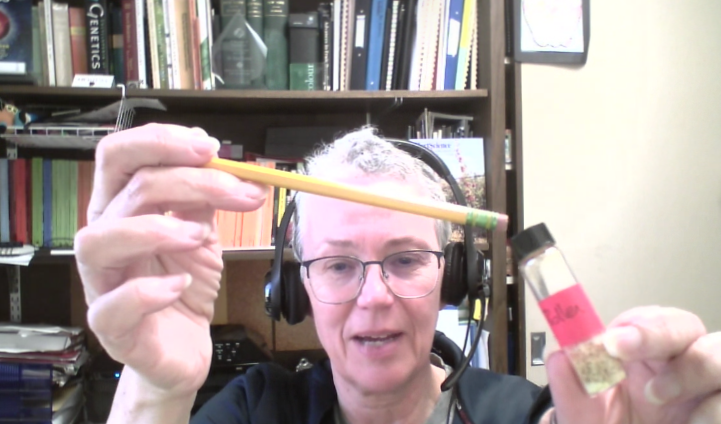
So I artificially do that, if you like. I pretend I'm a bee. I have my trusty pencil eraser. This is my pretend bee. I decide, okay, I want to see if I combine pollen from, let's say, Cripps Pink or Pink Lady as a variety. And I combine that with flowers of a Honeycrisp tree. I'd be getting seeds that are a result of those two parents. What I can do is I can go collect my Cripps Pink pollen with my trusty pencil eraser. I can dip it into the pollen and I can just rub it onto the flower of the Honeycrisp. I know then that any seed that are in that apple, they're a result of my choice of pollen rather than what the bee brings in. So we kind of are like bees, but we're a bit more controlling.
Dr. Universe: So apple trees have apple flowers, and the apple flowers have pollen and the egg part, right?
Kate Evans: Yeah.
Dr. Universe: But for the apple tree to make baby trees from seeds, it has to have pollen from another tree, not its own pollen.
Kate Evans: Correct. Yes. It's something that you get in different species that flowers have both the male and the female parts. So in this case the pollen and the egg cells. But they have what is called self-incompatibility so that pollen will not grow down the stigma to fertilize the egg cells in the flower. They are self-incompatible.
So you have to have pollen from a different variety to make that apple grow in the first place, because the flower on the apple tree needs to have pollen to actually stimulate the fruit to grow regardless of the seeds, right? You know, most people are interested in the fruit, not the seeds, but the two are interlinked, right? You obviously you get fruit if you get seeds. And so that whole process is relying on another source of pollen.
Dr. Universe: It was so interesting how you taught me when we talked last time about how the apple is part of the mother tree, and it's the seeds that have the DNA from the mother tree and the tree that donates the pollen.
Kate Evans: Yeah, the fruit that grows on the tree. Ultimately, it is that maternal tissue. It is all from that tree. The flower is maternal. The flower swells and becomes the fruit, ultimately. So Honeycrisp apples grow on a Honeycrisp tree. It doesn't matter what has pollinated them. They're always going to be Honeycrisp apples. But the seeds in the middle are all the unique combination of that pollen DNA and that mother DNA.
If you have a human family where you've got the same two parents, mom and dad, and you've got a whole load of siblings, brothers and sisters, they're probably quite similar. Those brothers and sisters, but they're all different. So there might be characteristics that they have in common. The usual ones with humans, you sort of think about eye color, but you also think of things like nose shape or your ears stick out or color of hair and all those sorts of things.
So often you can recognize a set of siblings and you can think, oh yeah, you must be related. But each one of those people are different. And that's exactly the same with the seedlings that are a result of the seeds in the apple. So they might have the same two parents, but every seedling is a unique combination of the DNA from the mom and the dad.
Dr. Universe: Which means that if I eat an apple that's super awesome, and I'm like, 'Oh man, I want to grow those apples at my house,' and I plant the seeds. It's not going to be the same kind of apple, right?
Kate Evans: And often if your apple that you've eaten is from a commercial orchard, usually the sources of pollen in those orchards, they're very carefully chosen varieties that are going to flower a lot, right. Produce a lot of pollen, be very easy to manage, not get in the way of the commercial main variety production. So often the varieties that are there for pollen can be crabapple types, very small fruited apples.
So your seeds from your apple that you've purchased in the store are fifty percent that nice, yummy apple DNA, but fifty percent from a smaller, not yummy tasting crabapple type.
Dr. Universe: So your job is to make new kinds of apples that didn't exist before, right? This may be a weird question, but why?
Kate Evans: That's a very good question. Why? Well, I think that there is a lot that we as apple breeders can do to make new varieties of apple that are actually better for the consumer. They taste better, they store better. S
o you might want to go purchase an apple in October and you might really enjoy it. And you might want to say, okay, I'm sticking to this one variety, I love it. I want the same eating experience in April and in July. And so that apple, it's harvested once a year, right in the northern hemisphere. Those trees are only producing fruit once a year. And so we want robust fruit that stores well, gives consumers that great eating experience.
And then also those new varieties need to be good for the grower as well. And that whole food supply chain. So there are some varieties that are great eating experiences that are actually really quite difficult for growers to produce. That's not so sustainable in terms of what you as a consumer want.
Dr. Universe: So what does that look like during your day? Like you come into work and what does it typically look like?
Kate Evans: So my day varies all the way through the year. I don't have a standard day, which is one of the reasons why I kind of enjoy doing what I do. Right now, we're in bloom time. We're just starting to get apple flowers that are starting to open. And so we're either collecting flower buds for pollen, or we're actually transferring pollen onto flowers to help to make new crosses. So at the moment, it's all about, okay, having somebody from my team out checking the mother trees or the pollen trees that we want to use. Next week we'll be planting.
So in the fall, obviously I'm tasting fruit all the time. I'm out in the orchard selecting apples that look good, that taste good. So having always had a really busy spring and a really busy fall, we now have this experiment going on all summer long where we're out looking at fruit surface temperatures of specific target apples on a whole family of apple seedlings, to see if we can pick up differences between those siblings in terms of how those apples are dealing with that high temperature that we're getting.
Dr. Universe: Like with a thermometer?
Kate Evans: Yeah, it's a really cool thermal camera. It actually clips onto the back of your cell phone, and you can just go and point it at the apple on the tree. And it takes a thermal image. And in that image, it gives you the option to just find, okay, what's the hottest spot on that apple? And that's what we're interested in knowing.
And then another part of the same project is actually going in very specifically and causing sunburn on certain apples, just exposing them with kind of like a heat gun to stimulate them to start to burn. Um, and then what we can do is we can extract tissue from those apples at several different hourly periods afterwards to look at which genes are being expressed. And we're hoping that that will help to show us. Okay, well, what is the difference? What genes are coming on, which ones are maybe being suppressed. So why are some more resilient to sunburn?
Dr. Universe: That's so interesting. It also makes me wonder if the trees are used to you being a helpful bee. And then you're out there exposing them to heat.
Kate Evans: Yeah. We're not being very nice to them at all. I have to say, it feels bad when you kind of say, 'Oh, now I'm off to the orchard to burn some fruit.'
Dr. Universe: Jumping back to spring right now. So when you go out to collect pollen, you remove the flowers and, like, shake them?
Kate Evans: Yes. It's really not difficult at all. And anyone can go have a go, which I think is kind of fun. We collect flower buds that we call a popcorn stage, which is when the bud has swollen to its sort of full round shape, but the petals haven't opened yet. The point being that as soon as the petals open, they get little visitors. Insects come in and then they'll bring pollen from other varieties, which is what we don't want. We want good, clean, true source of the pollen that we're collecting.
So we wait for this popcorn stage and then we literally just go with a little paper bag and we just pick these flower buds into our little bag, put it in the ice box, and then come back to the lab because it's one of those jobs that's just so much easier if you're sitting down. Maybe you put the radio on or whatever. You're listening to your music and you just sit there and we have a wire mesh grid that we tend to just put over, like a little petri dish or a small dish. And then you can just rub the flower buds on this mesh and the anthers, which if you look inside an apple flower right now, they're yellow. They're like sort of little yellow balls, I guess, not fully round, but they're pretty solid. They will just scrape off through our little mesh and fall into the dish that we're collecting. Then that we just dry and then they burst or dehisce and the pollen comes out.
Dr. Universe: Can you save it? Can you, like, stick it in the freezer until next year?
Kate Evans: Yeah. The really one of the really neat things about apples. There's so many neat things about apples, but one thing that I love because it makes my job so much easier, is that apple pollen is really quite robust. We freeze it, we make sure it's dehydrated. So we put some silica crystals in a box, which sucks some of the moisture out of the container. So we need to keep it dry and we need to keep it cold. And then it's really good for quite a few years, which is not like other species. Other things like cherry pollen, for example, is nowhere near as robust.
Dr. Universe: So then how do you transfer the pollen to a flower?
Kate Evans: Once we've dried out our pollen and the anthers dehisce and we've got all this nice yellow powdery pollen, we tend to store it in little vials, which I could show you. Would you like one? This is how we store our pollen. This actually has pollen in it. And then we can just literally remove the lid, take our pencil eraser, put it in and then our eraser covered in pollen at the end. It sticks beautifully to the eraser, just enough to allow you to transfer it, but it then comes off onto the stigma because the stigma is super sticky, specially designed to stick the pollen on. That's it. Very easy.
Dr. Universe: Wow. And then eventually, after years and years of work, you end up with a brand new apple, like the Cosmic Crisp® or the Sunflare™. Correct?
Kate Evans: Yes.
Dr. Universe: How does it feel when you make a new apple and then see it growing on farms or being sold in stores?
Kate Evans: You know, I've been doing this job for thirty something years now, and I've never been in a position like we are right now with Cosmic Crisp®. Having Cosmic Crisp® in stores across the US is really mind blowing. It's just a wonderful feeling.
Actually, I was just talking to a colleague who said, 'Oh, my daughter's in Florida this week. She just sent me a photo of Cosmic Crisp® in the store,' because obviously, a lot of my colleagues here are a lot of the tree fruit scientists at WSU have also worked on different elements of Cosmic Crisp®, you know, best ways to grow it, best ways to store it, etc. So it's kind of like a family deal.
You know, for me, one of the neatest things is when I go into the store and you see a customer just go straight to the Cosmic Crisp®, no thought about it. They know that's the one that they want to buy, and they just put the fruit straight in their cart and that's it. No decision because they've already made it. That's what I like. That's what I'm buying. And it's kind of, oh, that makes me so happy.
Dr. Universe: That's one hundred percent me at the store. I'm like, 'Hey, I love this apple. My friend made this apple.'
Kate Evans: It is so nice because I have colleagues across the country who send me little photos. Oh, you know, look what I found. And when it first hit different stores across the country, they were so excited to see it as well. And now it's getting out internationally as well. We're seeing a lot of fruit this year from Washington being sold in Vietnam, for example. I mean, that's really exciting too.
Dr. Universe: Are you working on new kinds of apples? Is that a secret?
Kate Evans: Oh no, it's not a secret. So I'm always working on new kinds of apples. The next one is Sunflare™. That one is just in the process of first trees being planted commercially this year, so that's very exciting to get it to that point. It's very early days for that one, but it's quite a different apple to Cosmic Crisp®, so I'm always excited to see what consumers will think.
Dr. Universe: Do you have a favorite apple?
Kate Evans: I get asked the question, do I have a favorite apple, quite often. I always used to answer, it's the next one, because I honestly never really knew how to answer that question. I now have, I think, a better answer. I like the texture very much of the Cosmic Crisp® apple. I like the very ultra crisp, ultra juicy, slightly firm texture, but I don't have one favorite flavor. And I think that's because I'm spoilt by the fact that I have thousands of seedlings. Everything tastes slightly different. And so I think what I like the best is the fact that I have this range of flavours every year, right? You know? I mean, who else gets that?
Dr. Universe: You probably taste more apples than anybody.
Kate Evans: I think that is typically the fate of a breeder. We all taste an awful lot of our crop, but again, I feel extremely lucky to have worked in a crop like apple where I'm dealing with a fresh fruit product. I can literally just take that apple off the tree and bite it.
Dr. Universe: Did you always know that you wanted to be a scientist in general and an apple scientist in specific?
Kate Evans: I always liked science, but I, in high school, got out of biology. I ended up doing maths, physics, chemistry. I ended up swapping back into biology because I really found, you know, I want to do that. And plant biology specifically, I think it had always been there as something that I've always enjoyed, even as a kid, just sort of pottering around in the garden, pulling leaf buds off the beech hedge to sort of open them out and see, oh, what an amazing leaf this is. It's all fluffy and folded up. I was a kid who pulled the flowers off the plant just to see what was inside them. What did it do? What was a flower? I think probably the plant biology side of things was pretty much my fate.
I got interested in genetics. And really, I think I've just ended up doing a job that is a combination of those two things. But I kind of fell into apples. It literally just happened to be a job that I saw advertised after I finished my graduate degree. I figured I'd apply because it sounded interesting. And yeah, what are we now thirty four years later? I've tasted a few apples.
Dr. Universe: Do you have any advice for kids who might want a job like yours?
Kate Evans: Oh, I think one piece of advice is just always to not be afraid to take an opportunity, even if you don't really know what that is going to lead to. Because, you know, as kids, how do you know what a job is? You don't know that there's so much out there. So take an opportunity to kind of learn about something different. It might tell you, oh, I want a job where I can spend some of my time outside in the sunshine or in the freezing cold or whatever. Or, you know, I want a job that is helping people in some way. You know, there are many different ways that you could do that. There's typically people think of health care, but agriculture and food production is a really important way of helping people.
Dr. Universe: What is the best part of your job?
Kate Evans: I love early spring when the seeds are just germinating in the greenhouse. I can walk into my greenhouse and I can see these thousands of seedlings just popping up and the cotyledons just popping out of the seed coat, and it's all lush and green and vibrant and full of life. And it's a new beginning every year. That is my absolute favorite part of the job.
Dr. Universe: Do you talk to your plants?
Kate Evans: Oh, I do sometimes, yes. I was kind of laughing with one of my team the other day out in the greenhouse because she was laughing at me, because one of my favorite things to do when the cotyledons are just opening, and most of them will pop their seed coat off, it splits and it just comes off naturally. Some of them get stuck and oh my goodness, those ones. I must admit I have to speak to them while I'm just helping them on their way of just kind of popping the seed coat off. And then you can almost hear the sense of relief that those little seedlings get as they're not trapped anymore.
Dr. Universe: That's all for this episode, friends. Big thanks to Kate Evans, as always. If you've got a science question for me, you can submit it at askthedoctoruniverse.wsu.edu. That's A S K D R U N I V E R S E dot W S U dot E D U. Who knows where your questions will take us next?