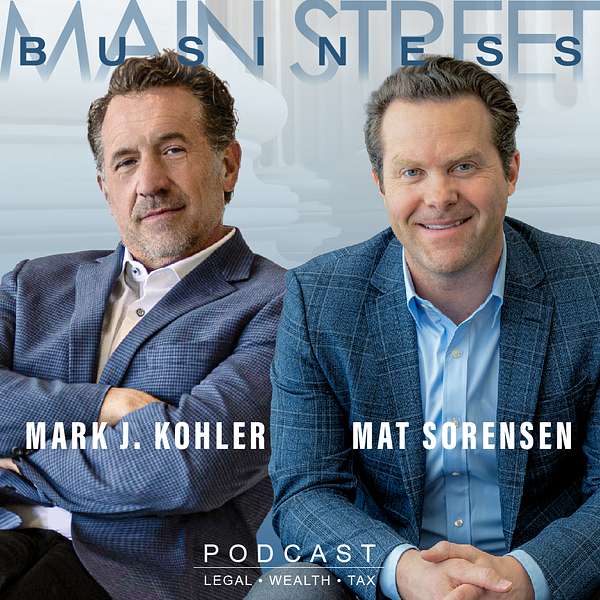
Main Street Business
The Main Street Business Podcast, hosted by attorneys Mat Sorensen and Mark J. Kohler, is the go-to resource for entrepreneurs, investors, and business owners who want to build, protect, and manage their wealth. Each episode explores real-world scenarios and offers practical advice on business structuring, tax planning, side hustles, real estate, self-directed retirement accounts, and more.
With decades of combined legal and tax experience Mark and Mat make complex financial topics understandable through charismatic discussions and practical education. Their goal is to empower listeners to make smarter legal and financial decisions by turning advanced concepts into clear, actionable strategies for LLCs, corporations, estate planning, tax reduction, raising capital, asset protection, and retirement planning.
Mark J. Kohler is a CPA, attorney, best-selling author of six books, and a nationally recognized authority on small business tax and legal strategies. Mark serves as a Senior Partner at KKOS Lawyers and Board Member at Directed IRA Trust Company, which manages over $3 billion in assets. As the founder of the Main Street Certified Tax Advisor Program, Mark has trained thousands of CPAs and Enrolled Agents nationwide, helping millions of small business owners better navigate tax and legal strategies. Mark also co-hosts The Main Street Business Podcast along with Mat Sorensen.
Mat Sorensen is an attorney, best-selling author of The Self-Directed IRA Handbook, and CEO of Directed IRA & Directed Trust Company, a leading self-directed IRA custodian with nearly $3 billion under administration. He is a national expert on self-directed retirement strategies and a Senior Partner at KKOS Lawyers. Mat also co-hosts The Main Street Business Podcast along with Mark J. Kohler.
Main Street Business
#606 Open Forum - Tax Strategies for Small Businesses in 2026
In this Open Forum episode of the Main Street Business Podcast, Mark J. Kohler and Mat Sorensen tackle real-world tax, legal, and business questions straight from small business owners and investors. From S corporations and QBI deductions to rental real estate, asset protection myths, HSAs, and retirement account strategies, this episode cuts through bad advice and explains what actually works under current IRS rules.
The discussion covers common traps like trying to deduct personal investing as a business, relying on so-called “privacy trusts” for asset protection, and using AI or the IRS hotline for nuanced tax advice. Mark and Mat break down why some strategies are too good to be true, how to properly structure entities across states, and what business owners should focus on in 2026 to build wealth while staying compliant.
If you’re a business owner, investor, or high-income professional looking to understand tax strategies, retirement planning, and asset protection the right way, this episode is packed with practical guidance and hard truths. Subscribe for more expert breakdowns, drop your questions for future open forums, and check out the next episode to keep leveling up your tax and business strategy!
You’ll Learn:
- How S corporations and the QBI deduction really work for small business owners in 2026 — and when they don’t save you money.
- Why treating personal investing as a business deduction is a tax mistake and what you can deduct legitimately.
- The truth about asset protection strategies, “privacy trusts,” and when a holding company structure actually makes sense.
- How to legally pay family members (like your children) through your business and what the IRS expects.
- What the IRS Hot Topics are right now — from HSAs and retirement plans to rental real estate tax benefits.
- How to avoid common pitfalls with solo 401(k)s, HSAs, and mixed-income strategies that cost people real dollars.
- Practical, experience-based answers to real listener questions instead of theoretical or generic advice.
Get a comprehensive tax consultation with one of our Main Street tax lawyers that can build a tax strategy plan with an affordable consultation that will leave you speechless!!
Here’s the link - https://kkoslawyers.com/services/comprehensive-bus-tax-consult/?utm_source=buzzsprout&utm_medium=description-link&utm_campaign=main-street-business-podcast&utm_content=msbp606-open-forum-small-business-strategies-2026
- Grab my eBook 30 Unique Strategies Every Business Owner Should Know!
- You don't want to miss this! Secure your tickets for the #1 Event For Small Business Owners On Main Street America: Main Street 360
- Looking to connect with a rock star law firm? KKOS is only a click away!
- Are you ready to get certified in EVERY strategy I teach? Start your journey with a FREE 15-minute discovery call to explore the Main Street Tax Pro Certification.
- Check out our YOUTUBE Channel Here: https://www.youtube.com/markjkohler
- Craving more content? Check out my Instagram!
Barack and ChatGPT will not be able to answer it properly.
SPEAKER_00:Managing your stock portfolio is not a business. You cannot write off your home office to manage your stock portfolio.
SPEAKER_01:There is no asset protection in these privacy trusts. If they sue you in a privacy trust, they're going to go after you personally. All of your assets.
SPEAKER_00:You do not issue a child under age 18 a 1099 ever. The IRS is not there to give you tax advice. Calling Satan to find out how to stay out of hell is not going to get you the right answer you're looking for.
SPEAKER_01:Welcome everyone to the Main Street Business Podcast. This is Matt Stornson, joined by the incredible Dapper and intelligent Mark J. Kohler. And this is the Open Forum Podcast. This is where we're covering your questions. We think we have some smart answers. You judge that. But uh I'm here with the main man, Mark J. Kohler.
SPEAKER_00:Well, thank you, Matt. I appreciate the word Dapper. I this is a new jacket. I like that we're both wearing.
SPEAKER_02:All the compliments I gave you. You pulled dapper as the one you liked. Yeah. Well, okay. Sorry.
SPEAKER_00:I I appreciate that's yeah, I guess uh, you know, that's where I was at today. I put on a new jacket, so I guess I went there. You look great too. We're we're December was kind of chaos, so we were wearing sweaters and pullovers and pull whatever, you know. Uh but uh but now we're in our jacket weather. Okay. Well, yeah, I love the open forum, and we are gonna get into it, folks. This is where you can submit your questions. We want to be holding more of these open forums in 2026 on the eve of a new launch of our website and a better methodology to get your questions and answer them. So we're gonna be doing more of that, and I'm excited about that experience. So I'm ready to kick it off, Matt. Are you? Absolutely. Okay, so the first question I have is from Muggs338, and he says, so Matt and Mark, what would you place on the top of the list for 2026 in a small business for a tax strategy and investment growth based on the recent IRS rules changes? Uh, especially, he wants us to discuss, or Muggs338, the car loan interest deduction for American-made or finely assembled uh assembly cars in the U.S. We have three years of deductions. How can we capitalize on this, either business or personal? All right. Well, Muggs, great question. Uh, I'd like your first one of hey, kicking off the year, if I'm a small business owner, want to build wealth, is there a tax strategy that speaks to you? Man, one of them. I'll I'll give one. Matt, you can give one. Let's do that. Um, now on this car loan interest deduction, this is a unique one that it only applies to individuals. So this you cannot use this deduction if you're using your vehicle for business or you're gonna have to prorate it or somehow.
SPEAKER_01:Um that that interest would be deductible anyways in your business.
SPEAKER_00:Yeah.
SPEAKER_01:If you were using it for business.
SPEAKER_02:So you're good already. I know.
SPEAKER_00:And it's because even if you use the mileage method, you can deduct your interest on your auto loan to in your business proportionally based on the percentage of business use. That's you could do that anytime. So, mugs, if you're using your vehicle for business, which I would hope you are to some degree, and even using the mileage deduction, you're gonna be able to write off the interest, and there's no income limits, no phase out proportionally based on the percentage use of in your business. Okay. But this new deduction under the One Big Beautiful Bill to help U.S. automakers is that you can deduct up to$10,000 in auto loan interest above the line, even if you don't itemize, uh, but it phases out. And the numbers are uh basically uh phases out by 150 grand if you're single, adjusted gross income. And if you're married, filing joint, it phases out between 200 and 250 grand. My my only do I want people to take advantage of this? I guess I I this is in this income range, I really do follow the Dave Ramsey approach. I don't want you going into debt for personal auto loans, that you're not deducting in your business unless you absolutely, absolutely have to. We just have so many classic examples. Even lawyers in our firm that come join our firm after going through law school and have student debt that will not go get an auto loan, they're gonna buy a cheap car that works, pay off their student debt, and try to never go into an auto loan scenario. You find an episode of Dave Ramsey where he says it's okay to get an auto loan. If you do, you can deduct the interest above the line. Knock yourself out. That's my personal opinion. I apologize.
SPEAKER_01:Right off the interest with your I I disagree with Mark and with Dave Ramsey on this. All right. Here's why. Because I've been that guy that's bought the cheap-o car that breaks down all the time and that I swear costs me more money to fix and repair than the newer, reasonable car. I'm not talking about a luxury car, I'm talking about a newer car with the warranty. I always buy certified pre-owned, pro tip. Okay. You don't get you get the reduction in price. You're not buying premium. You get the extended warranty with the certified pre-owned. And I'm giving you the floor. I will respond. Okay. I'm saying let's hear me out. Hear me out.
unknown:Okay.
SPEAKER_01:All right. Is now I got a warranty that car has an issue or a repair. I at least can budget for this now better than I can the POS car that needs a new transmission. And now I'm three grand out of pocket. So I personally like that. I know what I can budget for. And you can get it, whether it's a Toyota Camry certified pre-owned or whatever, something that's still got some good warranty on it. I don't know. That's my stand. Even if you have to get a loan to buy that car, that's that's uh that's what I'm for.
SPEAKER_00:Yeah, that's my position. All right. Before we go back to number one tax strategy, I would like to ask the court if I may have a rebuttal statement. Yes, Your Honor. Would you like to, yeah? Okay, thank you, Your Honor. Um, I would say what I just did for my beautiful little daughter Molly. My daughter Molly, who is 22 years old and works in our company, she's awesome. She listens to the podcast, so I want to give her a shout out. Um, we just went and got her a new car in order to make sure it was safe and reliable. And we leased that car because the lease payment was half of what it was going to be to buy it, and that lease is going to cover up bumper to bumper, and she got a reliable car. Now, would I love her to go out and just buy a pre-owned used car without a loan or a lease payment? Yes, I would. And I would like all of you to do the same too, as Dave Ramsey would. Save up your money and buy something reliable, not a POS. I won't tell you what that acronym means, but it's not point of sale. So I would recommend we never go into debt for a vehicle, but sometimes we have to. And so I will concur in those situations with Mr. Swarenson that reliability and safety is the primary concern. Uh, but if you want to deduct your auto loan interest, yes, it is a write-off. Okay, my number one tax strategy for 2026 for small business owners, it is the same as it always has been. Dial in your S Corporation. I hate to say it, it is bread and butter basics. The FICA expense and using the S-corp is one of the primary strategies every small business owner should uh use. And then you said investment tax strategy, that of a rental real estate property. I don't know if that's a short-term rental, long-term rental or self-rental, but I like my small business owners to be investing in rental property as well. Those are my two top strategies for 2026. They've never changed. I don't foresee that they ever will. Matt, sorry, what are your number one of those areas?
SPEAKER_01:Well, for small business owners, I would say QBI. Um, and this was one that got renewed in the one big beautiful bill. This is the 20% deduction you get automatically. This is one you don't have to do. You have to have the right structure. Okay, you're the pass-through entity, you're using the S corporation. Um, this could even be an LLC or partnership sold proper. You get that 20% deduction immediately on your income in that business. So now there are some phase outs for certain professional services and stuff like that. But otherwise, I love that one. That was one that was on the chopping block and may not have been carried over, uh, but we got it and it was made permanent. Permanent. We will always have this. There's not a sunset on it, unless legislation changes, of course, but there's no sunset on this where it goes away like it was set the first time they passed it. So okay. All right. Well, thank you, Matt. All right. Uh your next question. What do you got? All right, I got a question from Sandy on HSAs. She says, and she's battling between ChatGPT and Grok on her answer here. Okay. Chat GPT and Grok disagree. All right. She said, now Sandy says, this question is from my husband. Okay. Sandy did not want to be responsible for this question. Uh it's a good one though. Says for tax year 2025, after the one big beautiful bill changed, does a marketplace bronze plan that has an out-of-pocket maximum of$9,200 above the$8,300 high deductible health plan limit and has charges fixed co-pays for in-person primary care, specialty visits, yada yada. Um, does it uh so that I might still qualify as a high deductible plan so that HSA contributions are allowed. So now she says, My spouse has this plan, he is an S-corp, S-Corp pays for it, yada, yada, not part of the question here. She says, Chat GPT said the plan is eligible, Grok said it's not. I called the IRS. Unfortunately, I was on hold for 45 minutes and no one even answered. I I listen to your videos often, I've learned so much about tax savings, S-Corps, and personal tax savings. I thought you could help me out with this. All right, Sandy, you have got Mark and Matt here. You do not need Chat GPT and Grok. Um, we are going to answer this question for you. Here's the deal. And here's why the confusion is, and here's why you should not be relying on AI to answer questions. The one big beautiful bill was passed in 2025, but the provisions on HSA plans, qualifying plans, like a bronze plan in the marketplace, went into effect in 2026. So in 2026, every bronze plan, if you bought on the individual marketplace, qualifies as HSA qualifying, you can have an HSA. Period. In 2025, it depends. Now, one big beautiful bill is passed in 2025. Many of the provisions were effective in 2025. This HSA one was not one of them. So in 2025, whether a plan is qualifying, if it's a bronze plan, in order to be able to have an HSA goes back to the regular rules, which there are many. Let me just say this Grok and Chat GPT will not be able to answer it properly, in my opinion. Um there are the high deductible limits, and you're saying you're meeting that, and the fixed co-pays you say the plan meets that are irrelevant. There's like 10 other things that are like minute crap. I don't even know. And you and the IRS, bless your heart, doesn't know anything. I'm sorry. Yeah, they know nothing. They will not help you on a phone call. They will not tell you whether a plan is qualifying, even if you did talk to someone. And frankly, I'm happy you did not talk to someone because I'm more convinced they give you wrong advice than actually give you the right answer to this. The boy who I would call, though, is the health insurance company. They know whether this plan is HSA qualifying or not. They would have marketed this as an HSA qualifying plan if it was an HSA qualifying plan. Now I know you might be thinking, but Matt, the law changed. The law changed to be effective in 2026. So if you bought the plan in 2025, it should have been marketed HSA eligible. It should be all over the plan and your enrollment information. And if it's not, you can at least call the company to confirm. My guess is it's probably not because you haven't seen it on your information documents.
SPEAKER_00:Wow. Matt, great comments. And I want to echo some of this. What was that uh caller's name? Sandy. Sandy. Sandy, I'm so glad you ended up here for a number of reasons. Because I really want you to hear this and so many of our listeners. First, I'm going to work in reverse on what Matt said and clarify a couple points. The IRS is not there to give you tax advice. The IRS is there to collect your tax payments and make sure you file your tax returns correctly. And that's even questionable. They are there to just process your tax returns. So, everybody, I I like that you are being taking the initiative when you try to get an answer to these difficult questions. But calling the calling Satan to find out how to stay out of hell is not going to get you the right answer you're looking for. They have a self-preserving interest, as does the devil, uh, with your soul. So I don't know if you want to call the devil for information on how to best interpret the Ten Commandments. So be careful there. I don't know if that analogy worked, but I was trying to make it work. I'll shoehorn that in. Now, with that said, we also have Grok in ChatGPT. I have had high hopes. I even last night got turned around by Grok, and I asked Grok to quote Mark Kohler in his own book, which I uploaded into the conversation in Grok, which I have also done in Chat GPT, and could not even get a straight answer. More and more I have lost faith in AI. And the scary part is, Matt, I know you feel this way. I've been in the studio recording videos, trying to train people on tax strategies, and I've got a great product for business owners and for professionals. And then I hear people go, yeah, I just went to ChatGPT. And I'm like, maybe I'm, maybe I am being outdated. Maybe I am becoming worthless, and AI is going to replace Mark Kohler. But I'm telling you, people, every time I go to Chat GPT and ask that for information other than to do a math calculation, I'm not getting the right answers. Be careful. So finally, Matt nailed it. The one place that is tasked with telling you if it is an HSA qualifying plan is the health insurance company itself. Not the HSA provider, like directed IRA, not uh your accountant, not your lawyer, not the IRS. The one place that is supposed to tell you if it is a qualifying plan is the company providing the plan. And that is the insurance company. So I think, Matt, you made a lap as well. I said it a different way between our comments. I hope many of you took something from that that I thought was very, very important. Number of points there. Thank you. Well, Matt, I've just pontificated. I don't think it's fair for me to go to my next question. Do you have one you want to hit real quick? And I'm going to grab my rock star here in the fridge. And um I've got a great question here after you.
SPEAKER_01:All right. This is a question in from Sass Nain 7. Says, we are high-income W-2 married couple. We've been taking care of a small animal for the last three years. We are planning to open a nonprofit that will rescue and rehabilitate small animals from our home. Should we open an LLC for this operation and cover expenses through it? We are also planning to help elderly, poor, and orphans overseas by giving them small grants. Should we open a separate nonprofit or can we combine these nonprofits and open one general nonprofit, please guide?
unknown:Whew.
SPEAKER_00:I want one question. What kind of small animal is this? That's all I want to know.
SPEAKER_02:Good question.
SPEAKER_01:I'm dying to know. I mean, they've been taking care of it for three years. It sounds like this might be a pet, um, but who knows here. I don't know what's what's the uh rehabilitation of this small animal and the eventual outcome of this. Is this animal going back into the wild? What are we talking about here? Um, because here's the point, and this is actually relevant to what you're trying to ask here is you want to do a nonprofit. You're like, hey, I'm doing a charitable thing. There are nonprofits that will go rehabilitate animals that are injured or lost or whatever, and get them back out into the wild or whatever it may be. And they have expenses for that, and they've got to house them and provide them some things. Um, and you got one question, then you go on another question about some other nonprofit person. Okay, you could establish a nonprofit for that. I would not be doing that with any care or concern for taxes. This will be this must be coming from the charitable part of you, not the tax planning strategy part of you. This is different. I know you're thinking, but couldn't I contribute some money that would be tax deductible? Perhaps you could maybe fund some of this and it could be tax deductible. Um but the the problem with these nonprofits, and this is and this is many clients that call us to start out, is they're thinking of, how can I save on taxes? You're gonna lose money on this. I'm just saying your financial net worth is not gonna improve because you start a nonprofit. It will go down. This will cost you money. Maybe you get a tax deduction, but if you give 100 grand for this, sure, you get a tax deduction that maybe saves you 30,000, but it cost you 100. You're better off just keeping the 100 and being a little charitable here on the side and giving to other charities or taking care of an animal and not having a nonprofit for it.
SPEAKER_00:So yeah. I I will add one last thing before my next question here from Scott is just remember that a you you threw out, well, maybe it should be a business. Should I open an LLC of some sort? A business has to have a profit-seeking or revenue generating motive.
SPEAKER_01:Yep.
SPEAKER_00:Um if you're rehabilitating animals and then selling them or training them and selling them, okay, you've got a for-profit scenario that might allow you some tax deductions. And you go down that path rather than a nonprofit path. But you've got to tell me how it's gonna make money. And um so maybe reevaluate your goals, your purposes, and reasons for what you're doing. And um and it and I would I've got a funny example, but Matt, you go first.
SPEAKER_01:Yeah, I was even gonna say, again, if you did a nonprofit for this, I'm just saying the cost to the nonprofit, maintain it, do the tax returns. You're this so if you're spending some money taking care of some of these animals and just being a person that loves animals and you want to take care of them, and it's costing you thousands of dollars, I just keep doing it that way. If you're spending tens of thousands of dollars or a hundred thousand plus on this, maybe consider the nonprofit and trying to create some organization around it. But if you're not even close to That, I wouldn't even go down that line. It's not the juice isn't going to be worth the squeeze. Yeah.
SPEAKER_00:I I want to throw this out. And I hope many of you that are here is because you appreciate the approach we take to our open forum. Matt and I go down some tangents and talk about life because I really feel I do really feel it. Tax planning in business is about life because it affects what you're doing and why you're doing something. And you just can't answer a lot of these questions in a vacuum. Anyway, I just wanted to share this example from this morning. I was spending time with my cowboy. This is my cowboy that runs my ranch when I'm not there. And uh he's an 80-year-old gentleman that has been there, done that, everything. And if you've watched Yellowstone, this is he's my Lloyd and Rip wrapped up all in one. And I love just hanging out with him. And I think many of us in life need that person, that grandma, that grandpa, that person that's just lived life to keep us grounded. And so on this point of this charity idea that you have, Greg was just today. We were talking, he's like, Mark, you tell me what you want, and I'll tell you if we can do it. Figure out what you want. Don't figure out how you're gonna do it. Just and I think in life, it's like it's kind of like you've got to decide what do I want? What's gonna give me that feeling that what what's that thing I really want? Focus on that. How we get there, I'll tell you. But you that's the goal first and be really clear about it. And it makes life so much easier. I don't know. Just kind of a grounding thought. Sound like Matt, you wanted to echo that?
SPEAKER_01:No, yeah, I I totally agree. I think sometimes we get we figure out a tax strategy or an incentive, and then we work backwards on how we get there. I think that's or you hear of a tax strategy and you think, oh, I can if I uh go the opposite way. What are you doing or planning to do? What's the best tax strategy based on that?
SPEAKER_00:Yeah. No, it's so good. Okay, this is a question from Scott, and this is gosh, great questions today. Says, hello. My question comes from the fact that I do multiple things in parentheses to try and generate funds. And I'm gonna go to the last sentence, a little reveal. I am retired and bring funds, uh live off funds from my 401 in my retirement. So he says, I'm trying to make money while I'm in retirement, living off my 401k. And he says, for instance, I have purchased domains, URLs, in hope of selling them for a profit. I tried to set up, I try to set up affiliate relationships to get a commission when I sell things. I travel around the country looking for land to buy and sell. And I'm looking for some patented mining claims to buy and possibly prospect on. This guy is.
SPEAKER_01:How's retirement going for this guy?
SPEAKER_00:Yeah, I mean loss. And then he goes, and then I manage personal stock portfolio and my 401k. All right. So and I guess his for he says, hello, my question comes from the fact that I do all these things. For instance, I do all the things. I'm retired, and and then I'm like, and where's the question in this?
SPEAKER_02:I'm sorry, Scott, but but I I'm reading into it that he's like you led Mark down a road to nowhere.
SPEAKER_00:I'm like, like a country song. I'm I'm I'm loving this. But then um, so he's doing all these things to make money, and I know what his question is. Where what's my tax strategy? And of course, we that's one of the primary focuses of our show. And so I can read into this that he's like, I'm trying to do all these things. What should my strategy be? This kind of relates in a large part to what Matt's question just was. I think you need to realize, people, that in order to have a business and take tax deductions, you have to have a for-profit motive that is a business generating, income generating uh concept. And why I like this question is managing your stock portfolio is not a business. Creating investment income is not a business. You cannot write off your home office to manage your stock portfolio. Now, is a business of buying and selling domains work? Yes. Buying land and reselling land? Yes. Um becoming an affiliate, yes. So you may want to set up an entity, a bank account, and start tracking the revenue you earn doing those business deals. And then you can write off expenses related to that. But just remember managing your stock portfolio is not a write-off or a business. And so, Scott, I wish you the best. It sounds like you're living the dream. And try to bifurcate your investment life from your business life. And that, and then both of those can generate income for your retirement, but they're two different types of income. So I hope that helps you.
SPEAKER_01:Yeah, and I just add the IRSC is kind of like investment management expenses is not deductible. So any of those expenses you're occurring, you go to a conference about investing your money, you know, you you're buying the Wall Street Journal or a course on investing, that's investment management expenses not going to be deductible. But if you go over on the other side, of course, is the the business stuff, affiliate income, even flipping land, or some of these other things you're doing, um, now those things you have deductible expenses once you start having income from those, of course. Okay, I got a question here from B3N Co. Or maybe it's Benco. I don't know. All right, this is a great question. This is on asset protection. Ben Co asks, please compare and contrast the following strategies with an eye towards the ability to simplify bookkeeping and scale. Option A. Use one Wyoming LLC holding company holding multiple state-specific LLCs, each holding one property. Option A. Option B. Use one Wyoming LLC holding company registered to do business in that state with each property deeded into their own real estate privacy trust. He says B is purported to be better than A because it simplifies bookkeeping by having one LLD instead of multiple, while keeping Wyoming's superior protection on the front line in each state. Also, the Wyoming LLC would appear empty on search because the trust is not public, and the properties are protected from each by the ability to change trust beneficiaries even after notice of a judgment without it being a fraudulent conveyance. The strength and simplicity seem too good to be true, so please educate us. Thank you. Ben Coe, I love your question. And you knew it. It was too good to be true. It's totally bullshit. Do not go down option B. Option A is where we're going to be going. And that's the reality of what clients should be thinking about. If you want a Wyoming holding entity, we like that. There's some privacy, there's some outside liability protection, but that Wyoming LLC would own a LLC, let's say, in Arizona for the Arizona rental property. It owns an LLC in Texas for the Texas rental property. Those that Texas rental property is deeded into the Texas LLC. The Texas LLC is owned by the Wyoming LLC. Now, this is not for everyone. This is for people with million-dollar type of estates that are adding in this Wyoming LLC, or maybe they want some privacy. But the reason you're doing that is asset protection. I'm not doing this to simplify your bookkeeping and scale. I know you've got more LLCs. I know you have an LLC now in Arizona because you got an Arizona property, and you got an LLC in Texas because you got a Texas property, and then you buy a property in Wisconsin and now you got a Wisconsin LLC. I know that costs you more, but that gives you asset protection that's real. Option B is BS. There is no asset protection in these privacy trusts. If they sue you in a privacy trust, you're the trustee, you're the beneficiary, they're going to go after you personally. All of your assets. There's no liability protection in a trust. There's some privacy benefits, and we can talk about that, but there's no asset protection in that. And you might say, but Matt, the Wyoming LLC is the beneficiary of that trust. Cool. So do you have 20 properties in these trusts? Now they're all affected. You get one lawsuit, the liability goes to the Wyoming LLC that's the beneficiary of the trust. They can go up to all those other assets that are in the Wyoming LLC. All right. So I would not go down this option B. Someone talking about being able to change trust beneficiaries without it being a fraudulent conveyance are totally BS. That's not what these Wyoming LLCs are used for. So I'm glad you asked this question because we see this way too often. There's some idiots out there promoting this strategy. It doesn't work, it's causing you more problems. You're actually exposed and not protected. And you set up all these trusts that aren't doing much for you. Maybe some privacy. I don't know.
SPEAKER_00:Wow, can I just say amen? I mean like hallelujah. Can someone start playing the organ? I need a choir. Like I mean, be and drop. Yeah. Baptize someone. I mean, you just nailed it. Yeah, I mean, that's that was perfect. Um enough said. I will let that, I'm just gonna completely concur. Uh all right, I'm gonna jump over to, and I mean that. I I just I I don't want to be to drummed to death. So, Matt, well said. Thank you, my fine sir.
SPEAKER_01:Yeah, and by the way, if I'll can I if I can I just say, get a consult with our attorneys at KQS Lawyers. Like we are doing real strategy, real planning, protecting clients' assets across the country with attorneys that have been working with clients, hundreds of clients, thousands of them that have done what you have done. We know what works and what doesn't work. And so we're real lawyers backing this up. So get a call at KQS Lawyers, we can help you get this structured properly.
SPEAKER_00:Yeah, completely agree. Okay, so question from Dr. Dave. And this is about education expense. And this is a I don't want to say gray area, but it is an area area that I don't know what the definition of gray is, but it's a tricky area. And uh so let's get the issue on the table. Dr. Dave says I'm a retired, I retired from dentistry in December of 2025. But during 2025, I started my new venture as an RV technician, including attending the N R VTA uh and signing up for the Small Business RV or course. This is a training program down in Texas that I've been affiliated with over the years. I love them. Uh Steve and Coop, you guys do a great job down there. Now, when he asked, he says, when I asked my tax accountant about deducting startup expenses, she did a little research and sent me this from, I assume, the IRS website or some publication. So he included in his question just a copious amount of information of when education is deductible and when it is not deductible. Startup expense is even a different category, or can include education or not, uh, and can be a necess a useful strategy in trying to write off these expenses. Now, I am not kidding, I could do an hour presentation on this topic and really unpack it. But I do want to give Dave some general guidance, and for many of you out here that go through this experience, you might go to a real estate seminar and start doing more real estate investment. You might go to a um other class on um uh buying and selling businesses. There's all sorts of education models out there that might help you in your launch of a new business. Here's what I want to say, and Matt, this is kind of interesting. I've never really said it this way. Education is typically not deductible under the IRS code. Why is that? It's because a lot of people go do education, take education, and do nothing with it. And so the IRS is like, we're not gonna allow education for education purposes via write-off. But in the publication and code, it says, and I even quote this gentleman, education costs are deductible as an ordinary and necessary business expense only if the education maintains or improves skills needed in the existing business. See, the person already has a business and is getting education to improve or maintain that business skill. And number two, does not qualify the taxpayer for something new. Because, see, again, the IRS is like, we don't want to let you write something off to go do something, we don't even know if you're gonna do it. Or so the concept is if you've got a business that's making money and you go get education, that doesn't get audited. It's very common. Continuing education. In fact, the IRS has examples of workshops, seminars, and conferences related to your business, online courses that improve your current business skills, continuing education, industry certifications that maintain. So, what I want to tell people is when you go to take a tax write off in the arena of education, again, I'm trying to distill this down to our approach to this. Start making money, start a business. Oh, and then you went to a workshop to get better at it, I want to write that off. You walk in my door and go, hey, I went to a workshop and spent$20,000 for this guru influencer, and I'm gonna start a business. I'm gonna go, uh. Do we call it startup cost? Do we call it this? How do we shoehorn this in? Because the client hasn't made any money yet. But they want to write it off. And of course, the influencer company that's selling this education told them it's a write-off. Yeah, it is, based on a certain fact pattern that works. So be careful, people. Go make money. I would argue, Scott, oh, you're an RV technician already. You're helping out your best friend and your buddy down the street with their RV. Oh, you went to go get additional training to do that? And you're already making money doing it? I'm sorry, did you say education? I didn't hear that. I'm sorry. You got a business and you had an ordinary expense to make it better. That's where I'm going with this. So, Scott, it's about framing the question and building a fact pattern that supports your strategy. Most accountants don't like going there. They like saying, here's the rule, don't abuse it. Because if you do, I'm afraid I'm gonna get sued too. Bye! And they go hide under a rock. And I'm sorry, but that's the accountant mentality. I want to construct the best fact pattern to support your write-off ethically and honestly. And I want you to live the American dream and make some damn money. That's my approach. I don't know. I hope that helps. Matt, I don't know if you want to echo that.
SPEAKER_01:I mean, we're bringing back the organ and the band and everything. I'm I don't have anything else to say. That was good. That this is a tricky one, though. That was a tricky question. I'm glad you picked that one up. I skipped that one. All right. Um, this question is from B. Johnson Jr. says, hi Matt, I have a solo 401k. He knew I would pick this one up. He says, I have a solo 401k with directed. I started in it in 2024. At that time, I just had my S-corp with no employees and several LLCs with passive income. In October, I purchased an LLC that has seven employees. Does that and that that company does have a retirement program for those employees? Do I have to close my solo 401k and participate in that program? All right, B. Johnson, I'm glad you asked that question. And I don't have great news, but I do have an answer. Okay. It's not the one you're hoping for. Yeah, yes. Yeah, yeah. You do have to close that solo K. Um, I mean, you can keep it, you just can't contribute to it. Because now you own a company, this other LLC that has seven employees. I presume you own 50% or more of that company, which if you do, that means your other solo 401k is not going to qualify. So you can still keep the solo K, keep investing those dollars you have in there, but you can't make new contributions in. Now, this existing company you bought, I presume you automatically qualify yourself as a qualifying employee in it, but you already have employees over there that are qualifying in that retirement program. I don't know if that's another 401k or a simple IRA or what that program is over there. But this does cause problems for your solo 401k going forward with new contributions. So um you may want to sideline that, just keep investing the dollars you have. You definitely have some options there though. Um, but no new contributions in the solo 401k. Now I got some workarounds possibly. You got a spouse. They could if maybe your spouse is involved in that other company that you had before you bought this business. You can there's actually some spouse rules where you're if your spouse has a separate business, they can maintain a solo K, even though you may have a company with employees, or vice versa. That'd be the only workaround here if you're married and trying to work this ownership to keep the solo K if the existing S-Corp you have, and that's business and income is separate from this new LLCU purchase. It's a long shot, but it's one to maybe consider.
SPEAKER_00:Cool. Cool, great comment. Well, I'm gonna maybe take this as my last question here, and we have got to hold, as I said at the beginning, and I'm telling this to my amazing co-host, there's such an opportunity to do more shows this year with this uh open forum format. We've got just so many great questions here. Um I but I we uh with our time limits today. I'm gonna take this one, Matt, and maybe you choose your favorite final question. If I may suggest. Okay, this is NZ 2123. So I have a question in regards to paying the children. I understand if you pay him, so they've got a son here apparently, if I pay, I'll say them under the standard deduction, they do not have to file a tax return. But and I'm gonna say federal standard deduction, a federal tax return. We won't worry about state for a moment. But does that just negate the rule of having to pay uh paying anybody cash over the allotted amount for of$600? I have to issue them a 1099? I guess I'm not understanding why I don't have to file a 1099 if I'm paying them over$600. Is there, but isn't there a problem with this? Would shouldn't I file that 1099? And doesn't that trigger a tax return for the child? Please explain. Now I paraphrased the last couple sentences there, but great question. NZ 2123, here's the First issue. You have a different rule or process for a child under age 18 than you do for children 18 and older. That's the first issue. For example, anybody out there, if you have a small business and you have children under age 18 and they are helping you legitimately in the business, freaking pay them. You get a tax write-off. And just as NZ 120 2123 said, they do not have to file a federal tax return or pay tax on the income under the standard deduction. So if you pay them, you get a write-off. They don't have to file. And because they're under age 18, and you pay them out of the proper entity, not an S-corp. We usually set up a sister company for this. More podcasts and trainings on that you can get from us. But you do not issue a child under age 18 a 1099 ever. Yes, accountants out there, you're probably wanting to put your fingernails on a chalkboard, but no, do not do it. And I've got all the authority and backup for this in multiple writings. When your child is under age 18, when you pay them out of a sole proprietorship, you are not required to give them a 1099, even if you pay them a hundred freaking grand. Now, if you pay them under the standard deduction, they do not have to file a tax return because they're under age 18. There is no FICA withholding, Social Security Medicare, Sudafuda, blah, blah, blah. Workers' comp even. Now, state of Washington has some weird worker comp stuff, but let's set that aside. So that's the under age 18 rule. But NZ2123 and everybody else out there, if you pay your kid that is 18 or older$601, you've got to give them a 1099. And you're going to issue that 1099 out of your S-Corp, out of your LLC, out of your sole prop, out of whatever hell you're running your business out of, you're going to have to give your child a 1099 if you pay them more than$600 and they are$18 or older. And then they are going to have to file a tax return. And if you pay them less than standard deduction, they are not going to pay tax. But you have to issue a 1099 and they have to file. And guess what? A 1099 is going to go on a Schedule C. And they may pay self-employment tax, but maybe not income tax, depending on their bracket. So that's the procedure. Remember, there's two sets of rules under H18, over H18, and that's what got you turned around on this. I think you're good to go.
SPEAKER_01:All right. Love it. Okay, here's my last question. This is from Muggs 338, and it ties back into the last one I talked about on Solo Ks. It's the perfect question to bring it back all together. Muggs says, I've chimed in before, been watching you guys often. My question here is: my wife has a small business in the medical field. We spend hours doing medical billing. A lot of the rates out there to outsource are 6% of monthly grosses. That's roughly$4,000 to$5,000 per month in savings by doing it ourselves. I presume here, husband is a physician, wife does the medical billing here. Now, is it feasible to open another LLC as a medical billing company, specifically for our existing businesses where we pay the new LLC for billing services, even though all income filters back to our 1040? Would the separate business open up a solo K option, even though my wife has a fully funded 401k through the primary business and I have my 457B through my government job, no match. Any guidance would be great. Okay, Muggs338, great question here. I was just talking about how there are some workarounds for those of you business owners with a spouse where you have some businesses with employees and you have other businesses without employees. Where in that business without employees, you can do a solo K, and that's totally fine. However, the way that that needs to work is that business with no employees where you're doing a solo K, your spouse would need to own. The business that you have, maybe this is the medical business, you're the physician, you own the medical business, and it has a 401k for employees, and you participate in it, or maybe it doesn't, and you just don't want to offer one. It doesn't matter here, but it's got employees. The question is can I do a solo K over in this separate business that my spouse owns? I don't own it. And the solo K rules are clear that a spouse that has their own business separate from the company you may own, um, they they can do a solo K. The problem is it must be separate. It can't be receiving income from you and your company that you own. Now, maybe you're one of 10 customers that outsource medical billing to this, your your wife's LLC, and that would be okay. But if you're the only customer there, maybe there's only one or two, I don't think you're gonna be able to consider it separate, and that's gonna not allow that solo c workaround for your spouse.
SPEAKER_00:Yes, and I I want to add that that was a little confusing, maybe. Sorry. Yeah, the the terminology that you would like to research on this, and I would recommend this caller have a consult with one of our tax lawyers. Kevin Kennedy is one of our uh partners that has really pioneered this area, and he can help explain the term separate line of business. There is code section after code section on what's called the SLB. And if your spouse qualifies as an SLB, he or she can set up that solo. And I love this strategy. Now, does that mean they need to have two clients, five clients, just you? It's a sliding scale, it can get gray and muddy really quickly. So understand um the rules before you embark on this. The other thing I want to point out, too, is in that question, you said, well, my spouse already has a fully funded 401k, or I already have something over here. Hey, everybody, remember, you can have two 401ks. A fully funded 401k, that's a weird term. Does your spouse have a 401k at work where they match up to a certain amount? Sure. Take the match. The rest of that, holy crap, I might want to do that in a solo 401k. Fully funded means you fully funded it and probably overfunded it when you shouldn't have. Get the match, get the hell out, and do a solo, if you can, under an SOB strategy. So I like how Matt said there's workarounds, there's strategies, there's options, fact-driven. Get a consult. I think there's something to play with here.
SPEAKER_01:Yeah. Yep. Yeah, and you've probably got a lot going on here. Obviously, you're a business owner, you're you've got a government job too that you're maximizing retirement account contributions on. I mean, it is a really good question about being strategic about how to save in a tax-advantaged way. So I love the angle you're going here and trying to use every loophole possible. So um you're kind of you're like kind of the client we like. I mean, I'll just say that, you know, that you're our people. So um, all right. Well, thanks everybody who've submitted your questions. Remember, you can submit those at mainstreetbusinesspodcast.com. We are going to be doing more open forum shows, as Mark said, trying to get out to the people, answer your questions. We love seeing um you guys answer the ask these questions and things that you're up to. Um, hopefully you've learned something here from the questions other people have answered. We'll be back, of course, next week with another amazing episode of the Main Street Business Podcast.
.jpg)