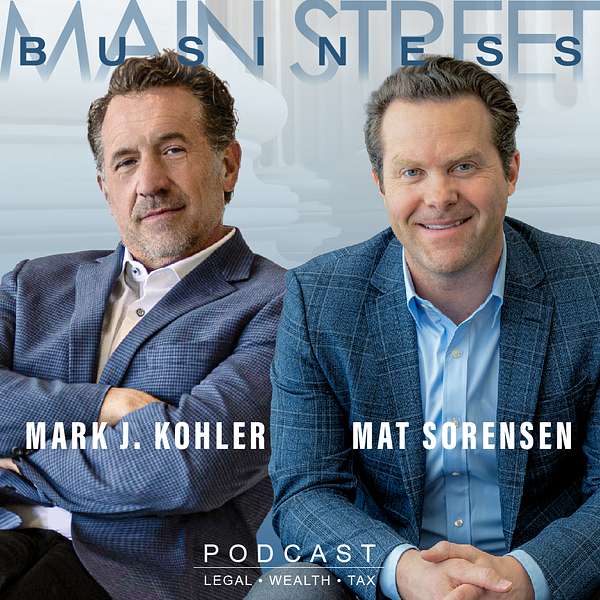
Main Street Business
The Main Street Business Podcast, hosted by attorneys Mat Sorensen and Mark J. Kohler, is the go-to resource for entrepreneurs, investors, and business owners who want to build, protect, and manage their wealth. Each episode explores real-world scenarios and offers practical advice on business structuring, tax planning, side hustles, real estate, self-directed retirement accounts, and more.
With decades of combined legal and tax experience Mark and Mat make complex financial topics understandable through charismatic discussions and practical education. Their goal is to empower listeners to make smarter legal and financial decisions by turning advanced concepts into clear, actionable strategies for LLCs, corporations, estate planning, tax reduction, raising capital, asset protection, and retirement planning.
Mark J. Kohler is a CPA, attorney, best-selling author of six books, and a nationally recognized authority on small business tax and legal strategies. Mark serves as a Senior Partner at KKOS Lawyers and Board Member at Directed IRA Trust Company, which manages over $3 billion in assets. As the founder of the Main Street Certified Tax Advisor Program, Mark has trained thousands of CPAs and Enrolled Agents nationwide, helping millions of small business owners better navigate tax and legal strategies. Mark also co-hosts The Main Street Business Podcast along with Mat Sorensen.
Mat Sorensen is an attorney, best-selling author of The Self-Directed IRA Handbook, and CEO of Directed IRA & Directed Trust Company, a leading self-directed IRA custodian with nearly $3 billion under administration. He is a national expert on self-directed retirement strategies and a Senior Partner at KKOS Lawyers. Mat also co-hosts The Main Street Business Podcast along with Mark J. Kohler.
Main Street Business
#607 Open Forum — Tax Expert Answers Your Most Difficult Tax & Legal Questions!
Are you making smart tax and legal decisions, or leaving money on the table without realizing it? In this episode of the Main Street Business Podcast, Mark J. Kohler tackles your toughest questions and breaks down real-world tax strategies, asset protection myths, and retirement planning mistakes that business owners and investors face every day.
From selling million-dollar collectibles and avoiding unnecessary taxes, to understanding how S Corporations can impact Social Security benefits later in life, Mark tackles listener questions with practical, no-nonsense advice. You’ll learn why LLCs don’t magically reduce taxes, how charitable remainder trusts really work, and when trusts actually make sense — and when they’re a complete waste of money.
If you’re a small business owner, investor, or high-income professional looking to legally reduce taxes, protect assets, and build long-term wealth, this episode is packed with insights you can use right now!
You’ll learn:
- Why setting up an LLC or corporation won’t help you avoid capital gains taxes when selling high-value collectibles
- When trusts actually make sense for asset protection—and when they’re an expensive mistake
- Why Social Security has diminishing returns for high earners and how S Corporations change the math
- The rules around depreciated equipment and why you can’t “reset” depreciation with a new entity
- How self-rental real estate strategies can unlock powerful deductions for business owners
- What counts as a prohibited transaction inside IRAs and Solo 401(k)s—and what doesn’t
Get a comprehensive tax consultation with one of our Main Street tax lawyers that can build a tax strategy plan with an affordable consultation that will leave you speechless!!
Here’s the link - https://kkoslawyers.com/services/comprehensive-bus-tax-consult/?utm_source=buzzsprout&utm_medium=description-link&utm_campaign=main-street-business-podcast&utm_content=msbp607-open-forum-toughest-tax-and-legal-questions
- Grab my eBook 30 Unique Strategies Every Business Owner Should Know!
- You don't want to miss this! Secure your tickets for the #1 Event For Small Business Owners On Main Street America: Main Street 360
- Looking to connect with a rock star law firm? KKOS is only a click away!
- Are you ready to get certified in EVERY strategy I teach? Start your journey with a FREE 15-minute discovery call to explore the Main Street Tax Pro Certification.
- Check out our YOUTUBE Channel Here: https://www.youtube.com/markjkohler
- Craving more content? Check out my Instagram!
In 2026, the maximum you're going to be able to get is approximately$4,100. That's it. Would you rather give the government$1,000 and let them invest that for your retirement, or would you rather take that$1,000 and invest it in what you know best? If anybody listening is getting promoted some sort of crazy asset protection, oh, this is what the Rockefellers did. Holy crap. Run forced run. Get out of there. Do not cheat. You've got to go up the escalator to heaven someday, too. And you don't want Peter asking you if you cheated on your taxes. Welcome to the Main Street Business Podcast. My name is Mark J. Kohler, CPA attorney, and I'm here to answer your difficult tax and legal questions. I know as a small business owner, it's oftentimes very, very difficult to get a straight answer or an answer that you can feel confident in and maybe even get a second opinion and go, wow, I wasn't crazy. That was a great answer. I needed that. So I'm going to try to help you out today. We've got a multitude of questions here at our mainstreetbusiness.com platform. Please go to the website and submit questions in the future if you've got one in a number of categories. So check it out. I think you're going to love it. Normally I'm here with my partner, Matt Sorensen. He's out on vacation right now. And a lot of times we cover for each other and handle some of these podcasts individually, or when we're together, it's even better. So make sure you look at some of the older podcasts on the platform at iTunes or even here on YouTube. And please subscribe, give us a like or two thumbs up, 10 out of 10, 5 stars, whatever it is. Thanks. Now let's jump to our first question. I love this one. This one's from Michael. And the question is I will be selling a collectible through an auction in two months. I've had this item for over 40 years, and it's estimated to bring in over a million dollars. How can I set up something, an LLC or a corporation or anything to avoid being raked over with cars for to avoid being raked over the coals with taxes? Yes, I know I'll have to pay some tax, but how can I avoid paying the full 28% plus 13% in California? Well, for those that didn't know, when you sell a collectible, there's a flat rate. It's 28%. It's not whatever your rate you're in or capital gain. It's just collectible tax rate. Kind of sucks. It's 28%. So Michael here is feeling the pain there. But to add insult to injury, he's also in California. So we've got this 13% rate that's going to be on top of that. Oh my gosh. So he's paying 41% in taxes. Not fun. So what does he have out there to maybe do as an alternative or some structure? First, I hate, I'm going to say what doesn't work, and I'm sorry, an LLC is not going to help you at all. A corporation is not going to help you. An S corporation is not going to help you. And heaven forbid someone sells you the scammed, crazy idea of setting up a Wyoming LLC. How the hell is that going to help? Oh, well, you can set up an LLC in Nevada or maybe Washington or Texas or some state that does not have state income tax, then sell it. You won't pay tax in California. Wrong. It's a lie. It's a scam. Setting up an entity in another state is not going to help you from California either. Okay, sorry. Got that bad news out of the way first. But what can you do? Well, the first thing that I think would be the best strategy, to be honest, and let you keep every red cent and continue to invest it in other items is by doing a charitable remainder unit trust, a crut. Now hear me out. This doesn't mean you're just giving your money to charity. These cruts are amazing. And I'll summarize it quickly. I've got other YouTube videos on this, articles, and you can do some homework on it. I'll give you a couple of our ideas too, quickly, but what's cool about the crut is you're going to set up a charitable trust, donate this collectible item, whatever it is, to the trust. You're going to get a tax deduction, usually when you do the math with a crut, of about 10% or whatever the value is. So if you donate a million-dollar asset, you're going to get a$100,000 deduction. Well, you're like, why don't I get a full deduction? Well, because the charity doesn't get the asset right now or whatever is in the account, it gets it when you die. So for the next 20 years or the rest of your life, whichever's longer, whatever in that trust every year, it's going to be calculated for its fair market value every January 1st, and you're going to get a percentage of it paid out to you quarterly for the rest of your life. Now, depending on your age, and it could be as low as 5% or as high as 15%, if you're between 40 or 60, there's going to be a range, and it's based on your gender. Males die before females, sorry. So if Michael, you are say 50 years old and obviously a male, you're going to be maybe getting an 8 to 10% payout. Don't think of as it as a rate of return. Whatever the value is on January 1st is going to pay out this fixed percentage annually. So if it's 10%, you're going to get 2.5% every quarter for that year. Then it's revalued. You get that 10% next year for the rest of your life. Asset protected from a lawsuit, even. Amazing. Now you will pay tax when that money comes out every quarter, but the original pie is not sliced out by 40% with taxes. You get the entire million in that account. And here's what's cool you can be the investment trustee. You can keep investing it. You could buy real estate, crypto, stocks, bonds, mutual funds, another collectible item. Put it in different buckets. I don't care as long as that's passive investments. You can't go start a business with it and give yourself a salary. So you're going to do more passive investments. Maybe you double the value in another five years. It's revalued every year. You'll get that 10% or whatever the percentage is based on your age. So I love the crut because you sell it tax-free, get all that money in an account, continue to control it, get a$100,000 write-off in that example, and then it's recalculated every year. Pretty powerful. If you're interested in that, talk to one of my lawyers at my office, Max, Max Merritt is our lawyer that's dedicated to the CRUT accounts. And we've set up hundreds of them. I've set them up all through my entire legal and tax career. Now, if the CRUT doesn't get you excited, the only other thing you can do is come up with an offsetting deduction. So you would sell it, and before the year is over, you go find another investment that could create some depreciation, typically, that would offset the taxable gain that you're going to have over on this side of the aisle. So let's say you sold it in June, and then you've got now five to six months to go reinvest it in something that would give you a tax write-off as much as you could up to that million. Now you're going to have a basis in this, so maybe it's 900,000 of the taxable gain. I don't know. But real estate, love it. I'm a big fan of short-term rentals. You could create enough depreciation to wipe out the entire gain with, say, two or three short-term rentals. You might do long-term real estate if you're a real estate professional, because you have to be a real estate professional to use that long-term strategy. Short-term rentals, you have uh there's a loophole there. You can learn more about that. Um you could do oil and gas. I love oil and gas. You can get an offsetting IDC and tangible drilling cost, depreciation deduction on the exploratory oil rigs. I've got several of those investments. They've played out very well. Not giving investment advice, do your own research. The last thing is the new opportunity zone strategy could be really good for you, but it doesn't kick in until January 1st of 2027. Under the one big beautiful bill, the states right now are designating their new opportunity zone areas. Come January 1st of 27. You could sell your asset, kick it all into opportunity zone real estate. And there's three or four benefits. I won't go into them now. Go to podcasts on it, and again, articles on the opportunity zone. You would be able to delay the tax, reduce, uh, increase your basis, reduce the taxable amount, um, and then 10 years later, not even pay any tax at all on the new investment. So there's that could be a benefit. You can't do a 1031 exchange, and again, you're not going to get around California unless you move out of there before you sell it. Like literally move out of California. I used to live there. People would say, how can you be a self-respecting tax lawyer and live in California? Sorry, I divorced California. It wasn't me, it was them. Okay, so Michael, think about that. I think um those are some great options that really might be a good option. There's a number of options there that could really work for you. All right, so let's jump over here to another question. And this is from um what's the handle? Mark Matt number one? Mark Matt One? I don't know anyway. That's funny that it chose that handle here, I guess. Thank you. Um the question was about self-settled trust. Is this type of trust worth getting into? I have a net worth of approximately four million dollars. Well, there's a lot of different trusts out there. Just saying self-settled trust doesn't tell me exactly what type. But I will say this. Um I I I can't think of a trust that right out of the gate that I would think would help you at all based on your four million net worth. And let me say it this way: a lot of people that ask that question going, oh, I'm worth four million dollars. Should I do this irrevocable trust or self-settled trust? Or would that be a value to me or a benefit to me? Um I don't have one. I can set one up tomorrow. I've written on them, read about them, studied them, been to school on them, have copies of irrevocable self-settled trust in front of me right here. Hell no what I do. I wouldn't even do one if I was worth$14 million. Here's the problem: a lot of trusts have baggage. If they truly are built for asset protection, that means you have cut ties with it, and it's uh what's called it's not a defective trust or a grantor trust. You've literally put those assets over there, and if someone sues you, they can't get at them because you don't own them anymore. So that's an irrevocable trust that you might be getting promoted by an influencer or some company. And I'll tell you this right now: if anybody listening is getting promoted some sort of crazy asset protection, oh, this is what the Rockefellers did and wealthy people do, and this influencer said I should do it too. And it's 10 grand, 15 grand, 20 grand. Holy crap, run forest run. Get out of there. Please pay my office for even an hour of consulting time for us to tell you the pros and cons of any type of trust where they're pitching you that math. I've never in my career charged anyone more than$5,000 for a trust and would never do that. The charitable remainder trusts are the only ones we charge five grand to eight grand. I mean, that's just those are, I wouldn't even put it in this category. Now, here's what you do need: a standard revocable living trust. If you die, where does your money go? There's no probate, it's clean, it's organized. You could consider a domestic asset protection trust. I guess that's a type of self-settled trust, but it you and it does give you some asset protection, but it's not one of these irrevocable, crazy trusts that is going to cause tax problems and literally rips the control out of your hands. So consider a revocable living trust, maybe a domestic asset protection trust. The only other type of trust that we use a lot is a spendthrift trust for children that are handicapped and you're trying to protect that money for them for years to come where they can still get state or federal aid, something like that. So I, yeah, some elder law attorneys out there. Well, don't forget the Medicare, you know, trusts or Medicaid trusts. Yeah, those are out there to try to create some funding for Medicaid, but just be careful. Um, get a second or third opinion when you're ever spending more than five or especially 10 grand more on a trust. It's just it's crazy, crazy stuff. All right, here's a question from Muggs338. And the title Muggs gave us here was S Corp benefit and reasonable comp. The real heart of the question is S corporation and taking too little of salary that screws up my social security. That's really the heart of this question. And um let me just paraphrase a little bit of it here. He says, my question is how to both take advantage of the S election if net income is over 50K. My wife has netted almost 200 grand or more. So we pay the max in FICA, ugh, heaven forbid. I understand the savings of lowering FICA by lowering the owner's income with the S-election. But that's what's then the impact of paying less into Social Security and my future withdrawals at age 62, 65, 67, or older? Would it be smarter to take the FICA savings and put it in a Roth IRA? Oh, Muggs, you're on to something. By the way, my wife and I max out our 457s and 401ks at our day job in her business. Okay, Muggs, this is a question I get a lot, and I want all of you to hear this because all of us as Americans are gonna be entitled to Social Security. Now, Social Security is a big deal, and I want you to take advantage of Social Security, but it's also a it has a law of diminishing returns. You're only gonna get so much Social Security. Even if you pay in a ton, you still get the same amount. Like, let's say just say Warren Buffett. I don't know if I can put myself, I'll just say, think of Warren Buffett. He's probably paid millions of dollars in FICA over his lifetime. When he files for Social Security, he's gonna be the same as me. We'll get the same amount. Because no matter how much you pay in, it's gonna get capped at a certain amount. Well, how it's calculated in a simple explanation is your earnings over your highest 35 years of earnings. So the what did you make in your most productive 35 years? And that becomes your AIME, average indexed monthly earnings. Now, once you come up with that number, then it works backwards and figures out what your social security is going to be for your the rest of your life when you apply for Social Security, and then it's indexed for inflation after that. Now, here's the shocker. In 2026, the maximum you're gonna be able to get this year at full retirement age is approximately$4,100. That's it. And that's if over 35 years you averaged over$185,000 W-2 every year for 35 years. The most you're gonna get is$4,100 in change this year. Okay, so if that doesn't say something, I will explain it for you. That means you are better off to pay the minimum amount you need to into Social Security every year, take the savings and invest it, put it in a Roth IRA and let it grow. Let me get this straight. If would I think I can answer this in another way? Would you rather give the government your money, your, let's say it's$1,000? Would you rather give the government$1,000 and let them invest that for your retirement? Have no control over it, they get invested in whatever the hell they want. They'll probably use it in the government and come up with some calculation. But would you rather have the government invest your$1,000 for the next 35 years and see what you get? Or would you rather take that$1,000 and invest it in what you know best? You invest it in anything you want, grow it, build it. Who do you think is going to do a better job? Who do you think is going to care more? So, now does that mean you forget about Social Security? No. You take what you get. The average is around$3,500. That's it.$3,500. The worst you'd probably get is three grand. So pay in the least amount you have to to keep the IRS off your back, and then be disciplined enough to take the savings and invest it in your own Roth account. That's why the S corporation is so powerful. You're going to save so much in taxes. And with just a simple model of an 8 to 10% return with the savings on FICA over 10 years, you blow Social Security out of the water. I've done it over and over again on spreadsheets, and I'm sure you can imagine the result. You against the government investing, you're going to win every time. Okay, next question is from Farmer T. Now, since I'm building a little ranch and doing some farming, something I grew up on in the eastern Washington, going back to my roots, no pun intended, and loving every minute. I thought I'd take Farmer T's question. He says, I bought an excavator for my farm business back in 2019, and since then I fully depreciated it. The entity that I bought the equipment under ceased to do business in 2023. Now, in 2025, I created a new company and I would like to sell the excavator or contribute it, to be honest. It's the same thing, to sell the excavator, contribute it to my new business and be able to depreciate all over again under the new entity. Can I do this? And I can hear under their breath, yes, Mark, please tell me, tell me, tell me. If so, what are the steps I need to take to ensure it's done correctly? Farmer T, the answer is no. There's no way to do this to get to redepreciate it unless you had a great idea. You want to sell it to the business. So you're going to take this mini excavator. I own one of them. I love it. But let's say it's, I doubt it's worth 10 grand. Let's say it's worth 10 or 15 grand. Probably worth 15, they hold their value. So 15 grand mini X, you're going to sell it to the new business. Could you then depreciate it in the new business? Yeah, you could. But guess what? You have zero basis in that mini excavator. You already depreciated it. So when you sell it to the business, you've got to claim$15,000 of income and pay tax on the$15,000 of income. So you can re-depreciate it over here. Now you might want to try to cook the books, sell it to a friend, the friend sells it back to you. I don't know. Not good. Do not cheat. You've got to go up the escalator to heaven someday, too. And you don't want Peter asking you if you cheated on your taxes, especially Matthew. He was the apostle that was a tax collector. You don't want him in there. So just don't cheat. But the technical rule is there's no way in hell, that's a technical term, you're going to be able to depress. Depreciate it again without recognizing the gain of its fair market value and selling it to yourself. So put it in the business, use it, love it, because you're the same owner and you already depreciated it. The IRS conflates those and you can't do this. So again, you're probably like, well, you mean if I sell it to someone else, I need to pay tax on that? Yeah. Sorry. It's a business vehicle, business equipment. You depreciated, and now you're going to sell it. Sorry. Okay. Now you could offset it by selling it and buying something else and depreciating it and offsetting the gain you just had, maybe in another business of some sort, but you're going to have to find a legitimate offsetting deduction to pull this off. So thanks, Farmer T. Good luck. All right. Next question. Devin H96. Hey, Mark and Matt, I'm a huge fan of the podcast. I had a potential investment opportunity come up, and I was wondering if you would tell me if it's a prohibited transaction or not. So that means we're talking about probably an IRA or 401k investment. Says I have a friend who just opened a small coffee stand in my area. I prepare his taxes for him, and I will be in the future as well. Would I be able to take funds from my solo Roth 401k that I have at directed IRA and invest it into his business? I'm worried since I'm a CPA and I know the prohibited transaction rules are tricky. I value my license greatly and do not want to put it in harm's way, as well as my retirement fund itself. Would I be able to both invest in his company and still be his tax accountant? I love your podcast, and the value of the education you bring in the industry is unprecedented. You have my sincere thank you. Well, this is a great question. And it is a little, I wouldn't say gray, but it's easy to get confused with this issue. So let's say you have an IRA. I want everybody to get on the same page here, and you want to invest your IRA in this person's coffee store, a stand business. Well, could you do that with your brother or sister? Yes. Certainly with a friend, certainly with someone you don't even know. But could you can invest in that coffee stand with your mom or dad? No. A child? No. A spouse of a child? No. Anything lineal in that family pecking order is going to be a problem. And here's why everybody, the IRS just doesn't trust you that you're going to give your IRA a fair deal. You're going to screw over the IRA, which means screwing over the tax code and the government. So not allowed. But if it's an arm's length person, then you can pull off the investment. Now, on this list, I want to look here and give you the specific verbiage used for this, there's other people that can be a problem too. A fiduciary of the IRA. Now, would a CPA be a fiduciary to the IRA? Not likely, because this includes anyone exercising discretionary authority over the IRA, i.e., the owner has ability to control the investments or is going to be able to control the IRA without the IRA owner's uh explicit approval. So would the CPA have that authority? No. Number two is service providers to the IRA. Now that's a great question. Is this CPA a service provider to the IRA? No, he's a service provider to the IRA owner. And this generally involves anyone getting compensated for investment advice or managing the IRA. The CPA is not doing that. They're simply doing the tax return for the owner, not getting compensated for managing the IRA. And what would be an example of this? Matt Sorence and I are owners of directed IRA, the trustee company that might have this person's account. Well, because we're being compensated to manage their account, even though we don't manage the investments inside it, we would be a service provider. So if I was opening up a coffee stand, this caller, I they could not invest in my coffee stand because, or vice versa, because I'm a prohibited party as a service provider to the IRA. Other than that, it's going to be partners or entities that have any of these people with 50% or more control. So the short answer here is you are fine. You as a CPA can invest in the coffee stand of your clients because you're not, again, providing compensatory services to the IRA itself. You're not a fiduciary to the IRA account. You're simply doing the tax return for the client. You're fine. And I know you put it in here, you're worried about your license and worried about this. This is not an egregious issue, even at that. You're not, you're, you, you, you'd have to do a lot more to your license in a situation like this. So I give you full green light, pull off this investment based on the facts you've given me. I don't know anything else. Hopefully, this isn't your brother-in-law or something. Well, I guess that wouldn't even be a problem either. But anyway, um, you're fine being the CPA of the IRA owner, just doing their tax returns, not providing investment advice or fiduciary services to the retirement account. Okay. Final question is from DS Services. Thank you so much for your great podcasts and YouTube videos. My question is about, thank you for listening. My question is about potentially buying real estate and how to make it a business write-off, if it's even possible. Our business is an S corporation. Okay, we'll just assume it could be a we even find out here, a restaurant or anything, whatever. So it's an S-corp. We are looking at a couple of properties in Wyoming. One is a commercial lot that has uh some shop and storage space. So I um I would say it's a shop and storage unit, not a lot. A lot sounds like it's empty, but whatever. So it's a commercial lot with a shop and storage space, plus three residential rental units on it. This one could be bought as a potential new location for the business, and it would be, in fact. The other is a forplex. Can either of these use company money to buy, or would we have to purchase individually and run it back to us? Um D services, I love your question. Uh DS services. But um there's a I I want to clarify a few things here, and it's a little um interesting the way you laid it out. The the first thing is that for any of you out there owning an operational business, S Corporation, let's say you want to buy a building, a warehouse, a shop, some storage units, and you're going to use those in your business. Your business is going to be the tenant. Are you gonna get some extra write-offs in that structure? Absolutely. It's called a self-rental. Well, I want you to learn about the dash four election. I teach on this, write on it. You're gonna see other things out on the web on me about this or on this topic, and you want to consult with one of our tax lawyers. But anybody out there, the point is when your business buys a property and rents it back to your business, that is a huge write-off opportunity where you don't have to be a real estate professional and you can use bonus depreciation and get a huge write-off. Okay. Now, structurally, how do you do it? You set up an LLC to buy that building or storage unit or shop, whatever the hell it is. And then that LLC rents it back to your business. Then you make a special election called the Dash 4 that says, I'm the 100% owner of the operational business, I'm 100% owner of the uh storage unit, and we're gonna rent it back to my business. And the IRS says, okay, that's one economic unit, you're golden. Now, in this structure, you would take money out of your business, fund the LLC, go get a bank loan, and buy the property, and then lease it back to your business. You would not have the S Corp own the building. Hell no, not a good thing. So you would take profit out of the business, go buy the commercial space, and rent it back to your business. That is it's classic. It's ideal. I'm doing it on four different properties. This is a dentist renting his own dental building, uh a doctor renting his own doctor building, a lawyer, a restaurant owner, a realtor, a broker, a contractor, all of us will want to buy our own building and rent it back to us. We are our best tenant. Now, where it gets a little confusing is your question. You say, Well, I'm gonna get some residential rental units. That's great, but that does not qualify for a self-rental because this fourplex or residential unit stuff that you're gonna rent to someone else. And that's great. I love cash-flowing rental property, even if you don't get the self-rental or the real estate professional deduction. Just buy, I buy rental properties all the time where I don't get the real estate professional 100% bonus write-off. That's okay. Rental property is what the rich buy to get more wealthy and create tax-free cash flow. Now, are you gonna get that dash for benefit? No, because you're not the tenant. Your business is not the tenant. Some college student is or family or whatever you're doing with the residential units and forplex. So it doesn't mean don't do it. It just your write-offs are not gonna be as big, but you're still gonna have tax-free cash flow. 99% of the time, that's what happens. So I recommend if if that's this has been helpful, is get a consult with one of the tax holders, map it out, put it on your trifecta, and understand the steps, and you it's magical. I love where you're headed with this. Let's just kind of make more sense of it and split it up. So, everybody, hopefully this has been helpful. I love answering questions for the open forum. Please get to mainstreetbusinesspodcast.com. Uh, click on submit a question and send them over. I want to have more podcasts where we just answer questions and help you on your quest for your American dream. Thank you so much for watching. Give us a again a five star like, a subscribe, whatever, and I'll see you in the next episode.
.jpg)