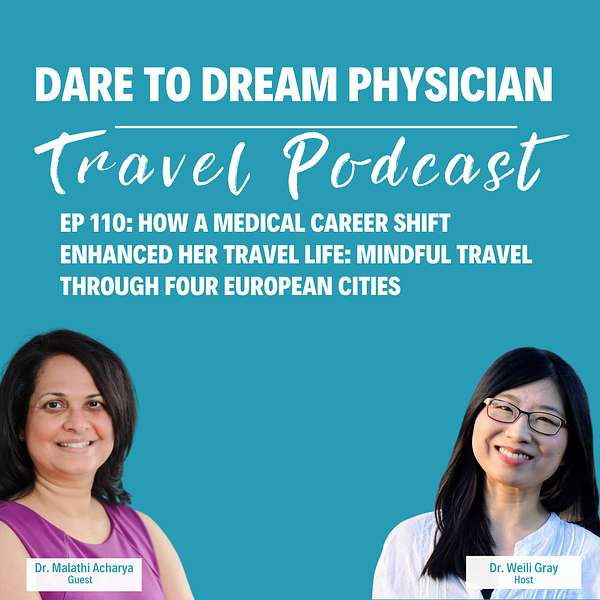
Dare to Dream Physician Travel Podcast

Ep 110, How a Medical Career Shift Enhanced Her Travel Life: Mindful Travel Through Four European Cities, with Dr. Malathi Acharya

Dare to Dream Physician Episode 110

Use Left/Right to seek, Home/End to jump to start or end. Hold shift to jump forward or backward.

0:00 | 30:36

Dare to Dream Physician Resources:

DM me on FB, IG, or LinkedIn to learn more about travel hacking with credit card points to get free flights, lodging, and more!

Get a bonus with Rakuten AND support the Dare to Dream Physician!
https://www.rakuten.com/r/NEODEN2

Dare to Dream Physician, Life Planning for Physicians
https://daretodreamphysician.com

DreamPhysician on Instagram
https://www.instagram.com/dreamphysician/

LinkedIn
https://www.linkedin.com/in/weili-gray-md/

Dr. Malathi Acharya 's Resources:

Website: Ayur.today
https://www.ayur.today/

Ayur Integrative Medicine on LinkedIn
https://www.linkedin.com/company/ayurintegrativemedicine/

Ayur Integrative Medicine on Facebook
https://www.facebook.com/ayurintegrativemedicine

dr.malathi2023 on Instagram
https://www.instagram.com/dr.malathi2023/

Ayur Integrative Medicine on YouTube
https://youtube.com/@AyurIntegrativeMedicine?si=JGhAJmzUPXDDslca

Dr. Gray, Host

Hi everybody. Welcome back to another episode of the Dare to Dream Physician Travel Podcast. I am so excited that you are listening this week. I hope you're having an awesome week. and actually if you're listening to this on a Monday morning, which is when usually this podcast comes out, I, hope that this episode will. Fire your travel dreams, even if you may just be, know, at home. and I just hope you have a fantastic week ahead. I am excited to, chat with our guests. we're gonna talk about. Her approach to traveling and how that's changed after she recently, went through some changes in her medical career. and, and we're gonna talk about Europe, Eastern Europe mostly. because she recently had trip there and, and loved it. I'm so excited to learn more about that. so welcome to the podcast, Dr. Maldi Acharya. I am so excited to have you.

Dr. Acharya, Guest

I am likewise excited to be on this podcast with you. I travel and can better topic to.

Dr. Gray, Host

Excellent. So, please introduce yourself. tell us a little bit about yourself. Who you are, where you live, what you do.

Dr. Acharya, Guest

My name is Dr. Malti Charia, and I'm an integrative medicine expert. I help, people with chronic illnesses take back control of their life and, give them the hope that they can lead a full unsatisfying life. I also help healthy people achieve their health goals and age with vitality so they can continue to do what they want to do. I'm a founder of IU Integrative Medicine and, that is my integrative medicine practice. And I, practice in the Bay Area in the Northern California.

Dr. Gray, Host

that's so great. I love that you're an integrative medicine expert. Was that always been your background or did you recently, go into this field?

Dr. Acharya, Guest

Interestingly you asked this, no, that's not actually what was my background. I was born and raised in India, in the southern part of India. And, come from a family of physicians, Trained in traditional Western medicine. and when I grew up, it's very strange because when you talk to physicians who grew up in India, usually they'll tell you that they were exposed to a lot of Ayurveda and natural medicine. But my story is the opposite, right? So when I grew up where my physicians were Western trained and we had a. Western trained physician approach and upbringing. not much of exposure to traditional medicine or ethics. So that's how I grew up. I, I, trained in internal medicine. That's my, area I specialized in, practiced as a hospitalist for the first part of my career. And in the hospital, it's all medications. Patients are obviously much more sicker, so it's all medications. So, There was not much of natural alternate systems or nothing there. then I transitioned to become a primary care physician, and at the time that I became a primary care physician, my panel people who empaneled with me, they are, they were mainly younger patients and, they were more of Southeast Asian origin. Patients who lived in this area and they were the ones who started questioning my thinking or started questioning me, we don't want to take medications, doctor, what can you tell us that what can I do naturally? What diet changes can I do make for this problem? That'll help me? And to be very honest, I never had any answers for them initially.'cause I was the strict, Western trained physician. Right. then people kept asking me and asking again and again, I still remember distinctly, uh, patient that I was seeing one day. and, she was, she had come in for some cheek pain, but she was talking to me about her diabetes. I was addressing her diabetes, and I was asking her how she's doing, and she said, doctor, you know, none of those medications that you all gave me worked. I actually went to an alternate medicine pro. Provider and they started me on a medicine that reduced my appetite and I automatically stopped eating, started eating less. I didn't want to go and gorge on all the carbs that I was eating. And guess what? When I started eating less, my me sugars came when control. It was not your insulin or your medicines. And I was like, Such stories, Then I started really thinking of so many people are asking for it. If so many people, have, people have tried things and it has worked, then there must be some truth to what people are asking for. That's when I really started looking into, alternating integrated medicine. How can we, how can I. get myself skilled or trained that I can blend everything. So then I found the fellowship, at Andrew will Center for Integrative Medicine, and I started the fellowship and it was one of the best decisions I made in my life. It, there were so many knowledge gaps that I had that this training really filled for me. I, the good thing was I started this training when I, right when Covid started, so August of 2020. And what I started doing was as I went through the units, I started practicing one thing out of what they were teaching me. I picked one or two things and I started actually practicing in real life. And I can tell you that whatever I learned and practiced in that course, and that fellowship really helped me. Not burnout during that tough time of covid, covid, which was tough as a physician, tough as a person, with parents back, there's so many stressors that I faced and this kept my head, about water, so to speak, and nothing else I was needed for me to be convinced that if this helped me. It's going to help so many other people. So that's when I, I left my employee as a job, as an employed physician, and I started my own practice. So my journey into integrative medicine is, wasn't as straightforward, was a roundabout journey, but I'm really glad that I've reached this destination now.

Dr. Gray, Host

Yeah. Oh, that's really amazing. And I, we were chatting and you were telling me that, well, one that you've you've have a long history of traveling and you really love traveling. traveling is part of who you are. but what I was really, intrigued by was you said, after you went through your integrative medicine training, you started approaching traveling in a different way and. Can you share a little bit about that, what was traveling like before, and what, how did you change as a traveler?

Dr. Acharya, Guest

when I grew up I really didn't travel much. My parents were not travelers, so I never really saw or went to any places or saw any new places till about, 25 or 26 and that's when I, at that point, I decided that there I am going to see. In this world. It just that whole idea of going and seeing new places really. So we. Every vacation that I got or, when we are in the employed position, you, your vacations are decided and pretty narrow flexibility there. So I would make sure that when I get my vacation, my husband's vacation would be lined up. And when my kids were younger, I would, when they were in elementary school, I would take them out school also to accommodate my vacation schedule, which was important. We would travel. It was just the fun and the desire to see new places. Of course, travel, no matter what the intention to travel is fun because you go to new places, new people, it was, and then you come back filled with those memories and then, okay, this is why I am work. And I'm going to work so that I can earn enough till my next travel and I'll collecting more memories. Right. That's how it, that would always be my motivation. you know, I went through the integrative medicine fellowship and there was, there was at, we all know at that time travel was closed our restricted for quite a while, quite a while. before that, there's always that stigma that's attached, right? Traveling is expensive. It's for people who can, it's for people who can afford it. It's not for all those kind of stigma attached. And I would always, maybe it is, I don't know. Maybe it's an expensive habit and this and that. There's always some thoughts at the back of my mind. But during that time when I was, we were not able to travel. I really missed the travel, and I went. As I analyzed, I went in and I introspective and templated what part I understood that my exposure to, different sites, different sounds, breathing the air from new places. That was my way of connecting to nature and integrative medicine. We talk, there's a lot of importance of being connected, time in nature, being connected to the earth and being grounded. it has a lot of healing, grounding power, and we know that we always advise time in nature when you're stressed, anxious, burnt out with the grind of daily routine. Take 10 minutes and sit outside in nature. So this time, so that's when I understood that going and seeing these places, the sites, the sounds, the air was just my way of connecting to nature and I really missed it. Then everything became clear. it's not just a matter of, Hey, I can afford it and I'm traveling. It is. This is how I connect to nature. This is one of the ways by which I connect to nature, and, I've been much more mindful about what I observe, what I take in my com comparing what, sim similarities in the habits, similarities in the lifestyle. so it's been a much more immersive experience for me where I feel like I collect, I. Way and accumulate way more memories than what I used to do before.

Dr. Gray, Host

So what I am that's so lovely. And it's such a great description. Thank you for that. And what I'm hearing from that, is it's almost like a. Like a paradigm shift. So, when you were in your twenties, you realized, Hey, I love traveling. I just, I wanna go to every place in the world. And it is that like, youthful wanderlust, which I, I still have, I'm in my forties, but I have that for sure. but then, there was a period like during the pandemic when we couldn't travel and you started questioning. You were like, well, do I really need to travel? Look at all these other things that are happening. Is travel just something, for the wealthy? Like is it responsible, for me to travel when there are all these other needs in the world? Then after going through your training and learning about, well, it sounds like the training is really transformative for you in that you got to try out different, modalities, like lifestyle modalities, and I'm guessing one of them was meditation from how you're describing it.

Dr. Acharya, Guest

Definitely yes. Mindfulness, eating healthy, spending time in nature, you that, started making that as a priority and a routine, and sitting near a plant, sitting in our garden, in your backyard. It's not a big deal. We don't have to go for, hikes, it just get out of the house, sit in the backyard.

Dr. Gray, Host

Yeah.

Dr. Acharya, Guest

Brother stand between, in the, you have few sit right next to them.

Dr. Gray, Host

Yes, so, so being more. Connected and present and connected to the natural world, even if, like, even if you live in a city, the plants that you have, even the plant that you have in your home. so, so just being in, tune with that and in the training kind of knowing, well, this is actually good for my health. there are studies that show that, time in nature is good for mental, physical health. and so you know, then the next time you go travel, you brought that new frame of mind, like being present, being mindful, into your travels, it strengthened or intensified your experience with travel.'cause in the past, like you would travel and you have memories and you collect memories and that was meaningful for you. But now it's even even more intense experience because you are being more mindful.

Dr. Acharya, Guest

Absolutely. It's like it 10, the value. It's not just value is not the right word. It tenex my experiences and that those experiences still, we use, we keep those memories, those fear, all of the help us go through our day-to-day life,

Dr. Gray, Host

Yeah. Yeah. It's, there's a book that I'm a big fan of and I recommend, for all listeners and for everybody, which is, I forget the name. Bill. Bill, I forget his last name, but Die With Zero is the name of the book. and it's interesting'cause it's like, it's got this really catchy title, like Die With Zero. Like, does this mean we just spend all our money and then we die? Actually, that's not really what the book really argues. It's a, it's really about what, how do we maximize fulfillment in our life? knowing that we have limited time knowing that there's an opportunity cost. So like, let's say you're in your twenties and you're like, I would love. To try skydiving. I'm just making an example. but like, well, I can't do it right now. Like, maybe I'll just, just wait. Right. Well, by the time you're 50, like if you have, joint problems or other health issues, you may not be able to go skydiving. So that's, there's an opportunity cost in waiting, in that, like, you may never have that experience. So, so anyway, what I love about that book is, it's, it is like life isn't about. How much we die with or about money or about net worth. it's really about net fulfillment. Because this guy comes from a financial background and so he's like, if you change the equation to maximize fulfillment, you'll have a better life. and so I like that, you. Approaching, traveling with a more mindful, with a more present, approach, so you may be paying$10,000 for that vacation, but if you go into it with more mindfulness, like you're getting more fulfillment and more, value out of it.

Dr. Acharya, Guest

as you were talking and you used the words fulfillment, I, in my mind I'm like, that is the word. It's not value, it's the. Fulfillment. It connects the fulfillment that you use, the most appropriate word I wanted, to describe that experience.

Dr. Gray, Host

Well, I love, I love this topic of, and there's actually in, in the travel, like for people who sort of study travel, there are these different approaches to travel. There's. and I'm not gonna remember all of'em off the top of my head, but there's like mindful travel, immersive travel, transformative travel. So, so there, there are these different approaches that people can use for travel. what you're describing, a lot of it is that mindful travel, like being present, taking in just the senses like as you're traveling and also connecting to, to nature. And so even if you may be in a city, I. Especially European cities, they're so beautifully landscaped, right? Just like if you see a flower like stopping and enjoying the flowers. And so yeah, share with us I think all of us listening are dying to know. We want examples of this. How do we become mindful travelers?

Dr. Acharya, Guest

recently I, my husband and I traveled to, four cities in Europe. About three months ago in the dead winter. And I got myself all cube with nice warm clothes and I was like, I need to try this out and make sure that I can survive winter travel now than try it out 20 years later. So, just in the middle of winter went to zero degree temperatures and the first place where we landed was Budapest. Budapest hung right Hungarian Capital. And, It's, it's a very different European city compared to other places. And, the streets are wide, usually European, when you picture European, cities and traffic in the street, the, the beautiful buildings, all different architectures, but the streets usually narrow. But Budapest, it's a contrast is huge wide. So that was contrast that I. Hungary was the not so famous of the duo, Austro-Hungarian duo. Yeah. those days, so Austria and other places, they all won wars and they were glorious. Hungary was often on the, not on the Victor side. they lost a few wars and you, I could feel that, That sense of loss, that people had the pe people, the guides and whoever we interacted with, mainly the guides who would explain different things. You could sense that feeling of loss that they had. But still, it was not that they were down and out, but they had that, we were not the victorious ones in those. So those are the little things that I, started noticing and picking up. There is a lot of interest for, alternative medicine in Europe. I mean, I saw so many Ayurvedic centers Ayurvedic spas and Budapest. so those are the things that struck with me. I also, we saw that, I think the second largest synagogue was in Budapest.

Dr. Gray, Host

Oh wow.

Dr. Acharya, Guest

I believe the largest one is in New York, I believe, but it was there in Budapest and I, so that was one I was, that was a memorable visit.

Dr. Gray, Host

I've never been to Budapest. I've been to Vienna many years ago. but I'm curious, it's like when you first land and you walk around the city, like what, what does it look like? the images

Dr. Acharya, Guest

clean. Clean. You know it. It looks to other European cities in the architecture and all your different architecture buildings and all that. Wide roads so that you will not miss wide roads. You don't have to worry about squeezing through wide roads, those are the three things that come to my mind.

Dr. Gray, Host

Very nice. and did you eat, did you enjoy the local cuisine?

Dr. Acharya, Guest

So the thing is that we, I'm a vegetarian, so. There are some places where the vegetarian, food options are restricted. Wherever possible. We do explore vegetarian food, but this trip, it's funny, but we decided to do this in this trip. there are lots of fantastic Indian restaurants

Dr. Gray, Host

I was gonna say, if you're vegetarian and you're in Europe, you can probably find vegetarian Indian food.

Dr. Acharya, Guest

And I'm going to go on a limb and say this, there are better Indian restaurants in the smallest European cities than, bay Area overall. I mean, I know there are few restaurants in Bay Area that are really nice, Indian food, but even the smallest towns in Europe have great Indian food. So, My husband and I decided that this time for dinner, we'll just hit all the Indian places. And that itself was an so breakfast. We'd explore, local, whatever we can have, but we just went to different Indian places and we didn't run out. I mean, we never repeat, we repeated a restaurant if at all of our own choice because we wanted to go back there again. But wow. it was a fantastic experience there, the variety of food and the taste and. it was just amazing to see even the smallest stones offering that. I also noticed that breakfast options, they were so healthy all through the different cities that we went through. lot of, what we, what I, what we learned in integrative medicine, whole grains, healthy proteins, nuts, vegetables, salad in the morning, The breakfast really, or I was amazed by the focus on health, the healthy breakfast, anti-inflammatory type of breakfast, everywhere that we went. vize this, it's ancient splendor. So much modernness, right? So it's fashion in a beautifully European place. So Vienna has, and it's juxtaposed very beautifully there. it won't feel contradictory. the history as well as the fashion of Vienna, Prague is, oh my God, Prague is beautiful. It has its own vibe, the old city center, and, Know, the Charles Bridge and the, I believe it's, or River, I don't know the right pronunciation. Prague has another different vibe to, it's, Berlin. Berlin was of course, that divided you seat of east and west and the contrast and, To hear about how, like one city was divided into East and Western, what people went through and after the wall was built, the people who live near the wall. Stories of how people who live near the wall were always in, what's going to happen if a wall breaks out? This is the, if the wall breaks out between the east and west, this area is the one that's gonna be affected first. All of those feelings, As you go through and hear all of those conflicts and feelings, and as we read, as I read in integrative medicine, those trauma and those, how they get in into our d n A and transmitted to the people. So it all, there are so many ways where I started seeing things and understanding things in a different way after my fellowship trade.

Dr. Gray, Host

Yeah. Yeah. That. That's wonderful. and so you're giving examples of, just how to be mindful, like you're sitting at home or like, just being more, tuned into the greenery, like the plants and things. Was there, can you give us an example of, when you were on this trip, did you like have this moment that was like really memorable'cause you were just so tuned into everything.

Dr. Acharya, Guest

two things were very memorable. One, how people embraced alternative and complimentary systems of medicine. Embraced it all everywhere. We saw, even in, we had, we visited Bratislava, it was a day trip and we could go from Vietnam. So Bratislava is the capital of Slovakia. So Czech was Prague and Slovakia Bratislava. a very developed country, not so developed country and. Was not on the right side of thing, economically where it was not on the right side after the war. what happened there? even there, I saw Ayurvedic clinics, so that really caught my attention and their eating habits. I mean, the amazing breakfast options that they had. I sort of felt that it reflected what they also eat. I may be wrong, but I felt that it was a perfect anti-inflammatory breakfast that you can of.

Dr. Gray, Host

Mm

Dr. Acharya, Guest

So those are the two things that really stuck to me after this trip.

Dr. Gray, Host

Yeah, I, and I think as a traveler, It's when you travel to a place, everything is fresh and everything is different. Like you said, the air, the air is different, right? Like you arrive, you, you fly, six, 10 hours or whatever and you get to your destination and the air is different'cause you're in this totally different place. Everything that you like, just take for granted at home. there, there's this is the side of the road that we drive on, for example. anything can be different. And I think that almost forced us, us to be more mindful. I just remember having these, when I travel to places like I, I have these memories of things. Of everyday things that of about the culture and the people that are there that I observe that stuck in my mind that if I were just, going to town in Vermont where I live, I'm not really gonna notice. and so one of my memories, this is a long time ago, I was in Berlin probably around 2002. I was a college student, and I was traveling alone in different cities in Europe. I remember, so Berlin is actually like, a spread out city. Like, it's not like, a crowded, loud city. And it was, I don't, as someone who doesn't like cities, I'm like, oh, this is, I can handle this. So I was walking around and I just remember, standing and being at an intersection and I saw, These, these guys that are dressed in like leather jackets and they're, I mean, they're German guys, local people. And they had a mohawk, they had the hairstyle. they just, they look like they were, they looked different, right? they're, they probably belonged to a certain lifestyle or a certain group punk rock stands for anarchy. And the cool thing was there was a red light and I just thought it was so funny even though there is a red light and there's no cars coming by, they're still gonna stop at the red light. So I was like, that's really interesting and just little things that you pick up. that actually the recently, on our travel to The Bahamas, I was at this restaurant and it was a family style restaurant. it wasn't, it was like in between meals. So not a lot of people were there except to get takeout, and we were the only family sitting and. One of the things that I noticed I never noticed when I was a traveler, back when I did world travel on my own 20 plus years ago, was everybody that came in, they had a kid, the parent comes in this restaurant, they all had their phone. Like the parent would look at the phone. Now that the kid. And, and the kids, some of the kids would have their own tablet. And I'm like, this, I never, I, and maybe this also is what it's like, when I go to the restaurant in Vermont, but I don't pick up things like that. It's like, you are hyper observant, right? When you are, in a new environment and it's, it is that mindfulness.'cause I'm I mean, honestly, I probably, someone could probably catch me doing that. If I'm at the grocery store, I might be looking at my phone and my kid might be with me. So I'm not saying that this, I'm not criticizing any of these people, but It's like, I just like, I could see it so clearly and also there's a feeling that I get from, I'm like, wow, like how sad, Like, here's a kid, going to an everyday thing with their parent and the parents looking at the phone and the kid's either standing there, no one's necessarily I mean, I think before we had phones, you would just have a conversation with a kid or you would at least look at them and something might come up. And so, you get these feelings and you get these, insight, like ob observation. You obs you can observe more intensely and you have these insights just because you're in a new place.

Dr. Acharya, Guest

Absolutely. I mean, I couldn't agree with you more. It's, we are more receptive to look, observe and then the observations and conclusions that we make from that work better than if someone were to tell us, Hey, don't do that. that those moments of, or hards is what this looks like, will make, maybe make me go back and make a conscious effort to not do that. so it's, yeah.

Dr. Gray, Host

Yeah. Yeah. Yeah. So that's really neat that, you started. You started being even more tuned in as a result of, of your professional training. I love how it's also affecting your travel style.

Dr. Acharya, Guest

Definitely, definitely.

Dr. Gray, Host

So, so you were mentioning that you flew in and you, You sort went along these cities and they followed the Danu River. and how long was this trip for that? How long did you go for,

Dr. Acharya, Guest

this trip was for, about 12 days. So it's about three, three to four days in each place.

Dr. Gray, Host

Yeah. Yeah. And would you rec and did you drive? Oh no. You took the train.

Dr. Acharya, Guest

We took the train. Yeah. Europe is fun because of the train,

Dr. Gray, Host

Yeah, you were mentioning that's one of the things you love about traveling in Europe. Tell so, so for people who have not ridden the train in Europe, tell us what that experience is like.

Dr. Acharya, Guest

Oh, it is as perfectly orchestrated as you can think. that, the timings are very reliable. Things are very clear. you go at, and you don't have to show up like an hour and a half or two hours earlier. So you, once you buy the tickets, you just have to show up What. 15, 20 minutes ahead of the departure time. They're pretty much on time. Yes, they do run late, but it's not that, in the places that we went, they were on time and German trains are you? They're perfect. I mean, they're timing, sticking to timing, schedule and everything. It's nice. Every station usually has its own character. So we always have the station picture, this station. So with our luggage, all of us standing, both of us standing with our individual luggage, we always have a picture. So you have opportunity to take pictures in the station, get on the train, really, and first class, second class, whatever you wish you. The non-expensive options are very comfortable clean. so train travel is fun in Europe

Dr. Gray, Host

So different from so many other, I just remember I. I took the train. This is a long time ago. I think when I was visiting a college, so, over 20 years ago, and, Amtrak and I, it was not clean. It was okay. I mean it was, but it was, it was not. Comfortable or I don't know. I mean, maybe Amtrak has changed. and then my other experiences taking trains is, in, in more like thorough world countries, like, in China and Pakistan, and I think in those places like you, we would try to get like the, the nicest class. So they were fine, but it's also, you probably.

Dr. Acharya, Guest

I in India. Now in India there are a lot of, flights and air travel is the norm. But when I was growing up, it was a lot of train travel and yes, train. I'm, it's not new to me, but I was so used to it. Again, the cleanliness, right? They were not really clean, it was not comfort and cleanliness were much, lower level when I was growing up. All that has definitely improved. But European trains are a class apart.

Dr. Gray, Host

Yeah. that's, Well, that's really wonderful. Well, thank you so much for, coming on and sharing with us your experiences with travel and, what, you're, you've been up to professionally as a physician. I am, really excited to, see, where you go with your practice and how you can help people through, integrative medicine. can you tell our audience how, how can they find you? how, if someone like maybe lives in the Bay Area and they're interested in, in getting your help.

Dr. Acharya, Guest

So you can find me at my website www dot ayur today, and I'm going to spell that out. It's a y u r Ayur today. And, Dr. Bailey, thank you so much, for giving me this opportunity to chat about something I really love talking about.