Wildlife and Adventure Photography
Wildlife and Adventure Photography is a podcast for those who believe the best images are earned, not taken. Through field-tested insight and thoughtful reflection, each episode explores how preparation, patience, and creative awareness come together to produce photographs with lasting impact.
Wildlife and Adventure Photography
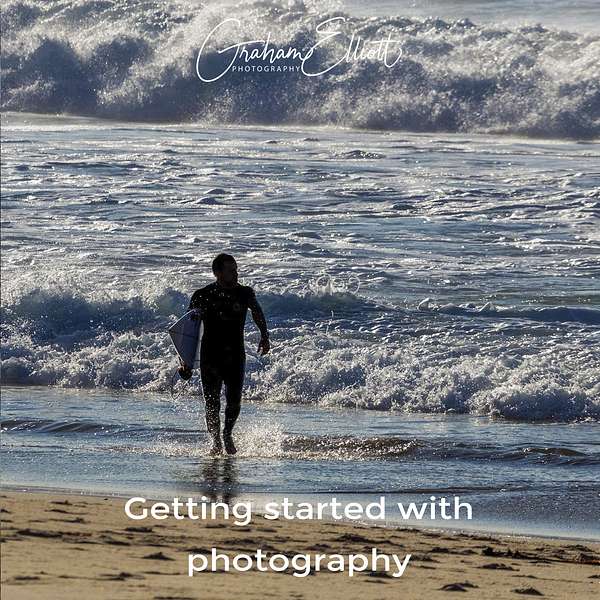
Getting started with photography
Use Left/Right to seek, Home/End to jump to start or end. Hold shift to jump forward or backward.
If you're new to photography (and I'm talking about DSLR and Mirrorless photography primarily), the equipment and settings can be quite daunting. So where to start?
In this podcast I'll take you through what I believe to be the most important considerations for your kit; camera body and lenses, and how to quickly get on top of the 'techy' part.
What is the "exposure triangle" and what do you need to know, and why?
I'll talk you through what you need to know about 'Aperture', 'Shutter Speed', and 'ISO' and how each one impacts your final photograph.
As always, I recommend that you take a training course if you can. A face to face course is likely to get you the best results, if one is available. If you don't have that option, check out on line courses to see if there's one for you. Make sure that:
- You like the teaching style
- There is a practical aspect where you can apply the theory
- There is a money back guarantee if that particular course isn't for you
You can check out my courses below.
It's time for another podcast...
Join me for my live mini-workshop on Tuesday, 26th February to learn more about composition... And, if you can't make the live event, you'll have access to the recording. Find out more here.
Have you bought your 2026 Wildlife Calendar yet?
Find out more by clicking here
Support the show
Thank you for listening to my podcast. If you would like to subscribe, you can do so here:
https://www.buzzsprout.com/1803730/support
Website
Please check out my website for the latest collections, photography tips and challenges, and more!
Develop your photography by taking a course:
Go from "Auto" to Awesome photos in just one week (click here)!
Contact Me
You can contact me directly at: graham@ge.photography
Coffee?
If you've had value from this podcast, please help me continue with them. Most people don't, but if you would like to make a small contribution, how about a coffee? You can buy me a coffee here.
Please don't keep me a secret! Please share my podcast with anyone else who you think might be interested.
Thank you for listening.
Foreign. Well, hello. I thought I'd put together a podcast which is aimed more at people who are just getting started in photography and perhaps give you a few things to, initially look at. Because I know when you first start with photography, particularly if you've bought yourself a DSLR or a mirrorless camera system. And this, this is primarily what this podcast is talking about. Once, you get hold of the camera, you'll find there's a lot of controls on it, whether they're physical controls on the body, maybe a rotary control or a button or whatever it might be, and then there's a whole lot of menus as well. And all of that can get pretty daunting very quickly if you don't understand the basics of, that type of photography. So digital photography using, a single lens reflex camera, Digital single lens reflex or a mirrorless camera. Now, this is what I'm focused on, to use the phrase and the way to identify the kind of camera I'm really talking about is the, it's camera where you can remove the lens and put on a different lens. And that essentially is the sort of photography I'm talking about. So I'm going to take it back. Obviously, I don't know you, I don't know what your, what's pushed you to this point? What's inspired you to get involved more in photography? So I'm going to just make this podcast really a series of questions that you'll have to answer for yourself. So the first question is, what type of photography do you want to do? What is it that's inspired you to, invest in the equipment yourself? Or maybe you've got it as a gift. And that photography, it might be something like landscape photography, it might be night photography, you might be into that, it might be sports photography. And by that I mean things like soccer or rugby or motor racing, those sorts of things. It could be event photography, so things like air shows or just any kind of event that you might be, involved in regularly. It could be wildlife photography, which is obviously what this series of podcasts is primarily concerned with. It could also be travel photography, which is another aspect of what I tend to talk about these podcasts. And within travel photography there's a whole range of different things you could be doing. I mean pretty much everything I've already just mentioned could contribute to or could be, put under the, the title of travel photography. So there's an awful lot of, different options there. I mean architecture stuff, like that, so that is question number one that you have to answer is what is the style of photography that you're primarily interested in? I want to make this one style only at this point, because the best way to move forward with your photography, at least initially, is to just concentrate on one particular style and just do what you have to do to start producing the kind of results that inspired you in the first place. Because there's nothing more satisfying, I think, than producing a result photographically that is exactly what you were going for. And you actually find quite interesting, you find quite inspiring, whatever it might be. But you get an emotional, you know, a nice emotional response to it, not, you know, anger and rage and things like that. So start getting clear on that first of all. And that will begin to drive at least some of your decision making on things like what lenses do you need? Do you need to learn how to use a flash gun? do you need a tripod? You know, what are the other elements around the camera and the lens itself that you might need to think about because of the photography you're doing? And another question it will answer for you, at least initially, is what kit do you need? So I'm going to assume that most, I mean, and it's not really an assumption. I mean, the fact is most camera bodies that you're going to buy, whether you're looking DSLR or mirrorless, are going to be good for general purpose photography. And by that I mean of all of the sort of specialities I've mentioned, you will be able to get a result, of some sort with that body. It might be better at some than at others, but, at this stage you really want to just start getting results and down the track you'll be able to refine that and maybe change the camera body that you're using because it offers certain features that aren't on your current body but are very, you know, start becoming more and more important as you develop the area or the areas that you're photographing. However, the element that is likely to be most affected is the lens that you're using. Now I would definitely recommend a zoom lens when you start out that might be a telephoto and that is basically a longer lens. And by a longer lens it just means it magnifies the image more. So the focal length is how we define the lenses. So you might have, a zoom lens that has a range of 70 to 210 millimeters or something similar to that. Use, the telephoto, I use in most of my work is a 100 to 400 millimeter lens. But it basically just tells you the sort of magnification you're likely to get. So clearly, if you compare 700, if you take a 700, 210 millimeter lens, whatever you're looking at 70 millimeters is not going to be as magnified as when you slide that lens forward and you're at 210. Then the image is much more magnified. And so if you're doing landscapes, that sort of a long telephoto isn't going to really work for you. You want to have something short. in that case, you're going to have a short distance, which might be 28 millimeters. You might have, for the sake of argument, a 28 to 50 millimeter. And here I'm kind of making up numbers a little bit because different, camera manufacturers have different ranges. But if, if you want to do landscapes, you want to be down at that end of the sort of 28 millimeters to 35 or to 50 millimeters or that sort of thing. If you're doing portrait work, you're going to be looking at around the 100 millimeter mark. So that's the sort of magnification that you want. It allows you to zoom in a little bit. You'll get a little bit closer, but, you'll still get a nice, sort of portrait of your, of your subject. And now the reason for the other thing to understand is, when you're looking at these numbers is not only how close do you get to your subject, which is the main thing, but there will be some distortion. So if you go to a very small number, and here I'm thinking of something like 14 millimeters. So that's actually getting into more of a specialized focal length. But what it will tend to do is create a huge amount of curvature. It's what we call a fisheye. Or you're starting to get into what are known as fisheye lenses. And that simply means that if, you're photographing a level horizon with a 14 millimeter lens, you're going to see very obvious curvature on that horizon because of the effect of that lens. So don't go too low in the numbers and you're not magnifying at that stage, you're actually pulling right back from your subject. And what you'll get is a lot of curvature. And that something like 28 millimeters, you'll start to get curvature. So you wouldn't want to use a 28 millimeter on a, for portrait work, unless you're quite a long way from your subject in which case it's really not a portrait in my opinion. but it's more putting somebody in context of a much wider environment. So again I don't over complicate this but just to give you an idea of what those, those numbers mean and depending on the type of photography you're doing, what would be a good kind of focal length to be using? Bearing in mind that you, you probably want to vary those numbers a little bit which is why getting telephoto lenses is a great place to start because you're just by doing it and obviously photography, you learn photography by doing it. It's like swimming. You can read a lot of books about swimming but you can't swim until you're in a pool or in the ocean or wherever you are and then you do it and you're going to make mistakes. You're going to get a, you know, swallow water, you're going to do all those sorts of things. photography is the same. You're going to be making a lot of mistakes but they're really valuable because that's where you really start to learn photography by, by making mistakes. So to get you with the best possibility of starting to get good results when you start, think about the kind of photography you want to do and then with the, the camera body and the lens or lenses you have, make sure ideally you're using zoom lenses to start with and you just have a zoom range as I've said, that will be defined by millimeters, by the length of the lens focal length of the lens. Make sure it has the sort of range that's appropriate for the sort of photography you want to do. And I think in most cases you'll probably find that having a telephoto zoom, so maybe as I've said something like 70 to 200 or 210 and a wide angle zoom that might be in fact something like 28, 70 is good because then you've got the full range between the two lenses. There's, there's not an overlap with those but you've covered everything to 28-200 mm. you've got in, in the case of though using those two lenses you can cover that whole range. So that's a good place to start. You'll probably find it's a bit fiddly at first maybe switching lenses but you'll again you'll, that's just part of learning. Now the next thing, and I guess probably the last thing I really want to spend some time talking about is understanding the exposure. Triangle. And again with photography, when you're learning, I do recommend that you take a course. find somebody who describes things, describes how to do things in a way that suits you, that you can understand and you can apply. Because what you don't want to do is, is invest in a course and then find you're really not getting along with the way that works, the way the information is being presented, you can't make use of it and then what's the point? So I have courses on smartphone and also dslr, mirrorless. with mine you get a week to try them and if, if after a week, you really can't get on with them, then just let me know and you get a full refund. So you know, that's just what I offer. I would recommend also looking at other courses that offer the same site kind of money back guarantee because as much as the course might look good, when you're looking at all the marketing stuff and the description of the course, if you can't get on with how it's being presented, and it isn't. So with mine there's some theory and then you apply that theory. So there are ah, activities that you do after each lesson to just really bring it home, which is the way I like to learn. But that might not work for you. So just make sure that whatever you invest in there is the option to pull back if, or to pull out of it if the way it's been presented doesn't work for you. So exposure Triangle. Now it's one of those things that I find a lot of people get quite intimidated by and there's really no reason. And the comparison I like to make is that if you're driving a car, and I'm assuming that most of the people who listen to this have some experience of driving a car, there is a three way relationship that you're very familiar with and that is if you put your foot down on the throttle, on the gas, the accelerator, whatever you call it, where you are, what happens is two things. One is the car goes faster and secondly you start to burn more fuel typically. So there's a relationship there. And there are also ways you can measure what's going on. So the one that you probably are familiar with is the speed as you go faster. You might go from you know, 50Ks an hour to 80Ks an hour, let's say, or from 30 miles an hour to 50 miles an hour, whatever it might be, whatever you're familiar with. So these are technical numbers. They're actually a way of measuring speed, whether it's kilometers per hour or miles per hour. But there's a number in there. So. But you're familiar with that, and I'm assuming you're not intimidated by that. However, there are two other things going on. There's the amount of pressure you're putting on that pedal, which could be measured, in newton meters or pounds per square inch. Now, you probably have absolutely no idea what those numbers are. But nonetheless, you are increasing that number when you put your foot down. And then the other thing that happens is your, you'll be using more fuel. Now, you could measure that in miles per gallon if you're using imperial or, kilometers per hundred liters or kilometers. But however that's measured, I can't even remember, to be honest. But you know that you're burning more fuel. Do you need to know all of those numbers? Probably the speed one you do because that stops you, you know, getting speeding tickets. but the rest of them, not really, you know, that you might have an interest in them. And some people have absolutely no idea what the fuel consumption is, whereas other people are completely on top of it. So the exposure triangle is very similar. It's essentially the relationship between aperture and that's how much light is allowed to come through the lens. And the way that's controlled is that there, are actually, I guess you call them leaves, the metal leaves. But as you change the aperture, they close down to let less light through the lens or they open up to let more light through the lens. And that's all you really need to know about it. It controls how much light is coming through the lens. And that is part of the triangle. The next thing is the, shutter speed. So how fast is the shutter, which in most cameras is a little curtain, that moves across. But again, you don't even need to know that. you just need to know that the shutter will be going either fast or slow. And as it goes fast or slow, it also lets in more light or less light. And then the final part of that relationship is ISO. an ISO is simply how sensitive the camera or the film is to the amount of light that's hitting it. So the ISO might be, low. So it's very sensitive. So let's say it's an ISO of 100. Or it might be very Sensitive, which might be an ISO of 4000. So you might see these numbers under those, categories on your camera. So how do you handle those? Well, a good way to start is to switch your camera into fully auto. And unfortunately, a lot of people that's, they put it into auto and that's. It never comes out again. But when you've taken a photo, taken a photograph, what you can look at when you're reviewing it on the camera is the settings. And you'll see, see, those three settings are there. You'll have the aperture setting, the shutter speed and the ISO. And they'll have numbers against them, but it will give you a reference. And a great way to learn to use the exposure triangle is to take that reference that you've taken in, automatic, write those numbers down, or if you're good at memorizing the numbers, then memorize them, switch the camera to manual, and then you can manually set each of those three things so your aperture, your shutter speed and your ISO. And just use the numbers that you've just taken, that you've just copied from the camera. Set the manual, selections to those numbers and then take the photograph again. And what you will see or what you should see is exactly the same, result. now, what the exposure triangle is all about is making sure that you've got the right exposure. And the right exposure is simply means that you have enough light that your subject is bright enough and the background is bright enough that you can see what they are. And there's an optimum in any environment where you can see, everything quite clearly and it's in sharp focus. So that's really what exposure is giving you. And the way this relationship work, just as in the example of putting your foot down in the car, is that as you change. Let's take shutter speed. as you make the shutter speed faster, you need to compensate because you've got less light coming in. As I mentioned when I was describing shutter speed. And you need to compensate with either your ISO or your aperture to make sure that you can still see the subject. Because if you. And you can do this in the manual, mode, if you just change shutter speed, make it faster, and then make it slower and take photographs with each, you'll notice a difference in how bright or how dark that image is. You're also going to notice other things because shutter speed freezes the action. So the reason you might want to change the shutter speed is that you might want to capture something that's happening very quickly. So if you're doing sports photography, let's say, and let's say it's rugby, because I like rugby. And you really want to freeze the action. You want to catch the guy as he's grounding the ball to get a try. You probably want to get a fast shutter speed for that possibly around a thousandth of a second. Because if you have it on what the camera might say in auto mode to get the right exposure, but it doesn't know whether you need it, to capture fast action or it doesn't really matter, the chances are you'll end up with a very blurry picture because the shutter speed is too slow. So that's one aspect of that exposure triangle that you're going to want to vary to make sure you get the result you're going for. Now another thing you might want to vary is the aperture. And the reason is that and it relates to the question I think I'm asked. Yeah, I'm pretty sure actually I've been asked this question more frequently than any other questions do with photography. And that is how do you get a sharp subject that's nicely in focus but the background's out of focus? And you do that using Aperture. Because aperture, as I've said, uses those little leaves normally, sort of little metal leaves in the the mechanics of the lens. And that controls how much light is coming in. So when you're, when you have those leaves wide open. So using the full diameter of the, the lens to let light in. And that will correspond to an F number. Okay, so I'm going to use a little bit of tech here, but not very much. And that number might be 2.8. But the thing is that the number is very, is very, very small. 2.8 is a small number if you go to the other extreme to really bring the light down. So you might do this on a bright summer's day, for example, where there's a lot of light and it's very easy to overexpose. And by that I mean everything gets very white. you can't really see much of anything. You might, they call it stopping the lens down, but it just makes the whole light goes through very small. That might be F22, something like that, so a bigger number and that will compensate for being in a very bright environment. Coming back to that question though, how do you get a sharp subject and an out of focus background? You do that by controlling the aperture. Because the other thing that happens when you're at F2.8, so you've got a very big aperture. You're using the full diameter of the lens. Is that the way the optics work? Pretty much only what you're focused on. So what you've set your focus on, when you focus the camera, only that and a small area in front of it and a small area behind will be in focus. So for example, if I was to do that, if I was doing a portrait of somebody now the actual distances involved will depend on the lens you're using, exactly what settings you're using. But using an aperture of f 2.8, if I focused on the eye of that person, the chances are the tip of the nodes is going to be out of focus. So that's in front as in towards the camera and their ears which are behind the eye obviously most, with most people anyway, that ear will also be going out of focus. So it means you've got a very narrow band that's actually in focus. So a very narrow distance, around what you focused on that will stay in focus. If on the other hand you change that aperture so that it's a very small hole so there's very little light coming in, what will happen to your the area that's in focus is that pretty much everything will be in sharp focus. Everything in front of your subject, your subject and everything behind them will be in sharp focus. So again the way to really play with that is to do that little exercise by doing an auto shot. So take a picture in auto, copy the numbers down, go to manual and then use those same numbers but then vary the aperture. So two things are going to happen when you vary the aperture. First of all as you go to because I'm assuming auto will probably put you somewhere in the middle of that range. Maybe an F8, something like that. So as you make the aperture bigger so you go to an F2, remember the small number, you get a ah, lot more light coming in. What will happen is though the background of your behind your subject will go out of focus and it may already be partially out of focus. With the auto, mode depends really on what settings you've got. And if you go the other way to F22, you're going to find that the background is in very sharp focus but the picture gets darker. And that really is all that relationship is about. It controls how bright the image is. So you want it to be bright enough that you can clearly see what's going on, but you don't want it so bright that everything's White. And by contrast, you don't want it so dark that you can't see anything. So once you've decided how much depth of field they call it, how much is actually in focus, once you've decided what that is, you then would need to compensate with either the shutter speed or the ISO setting to make sure that the image remains bright enough that you can see what's going on. So you might want a narrow depth of field. But if you've got something that's going very fast, you might also need a very fast shutter speed to absolutely freeze the action. So once you've got those two things worked out, your shutter speed and your aperture, your shutter speed for freezing the action, your aperture for depth of field, you then need to compensate with ISO just to make sure it's bright enough. So that is it, you know, that is the exposure triangle. That's how it works. Oh, excuse me. That was exciting. I'm recording this on Christmas Eve, so I'm just having a slurp of wine. So that's it. If you're getting started, I would say go no further than that. Get to understand those elements. So get to understand. Give yourself a good starting point by having a camera with one or two lenses that are zoom lenses. So you can vary the focal length, start shooting initially in auto just to get some reference settings, and then switch to manual and use those settings and then vary them to learn what they do. Now, what I will say is the final thing is I don't use manual. I don't use auto. Sure. But I tend to. What you'll also find in the camera is you have a thing called modes, and that will prioritize one of those three settings. And normally the modes that normally get used to are either shutter speed priority, where you manually set the shutter speed, and the camera sets up everything else. usually it just varies the aperture. It will leave the ISO in most cameras where it is. And, the other option is to have aperture priority so the camera resets the shutter speed automatically. I'm not going to go into what ISO does. There is a reason why you might have your ISO at a certain point, but that's really for your training course to explain because I don't want to over complicate this. And m. I hope that what I've described so far is making sense and maybe some pennies are dropping or it's giving you a place to start, but if it's. Certainly if you don't understand what I've been talking about, I Absolutely. Recommend you get a training course and make sure you get one. First of all, it gives you a money back guarantee because you might not get on with the, the way the person who is teaching describes how to do certain things. But also get one that involves a lot of guided, practical work. Because, as I've said before, the only way you're going to learn about photography is by doing it. It's like learning how to swim. you will get a mouthful of water every now and again to use the comparison, but that's when you really learn and you'll know that you're getting there because you'll be able to look at somebody else's work that you like. This might be on Instagram or somewhere else. And by looking at that photograph you will already have a rough idea of what settings they've used to get that photograph. So what they've done with their shutter speed, their depth of field and maybe even ISO. some people, when they share work, they share their settings. They're useful as a general guide again, in my opinion. But you can't, if you use exactly those settings, the chances are you're not going to get the same result because you're using different equipment to them. And the actual results you get for specific settings will vary, from gear to gear. So the camera body and particularly the lens that you're using, you're likely to get different results. So have a look at those things by all means and get an idea about them. But look at the, the more general settings. You know, is it a, is it a long focal length? Is it a, you know, are they using the focal length of 300 millimeters to get that shot? Is their shutter speed 1, 500 of a second? Is the aperture, f 5.6. You know, this gives you, once you start looking at those, you don't have to remember the actual numbers, but just get used to the patterns. As, as a particular number gets bigger, what does that do to the result? As a different setting gets smaller in number, what does that do to the result? And I, I, hopefully, as I hopefully I've not confused you, but that I hope will give you a reasonable place to, to start to begin to learn photography. but yeah, just finish, do consider taking a course, or if you can work with someone, have some, you know, actually physically do a one on one course with somebody or you know, somebody teaching a group. That's also a good place to start too because clearly then you can show results, they can look at your settings and tell you what you're doing wrong. So that's. That's very valuable. But, if you're. If you're not in a place where you can do that, have a look at online courses, and they may be, well, hopefully should be, a really good alternative, for you. Okay, so that's it for this podcast. thank you for listening again. I hope you found it useful and I'll speak to you on the next podcast. Bye for now. Well, I hope you enjoyed that. Now, I just want to say thank you for tuning in and joining me in the, Wildlife and Adventure Photography podcast. If you have enjoyed today's episode, please give me a. Like a subscribe, maybe tell your friends, and by all means leave a comment. And if there is a subject you would like me to cover in the future, please let me know and I'll, be very happy to do my best. So thanks again for, joining me and I look forward to seeing you again. Next podcast. Bye for now.