Wildlife and Adventure Photography
Wildlife and Adventure Photography is a podcast for those who believe the best images are earned, not taken. Through field-tested insight and thoughtful reflection, each episode explores how preparation, patience, and creative awareness come together to produce photographs with lasting impact.
Wildlife and Adventure Photography
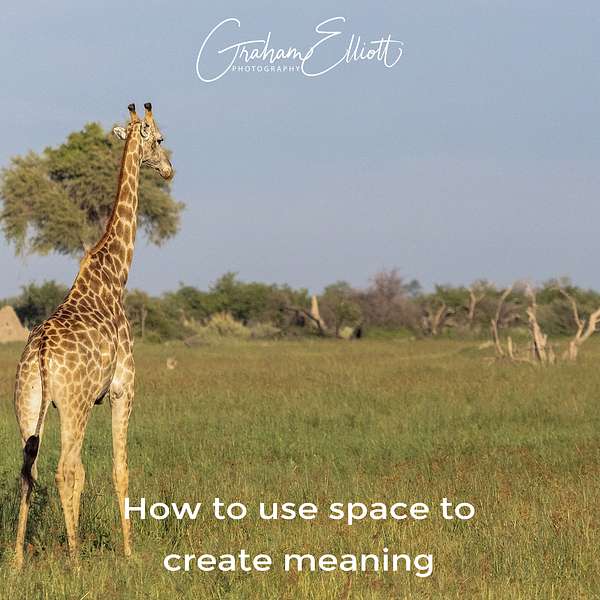
How to use space to create meaning
Use Left/Right to seek, Home/End to jump to start or end. Hold shift to jump forward or backward.
The use of space in a photograph has a big impact on the message you are trying to convey to the viewer.
Using the Visual Storyteller approach, you can use your composition to convey a feeling or story that you wish to share with them. This might be the context (the environment) where your subject lives, a feeling of size or significance, or to imply that something has happened, or is about to happen.
How you use space has a big impact on how your viewer with connect with your photograph. I like to think that the longer someone spends looking at a photograph, the stronger the connection they will feel to it, and the subject.
It's time for another podcast...
Thank you for listening. Please remember to take a look at the website as I have a few things going on, including mini-workshops to help you with your photography: www.ge.photography
Or join the mailing list... and I'll tell you myself!
Support the show
Thank you for listening to my podcast. If you have enjoyed it and found it useful, please consider a subscription. Most people don't subscribe, but those who do allow me to continue to produce this content. If you would like to subscribe, you can do so here:
https://www.buzzsprout.com/1803730/support
Website
Please check out my website for the latest collections, photography tips and challenges, and more!
Develop your photography by taking a course:
Go from "Auto" to Awesome photos in just one week (click here)!
Contact Me
You can contact me directly at: graham@ge.photography
Please don't keep me a secret! Please share my podcast with anyone else who you think might be interested.
Thank you for listening.
Foreign. Hello again. I thought I'd talk about space in this, podcast. Not the Final Frontier, but the space that you have in your photographs. So, what I mean by that is, basically an area in the photograph that doesn't appear to have much in it. It might be sky, it might be a, landscape of some sor. Maybe fields or grass or something like that, but basically not your subject. And something that doesn't have anything that's particularly catching your eye. So no leading lines or anything like that. So simply empty space. I've seen it referred to as negative space, by some photographers. I don't particularly like that term, if I'm honest. to me it's not negative at all. It's something that can be very positive. It can make a huge difference to your photograph. And the way I think about it from a creative standpoint is if you're listening to a piece of music, what's the difference in that music? When you have space, when you have, a little sequence, very short sequence with no notes, what happens when you drop a note here and there? What happens when you change the timing of that piece? What does it do to the mood? Because music is very evocative. It's a great way of getting mood, going. I think it's probably the most powerful art form we have for connecting with our emotions. So although we don't have that at our fingertips with a photograph on its own, obviously we can put photographs together to music, and I think that's very powerful. But there are options when we're putting together a particular image and how we can change the feel of it. So changing the timing of a musical piece can make it feel more upbeat, it can make it feel more reflective. you'll know what I'm talking about. If you listen to music, I'm sure there are different pieces that you would, listen to, when you're in different moods. So this kind of thing I'm really thinking about with how, we do this visually and one of the ways we do it is to use the space in the photograph. So what am I talking about here? What does that do? So if we have a photograph with a lot of space in. Can serve as, something that's in contrast, with whatever it is we're taking the photograph of. So it's putting the subject maybe in context. So if you've seen the movie Titanic, the Cameron, movie, there's a shot in that movie where they have the Titanic, which obviously very big ship, certainly for the time. And it is, cgi, I guess, doesn't matter. But, they pulled right out. So you've got the Titanic. But it's then. But it looks very small with all of this ocean around it. And to me, anyway, that puts the ship in context. Although for us, as a human being, human being, size thing, the Titanic is very large when we're right next to it. When you put it in the context of the ocean that it's crossing, it's actually tiny. It's insignificant. So this is, I think, a powerful way of using space to act as a contrast to our subject. Now, I've tried a similar thing with, an elephant. when I was in South Africa, we. I, was out one day, we were in, a kind of on the edge of a little valley, and there was a hill on the other side. And way over on the other side, this hillside is all covered in trees. But way over there there was an elephant just walking through a small clearing of trees. And I got that shot because, again, elephants to us are large animals. But if you put them in the context of their environment, they can appear very small and maybe even vulnerable. And that's another thing that you can perhaps suggest to the viewer when you have your subject, but very small in the frame. And the rest of it is this. This, empty space. Now, the empty space might be trees, as in the example I've just given, or it might be the ocean with the Titanic example. So you could perhaps do that with whales. If it's obvious, that there's a whale there, you can, put that animal in its environment, but that's what you're doing. So it's part of this visual storytelling that I do talk about a lot. And, there's definitely one or two podcasts about it. And it's something that I talk about when I teach photography. So coming at it from the perspective of the Visual Storyteller, and what I mean by that is simply that when you're composing your shot, think about why you want to take that particular image. What is it about it that makes it worth taking that photograph? What's the emotion, maybe, that it's eliciting in you, or maybe you're trying to convey some sense of what's going on. so there's all sorts of things you can do with that idea. But the underlying, thought behind the Visual storyteller is it makes you really think about how you're composing your image, where you're putting your subject in the frame, how big the subject is, how small, all these kind of things. And space, and your use of space is a very important part of that. So one of the, if you're interested in this, if this is something that you maybe hadn't thought of before, there's a very easy way of experimenting with it. And I do encourage you with anything that you do with photography is to go out and just practice and try different things. So one of the things you can do is to take a photograph of a subject. Could be anything at all, a building, your dog, your cat, people, whatever it is. But shoot them so that they're quite small in the frame so you've got a lot of space around them. Now perhaps the ideal way to do this from the perspective of just playing with it is to have them right in the middle of the frame so that you have lots of space all around them. And then once you've got that shot, go to whatever post processing software you use and just try cropping that image in different ways, as many different ways as you can think of. And any editor will allow you to re crop the image. So that shouldn't be a problem. You don't need things like Photoshop that you pay for, free editors will do that. And just experiment with cropping that photograph differently. So one way to start is to start using a portrait format, so kind of vertical, the way people like to shoot with mobile phones. And just experiment with cropping the image so that your subject is at the top of the frame. So you've got a lot of space in the foreground, maybe to the left, maybe to the right. But you can also experiment with that and just see what difference it makes to you when you look at that photograph. Does it appeal to you more? does it not appeal to you? Do the same with the subject in the bottom of the frame. So again using portrait format, so you've now got a lot of space above them and again put them in the corners and even ignore the rule of thirds. So don't worry about having them on one of the third crossing lines. If you're familiar with the rule of thirds, put them right down in the corners so they're very small in the corners so that most of the frame is, is whatever space you've allowed for it. And once you've experimented that way, then just flip it. So go to a landscape format, so sort of more horizontal and do exactly the same thing, have a lot of space above the subject and Put the subject in one of the corners. And the same with having the subject high up in the frame so you've got a lot of foreground. And another thing you can do, so that's sort of one way of doing that with a small subject. Another way you can use space is, is to try taking a portrait of somebody. And I'd have them perhaps bigger in the image so more of, so you can at least see their face, maybe m. Their face and the top of the shoulders and do exactly the same thing. Start with them in the middle of the frame and then just re crop that image with having them over to the left, over to the right using landscape format again with the portrait format. Have them at the top, have them at the bottom and just look at how that image changes, how you feel about that image changes when you re crop them. And this is where you start to understand how space can really work for you. And I'm sure you'll find that some of these crops will evoke more of an emotion than others. And what we tend to do, particularly where we have people, but it can be other things as well is we use that space to start to tell the story. So if you've got a portrait of somebody and let's say it's landscape format, they are over on the left hand side of the frame and they're looking towards the right. So basically the space is in front of them and they're looking into that space. That kind of suggests one thing which might be that they're looking at the future or they're talking about what's going to happen. That kind of an idea. If you just shift them across to the other side so they're still looking to the right of the frame but now they're positioned in the right. So all of that space is behind them. That is a very different feel because then it's about what's going on behind them. Is this something about the past? Is something coming to them from the left hand side? And if you look at, I've seen this in quite a lot of tv, shows, dramas, that sort of thing. It seems to be more common now quite often where they're doing a headshot on someone, they will frame them so that if they're looking to the right of the frame they're over in the right of the frame, if you know what I mean. So the left hand side is empty and you've just got background there and that might be slightly out of focus. But it does suggest to you that something is coming from that side, that the space is there for whatever that thing is to move into. So I hope this is making, sense. but that's one way we can use space. Now another way of using it is if you're photographing something that's moving, it might be an animal, it might be a car, could be anything. If you have it moving from left to right across the frame. Look at how that image feels when you just change the crop so that rather than having. Let's talk about a vehicle. Because cars are very easy to photograph. If you want to go and experiment with this. Instead of having the vehicle in the center of the frame, which is what most people do, try re cropping it so that if the vehicle is moving from left to right, it's over in the right hand side of the frame. So the front of the vehicle is almost out of frame. It's just heading out of frame, but you've got space behind. That's very similar to what I was talking about with this, way of framing a portrait. So try that and see how it feels and then move it across. So it's on the left hand side. So all of the space is in front of it. So it has space to move into. What does that do for how you feel about that particular, image? So where we put the space where there's something moving, we're really creating space either for our subject to move into, or there's some relevance about the space behind it which talks about where it's come from, or maybe there's something coming behind it or these kind of things. Now another aspect of the visual storyteller is that we are natural storytellers. This is something that you've probably heard me say before, but this is why TV's so popular, why movies are so popular. And if you go back, it's in time. When books became available, they were very, very popular. Prior to that it was, people telling stories. You can imagine them sitting around the fire at home, telling a story, or centuries earlier sitting around the campfire telling stories. You might even do that today if you go camping. We like to sit around a campfire and tell stories. Whatever they might be, might be about our life or stories we've heard, but we love stories. So what we'll tend to do when we see, an image that's set up like that with empty space in it, we will start to create a story about that subject that gives a reason for why that space is there. If that makes sense. So this is a way of connecting with whoever's looking at your photograph. And it gives them a different experience because subconsciously you're inviting them to start making a story up about what they're seeing. if you're looking at a single image, that's definitely the case. If you're looking at a sequence of images, you're sort of telling more of the story for them. You're filling in more of the blanks. And that's also very powerful though. And again, how you frame your subject in a sequence of photographs is also important. But this is the whole idea about visual storytelling. And one of the, I guess ways of judging for me about whether a photograph is a good photograph or not is. Is how long somebody spends looking at it. If you. And imagine how you feel if you're showing someone your work and they just pick up, let's say you've printed some images, you, give them to them. They just pick them up and immediately drop them down. How do you feel about that? It kind of devalues your work. There's no connection with the viewer. But if they hold it and they're genuinely looking at it and kind of taken in, drawn into the image almost, that's a completely different experience. And that's a much more, powerful image. To me, that's a much better photograph because you've now engaged the viewer and they are, ah, becoming part of what they're seeing in so much as they're making up a story about it or it's something that's speaking to them in some way. So this is where things like the use of space can be very important. And as I've said, the best way to really understand this and to get on top of it is to just experiment with different subjects and. And think about things that you like to photograph. And maybe look at your favorite photographs. And if you've got them, if they're digital images, presumably most of them will be, if not all of them. And can, you play around with the cropping on that image? Can you reposition your subject one side or the other or have it higher in the frame or lower in the frame? And what difference does that make to how you feel about the shot? Does it make it a more interesting shot? most people, And this is why a lot of people try and learn about photography, because they just churn out very boring images. But for most people, subjects in the center, it might even be quite small in the center. but it doesn't engage the viewer in any way. Whereas if you start putting them to one side or the other, hence the rule of thirds. Why that's a good way of composing an image. It's certainly a very good starting point. And what the rule of thirds is doing is automatically drawing space into your frame, into your image. So there's an area there, which has significance in terms of the amount of the image it takes up. But there may be nothing in there. So you're inviting the viewer to, to pretty much fill that gap. So that kind of covers that aspect of photography. And I just felt, it was worth talking about because to me it's one of the. There are a few things you can do with photographs that make a huge difference to it. One of them is depth of field and how you use your background. but on the composition side there are things like leading lines and all these things which take your viewer on a journey. You might shoot on a tilt slightly so that everything isn't quite square. That can also be a way of drawing people in. But how you use space can make a huge difference to an image. And I think, certainly looking at the photographers that I like to follow, I would say pretty much all of them are very good. They've mastered that use of space. They know how to draw the viewer into the subject. But on the way they're telling them a story. So it might be about where that subject lives. you know, my primary thing is wildlife photography. So I'd be looking at the environment that that animal lives in. it might be more of an action shot. If, again, in my case, if it's a ah, predator hunting down prey, if it's one of those kind of shots. but again, you can even reframe those images so that ah, maybe that activity that's going on is very small in the frame and it's in the context of a much bigger area, maybe the whole world. You know, it's in the. In the big scheme of things, what's going on might be pretty major for those directly involved in it, or similar just on the edges of it. Maybe other animals in a herd. But in terms of what's going on for everybody else, it's very insignificant. So these are the kind of stories and the kind of messages that you can use space to start to convey for you to whoever is looking at the image, the final image. Okay, so that is it. I hope that's been useful and I will speak to you on the next podcast. Bye for now. Well, I hope you enjoyed that. Now, I just want to say thank you for tuning in and joining me in, the Wildlife and Adventure Photography podcast. If you have enjoyed today's episode, please give me a like a subscribe, maybe tell your friends, and by all means leave a comment. And if there is a subject you would like me to cover in the future, please let me know. And I'll, be very happy to do my best. So thanks again for, joining me, and I look forward to seeing you again. Next podcast. Bye for now.