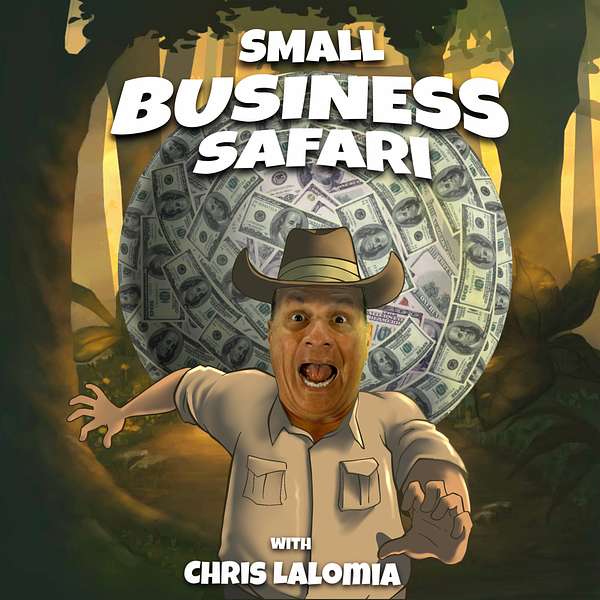
The Small Business Safari
Have you ever sat there and wondered "What am I doing here stuck in the concrete zoo of the corporate world?" Are you itching to get out? Chris Lalomia and his co-host Alan Wyatt traverse the jungle of entrepreneurship. Together they share their stories and help you explore the wild world of SCALING your business. With many years of owning their own small businesses, they love to give insight to the aspiring entrepreneur. So, are you ready to make the jump?
The Small Business Safari
From Door-Kicking To Strategy: Running A Profitable Handyman Business
What happens when you stop kicking doors and start building a business that actually moves upward?
Summary:
In this episode of The Small Business Safari, Chris and Alan push past a door-kicking moment to talk about what really drives sustainable growth: selling value, protecting margin, and executing a strategic plan that actually ships. We draw clear lines between handyman work and remodeling, break down why they are completely different operating models, and unpack the pricing mistakes that quietly kill profit.
We dig into real-world lessons like the $250 microwave trap, why leading with discounts is dangerous, and how reviews become proof of promise—not just social noise. Against a backdrop of market uncertainty and changing homeowner math, we outline three focused initiatives for growth: smarter CRM and AI use, relentless gross profit focus, and deposits that protect cash flow.
Most importantly, we rally the team around one word—Ascend—and show how alignment, execution, and close rate become the true levers for growth.
💡 GOLD NUGGETS
- Channeling passion into systems, coaching, and execution
- The small-ticket trap and the $250 microwave lesson
- Why handyman work and remodeling require different business models
- Pricing frameworks and good-better-best ranges
- Value over price—and the danger of leading with discounts
- Reviews as proof of promise and process
- Market uncertainty, homeowner math, and demand drivers
- Three initiatives: CRM & AI, gross profit focus, deposits
- Building team buy-in with tactical execution and one-word alignment
- Why close rate is the real growth lever
🎥 Watch the full episode on YouTube:
https://www.youtube.com/@TheSmallBusinessSafari
🌍 Follow The Small Business Safari
• Instagram | @smallbusinesssafaripodcast
• LinkedIn | https://www.linkedin.com/in/chrislalomia/
• Website | https://chrislalomia.com
Final Thought:
Don’t forget to go out there and tell your friends about this thing. Keep sharing the podcast—we’re just getting started.
Thanks to our sponsor Smart Hire Solutions LLC!
Passion is not rage, it's just pain. Did you really kick a door today?
SPEAKER_01:I did. I'll show you. Was it was it open or closed?
SPEAKER_00:Uh it was open uh after I kicked it.
SPEAKER_01:So good thing you know a handyman.
SPEAKER_00:Yeah. So in fact, uh when I came back later, uh one of the guys says, I'm not fixing that. I'm like, I don't want you to. In fact, I want you to draw an arrow to it because the next guy, the next guy who pulls that in a meeting with me is gonna get the same thing. So uh that was in a meeting? Uh yeah. Chris. I know. The passion came out, Alan. Yeah. And I and I have a uh yeah, it's just not good. Did it work? Um, unfortunately, I don't think it did. Uh, and unfortunately, I think we're at a uh an impasse, and I'm unfortunately think I'm gonna be party with another employee. Welcome to the Small Business Safari, where I help guide you to avoid those traps, pitfalls, and dangers that lurk when navigating the wild world of small business ownership. I'll share those gold nuggets of information and invite guests to help accelerate your ascent to that mountaintop of success. It's a jungle out there, and I want to help you traverse through the levels of owning your own business that can get you bogged down and distract you from hitting your own personal and professional goals. So strap in Adventure Team and let's take a ride through this party. Alan, we get ready to rock and roll. We're doing this without a guest today, Alan. I think it's fine. Okay.
SPEAKER_01:Yeah.
SPEAKER_00:I think we got a lot to talk about.
SPEAKER_01:Umic you sent me uh a minute ago.
SPEAKER_00:I do, but I can't get to that right now.
SPEAKER_01:So I think you got something you gotta burn your saddle, don't you?
SPEAKER_00:Alan, we look at a lot of stuff in our businesses. Uh small businesses, when we get into it, you guys have heard me say this a lot over and over, just said it in the last podcast. If you don't have passion for your business, you're not gonna work uh well. It's gonna be hard. It's gonna be a slog. If you're not passionate about what you do at work, it's gonna be hard. It's gonna be a slog. You're probably good at it, but to be really great at it, you gotta be passionate about it. I really think that. Where's the where's the uh cutoff between passion and rage? Um, so do you know where passion comes from? Where it comes from the Latin word of pain. Thank you, Alan. So I wish you could see the look on your face. I am I am on the edge of passion uh and pain. Yeah, so I am training another salespeep uh person, um, doing this because a guy that I had spent a lot of time training has to move away. And we have to unacceptable. I heard um, but he had to move away from mama, and I get it. Uh good guy, and I told him best wishes, and he's allowed to come back, which I don't often say that.
SPEAKER_01:No, you burn most of your bridges.
SPEAKER_00:I tried to make sure that I I burn all the ships. Yeah, that's right, and the bridges, and the skyscrapers, and your kids and your livestock. But that did it anyway. So scorched earth is normally your policy. Yeah, I usually go that way. Um, and it usually hurts my foot because I have to kick something. Um, literally the door today and broke it in. So uh I'm training a new sales guy, and I said, let I said, Load me up. We're gonna see a million things. I want to see everything. So we start going, and in the handyman world, um, we'll see two or three exterior trim repairs, uh, which start to get uh pretty systematic. And we have systematized how to quote those. Um, but then you're gonna walk in and you're gonna have somebody who wants to add a space underneath their stat addicts uh and underneath their stairs in their home for a little more storage. Then you're gonna go see somebody who wants to fix one door of a melamine door that's got the thermofoil over it that's already flaked off, which you have to explain to them that that's impossible and they won't hear you. And then then you're gonna go look at a master bath, which literally I can quote within 10 minutes.
SPEAKER_01:A master bath.
SPEAKER_00:A master bath. I can look at everything you look at. I don't care if it's uh a 20.
SPEAKER_01:Is it just because you're rounding up by 10 grand?
SPEAKER_00:Well, I I'm not, let's just say I'm not good into the penny. Um, but uh no, it's because we have a system and we know exactly how much it costs for us to do it by the square foot, by the linear foot. Um, whether or not you're doing a standalone uh upgraded tub, or you're gonna keep your own tub, or you're not gonna have a tub, um, or if you're gonna expand your shower footprint. We have all that in my system.
SPEAKER_01:And you can do a good, better, best, boom, boom, boom.
SPEAKER_00:Boom, boom, boom, done. And I I get the range, and then I can go calculate it, and it's all based on the the quote really will depend on your fits and finishes. You know, what kind of trim do you want to do when you're done? What kind of what kind of fixtures do you want to use? You know, what kind of shower? Do you want to have a heated floor, not a heated floor? Do you want to have uh a Kohler or a Hans Groey uh shower, or do you want to have a Delta Mowen or I don't use anything lower than that? And so I know that. So we run across one and it's a microwave. And I'm going for a an existing customer. I'm going to his daughter's house. What do you what do you mean you're doing a microwave? So they have bought a microwave and they want to install that over their oven. Oh, okay. Over their oven, over their oven. It's like to hire you to plug it in, then no, it's already plugged in and it's sitting on their kitchen table. And I get there and we do the measurements and we look at it. And the reason I'm there is because uh my customer could not get the microwave out over the double oven because they didn't know how to. And I said, you know, um, we know how to do that, it's not necessarily that difficult if you know what you're doing. Um, that being said, I said let's just measure everything up. And I measured up and I realized that this one's just slightly larger. The microwave is larger than the opening, not than the opening, other than the one they have today. Uh so I can get the microwave in. It is a countertop only microwave. You can put those in cabinets now. Uh, it's okay. I had to go check with my appliance specialist because if it's anything too hard or appliance repair, I usually send it to these guys. And they said, no, no, you can put that one in the cabinet. I'm like, great. Here's the thing we looked at everything I just talked to you about, and I told my guy that I'm training, I'm like, we are gonna spend more time on this$250 installation of a microwave that they're gonna think is really expensive and a lot of money because the father is doing it for his daughter and son-in-law, um, both of which are working and going to school and have three kids.
SPEAKER_01:Um, so it$250 is you're not gonna make any money and and they're gonna be ungrateful. And that's a that's a lose lose.
SPEAKER_00:I I will have probably worked on this one uh forget the time I was in the house after the fact. I probably have now put an hour and a half into it. How do you avoid that? You gotta avoid that, Alan, because that's not a recipe for making money. No, you gotta have passion, man. And I was like, I want to salt this. And I might get I get I get my current customer's master bath, uh, which I did for them, and I've done their master bath, which is why I'm willing to go out and take care of his daughter's place. Um, so there are times when you're giving back and you're running a nonprofit, and this one feels like a nonprofit.
SPEAKER_01:Yeah. And usually the small jobs are the ones that uh are the biggest pain in the butt. They are, and that's and people complain a lot.
SPEAKER_00:Yeah, and so when I talk to you, as you know, I'm the now former president of Neri, but now chairman of the board. Thank God I don't have to genuflect anymore when I walk in. It was hard giving up the uh the the hat and the uh scepter, uh the crown, that is. Um, so I did that was hard giving that up. I kept the robe. Uh I kept I kept my uh my outer vestments. You use that for sexy time, right? Uh and uh um, but I still enjoy it. But when I talk to other remodelers, I mean some of these guys are doing jobs, a million, two million dollar blow ups on homes and San Antonio, Texas, uh Austin, Texas, uh Palo Alto, and that's a lot of money, Alan. I don't know if you think that's a completely different animal.
SPEAKER_01:I mean, like honestly, uh, and I don't know if you're comfortable saying this on the air, but I bet you are. I mean, where is your sweet spot?
SPEAKER_00:My sweet spot is that handyman for a day to two or three days. So anywhere between a thousand and three thousand dollars spending with us, we rock solid. Now it's that's a handyman for a day, or maybe we've got a couple days worth of work to do there. We're in and out, we knock it, we know how to do transactions, it's a totally different beast. And they're happy. They are happy, but when they're not happy, if somebody were to come to you and said, I'm spending a million dollars with you, Alan, I'm not happy, that's a lot of money. Now, if I turn around and said, Alan, I'm spending$250 with you, that's a lot of money. Are you gonna say, Well, no, it's not? Kind of, I want to. Yeah, but Alan, if I put$250 on the ground and said, You can't pick that up because that's not a lot of money, you're gonna no, it's a lot of money. It's all relative people. That's the problem. And that's where you got to really have your service buttoned up and you really got to prove your value proposition for me and my company. And that's where I've seen remodelers when things are slow say, I'm just gonna do handyman stuff. I'm like, don't do it. And that's why I've been on other podcasts, and I'm like, hey, you're a handyman company? And they're like, Yeah, I want to scale up and do remodeling. I'm like, don't do it. Because you can't do both. Because what happens is just like when you and I came out of the corporate world, I was running a$20 million loss center. You know, I was a operational center, but I had a$20 million a year budget. Um, and then I came out running my business where I had a uh$5,000 month budget. Right. And every dollar counts. And it's hard to look for every dollar and every penny when you're saying, eh, it's a million bucks. All right, a million on$20, that's a lot. But when you're saying, hey, Chris, they want to throw, they want to do a birthday lunch for a 20-year employee. I'm like, absolutely, you know, cater it and do the whole thing. What is it? A thousand bucks. Bah, who cares?
SPEAKER_01:Oh, I remember those days, right?
SPEAKER_00:And now, if I said, Hey, Alan, um, can you uh take me out to a fancy dinner and pay it, pay a thousand bucks for it? I'm just hoping you're looking at the bottom of the wine list. Exactly. So that's the thing, is that you know it's all relative, and that's the hard part in our businesses, is that your value proposition is all based on the relative area you're you're working in. Now, the million and two million dollar guys I'm talking about, really the$500,000 ones, the most uh precedent to me is that they're dealing with these guys for six months. And if it's a bad client and a bad actor that's a bad six months. That's a rough six months. That's a good chunk of your life to be on the pooper. I've got I've got a day.
SPEAKER_01:Yeah, and you can hold your nose and do anything for a day, right?
SPEAKER_00:Yeah, yeah, again, it's all relative, but yes, uh, I think we can. And that's why, you know, we got now, what, 1,380 Google reviews. I mean, I sit there, I'm looking at you right now, going, wow, dude. I can't even imagine. I I never thought I'd be over a thousand. But we've really put a press on it. We asked the guys to do it, they asked for it, they believe in what we're doing. We've got 15 great guys right now, knocking on wood, uh, doing the work out in the field, and uh we're up over that. And that's just proving to me that people take the time to go tell you that you're doing a good job. That's not out of the goodness of their heart. They're taking a minute because they really believe in what your guys just did.
SPEAKER_01:Yeah, because it's got to take a stick of dynamite for me to leave a review anymore.
SPEAKER_00:Yep. And I would say I've got great friends over the years when I've said, I'm begging you, I'm gonna do this for free. Can you just give me a review? I they still have not.
unknown:Oh.
SPEAKER_00:Still I got a job you can do at my house for free, and I'll give you a review. No, you still pay, and you still give me the review, which you have. You have done the review, so I'm thankful for that. So, how's 26 looking for you? Let's timestamp this. Let's talk 26. So uh 2024 to 2025 in the home services business. I was up 1.5%. 1.5. Oh. Then you start talking to those guys. Were you rounding up? I was, because it really is more like 1.27. So that means 1.5. You're lucky I had to rode up to 10. I know I wanted to so I'm tonning it. Tonning it. And I didn't, and unfortunately, uh my net profit did go up slightly, but I did spend more.
SPEAKER_01:So you cut your way to profitability. Is that what I just heard?
SPEAKER_00:No, I stayed even. Um, and I did it by being more efficient in the top uh top area, uh, and that's by making some changes in the structure that I have and the way I deliver remodeling services. Um, because I was stupid for 10 years. Um, so good news is I'm a quick learner. Yeah. 10. Um, I spent more in advertising last year in 25. Good for you. Yep. And uh when I compare myself to others in the business, and you know, a lot of guys listen to the pod have chimed in and told me about their businesses. And as you know, we've had other smaller companies come and visit us here at the Trusted Toolbox, but guys of size, guys who've been in the business for as long as I have, um nobody was up. Everybody was slightly down. And so does that make you a winner? By comparison. Right. Does that make you feel better?
SPEAKER_01:No, not at all. No, it was uh the last year, yeah, so commercial real estate. Weird year. You know, another year where interest rates were down a little bit, prices came down a little bit, you know. Nobody's pessimistic. It's just nobody's doing anything. And we're not in a recession.
SPEAKER_00:Would you say uh the term I've been using is uncertain. I think a lot of people are very uncertain right now.
SPEAKER_01:Yeah, you know, of course, we've got things going on in the government and the tariffs and all that stuff, and and uh I don't know what it is.
SPEAKER_00:So uh I I I don't think it's the tariffs. I will put tariffs in the top three. I don't think that's our private.
SPEAKER_01:We're kind of used to just tariffs being applied willy-nilly and then all of a sudden they go away. But it is weird. I mean, there was a prediction, you know, we're trying to do the soft landing going back to the Biden administration, and then Trump comes in, and I I feel like the between the two of them that actually happened. The economy has slowed down, but I don't I don't, I mean, you know, we had the economist on, I think it was a year ago or something, and he talked about there's recessions and various verticals, but I I mean I'm not seeing it. I I feel like most people, if you know, if you need to sell your house, you're selling your house. You need a job, maybe it's a little slower to sell your house, not much. I mean, still historically, pretty quick. Get a job historically, still pretty quick. I mean, but it takes a little bit more leverage to get people to part with their money.
SPEAKER_00:Yeah, I actually you said uh two words that I would uh tell you and challenge it is that if I need to sell my house, yeah, I'll sell it. If I want to sell my house, I'm not gonna. Here's why. Most of us, 75, if we had beach on the on the pod, 75% of all mortgages are under four percent stat. Right. He said I would argue that 65% are under 3%. So you're in the cheapest interest home that you could possibly be in, paying the most uh principal on your uh number one asset. So if you want to sell your house, you're not going to anything. And by the way, everything is appreciated, especially here in Atlanta. Um, and across the uh across the U.S., uh very few markets have actually receded in price. So you'd have to go to a more expensive home because of interest carrying costs. So if you wanted to, 7% was not three. Right. What's seven minus three? Four. That's a lot. Uh I don't know about you, Alan, but that's a lot of money. Four. That's that's one, two, three, four, Elmo. And now people I think are getting used to the fact that you're not gonna see three again. And if you're in your sixes, okay. Well, welcome to what what'd you what was your interest rate in your first home in the 90s? Uh it was a lot. It was. I was at seven and a quarter and I bought down to get there. So I think people are going, I guess it is what it is. And now I really do want that house. I really do want that place to raise my family. I really do want to upgrade and get that extra bedroom and extra bathroom. And so I'm starting to see that in 26 already here in the Atlanta area.
SPEAKER_01:Yeah, we've got more activity in commercial real estate in 26 starting off than we had in 25 or 24 starting off. Now, it's still harder, but there's just more activity. There's more people that are looking for things or need, you know, they they their businesses need to grow, they need to find a new location, that kind of thing. I mean, that's that's happening.
SPEAKER_00:Yeah, I think uh the other thing you brought up the politics, and you can ignore it if you want. Um, and frankly, as you and I both know, we can't affect this at the national level, not you and I on our podcast. Um, of course, we might be able to affect it a little bit more than our little city of Johns Creek. Um, after the podcast, more to come on that one, people. You'll stay tuned to that. But when you think of that, you go, okay, but I think uh both sides of the aisle are looking at the same quarter. One's looking at from one side, one's looking at the other side, but they're both looking at a quarter. And the rhetoric you're gonna hear from one side is, well, it's Trump, he's a maniac, he's a he's he's doing this, he's doing that, he keeps changing his mind. And if you're on the Trump side, you're like, well, you know, he's just cleaning up all the mistakes that have been made and see what's going on. And oh, by the way, the Democrats are still in the way. I I don't care. I want that quarter. I want you to give me that quarter. Give me that quarter, give me the damn quarter. You guys can argue about something else.
SPEAKER_01:Well, you so this kind of leads into what I don't know if we have time anymore to talk about it, but you wanted to talk about strategic planning. I do, which I know you have a definite bias towards. Oh, maybe towards or against. I mean against. Yeah, yeah, yeah, yeah, yeah. I've sat in way too many strategic planning circle jerks that you know were a royal pain in the butt, and I don't know if we actually ever implemented anything. However, I think if done well can be useful, but the first thing that you need to do is you need to look at your market conditions and what's going on in the political landscape as part of that.
SPEAKER_00:A hundred percent. I I think you're right, and we're gonna get to it um because um I publish a newsletter. If you're not on my newsletter, uh just ping me Chris at the trusted toolbox.com, or you can go to Chris Lalamia.com and sign up for our newsletter. And you can complain there too. And you can complain there too. I accept all complaints equally. They all go to the same place. Passion is not rage, it's just pain. Did you really kick a door today? I did. I'll show you.
SPEAKER_01:Was it was it open or closed?
SPEAKER_00:Uh it was open uh after I kicked it. So good thing you know a handyman. Yeah. So in fact, uh, when I came back later, uh one of the guys says, I'm not fixing that. I'm like, I don't want you to. In fact, I want you to draw an arrow to it because the next guy, the next guy who pulls that in a meeting with me is gonna get the same thing. So uh that was in a meeting? Uh yeah. Chris. I know. The passion came out, Alan. Yeah. And I and I have a uh yeah, it's just not good. Did it work? Um unfortunately, I don't think it did. Uh and unfortunately, I think we're at a uh an impasse, and I'm unfortunately think I'm gonna be parting with another employee. Yeah. Um, just uh we're not seeing the same, we're not seeing the same side of the quarter, as it were. And that's not about politics. Has nothing to do with politics. So it's tough running a business, but um, this is the wrong this is the wrong month to be doing that um for me because this is my slow month. This is where I'm putting, I'm taking money out of my line of credit to make payroll. So is this when you do your strategic planning? I do, and it's the hardest part because and this is what I want to get into is that strategic planning, it is hard to do it when you're staring at uh market conditions and an option A. I don't have the revenue that I'm gonna have, and I know I will in four or five months, but it's hard to predict that it's gonna happen, even though this is my 17th year doing it. I know it's gonna pick back up, it always will. Um, I think I've got some really good marketing ideas that are gonna work hopefully for us this year. And I got some that were paying off last year. I'm just hoping they pay off even more. That being said, my plan for 2025 was to grow by a million dollars, and I did not. I stayed flat. So this year, my my conservative plan is to grow for that million, and my my bang out plan is to grow by two million.
SPEAKER_01:So that brings me to my question, which is you have your mission statement, you have your budget, you have your goals, and you have your strategic plan. But do they work together?
SPEAKER_00:So uh we use a mission plaque at the trusted toolbox because it's more digestible by my team, and it's always up in our training room when we get the whole team together every other Wednesday, so it's easy for them to see the very simple words that uh bring us all together and kind of galvanize us. Which is if you don't sell a lot, I'm gonna kick the door in and fire you. Is that or if you disagree with Chris and I mean you know that wasn't that in fact, that should be our mission statement. Uh don't ever disagree. No, I love I love I love it when people dissent. I just don't like it when they don't pay attention. So I um I uh I think yes, the answer is your strategic plan. Sometimes people say that's three to five. What I'm gonna tell you to do is to make it simple. There's a lot, and we're gonna have we've had business coaches on talk about it. Make it simple for yourself. You know, where do you start? Well, first you got to look at marketing conditions, right? Two, you gotta look at what you're offering, what your value proposition is. All right. Then you're gonna say, how much do you want to bring home? You know, because that's where it starts, you know. I think for a lot of us.
SPEAKER_01:Well, then that goes back to my question, though. You got your budget that you put together at some point, right? And then you have your goals, which I'm assuming the budget is real numbers. Goals are kind of what want to numbers.
SPEAKER_00:Those are the want to numbers, yeah. And so I haven't committed that spend because the spend that I can ratchet up and ratchet down in my spend is the advertising dollars.
SPEAKER_01:And then the strategic plan not only talks about the financial, you know, the the strategy and tactics to get to those goals, but it's everything else. It's it's you know, scaling or you know, all the initiatives that you want to maybe implement this year. Correct. Okay.
SPEAKER_00:Yeah, so we've got the initiatives. Um, but one thing I have how many how many? So right now we have three. Strategic initiatives. That is the software and the CRM that we're using is more effective use of that. And that's utilizing AI to make us more effective in delivery. And that means being able to maybe uh dispatch technicians more readily uh to do jobs quicker, um, which will speed our throughput up. Who's involved in your strategic planning? So in this case, it was my general manager and myself. I didn't involve other people on this one. Okay, so that kind of goes against conventional wisdom, right? It does. Um that being said, I feel like the team that I have in place right now is uh more conducive to tactical and execution than they are strategic. So if I tell them this is the plan and then help them, have them help me work out the details of the uh tactical execution, that's where I think their skill sets lie better in. Um I I've brought in the past, I've tried to do um back to what you have poo-pooed over the years. I've tried to do everybody together in a strategic off-site meeting, kumbaya, bowling, kumbaya cooking together, kumbaya going a boat together.
SPEAKER_01:So the argument for that is is if they're involved in it, one, there could be, you know, when you're I'm assuming part of your strategic planning is the SWOT analysis.
SPEAKER_00:And that's way too technical. No, I haven't gotten that far. You're you're actually better than I am. I am on that.
SPEAKER_01:Well, okay, but okay. So then the then the two benefits of involving your team are you may pick up some things that you're blind to. And then the other thing is is that you have team buy-in if they're involved.
SPEAKER_00:If they're involved at the strategic level. Right. All right. I think if I involve them at the tactical level, I'll still get the blind spots and the weaknesses that are gonna are gonna come out at more of a tactical level. Um, and not get them bogged down in something they're not used to thinking like, then they'll still feel like they're part of the plan. That's my guess. I'm gonna try it this year because I'm trying something completely different by not having them go off site and do something um because it hasn't been effective for me the last couple years.
SPEAKER_01:Yeah, and I think most of the time strategic planning isn't doesn't seem to be effective. And why is that? Because I mean, conceptually, it sounds like a great idea.
SPEAKER_00:Because I think uh I I I don't know the answer to this.
SPEAKER_01:I think we can spend three days circle jerking and you come up with all these great ideas, and then nobody looks at the plan the rest of the year. I think is half the problem.
SPEAKER_00:So I think uh in this case, better use of everybody's time is that they get a couple hours, uh, and then we get to work on the tactical execution of our strategic initiatives, and then they have input buy-in, and it's at their level that they I'm not gonna say the word understand, that sounds very condescending, but it's where they can they can actually make a difference. And I'm gonna go back to this. Um we'll vote for a president, but we're not impacting who who gets in, you know. But we at our level in the city have definitely impacted who got in. Yeah, I know you have. Um, and at the state level, we're kind of thinking maybe our podcast might. It could, it might do a little something, you know, don't know. So I want to get these guys at the level where they can feel like they've made the most contribution, and that's the level, that's where I'm going at with this one this time.
SPEAKER_01:This is the implementation piece. Here's what we're gonna do. Tell me how to do it better. Okay, uh that's interesting.
SPEAKER_00:Tell me how to do it better. What would you do that would make this better? This is what I want to do, but tell me how to do it better. And uh to do it again, I'm gonna do the same thing I've done every year, which I still have a firm believer in, is we're gonna have a word of the year for the company, and that rallying cry with uh with that up there has been good.
SPEAKER_01:Is the word of the year uh what you're really thinking?
SPEAKER_00:Well what word do you think I kicked to the curb when Kirk and I got together to talk about word of the year? Um I'll give you the words that we put out and I can't say that. No, I can't say that. Can't say do your fucking job. Nope. That's not one word, by the way. What words do you think that I had to kick to the code?
SPEAKER_01:Oh my god. I mean, they're all the ones that George Carlin talked about.
SPEAKER_00:Yeah, yeah, yeah. No, uh none of those words were uh even uh I in fact I even I put those in front of him and he said, No, you said one word, Chris. You can't have adjectives in front of him. So uh words, accountability, words, discipline, uh, words, uh uh practitioner. No. So the word we picked this year was ascend. To ascend the mountain. And we talk about this in the pod because of the small business safari, and I keep talking to you guys about going up the mountain, making it happen. It's a journey, and one of the ones we're gonna put a training module together on is Mount Everest. And you talk about what it takes to get up Mount Everest.
SPEAKER_01:So is that word more for you than it is for them? And it's just a theme that you keep working on. It helps you lead.
SPEAKER_00:I think no. I think this is something they can rally around that's a little bit more Have you seen them rally around a word? Uh I think so. Um, because we have them all throughout our uh hallway when you walk up and down our office, and I've had people point to it um without them knowing I was looking at it, uh, telling somebody else about your attitude reflects your altitude. Or, hey, this is the first word of the year back before I started here. It was called culture, and I think we have a great culture. I've heard those words and emanated in the hallway, and that makes a big difference to me. That's awesome. Yeah, that's been pretty cool. And so, yes, I think one word does a couple things. It gives us a guidepost, it gives us something to remember, it gives us something that, while continually reinforced, actually happens over the next 11 months, as opposed to a strategic plan with 25 strategic initiatives and three outcomes and this and that, and nothing ever gets tracked or done. And I think that one word, that one guidepost, helps because we weave it into training. Um, we'll weave it into training for our CSRs and individual training, we'll weave it into our estimators in terms of book club and individual training there, and we'll bring it up all the time in team training with our technicians when we get to see them.
SPEAKER_01:Well, I think you pointed out one thing about strategic planning is you know, there's there's just way too many initiatives. I mean, and I I I like your number three. That's that's a that's a doable number of things.
SPEAKER_00:Next one is uh increase the gross profit. I I want everybody focused on the gross profit. I'll worry about the net. They're not there that's not their problem. Their problem is uh to solve is how can we be more effective selling to our customers and doing it the right way? That means are we buying the right materials? Are our guys not being paid for work that they didn't get to complete? Um, are we charging the right amount? Uh so each group has a different part of the grow our gross profit. Uh so that's another big part of the initiatives that we have. And and that's where I say, all right, help me. And uh, I've already had some help uh brought in. You know, I've already had uh Genessa come out of uh uh accounts uh payable and accounts receivable. And I've already had another initiative we just put in place already without even having our big company-wide meeting about it yet, and that is let's take a deposit before we start any work on the house.
SPEAKER_01:Do you spend much time looking back? So you you you had a flat year, your intent was to grow by a million, and I mean, can you easily identify why was it just the the market wasn't there, the the lead volume, the close rate, the you know okay, you pointed at me.
SPEAKER_00:Close rate, yep, number one problem. Uh, we were not closing as many as we should have. And um that's percentage-wise compared to previous years, and that was hence the issue I had this morning was hence the door kick. Yes, because I was teaching and coach coaching because I had been out doing a lot of estimates as of late, and I'm seeing some patterns, and I get to listen to these guys on their sales calls and evaluate them using the plot device. And I was trying to explain to one individual, and he was pushing back, and everybody else uh had been bought into it, and it What was he pushing back on? Okay, uh, he was pushing back on pick that scan. Yeah, leading leading in with discount. When I'm in front of you, I'm gonna give you a discount because I know you, Alan. I'm gonna give you the friend's discount. Well, Chris, I haven't So he's leading with that. Leading. We don't even know where we're at yet. We haven't even given him a number yet. Oh, that's dumb. Wow. You know what, Alan? No door gets kicked in today. Thank you, Alan, and thank you, everybody on the podcast. Alan has confirmed why I kicked the door in. Because he was arguing with me, telling me why it's he goes, so you don't want to win jobs? I said, Nobody wants to win more than anybody ever. And uh and that's hard. So when you're trying to coach and they're not listening, and I put his mindset was everybody wants a deal. Yeah. As opposed, but here's the thing I don't have, and we've had people on talking a lot about Amazon, I don't have a product. You don't you don't have reading glasses that one guy has them for 20 bucks for five, one guy has them for 17 for five, one guy has them for 16 for five. Who are you gonna go with? The same exact glasses, right? Well, 16.
SPEAKER_01:Right.
SPEAKER_00:Right, the same thing. Well, I don't have a product, I have a service, and I do things differently than other companies. I offer a one-year warranty, I offer background check, fully insured, trained technicians. And you're not the low-cost provider by culture. I and I can't. And so, but in our commodity, just because one guy says he can do it for 250 bucks and I do it for$300, it's not the same. And if I have to discount$50 to win the job, I will last resort, last resort, because everybody likes to feel like they have a deal. But let's face it, I also have to make money or I don't stay in business and I don't get to come back and help you with your home. And you don't get to write me a great review about how awesome we are if I'm out of out of business next year and I don't you don't get to use me again. And that's the other thing I was trying to impress upon everybody in the room was look, the work we do, 40% of people come back and ask us for more work. That tells us we're doing a pretty damn good job with a good value system. You gotta build on that. You gotta sell the value of what you're doing. And if I can't do that, and there are studies out there that say that 60% of the jobs we look at, nobody ever does anything with. And that is a big, big Well, that's a crazy stat. It is a crazy, real stat. And we learned that from Victor Antonio, um, who I will eventually get on the podcast. I missed my window, but we'll get him on. And you and I have met him one day. Um, actually, you weren't with me, but it doesn't matter. Um, it was Hank who's really there. I know. He should have been there with me. So, yeah, I mean, so looking at it, you know, the word of the year this year is ascend. When you look back on the year, the words that we've used over the year, I put it in the newsletter, I won't bore you guys with them. It's uh no, I'm kidding. Um, I was about to mall off again. But last year's word was dependable, and I used the Wright brothers as an analogy of um, were they the smartest people in the world? No. Were they the most funded people in the world? No. Absolutely not, yeah. But who were they up against? They were up against every national international power in the world trying to make flight happen. Yeah, government. By the way, the US was not mash international power at the time, it was Germany, it was Russia, it was uh other company, other countries, and these guys able to figure it out so much so that the the US invested in them and uh it became a big deal. So they depended on each other and their suppliers to figure out how to get the first in flight. And pretty impressive story. And we use that throughout the year to talk about how we depend on each other to get to that next level. Does it work all the time? Well, the numbers prove different. Yeah, maybe your word should have been close. So that's why this year the word is ascend, as in my foot may ascend up your if you don't close more. So I know we're gonna come to the close on this one, Alan, but uh, we had a lot of fun with this one. Uh thanks for letting me banter, let me go around, talk about it. Once again, buddy, I love having you on the podcast. Don't forget to go out there and tell your friends about this thing. Man, keep sharing this podcast. We're loving the numbers, love where we're at. We want to get even bigger. We're gonna do some great things in 26. We haven't talked about our podcast goals because Alan and I haven't talked about our strategic plan for our podcast.
SPEAKER_01:Oh, we should spend three days on the golf course strategic planning.
SPEAKER_00:You know what? We're gonna do that. Tim, Tim, Tim, we want to go to or DeCoufle. Or de Coufla. Well, he's out there running around on his Tesla all over the world in Houston tonight. Well, wherever he is, I just love it. They're on Facebook and DeCouple. Every picture Christy takes is of him with his hands in his pants in his in his pocket while Tesla driving around.
SPEAKER_01:That's right.
SPEAKER_00:Uh, and she's like, Yeah, he's not really driving.
SPEAKER_01:They're eating barbecue as the car drives them across Texas.
SPEAKER_00:Oh, dear God. But Tim, Tim, McLamore, Tim, MacLamore, he's not listening anymore. You know why?
SPEAKER_01:He's built his business. You know what he did? He he built a simulator in his basement. Tim, invite me over, buddy. I'll bring bourbon. I already put a driver through his ceiling.
SPEAKER_00:Yes, let's go. And on that note, keep putting drivers through ceilings. Get through that ceiling. Don't let that ceiling confine you. You go through it like Alan makes you go through it. Keep making it happen. We got to get out of here. Let's go, Alan. Cheers, everybody. Thank you for listening to this episode of the small business department. Remember, positive attitude will help you achieve that higher altitude you're looking for. Small business marketing, and we're going to be able to do that.
%20png.png)
