The Cancer Pod: Integrative Medicine Talk
Join Tina and Leah, two naturopathic physicians with years of experience in natural medicine and cancer care. Leah is the ”cancer insider.“ Tina is the science-y one. Listen in and join us as we talk with each other or respected experts in integrative oncology. Whether it is you or a loved one, whether you are in treatment or beyond, you’ll find helpful info, tips, and tricks to get through tough times. We frame things around cancer, but honestly, anyone can benefit. So, tune in, join our community of like-minded folks, and please let us know what you think!
Disclaimer: This podcast is for education, entertainment, and informational purposes only. Do not apply any of this information without first speaking to your doctor. The views and opinions expressed on this podcast by the hosts and their guests are solely their own.
The Cancer Pod: Integrative Medicine Talk
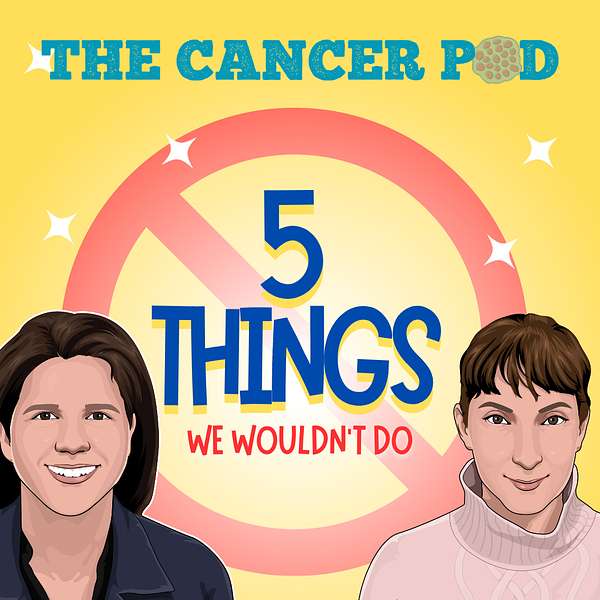
5 Things We Wouldn't Do During Treatment
Use Left/Right to seek, Home/End to jump to start or end. Hold shift to jump forward or backward.
Some things supporting wellness are a great idea — if you're not in the middle of cancer treatment! Tina and Leah talk about some good-for-you, healthy, and usually risk-free things you should avoid while getting active treatment. Avoiding anything that may undermine your treatment success is a top priority, so don't miss this one!
Become a member of The Cancer Pod Community! Gain access to live Q&As, exclusive content, and so much more! Join us today!
Check out our website! Looking for more information? We have blogs, merch, and all of our episodes listed by season and category.
Shop our favorite reads! We've joined with Bookshop.org to offer some of our fave books!
Buy our merch! Whether it’s a cozy hoody or a handy water bottle, we have something for everybody.
Have a comment or suggestion? Email us at thecancerpod@gmail.com
Follow us wherever you browse. We're always @TheCancerPod:
THANK YOU!!
What are we talking about today? Why am I talking about this stuff?
Tina:What? What's your point, Leia? I'm Dr Tina Kaczor and as Leah likes to say I'm the science-y one
LEAH:and I'm Dr Leah Sherman and on the cancer inside
Tina:And we're two naturopathic doctors who practice integrative cancer care
LEAH:But we're not your doctors
Tina:This is for education entertainment and informational purposes only
LEAH:do not apply any of this information without first speaking to your doctor
Tina:The views and opinions expressed on this podcast by the hosts and their guests are solely their own
LEAH:Welcome to the cancer pod Hello, Tina.
Tina:Hi.
LEAH:So I'm starting to get into spooky season. we're gonna talk about some things that might be considered scary to us.
Tina:All right, so we're doing an episode of what people shouldn't do during treatment, and that is scary in a
LEAH:It's scary. It's kind of spooky.
Tina:Knowing all that we know over 20, well, in my case, 20 plus years doing naturopathic oncology. In your case,
LEAH:I don't know, 10 something. I don't know. I don't pay attention
Tina:like 15,
LEAH:it 15? No, I don't know. I don't know. I, you know, I saw a post where somebody commented that 2013 was 10 years ago and they were like, yeah, it only seems like it was six or seven years ago. And that's kind of where my brain is like, I don't have any sense of time, but um,
Tina:Mine just conveniently. And you know, I graduated in 2000, so mine is kind of like self calculated every
LEAH:Yeah, you're a good round number. I am, I'm not, and the math is not my forte, so I
Tina:That's right. That's right. I forget you're a verse.
LEAH:I'm a ver a math averse. You should see me with patience. If I have to calculate something, I'm like, so sorry. But, um, yeah. So this is our, uh, It's not our, never have I ever,'cause I'm sure way back in the day, there may be things that we were like, oh yeah, that's not a bad thing to do. But, you know, information changes, treatments change.
Tina:We get smarter,
LEAH:Well, we get wiser.
Tina:we practice, you know, with practice comes some, you know, improvements. So that is what medicine is.
LEAH:And with practice, I think, know, we become more conservative.
Tina:Yeah, it's true. And, and it is, it is a funny word, practice because I think of it as literally that when people practice medicine and, that what that means is your clinicians practitioner of any kind is through time and observation, getting better at what they do. And so, don't discount experience. It's great to have young. People as practitioners'cause they know the latest and the greatest and the cutting edge. And, and then it's kind of nice to have someone who's been out a decade, two decades, maybe three decades, to uh, kind of bring in the things that aren't in print and you can't find on Dr. Google. nothing replaces experience anyways, that's in a grand gestalt of things.
LEAH:And so you, you definitely, I mean, I think we both do. We look at the risk benefit of everything that we do. And so there might be two people with the same treatment and we're not necessarily doing exactly the same things, based on their goals with treatment, their personal medical history, and all of that.
Tina:yeah. And today's episode is really about some things that you and think are risky. Too risky during treatment relative to the possible benefit, and qualifying this with during treatment. Because during treatment, you're trying to get a certain response from your treatment, whatever percentage that is. If it's, you know, 70% of people respond, or 90% of people respond to a given treatment. Great. What we don't want to do is lower that percentage, so we don't wanna take something that works 90% of the time and risk making that 85 or 70 or less. So the risk during treatment really is in getting in the way'cause in the studies, whether it's chemo or radiation, or even immunotherapy, the studies are done without any adjunctive integrative. Natural agents or anything like that. So we know those numbers. What we don't wanna do is ever even theoretically get in the way of success
LEAH:Okay, so let's start off. So what's the first thing that you would avoid with treatment
Tina:across the board.
LEAH:across the
Tina:Well, I would. Say avoid anything that boosts glutathione or taking glutathione itself.'cause there's supplements with glutathione in them. There's supplements that support glutathione and glutathione. Not to be confused with glutamine, which is an amino acid. Glutathione is. A means in our cells to rid them of some of the assault that's going on normally great out in the world today. I'm not getting treatment. I'm out in the world. I smell some smoke from the forest fires, glutathione within my cells helps my cells be healthy and detox, anything that claims to boost or increase your glutathione should be avoided during treatment. And I do have a hierarchy when it comes to this point. If you're taking radiation, absolute radiation works by. Creating oxidative damage and glutathione is a powerful antioxidant within your cells. So radiation don't take anything that supports glutathione during radiation. That's an acetylcysteine, that's lipoic acid, It's juicing. It's even taking your Vitamix or your juicer and throwing in greens and berries and nectarines or mangoes or whatever you put in your juicer and making a mishmash of. Highly colorful vegetables and drinking that during radiation. It's a big no-no, I think it could defeat the actual treatment. Glutathione is a very powerful antioxidant that is made within our cells. We create glutathione, and so whether it's a supplement or you're juicing, you are increasing your own production of glutathione, which could. Take away some of that oxidative damage that you need.
LEAH:It's the point. I mean, that's the, that's the point of, of radiation is to create oxid and, and some chemotherapies is to create that oxidative damage.
Tina:so that's why I say radiation is first a hundred percent of the time, don't do anything to support glutathione. Chemotherapy depends a little bit on which chemotherapy drug, and if you don't know one from another, which ones are working through oxidation and which ones are not, then I would say don't do it while the chemotherapy is actively killing cancer cells. And then with immunotherapies it's a little different. And immunotherapies, there might be some room for this, but I would take it on a case by case.'cause immunotherapies, there's a lot of different types out there. And that would be a case by case basis, but
LEAH:People don't always just get immunotherapy. Sometimes they do, but sometimes they're getting immunotherapy while also getting other systemic therapies, whether it's an oral pill or it's, you know, chemotherapy infusions or something. and that's what gets really confusing these days, is that it's not just straightforward. Treatments. It's, you know, it's a lot more nuanced.
Tina:Yeah.
LEAH:So interestingly, I had a patient ask, they've been using this patch that's like one of those anti-aging patches, and I'd never heard of it before. I didn't even know these things existed, um, to be honest. And they were gonna be starting treatment with radiation and. I said, well, let me look into this patch'cause I'm not familiar with it and I could find a lot of information online. But the promotional material for this product talked about it supports glutathione as part of this anti-aging process. And so they were using it for anti-aging, for, aches and pains and All of these other symptoms they were having that was unrelated to their cancer. And I didn't know if the patch did what it claimed to do, but it it claimed to support glutathione. And so that was a, no, that was a, that was an easy no.
Tina:Mm-hmm. During treatment, yeah, whether the patch works or not in that fashion, it's
LEAH:It It did. Yeah. It didn't matter even if it was, you know, just, you know, a bunch of hooey. And the other thing that the patch purportedly did was to support stem cell growth.
Tina:Another anti-aging kind of thing out
LEAH:Yeah. Yeah. So that would be like a number two type of a thing of not wanting to do when you have active cancer and going through cancer treatment is to support stem cell growth.
Tina:Right, because you don't know if we can differentiate between normal stem cells and cancer stem cells,
LEAH:Yeah. So that was a another way for me to be like, This other point that it's making.
Tina:not worth the risk.
LEAH:yeah, it's not worth the risk. And so this is something that we do as part of our job. It's not just kind of like, oh yeah, no, that's a great product. Or you know, like I spent a lot of time looking into this product and contacted the patient and they were really appreciative of the information, like the, and the time that I spent. So yeah, the stem cell thing. Was really interesting because there are more products than just patches that purport to do that.
Tina:Yeah, I think a lot of the things within the anti-aging community can be dangerous during treatment and even after treatment sometimes, Because of the characteristics of aging and the characteristics of cancer overlapping. So if you look in the hallmarks of cancer and the hallmarks of aging, you can see that there are similarities and we have to be careful that we don't help immortalize cancer cells along with our own.
LEAH:While, while trying to become immortal ourselves.
Tina:Yes, I don't, I'm not a huge fan of the anti-aging idea. I think we should just, Embrace aging and have more respect for the whole process, and maybe look to our elders instead of thinking that it's a bad thing. I mean, it's quite the, it's quite the gift actually.
LEAH:Well, I'm a, I'm a fan of, trying to age gracefully without doing anything that's,
Tina:Yeah.
LEAH:Because going through treatment, you really do feel a lot older, and I know I am older. My diagnosis was almost 10 years ago, so I definitely am older, but I always felt younger and now I'm feeling my age. And so yes, I understand the desire for anti-aging, but there are things that can be done that cushion. Cushion. The aging. It's not anti it's, it's just you're wrapping yourself in Bubble wrap.
Tina:It's not anti-aging. Okay. Okay. It's, it's softer aging.
LEAH:you go.
Tina:Aging gracefully. I like that. Because it's really important how you feel in your body. I mean, that's really it. You wanna live a long time with a lot of capability and enjoy life. I mean, no matter what, that's really the goal. It's not anti-aging so much as it is aging gracefully. Yeah.
LEAH:And, you know, we talked about anti-aging when I was, um, when I was a resident back at the naturopathic school. And there are things that weren't available at the time, but we were using things like fish oil and, you know, exercise or whatever. It was like there were a lot of. There were a lot of things that, treatments that we were doing that just seemed less spooky, less scary than what they, that is out there now.
Tina:Just supporting health rather than trying to, uh,
LEAH:Turn back time. It's really getting scary here. Um, okay, so, so number three. Is never would I ever take a probiotic during immunotherapy. And when immunotherapy first came out, we did give probiotics, certain strains of probiotics because you know, some studies had shown that it could be beneficial. So I remember There was an oncologist that worked at the cancer center who wanted their patients who were getting certain treatments to definitely take a certain strain combination of probiotics. Then dun, dun, dun.
Tina:Yeah, I think what happened is that fell into the unproven, right? So it was unproven at that time that probiotics would get in the way of an immunotherapy. Then there was actually evidence of people taking a probiotic and having worse outcomes and. Worse outcomes with certain checkpoint inhibitors in particular. These are those PD one inhibitors, checkpoint inhibitors. Maybe people have seen commercials for Keytruda or Opdivo. Um, but those, that's the drugs that we're talking about, they started to have some evidence that it was a bad idea. So now you went from an unproven and somebody makes an assumption when something's unproven. Those oncologists, believe it or not, were going without, they're, they're going rogue with no evidence to say that that was a good idea. They assumed it was a good idea. Turns out evidence was to the contrary. So now taking probiotics has been disproven for the most part until we figure out exactly which strains might work. And the reason for this is diversity within the gut. Diversity, meaning there's thousands and thousands of different types of bacteria. There's a plethora of diversity in the gut that leads to the best outcomes. So much so that. that it's very clear in the research that if they take an antibiotic which lowers the diversity in the gut, within three months of beginning one of these checkpoint inhibitor drugs, they have worse outcomes. And so I would actually have some patients who, out of necessity, took an antibiotic and now they're looking at immunotherapy. You know, being scheduled to do a checkpoint inhibitor. And I was like, when did you take your antibiotic? Was it a month ago? You know, like, can we stall a little bit more? And let's do everything to, to up the diversity in your gut before you even begin. We found this out the hard way, right? We just find this out through clinical trials and now we know. What creates diversity in our gut is a lot of different prebiotics. So, so you think about, Prebiotics are basically plant foods with various fibers that we can't digest. So it's everything from the starch in potatoes and legumes to um, beta glucans in some of the grains out there. so you really want to just eat a lot of very diverse plant foods, and that will feed the bacteria in the gut and that. Will then result in better diversity. So now you're giving a little bit of this, a little bit of that, a little bit of this, a little bit of that. you're supporting different strains and different types of bacteria, and that's your best bet. Again, the best results from a immunotherapy. So yeah. Antibiotic is the worst thing you can do. I mean, you do have to do it once in a while because antibiotics also save lives by preventing systemic infections. But if you can avoid it, great. Don't take a probiotic.'cause what that does is it limits the diversity because one strain or even 12 strains, it doesn't matter, they limit the diversity.'cause you're now promoting just those strains.
LEAH:And I think people also will take a probiotic. Because immunotherapies often cause diarrhea and bowel issues. And so sometimes that's a go-to for a patient or even a provider. A provider can prescribe an antibiotic and be like, oh, take a probiotic with it. Not thinking of the treatment that they're on. They're just like, okay, every time I prescribe a an antibiotic, I'm also gonna recommend a probiotic. and that's to prevent. Diarrhea that the antibiotic might cause. And so it's just it's hard. It's hard because it is one of those go-to supplements that people have,
Tina:and people think as harmless. I mean, even practitioners assume that it's harmless. The very earliest study, if some, if someone is really wants to dig into this, go back to the original studies on the PD one inhibitors. The checkpoint inhibitors in. The journal science in 2015, the first couple studies were coming out and it really showed how essential what and is inhabiting the gut has to do with how these drugs work. Like you have to have the right, and they're called commensal bacteria. We call'em probiotics or beneficial bacteria, but those. Little buggers that we had a whole episode on with probiotics in the past are absolutely essential to the drug working colitis, which is inflammation of the colon actually was associated with better outcomes from these checkpoint inhibitors. So when people had colitis, they had better outcomes. This was in metastatic melanoma specifically quite a few years ago. This is 2017 or 18. So we knew that sometimes in controlling the side effect, especially if it was with the. The organisms in the gut we were screwing around with. Then we could dampen the effect of the immunotherapy altogether, which is ultimately what this is. This conversation is about like, great, you can lower a side effect. Is that a good idea? Do we wanna do it in that fashion? And this is one of the things in my mind, when something lowers a side effect of any treatment, chemo, radiation, immunotherapy. That is one, I think to myself, is it lowering the side effect because it's lowering the effectiveness of the drug across the board, or do we have proof that the outcomes are the same and we're lowering the side effect? That's what you want. You want proof that once you lower the side effect, the outcomes haven't changed. That's, that's the goal.
LEAH:it's such a dance because if the side effect is severe enough, the treatment will be stopped. And so I have seen patients who could no longer get their immunotherapy because of severe autoimmune colitis. Or you know, or a rash or whatever it is that that happens because of the action of the immunotherapy, the side effect is so severe, so you kind of want to support against the side effect without completely dampening it as you said.
Tina:it is. and that's why the risk versus benefit is a pretty much constant mental exercise along the way. What is the risk? What's the benefit? What's the risk? What's the benefit? I mean, the benefit is being able to continue a drug that has been working for you to to limit the growth of your cancer, to eradicate it, if that is the benefit, but you gotta stop that treatment because your colitis is so bad, then it's worth the risk. Right. It doesn't, nothing is black and white. It's not, it's not like that we're playing percentages. We're like, oh, there's less overall response, but it may be worth the risk if the alternative is stopping the treatment. So yeah, risk benefit is a constant mental exercise throughout treatment. And you should have people you're talking to that know these risks and benefits. You as a patient are not, or should not need to be. Knowing the actual data, your job is just to bring up the conversation and to weigh it out and to use your own judgment. I think a lot of it is guided by the patient these days.
LEAH:Um, and that's always my concern with when people get recommendations when they go to a health food store. You know, like the person isn't familiar with all of the. Types of treatments and can make a recommendation. And that's always my fear when I tell patients, okay, go pick up a prebiotic and make sure it doesn't have this, or you know in it and you know this is what you're looking for. And there are products that have prebiotics and probiotics and so I tell them, if someone tries to steer you away from what I recommended, just be like, no, my naturopathic doctor told me this is what I need.
Tina:Yeah. It's a lot of information to kind of put in the hopper. Parse out and come out with a risk benefit. That's clear. that's why I say even theoretical risk is too much risk especially if, or you're getting a treatment that is otherwise curative, right? So let's just say you have a type of lymphoma that is likely to be cured with chemotherapy, or you're getting a checkpoint inhibitor and there's a certain subset of people who. Are cured with that checkpoint inhibitor with that given cancer. The benefit is so great. That zero risk really is, is your goal with the, when you're looking at cure,
LEAH:So what about probiotic foods?
Tina:I'm a little more liberal with that. I think Probio foods, I. Are more likely to be beneficial in that they're not high dose and creating a high population of a single type of bacteria. So, you know, like you take Lactobacillus Gigi, That's just one bacteria that's different than eating keefer or, and it's one, it's a much lower population in the actual foods, much lower population, whether it's sauerkraut or keefer or kombucha, it doesn't matter. so I don't think you, you're gonna seed the gut with singular populations when you're eating foods'cause it's more of a, a gentle nudge than it is seeding with a single strain.
LEAH:And then I have another. What if, um, what if a person is told to take. An antibiotic with treatment. Is there anything that you would recommend to help reduce the risk of having, antibiotic induced diarrhea?
Tina:I think the safest thing to take is the, smis Boer. How do we pronounce that? Is it bdi? Scro,
LEAH:I say croce B or sacro B.
Tina:Crobe, we'll just stick to that.
LEAH:Just take the out of it.
Tina:Yeah. the name brand that did most of this primary research is Flora Store and it's known worldwide actually as a probiotic. And I'm gonna put that in air quotes,'cause I don't think of it as a probiotic, but that's what they call it on the shelf and people will refer to it as, but it's not an inhabitant of the gut. Probiotics to me, I'm thinking of organisms that are actually inhabiting the gut and staying there and setting up camp right, and, and kind of creating our own little, uh, incubator in there of our various bacteria. Croise B is, um, technically it's a type of yeast and it's transient and what it does, it has been well proven to lower incidences of diarrhea from. Antibiotics, and in my experience, it has worked for this, but it does not take up residence. So it kind of goes through, it influences the gut, but it doesn't take up residence. So I'm less concerned that it's gonna overpopulate because there for maybe a week and then it's gone.
LEAH:Yeah. I think of it as, or how I learned of it is it crowds out the bad guys. It's often recommended for people who have had treatments, you know, all of the heavy antibiotics to get rid of c Diff, and so that's how I think of it, is it helps to crowd out all the bad guys, and so it's the bouncer. It's the bouncer in your gut,
Tina:Yeah.
LEAH:and that's how it helps to reduce the risk of, diarrhea.
Tina:Yes. Yeah, and generally it's short term and it, again, this is a risk benefit. If someone doesn't need to take it. I wouldn't have someone take it prophylactically because diarrhea is a side effect. I would say, okay, you have to take something. You're taking an antibiotic and you get diarrhea. Then I would institute it, because again, you're always looking at risk benefit and you don't wanna do any more than you have to during treatment,
LEAH:All right, so. We're gonna take a quick break and when we come back we're gonna continue with our list of five things we'd never do during treatment. All right, we're back. So recapping what we talked about, we've covered five things we'd never do during treatment, and number one was support or boost glutathione. Number two was supporting stem cell growth. number three, taking a probiotic during immunotherapy. So what would be number four on your list, Tina?
Tina:It kind of goes alongside the glutathione. It's anything that promotes itself as detoxification. Across the board. Now, I'm gonna put a caveat to this, because sometimes with chemotherapy, the chemo is acting very short term. You know, some chemos go in and out and they don't work very, very long. Like five F U comes to mind very short acting. So you can dance around the chemo and do some detoxifying, do some clearing out when the chemo is not at a dose that is therapeutic. But I do that per chemo, per drug. Look at the half-life, look at what's called the area under the curve. So there's a little bit of know-how and, and dancing around chemo. So if you are getting chemo, um, you can talk to the doctor, you could talk to a pharmacist. You could have a naturopathic doc or some other practitioner who knows this stuff work with you and you can detox around it or you could just abstain and do it afterwards. If you don't have anyone who can look at that drug and. Help you.
LEAH:And I don't do that with my patients. I do not look at half-life or any of that. I look at that as, Nope, let's not do it at all. So I'm a lot more conservative. That is not something that I did when I did my training. We would look into that, but since then, I'm like, I don't wanna mess with the function of the liver enzyme. Some of it doesn't, it's not just like, oh, you're speeding up or decreasing the liver enzymes in that moment. Sometimes it's, it's a longer term, so I don't even go there. That's not my, that's not my way of practicing.
Tina:Yeah. Yes. And again, I'm an, I'm seeing outpatients. You're an inpatient, you're at a hospital setting.
LEAH:Well, they're not, they're not literally inpatients, but yeah, it's an outpatient clinic within a hospital. Yeah.
Tina:so I think you're more conservative in the general scheme of, of interactions
LEAH:I have had patients ask about infrared saunas, which depending on their treatment, depending on what's going on, I either say yes or no. So, and those are considered detoxifying. are your thoughts on those? I.
Tina:Um, again, I think it would be, I. Case by case. infrared saunas do increase blood flow and they increase sweating, which is more of an elimination pathway. And we have a whole episode on detoxification where in my mind those are two very separate things. Elimination is excretion, whether you're pooping, peeing, sweating, or breathing out things. and detoxification to me is an intracellular. Event, whether it's in the liver or other cells in your body. So detox to me is getting, pumping things outta the cell like a, A very efficient detox is when the cells pump drugs or other compounds. It could even be pollutants, it could be heavy metals that goes into the cell, that the cell actually reacts by creating more exits for it and helps pump those things outta the cell like that. That's detox to me. Infrared saunas, I think increase elimination. Through sweat. and they increase circulation, but only to a certain degree, as in, a certain amount of penetration in the infrared. So I probably would, not do infrared saunas during treatment of any kind. Um, it's also a little bit of a stressor on the body. So if you're doing radiation, I don't think it's gonna be helpful. It's gonna be more tiring. if you're doing chemo, I probably would abstain for a few reasons. don't think changing the circulation in the sense of an infrared sauna is a good idea during treatment. Again, I might treat it like other detoxes where I dance around the chemos, you know, and I call it dancing.'cause you're literally doing it. You're stopping it, you're doing it, you're stopping it according to the drug actions. yeah, so I think I, it's kind of in the middle ground. It's kinda a gray area, case by case.
LEAH:And that's how, that's how I've addressed the infrared sauna question when I get it, is if their treatment is earlier in the week, then I, I'll say, you can try doing the infrared for a very short period of time on the weekend. Space it out. I wanna see if you're, it's gonna create a rash from the heat. You know, there, there are all of the different, possible side effects that potentially could be increased. And so I do that, not necessarily thinking about half-life, but just like, let's space it out. So if you do get a rash from the treatment, we know it's different than if you're getting the rash because the infrared is increasing circulation and heat.
Tina:Right.
LEAH:So we're up to our number five. We, I wish we had a drum roll. We could insert a drum roll. Drum roll. Number five.
Tina:A little bit of a cheat on our part in that. It's a double negative. I would never not get a second opinion about my treatment. I.
LEAH:So for those who that who are confused by the double negative, get a second opinion. It's okay.
Tina:Yes, get a second opinion. I think it's always a good idea to get a second opinion and get a second opinion outside the clinic of your first opinion. Ideally, go somewhere that's either an academic center, a larger city, community clinics, and I've Been to many community clinics, they are not cutting edge. They are wonderful because they serve the community, they give great care. And the, and the cutting edge down the road might do exactly the same thing as your community clinic. But what you wanna know is that that's true. And so I think a second opinion is always a good idea. It doesn't have to be the biggest of the big, it doesn't have to be MD Anderson, you know, but just go to a larger. City center. because the volume, so what happens in the cities, and so this isn't just to say city versus rural kind of thing. It just happens to be that in community clinics, many medical oncologists see all types of cancer, you can't be a specialist in everything. Where in the big city, there's so many people that the oncologists only sees. Fill in the blank. That cancer, it could be breast cancer, it could be colon cancer, but that medical oncologist only sees that type of cancer all day, every day. It's just a matter of numbers. And again, it's a medical practice. And so when you do the same thing over and over and over, you're gonna be more nuanced about everything and you're gonna have your ear to the ground if that's all you have to focus on. So yeah, get a second opinion.
LEAH:So do we have a take home message?
Tina:Don't take a lot risk during treatment.
LEAH:So cancel that. Uh, parachute jump. Solo parachute jump. No, maybe not. I don't know. Depends on the risk, you know.
Tina:Depends on the benefit.
LEAH:Depends on the benefit.
Tina:If it's something you've always wanna do,
LEAH:Yeah. You know, do that bass jumping. Um, so Tina, we have a song. We have a we have a song. Oh,
Tina:you're so good at this.
LEAH:I'm so,
Tina:You are
LEAH:I'm so, last minute with this. All right,
Tina:what? Doesn't matter. Everyone's good at something.
LEAH:I'm a dj. I'm I'm a, I'm a I'm a closet D closet. I'm a DJ and a closet.
Tina:Literally. Yes.
LEAH:Literally. So, uh, the song for our unofficial theme song for this episode, which can be heard on our Spotify playlist, and we'll put the link in our show notes, or you can go to our website and I think it links there too. I will put it up there if it's not. our song is never by heart.
Tina:Excellent. Who doesn't love heart?
LEAH:Heart's a great, great band, and if you've never heard of a heart, well go out there and listen. And, I, I wanna give a shout out to some of the places where our listeners reside. I was kind of joking. This is like romper room, which I'm sure a lot of people are like, what the heck is romper room? But The woman who was the host of the show, it was a show for little kids. She'd hold up a mirror and she'd say, I see Janie and Timmy, and she'd name everybody's name. So now I'm gonna hold up the mirror and I see people in Brooklyn, New York, and in Amsterdam, Amarillo, Texas, Columbus, Ohio, and Fergus, Ontario. Thanks for listening.
Tina:That's awesome.
LEAH:That's my best rom for room.
Tina:That is one of the nicest things about the podcast and one of the main reasons we've done it is to reach as many people as possible and it's limitless. And the idea of that is just,
LEAH:Oh, it's mind blowing.
Tina:It is, it's a mind blowing concept when you think about it. you know, even if you only reach a few hundred people, you're still reaching way more than you could otherwise. So thanks for listening.
LEAH:Yeah, that's why we do what we do and to everyone out there listening, follow us or subscribe through whatever podcasting streaming app that you listen to us. Leave a review, a rating.
Tina:Yeah, and our new website makes it super easy. Just go to our website and at the very top you'll see a tag that says reviews, and it says, help us, help others. And so that's it. That's all you have to do. You know, I. I feel like it's a little obscure on Apple Podcasts, how to leave a review. So just click on our website and at the very top you'll see reviews and yeah, guess a little, a little love there. And um, that helps other people find us too.
LEAH:on that note, I'm Dr. Leia Sherman,
Tina:And I'm Dr. Tina Caer
LEAH:and this is the Cancer Pod.
Tina:Until next time.
LEAH:spooky season.


Podcasts we love
Check out these other fine podcasts recommended by us, not an algorithm.

Natural Medicine Journal Podcast
Natural Medicine Journal
Five To Thrive Live
Talk 4 Radio
Huberman Lab
Scicomm Media