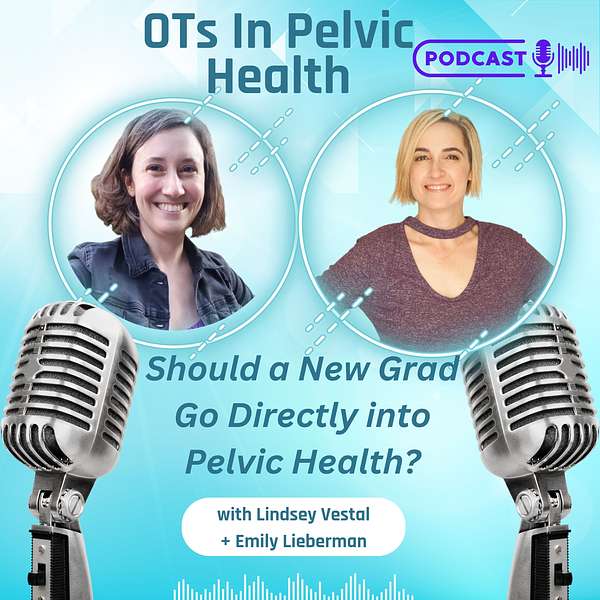
OTs In Pelvic Health
Welcome to the OTs In Pelvic Health Podcast! This show is for occupational therapists who want to become, thrive and excel as pelvic health OTs. Learn from Lindsey Vestal, a Pelvic Health OT for over 10 years and founder the first NYC pelvic health OT practice - The Functional Pelvis. Inside each episode, Lindsey shares what it takes to succeed as a pelvic health OT. From lessons learned, to overcoming imposter syndrome, to continuing education, to treatment ideas, to different populations, to getting your first job, to opening your own practice, Lindsey brings you into the exciting world of OTs in Pelvic Health and the secrets to becoming one.
OTs In Pelvic Health
Should a New Grad Go Directly Into Pelvic Health?
- The first ever Trauma-Informed Pelvic Health Certification by Lindsey + Lara
- Pelvic OTPs United -- Lindsey's new off-line community!
- Get Lindsey's 9 page OTs Map to the World of Pelvic Health.
- Meet Lindsey on the OTs for Pelvic Health Facebook Group!
- Check Out More OT Pelvic Health Content here.
- Find Lindsey on IG! @functionalpelvis
I was joined by Emily Lieberman for this episode. We talked about:
1) What advice would you have for other students who have identified this interest and may be considering pursuing a pelvic health position directly after graduation?
Emily talks about being a generalist vs specialist and that there was not not one right path to get there. We are not in an escape room - we are growing a garden.
A little more about Emily Lieberman:
Emily is a native Michigander, mom of two, and lover of chocolate chip cookies. Her favorite meal is brunch, her favorite word is “whimsical” and her favorite leisure occupations are thrift shopping and losing track of time in nature. Emily came to OT as a second career and has a previous master’s degree in Educational Leadership; her prior work focused on adult education, coaching and organizational development in community and higher education settings. She became interested in pelvic health through her own experiences as a client, and she is particularly motivated to extend trauma-informed care to those who have had difficult experiences in healthcare as well as folks who are trans and nonbinary. Emily graduated in August 2023 and accepted a full-time position in outpatient pelvic health as her first role as a practicing OT.
____________________________________________________________________________________________
Pelvic OTPs United - Lindsey's off-line interactive community for $39 a month!
Inside Pelvic OTPs United you'll find:
- Weekly group mentoring calls with Lindsey. She's doing this exclusively inside this community. These aren't your boring old Zoom calls where she is a talking head. We interact, we coach, we learn from each other.
- Highly curated forums. The worst is when you post a question on FB just to have it drowned out with 10 other questions that follow it. So, she's got dedicated forums on different populations, different diagnosis, different topics (including business). Hop it, post your specific question, and get the expert advice you need.
More info here. Lindsey would love support you in this quiet corner off social media!
Lindsey Vestal Today's episode is Should a new grad go directly in to Pelvic health? I am joined by no other than Emily Lieberman to have this conversation with today. She is a recent grad who just got her first job in Pelvic health and she's from Michigan. She's a mom of two and a lover of chocolate chip cookies. Her favorite meal is brunch. Her favorite word is whimsical, and her favorite leisure occupations are thrift, shopping and losing track of time in nature. Emily came to what, as a second career, very similar to myself and as a previous master's degree in educational leadership. Her prior work focused on adult education, coaching and organizational development in community and higher education settings. Now, Emily became interested in Pelvic health through her own experience as a client, and she particularly was motivated to extend trauma informed care. To those who had. Difficult experiences in health care, as well as folks who are trans and non-binary. Emily graduated in August 2023 and accepted a full time position in outpatient pelvic health as her first role practicing as an O.T.. I can't wait for you to hear today's conversation.
Lindsey Vestal New and seasoned OTs are finding their calling in Pelvic health. After all, what's more adult than sex, peeing and poop? But here's the question What does it take to become a successful, fulfilled and thriving OT in Pelvic health? How do you go from beginner to seasons and everything in between? Those are the questions and this podcast will give you the answers. We are inspired OTs. We are out of the box OTs. We are Pelvic health OTs. I'm your host Lindsey Vestal and welcome to the OTs and Pelvic health Podcast. Emily, thank you for.
Lindsey Vestal Being here and thank you for being a guest on the OTs for Pelvic health podcast. I'm really excited about our conversation today.
Emily Lieberman Thank you so much for having me. Lindsey This is amazing and I'm so thankful to you and all that you do for our community. So it's very, very much my pleasure to be here.
Lindsey Vestal I want to talk about something that I think we don't hear enough as students and even as new practitioners. And where I'm going with this is that I know firsthand that you had an interest in Pelvic health even before you started school, and I can absolutely relate. I was in the same shoes. In fact, I knew Pelvic health was what I wanted to do. I just didn't know the vehicle that was going to take it was either going to be what school actually I didn't even know about at school, so I had applied to school. And while I was getting in my volunteer hours, the director put me with an o. T because the p t I was following called in sick that day. And so therefore I discovered O.T. moving forward, changed my world, Iraq's my world for the better. I completely withdrew my applications and I applied to O.T. School. So just like that, I know you were also drawn to Pelvic health, and I'd love to know, Emily, what advice would you have for perhaps other students who have also identified this interest and may be considering pursuing Pelvic health directly after graduation?
Emily Lieberman I love this question, and I could talk about this all day, but I will try to boil it down to some nuggets. One is definitely recommend like first and foremost to connect connect with other teachers who are in public health, who are interested, who are interested in sort of adjacent topics that a person might be passionate about, of course. And join the OTs through a public health Facebook group. It is my favorite place on the internet. Really. Like often the only reason I'm even logging on to Facebook is to see what is going on in that group. And then through that and through other ways that you can connect with people. I also highly recommend to find other people in your geographic area, even if it's on the state level. Like there are people that I've never met because they might practice in different regions of my state that are far away. But just knowing that, okay, there are other Michiganders who are doing this, especially in the early stages for me was really meaningful. And then some of those people subsequently I have met like at a conference that I presented at one of my and I consider her a friend now from the group came to my presentation and was like my biggest cheerleader. So I think that is incredibly valuable for learning more about the field and just feeling supported, feeling like you always have people who have your back. And I think that this is a great thing to do. I would say also like it doesn't have to be a rush, but over time can connect with people in adjacent professions as well. So depending on sort of the population or topics of interest, like maybe that's midwives, doulas, lactation consultants, because you know, you have an interest in like perinatal and postpartum care, or maybe it's even if there are not specifically other options, right, in your city or town who are in some type of pelvic health. But there are Petey's who are there doing that work to meet them, to, you know, shadow just connect, I think especially. One thing that I didn't maybe appreciate as much earlier on is that the barrier to entry for doing that is so low. As a student, everyone is just really happy to help a student or almost all people. And so you can just cold call or cold email and ask whatever your ask is, and then those people can be in your network and resources to you later on. So that would be my number one. Number two. And this is something I know you talk about, Lindsey, is to really think about there is no one correct path. And so like in my case, out of the second career, I'm already not sort of the typical like in my program, I was one of very few students who were significantly out of undergrad and that was okay. Like, I didn't feel badly about that. It kind of already got in my mind that there's not just one way to go about this, but it also does kind of creep in at times, especially if you happen to have a few examples like other people that you know or in your community that starts to kind of create the mold or the archetype in your mind like, that's how you go about it. And to sort of start to feel like, it's a game that I have to play or a puzzle that I have to solve. And I see a lot that people ask these questions like, Well, which course should I take? Should I take this course or that course? Or as a student you're thinking about, should I have a field work in this area or that area? I have to make the right decision for this. But it's really not like that in reality. And so I kind of came back to this idea of, you know, my life and my career are not an escape room. There's no single solution. There's not a timer. And so rather than thinking of it as a game that I'm playing, think of it more like maybe a garden or a rock garden that I'm setting up and it's evolving over time. And I could maybe just have one big buck later, like have some plants or put in the gravel over here. In my case, being a second career person or there were already these trees growing here and that's great. I don't have to uproot them because they have a value to what I what I bring to this from my previous experiences. So that would be my second thought. And then the third is almost related in terms of like having a guiding idea, having a plan of sorts, but also being open to that evolving. And this could seem kind of contradictory, but I don't think that it is, which is to be kind of working with that balance between, on the one hand, be patient with your education. Hey, trust the process of why it is valuable to be trained as a generalist and on the other hand, to take the initiative to feed those parts of you that are passionate about a particular population, particular intervention approaches or diagnoses or whatever it is that really lights you up. And knowing that if you don't take some action to kind of feed that hunger, it might not happen. So not everything is just going to sort of be served up to you in the setting of school because we have a really, really wide scope of practice. And that's a great thing about your profession. But it means that probably everyone has things that they wish would be covered more or would be covered less so. I think they take giving it time to unfold, soaking up the experience and being patient, knowing that. There may be moments of being frustrated and that is okay. We can have critical conversations sometimes about what we might like to learn more about or how things are covered, but really that there is a method to this. You will be happy when you are passing your biscotti that you paid attention to everything. And going back to why it is important to connect. I think the more time that I speak for myself that I spent saying that it is for Pelvic health Facebook group or speaking with others, the more then I saw like, these concepts or these things that we did that didn't seem like they are directly related or actually very related. And this is how it brings such a great value to this field. Then kind of the flip side of that being proactive and looking at, okay, well, this is the grower, the ones your water, what can I do to take opportunities or create opportunities to dive into these interests of mine? And deep in my understanding. And so for me, that would kind of fall, I think, into three categories, which would be in school, out of school, but during school and then field work. So like I know programs vary. My particular program, there were quite a few class projects, research projects, and we often didn't actually have a lot of choice. Like you might have had to choose a topic off of the list. So I would just try to choose whatever seemed like gave me the most joy or spark. And there were some things that I did get to pick a topic, and so I would just try to find getting a good friend, but also depth like I did to be pretty big projects in school about trauma. And that's incredibly relevant, as you know, and talk about. So that would be one way to get to it's like scratch it and do this thing that you're really excited about out of school. I think it can happen. And I'm certainly guilty of this at times like burning the candle at both ends, trying to study everything you need to study, be there for your projects and all. I want to take out this continuing education or I'm preparing this in presentation at our state conference. I don't I don't regret having done any of those things, but sometimes it did make me feel spread a little bit thin. So I recommend exercising moderation here. But you can make strategic choices about if you're not learning something that you wanted to learn. There's probably a way that it's within your reach. Not too expensive to be able to do this, especially with how much is online now. And then the third with field work. So we didn't have choice. In our level one field works, but for a level two, we got to like rank our preferences and being geographically dependent, I didn't have the whole world at my disposal. I would have loved to have done a pelvic health specific field work, but at the time that this was all getting put together, there wasn't really someone within a radius that I could drive to reasonably, who could have been my C.I., or at least that I was in contact with. So I didn't have a pelvic health field work too, and obviously it worked out for me. I got a great job, which I'm super excited about. So that is not absolutely required and I was really happy with what I ended up with. I did outpatient neuro and inpatient cute, and in both of those settings I got a great broad exposure, which was really enjoyable and informative for me. Public health is not the only thing in the world that I care about, but also within each of those, there was a lot that I was able to put on my resume. I talk about in an interview that that was highly applicable. So I would say be intentional with field work. Think about different. Advantages that different sites could have for you, but don't feel like everything is riding on that 1 or 2 experiences. And those would be my top tips.
Lindsey Vestal Way to bring it all together. I feel, Emily, like everything that you said was so intertwined and so connected with the myriad of feelings that we are that we that we have as students. The roller coaster of emotions, of wanting to have such a clear, direct path to get there. And I just really have to stand back and thank you for even someone who also it was my second career and now it's been been some time since I have graduated. There's so much that you said that I would have been able to derive so much value from as a student and actually now as someone whose whole focus is to support my students, whether they're new grads or seasoned practitioners, into, you know, getting into pelvic health, there's so much richness there. And I just want to take a quick second and kind of reiterate some of the things that I really heard that was really impactful specifically for me, which was reminding us as students and really I would go so far as to say even non students, is that being a little bit bold and brave and asking for what you need, whether that's an opportunity to volunteer, to have a conversation, to kind of pick someone's brain about their career choices, you know, fortune favors the bold in many cases and kind of stepping out of your comfort zone to to really help to understand another's path is so helpful. And I definitely agree that people are extra forgiving of students. So anyone listening that that can relate to, I hope that that resonates with you. I also really love this idea that as students were not in an escape room, and I think that's also very true for our entrepreneurs listening to this. Sometimes we do get in this frenzy of, gosh, if I don't figure this out right now, my life is going to take an entirely different trajectory into this idea of it being more like a garden and planting seeds is a much more even. Just picturing the two in my brain, an escape room next to a garden. My nervous system has vastly different reactions and even visual imagery as I imagine myself in both scenarios, and I'd much rather be in the garden. So recognizing we have a choice in how we're perceiving these situations was very powerful. And then of course I love this idea. There's not one way to for our career to develop. I would have never guessed that I would have had two careers in my lifetime, and the second one would be so much more vastly fulfilling, reminding ourselves that we have a flexible, evolving plan. And you know that that, you know, sometimes you're introduced to new things at times when we may not expect it. And that is exactly, exactly what we needed to hear. So beautiful. So beautiful. Emily, thank you. Thank you for those observations and for sharing that. And also thank you for sharing just how impactful a Facebook group has been for you.
Emily Lieberman Well, thank you, Linsey. It has just made a huge difference.
Lindsey Vestal And I do have to say, and this is a bit of a shameless plug, but it's really on my mind, and we were actually just talking about it before we went live, which is, you know, I remember back in 2014 when I or 2016, when I started the Facebook group and it was crickets for a while. Here it is, October 20th, 23. We have nearly 6000 members and it is such a source of community and connection and it is so supportive. I'm just so proud of our community. But I will say that I sometimes find myself wanting a quieter space. 6000 people is is is the size of probably some rural community larger than some rural communities. Some of our listeners may be joining from. And so as we know it can get a little bit loud. And I have recently started something called Pelvic OTP United, which is an off social media community that is for pioneer graduates. So when people graduate out of my introductory program, they're invited to come into this. And it has been definitely it's very new, but it's been a source of even more intimate solace. So I'll put the link in the show notes, or you can always reach out to me and ask if anyone is interested in learning more. But I definitely think community is. That's another thing you said and you know, the aspect of community is so incredibly enriching for figuring out and confirming the path that we're going on or perhaps helping us navigate a new one. So whether that's joining my community or any others that you find enriching, I think that's such a key part of the puzzle. Emily all.
Emily Lieberman About it.
Lindsey Vestal So I'd love to know, you know, you went straight into Pelvic health after after graduating and you have now gotten your first job. Congratulations. This is huge and fantastic and a culmination of so much of your work. And I'm curious, did this require you to step outside of your comfort zone? And if so, I'd love to know how it ended.
Emily Lieberman Lindsey and I will be honest, that actually surprised me. Not that there could be some stress with a job process. There's always that. But I think really how challenging it was at times because like I said, this was my second career. I felt like I had done this all before. And so it was a little bit confusing that it was feeling so outside my comfort zone, like starting to do that networking in my area and working on my resume. Just how how am I nervous system was getting keyed up. And so I was just listening to your podcast, the one about five things to recenter yourself when there's been a setback and I like pulled the car over to take out my phone, rewind and write down this quotation because I felt like it resonated so much. You had said, I think right after a setback and I quote, Keep going until you achieve what it is that you're aching to achieve, end quote. And it was that word aching that felt like it really connected because that was how I felt when I was on this job. I don't call it job search. Like, there's just is jobs laying in the forest searching for one. But this job process, this career development process, it was it was aching. I felt like I really wanted this more than I wanted any other job or opportunity prior to that. Like, it wasn't just that I needed something to do with my time in a way to pay the bills. It was that I really wanted to serve my community in this particular way that I have been working on for quite some time. And so it was a little easy, I admit sometimes for that to kind of cycle and transform itself into this feeling that the stakes were really high and that I needed to show up for this and stick the landing. And this is the moment and doing some tasks that I didn't always savor. Like I love to connect with people. I talked about that, my very first piece of it. But when I was in that space where it felt a little higher stakes of my life, I sure would go. Email to someone that I want to have a conversation with at a place that I'm thinking about applying to a job there and starting to get a little bit stuck in the wording right and re-editing and having to say, you know, this is good enough, Emily, you have to hit send now. And what I my first attempt strategy to get unstuck was kind of feel like boost your own confidence strategy. So to just try and summon some kind of confidence within myself and say those affirmations and that this would just get me in a better place. But it wasn't really working, to be honest. I felt like that was taking a lot of emotional energy and almost felt like invalidating for my own self. The fact that at least for me, this was challenging. Like they said, everyone is on their own path and they're on their own journey and everyone has their challenges and stresses at this point. It just happened to be that I was trying to do something that I didn't have a lot of examples for like close to me. So I had other peers in my program finishing up and not even everyone has gotten jobs yet and that's totally fine. Like, again, everyone on their own path. But we have the group chat and people start putting in like, you know, I'm going to continue on with where I was doing my field work or I get all created a profile and indeed, and a recruiter reached out to me and now I'm going to work at this place. And I was doing something that felt really different, like trying to apply for jobs that might not even be posted for O.T., trying to apply for this sort of specialty that I hadn't always even been fully encouraged towards in terms of that, you know, new grads out of school can do this. And so I eventually just started saying, you know what, It's it's hard to do hard things. And some of the time it felt like it came with a sense of ease. And some of the time I just did the thing even when it didn't feel very good. And so going with more of that, like acceptance and commitment therapy stance, that there's a bigger picture to why I'm doing this, even if it's not comfortable all of the time. If it's even if it doesn't feel good in every moment. I am going to take these actions in the service of moving towards this thing that I really believe in and that is really meaningful to me. And there were lots of parts that were really fun. Like I actually really enjoy interviewing and my interviews were all really fun. It was just some of those, some of those pieces that got a little bit sticky. So yes, that was how I handle that.
Lindsey Vestal Thanks, Emily. I am thinking very much now after hearing more about these lessons and everything that you're sharing with us about the episode with Kelsey Mathias, about whether or not you have to be an entrepreneur in Pelvic health, and she said something really similar. So I think that was episode 64 and she said something really similar. She said the models around her who are already in Pelvic health when she started her career were were entrepreneurs, and she felt like this was the only way to do it. You know, there weren't many jobs readily available for OTs. We certainly weren't listed in many job posts. And so the models dictated to her. This is this was the path. And she tried it because that's what she thought she had to do. And once she did, she realized it was not for her. And so all the humility that comes along with reinventing yourself and realizing that you have to kind of pivot and take a different direction. And it may have not been a path that she was acutely familiar with or had many examples of, but she had to kind of dig deep and follow that and follow her path in that. And I'm hearing a lot in in your in your same wisdom that you're expressing there. And I think these are incredibly important thoughts that we could continue to reiterate because while those of us in Pelvic health are fairly comfortable with taboo topics and don't shy away from things that are often under-discussed, I don't think we're talking about this aspect nearly enough of really like digging deep and following our own path and being able to pivot when something inside of us is telling to do so. So I really I really appreciate all that you're sharing with us about that.
Emily Lieberman I love that episode so much. I think I have heard almost all of them and I think it is my new favorite. I also pulled over and took notes from the interview with Kelsey because. Even though it's a different story. I did really feel like. A lot of overlap with her experience. And I remembered also something else that I wanted to say about Comfort Zone and working with that, which was that besides, you know, kind of mindset type shifts that I tried to make also, and this is going back to what I talked about earlier. Being able to call on my network was so important at that time. And I'll give an example, which was that my first interview, which I was just so excited for, also I had a like a phone phone interview, and then she invited me to come in in person. And part of that was going to involve doing an internal assessment. And the person who was interviewing me was the owner of the business. So of course I said, great, great. And then after the phone call, like, boy, okay, I can do this. I can do this. And there were things that I could go back to to review and get pumped about it on my own. I did take the Pioneers course. Amazing, amazing course. And so I went back to my materials from that. We watched some of the videos. Good Confidence booster. Also rewatched the I don't remember what we called it, like commencement address or something. And the pioneer of celebration, the kind of talk.
Lindsey Vestal Nerdy.
Emily Lieberman Graduation party. Yes. Because that was also very inspiring. And talking about like showing up to do this work and posted in the OTs Pelvic health Facebook group, I think there was a post about what do you have going on this week or what are you celebrating? Something like that. And I said, my gosh, I had my first interview and it involves getting doing an internal assessment and probably had some funny emoji. And lots of people commented, including you, Lindsey, Like, go for it, Emily, you're going to be great. Congrats. Blah, blah, blah. Which I didn't me like. I still would have gone and done it and would have been fine, but it was such a nice boost to just have that cheering section, right? That's why we have the fans at the game. And then I'm sure you remember you were so gracious and talked with me preparing for that. I think we were talking mainly about sort of like what I was looking for and valuing and then a little bit about prepping for that interview. And I also connected with that friend in Michigan that I mentioned and did more kind of line by line, like just what was I thinking about doing during this assessment? Okay, I think I'll start with this and bouncing ideas off of her, which was so, so helpful. And then because of circumstances that day, it didn't even end up happening that we did that internal assessment anyway. But by the time I was going to that interview, I was super excited for it and almost a little bit disappointed that it didn't pan out. So just an example of these little things that you plan along the way. We don't always know how exactly it's all going to play out, but that things come back around. And the more that you have kind of woven that network and support system, then those people are happy, thrilled to show up for you in those moments. And that, to me, kind of felt like a full circle. And then I'm hoping that after a while here, I will start to be able to be that person for someone else. And this is a way that we all loved each other up 100%.
Lindsey Vestal You are you. I'm sure you already are that person, Emily, to people that that you don't even know. In fact, everyone listening to this podcast is stepping up and sharing all this. Even actually before your official first day. You got the job. You haven't started yet. You're already giving back. So thank you. Thank you for that.
Emily Lieberman Thank you, Lindsey.
Lindsey Vestal So I'm so curious, based on your experience, are there any kind of like lessons learned that come to mind that you would want to share with other occupational therapy practitioners who are probably in a similar situation preparing to apply for positions in Pelvic health for the first time, and then perhaps any tips specifically for new grads?
Emily Lieberman Yes, definitely. Again, I could talk about this all day, but I will try to boil it down. So. One little mini soapbox that I have is that I think sometimes there's a bit of. Negativity, but I think it causes self-doubt. Sally Talk that makes sense come from a real place within that whole kind of pelvic health OT genre that is a little bit like, well, we're in this one down position now. The history of who's practicing in public health and who's recognized and how the jobs are posted. And I definitely benefit from the fact that I'm doing this in 2023 and not 2013. The landscape has changed a lot. So I will say that much. And like feel like I'm kind of standing on the shoulders of giants and people who have done so much advocacy. But what I would say, I guess, is advice and especially for new grads, is to not be in a kind of expectation that this is going to be so difficult or you're it's all swimming upstream uphill both ways kind of thing. And so an example would be, okay, this idea of getting past the gatekeeper because the position is positive or not up to you like totally is frustrating. And it's a real phenomenon. And I would argue based on like. Career development principles, and I did some career coaching in my previous job that. It's not really the most strategic approach anyway to just be throwing resumes out in the nether and hoping that they're going to land on the hiring managers desk. I mean, there can be 100 reasons why that didn't pan out, besides how the job description was written and whether it referenced your specific degree or not. So. Even though it fell sometimes a little bit like, my hand is forced that I have to connect with these people directly rather than just submitting my resume. That's actually a good practice. And most of the interviews that I had, I didn't even apply. Like I had a conversation with someone there either who was the hiring manager or who worked in the setting. And then that led to me being invited to apply, which is ideal. That's how you would prefer for it to unfold. So not that that's the only way or always has to go that way, but I think reframing to say, let's make that personal connection and that will be good for all kinds of reasons rather than viewing it from like, I'm already on the back foot. Perspective. One big takeaway for me, another would be really keeping at the front of the mind, okay, they're hiring a person, not a resumé. It can be tempting to really. Think a lot about the specific qualifications and how they're worded and how many bullet points and which courses did I have or not have. And it's not that those things are not relevant or have importance, but like going back to my example of having gone and done these interviews, I was invited to interview before anyone had necessarily even seen my resumé. So they didn't even know all those points in all which specific courses I had taken. But because of the way that I had a conversation and told a little bit about my background, my interests, some things that I had done, and then asked good questions about their setting and what they do, then that established that I am someone that they would like to get to know more about and. There's always you want to be professional, you're presenting your, you know, yourself on a good day. But I think to bring your own self to it and show that which about you is unique, not just, okay, that I'm an T and we have this particular value that we can add, but we're not just o t. Is there something about multiple things about each of us that we bring? And so highlighting that and highlighting the relevance. Like I mentioned, I felt like I was not the typical candidate because I was older, but that was okay for me. I talked about what I had done previously and drew the connection to this work and people responded really well to that. For specifically new grads, I think. Really? All of that is applicable to new grads. But the other thing I think I would say is to keep the faith. I took the approach that I felt like I owed it to myself to really give it a full fledged good go to get a position, a full time position in pelvic health out of school, because that is what I wanted and that is what I had been working toward. And so I gave myself time to do that. And I told myself not everything is under our control. If this does not happen now, that's okay. I will apply for other positions and I will get something and it will all work out. I can do great work within some other setting I can do work with in some other setting that is relevant to Pelvic health. Again, coming back to that, it's not an escape room idea. So. Looking at it, not in a wishy washy way of like, okay, man, you know, give this a go. Really throwing the hat over the fence to say I'm full fledged going for this. But also knowing that one job application process is not all that we are. There's a whole lifetime worth that will continue to evolve out of this. And so, yes, those would be my my recommendations.
Lindsey Vestal Every single thing you said had me at the edge of my seat, because it is I, I know more than new grads will be listening to this episode. But again, just kind of reflecting on new grads and also where I am here I am in my in my mid-forties. And there's still so much Emily, there's still so much in what you said that is very applicable to, I think, every aspect of our journey. So I feel really, really honored to have this conversation with you today, knowing that there's so many aspects of it that are going to resonate with every listener, no matter where they are in their professional journey. So I am I am just so grateful for your time today and.
Lindsey Vestal Keep us keep.
Lindsey Vestal Us informed with how your job is going. We're so excited for you and we'll be rooting you on.
Emily Lieberman Thank you so much, Lindsey. It has been such a fun conversation. And yes, this you will hear more from me, I'm very sure. Yes. I wouldn't have it any other way.
Lindsey Vestal Thanks for listening to another episode of OTs and Pelvic health. If you haven't already, hop on to Facebook and join my group OTs for Pelvic health, where we have thousands of OTs at all stages of their Pelvic health career journey. This is such an incredibly supportive community where I go live each and every week. If you love this episode, please take a screenshot of this episode on your phone and posted to IG Facebook or wherever you post your stuff and be sure to tag me and let me know why you like this episode. This will help me to create in the future what you want to hear more of. Thanks again for listening to the OTs and Pelvic health podcast.
