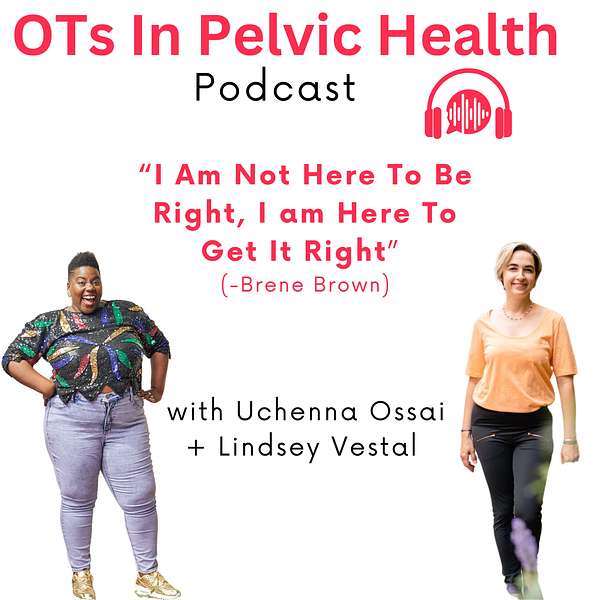
OTs In Pelvic Health
Welcome to the OTs In Pelvic Health Podcast! This show is for occupational therapists who want to become, thrive and excel as pelvic health OTs. Learn from Lindsey Vestal, a Pelvic Health OT for over 10 years and founder the first NYC pelvic health OT practice - The Functional Pelvis. Inside each episode, Lindsey shares what it takes to succeed as a pelvic health OT. From lessons learned, to overcoming imposter syndrome, to continuing education, to treatment ideas, to different populations, to getting your first job, to opening your own practice, Lindsey brings you into the exciting world of OTs in Pelvic Health and the secrets to becoming one.
OTs In Pelvic Health
"I'm Not Here to Be Right, I'm Here to Get it Right" with Dr. Uchenna “UC” Ossai
My guest Dr. Uchenna “UC” Ossai, is a sex-positive pelvic health physical therapist, sexuality educator and counselor. YouSeeLogic is her platform that focuses on improving the sexual intelligence of adults through innovative content and honest discussion that is free of judgement.
"I'm Not Here to Be Right, I'm Here to Get it Right" is a quote by Brene Brown that inspired our chat!
Resources mentioned in this episode:
- IG: Sex Positive Families
- Restorative Yoga for Ethnic and Race-Based Stress and Trauma by Gail Parker
- The Body is Not an Apology by Sonya Renee Taylor
- Pleasure Activism by Adrienne Maree Brown
- Better Sex Through Mindfullness by Brotto
- Anything by Bell Hooks + Audre Lorde
- All About Love by Hooks
- Love and Life
- The Political Determinants of Health by Daniel E. Dawes
- David William's Ted Talk
- The first ever Trauma-Informed Pelvic Health Certification by Lindsey + Lara Desrosier
- Pelvic OTPs United -- Lindsey's new off-line community!
Where to find UC:
- Her e-book "Sexy Swagger: A Guide for Reimagining Your Sex Life"
- IG: Youseelogic
- Her website
Pelvic Health Sexuality Counseling Certificate Program
____________________________________________________________________________________________
Pelvic OTPs United - Lindsey's off-line interactive community for $39 a month!
Inside Pelvic OTPs United you'll find:
- Weekly group mentoring calls with Lindsey. She's doing this exclusively inside this community. These aren't your boring old Zoom calls where she is a talking head. We interact, we coach, we learn from each other.
- Highly curated forums. The worst is when you post a question on FB just to have it drowned out with 10 other questions that follow it. So, she's got dedicated forums on different populations, different diagnosis, different topics (including business). Hop it, post your specific question, and get the expert advice you need.
More info here. Lindsey would love support you in this quiet corner off social media!
Lindsey Vestal I am so thrilled that you're here right now listening to this podcast. My guest today is UC Ossai, who is a assistant professor at University of Utah College in Health Department of Physical Therapy and Athletic Training. She received her clinical doctorate in physical therapy at the University of Illinois at Chicago and completed her residency in Women's Health and Movement Empowerment Science at Washington University in Saint Louis. Dr. Ossai is an American Association of Sexuality educator, counselor and therapist, certified sexuality counselor, and serves in the role as adjunct faculty at the University of Michigan School of Social Work Sexual Health Certification Program. Her clinical and research interests include sexual function in marginalized populations, particularly among black women and LGBTQ plus communities. She's also the creator of U.S. Logic, a sexual health platform for adults rooted in intersectional framework that focuses on improving sexual joy, pleasure and autonomy through innovative education and community building. I cannot wait for you to hear our conversation today.
Lindsey Vestal UC. Thank you so much for being a guest on the OTs for Pelvic health podcast. I have to admit, when a few Ortiz came back from the Pelvicon recent Summit, they were glowing. They were beside themselves with just how inspired they were by your talk. And I thought, my goodness, I would be honored to get you on here. And then I just, you know, consumed all of your content. And I got to tell you this, this conversation, I am I'm pretty much beside myself. So thank you so much for being here.
Uchenna “UC” Ossai Thank you. That is the biggest compliment in the world. I genuinely appreciate it. And I am just so happy to be just having this conversation with you and all of your listeners and your community. Woo hoo!
Lindsey Vestal All right. So let's get into it, because I have a ton of questions for you. So UC, you often talk about the importance of clear common language with our clients. So, for example, when they're referring to sex during one of our sessions together, you know, we might wonder, what exactly are they referring to? Are they talking about physical closeness, like snuggling or holding hands? Are they referring to penetration? You know, what exactly are they Are they talking about? And of course, we could take that even a step further. When they say penetration, what type of penetration is it? And so I'd love to hear from you. How do you recommend we start these conversations around getting that concise, clear common language with our clients?
Uchenna “UC” Ossai Yeah, I think there's a couple of approaches we can take. I think the first approach is actually really understanding our own comfort level with having these conversations. That is really, really important. I think that the. The common misconception that people have is that because we enter into the health care space as health care professionals, we've gotten more than enough sex education and information as we're going to need to be effective in our jobs. And that's just not the case. And and then a lot of us, we're human first, right? And some of us may have had more or less sex education growing up than others. Some might have had abstinence only education. Some may have had comprehension. Some may have just only had walk room chat or just what they pick up in the media. And so I think that's really important to first understand where you sit in terms of your sexual bias and understanding. And the second thing to is to be clear about those said definitions. There's a difference, like you said, about intimacy. Intimacy is closeness, security, feeling connected with their partner that's different than penis and vagina sex strap on and vagina sex, anal sex, oral sex. That's that's different. And so having that common language with your patient and saying, you know, when you say sex, do you mean vaginal penetrative intercourse? Do you mean oral sex? What can you give me as much specificity as you can so that I make sure that I design the appropriate intervention for you? And I think that's a good way to start.
Lindsey Vestal Yeah. I very much appreciate you, you know, kind of talking through the language we can use with our clients to be able to get to that in. And you're exactly right. I mean, you hit the nail on the head. We in in pelvic health, there is that assumption that we have enough sex education to be effective in our jobs and potentially we even feel a little embarrassed or ashamed when we don't. And so I love how much you're coming out and giving us these tangible tools so that we can step into that role that I know so many of us deeply desire to do, which is to be supportive, to be the best practitioner that we can. So I really appreciate that. And speaking of, you know, kind of getting to know our own comfort level better, you know, being curious about our biases, you know, our background, where we learned all of our personal information from as well as what we're bringing into that treatment room. UC. Do you recommend or how do you recommend we conduct, you know, our own sexual attitude assessment?
Uchenna “UC” Ossai Absolutely. So as as you know, the sexual attitude, reassessment is actually a course. It's a two day course that one can take to help examine their sexual biases, their values, and what why it's such an essential course to take just for I think everyone who touches a body should take this course. It's essential because it helps you identify where your limits are. Like what are your boundaries? You know, you might say, I'm very much aware of, you know, Bdsm and kink, but I may not be comfortable talking about that with my patient or client, but I definitely am going to build up a resource list that is a mile long to refer my patient and client to for someone who's kink informed and Bdsm informed. And so one way outside of actually taking that class would be to read books, do workshops. Emily Nagorski has a beautiful workbook that she attached to Come As You Are. She has another book that's going to be coming out in January that people can do their own work because oftentimes we recommend these books and resources to our patients, but we actually don't consume them ourselves. And I make it a policy for myself to at least have read at least 50% of the book, referring my patients to and actually read it as as the consumer. I'm not reading it as the patient. I'm reading it for myself, for my own knowledge base. I've also, you know, with my own experience as a pelvic health physio, you know, I've taken all these interviewing classes, I've observed, I've, I've, I have mentorship, I have supervision over the years in my practice that has helped me get to this understanding. But I also had that willingness and openness to learn. And like Brené Brown said, I'm a huge fan. I'm not here to be right. I'm here to get it right. And that's going to be a lifelong learning process because I even though I'm I'm considered an expert in the field, I'm never going to stop learning. And there are many things that I have knowledge deficits on, but I continue to to seek to seek to close the gaps in my knowledge.
Lindsey Vestal Yeah. Like lifelong learning all the way. And, you know, quite frankly, that's exactly what keeps being in this field. Like even more fascinating than when I got started a decade ago. You know, it's it's that thirst and that desire to do best by your clients. And I love that quote that you just shared by Renee Brown. I actually haven't heard that before. But it's is it is spot on. UC that, of course, the sexual attitude reassessment does when you when you take it, do you come away with how to process the information, sort of what to do with it once maybe you find out that information about yourself?
Uchenna “UC” Ossai Yeah. So I took the course as part of the sexuality counseling and education course through the University of Michigan, and that was a year long interprofessional program. And so I was in that cohort. And so it was a bunch of us. And sex therapy met medical providers, physicians, OTS, Petey's. And so we did it as a group. It was about 70 of us in the in the class for two days. And we had facilitators and guided discussion. And so it was more about processing and understanding my own sexual biases, what makes me comfortable, what doesn't make me comfortable, how to communicate that and and that how to communicate that and how to put that into into my clinical practice. I didn't feel comfortable after the two days because no one does, because you're just learning that. But it was through continued supervision and exposure over the remainder of the year and honestly experience that I was able to piece that together because that's one thing that is really unique about learning about sexuality and and also Pelvic health, to be frank, is that we take these courses and then we're supposed to know how to do everything. And it's like, no, we actually need guidance. We actually need mentorship. We actually need people to bounce ideas off of. We need community.
Lindsey Vestal I love the way UC describes that. We need guidance, we need mentorship people to bounce ideas off of and a community. If that's something you're seeking, I would love to invite you into Pelvic Ottps United. It's my off social media community where we do just that link is in the shownotes and let's get back to the conversation with UC.
Uchenna “UC” Ossai And and that's really important. But I did get the, I think the the blueprint and how to process this. And I did get the it opened my eyes in a way that I didn't I wasn't even I didn't even know it could be opened. And that was really lovely for me as as a young clinician. And I want to add one more thing to the question about how do you connect your own? Are having a diversity of people around you, diversity of thought, diversity of experiences, diversity in specialties and profession. That diversity is essential to deepening your understanding of how sex, sexuality, sexual health, sexual rights, how all of that intertwines and plays in people's lives. Because if you only spend time with people who look like you, who have your perspective, who have your lens, it's going to be much harder to expand and learn about sex and sexuality for the patients that come and see you.
Lindsey Vestal That's exactly what I was thinking when I when I heard you reflect on the fact that that two day course was interdisciplinary, just that that sheer variety in that learning environment had to have been absolutely incredible.
Uchenna “UC” Ossai It was amazing. I think that and I you know, what's interesting about my career is that I've never been in a siloed physical therapy practice. My my all of my academic professor experience has been in medical schools. So I've been assistant professor in medical school programs my entire career. I this is actually this past year of first year being in a doctor physical therapy program as a professor. And it's wild because also my clinical practice has always been multidisciplinary with licensed clinical social work p. T o t, p, A and b M.D. all you name it all, all subspecialties. And so I've been very, very lucky and happy. And to have this type of clinical and academic experience where when I talk about sex, when I look at sex, I'm not just talking it about act, talking about it, too. Just it's just it's just licensed clinical social workers. But to everyone who's a part of that pelvic health dream team.
Lindsey Vestal Yeah. And you really got to that when you talked about the fact that it's something that anyone who touches a body should take, and I'm hard pressed. To to think of many health care professionals that that don't. So I'm thinking everybody needs to take that course.
Uchenna “UC” Ossai Absolutely. Absolutely.
Lindsey Vestal I love how often you talk about the bio psychosocial model and that someone's you know, sexual history is actually I've heard you say their whole story. What are some ways that you would like to see pelvic rehab professionals step into this a little bit more in their practice settings?
Uchenna “UC” Ossai I think that we are taught about the bio psychosocial model and. And I. And I. And I. Please. Now, I'm speaking at this from a from a from a medical education lens and from a lens. OTs, you all always do way better than you do when it comes to most things, when it comes to bio, psycho social models, sexuality, all of the things. But I will say that we're taught about the biopsychosocial model. We don't we're not taught to embody it. We're not taught to educate our patients about it because we as providers have this knowledge. But our community, our patients do not. And it is our job as we as we provide them with treatment and education that we help to add to their perspective of their health by teaching them how to frame it. For example, when my patients come in for, let's say a patient comes in with, you know, provoked vestibular dineo right? And and we're talking about their experience, what brings them in. And one of the things I do is I say, well, you know, tell me, you know, what do you think? Describe this to you, to me. What is your understanding of why this is happening? What is your experience in improving this and getting this better? And then when I educate them, I don't just start by educating about the pelvic floor. I start with the biopsychosocial model, and then I explain to them this is this is the way we look at your health and how we approach it. And I'm going to give this to you and I want you to fill this out on your own and bring it back to me the next visit. And we're going to talk about that because through that, we're going to design an intervention that is in that fingerprint, that is in your bio psycho social footprint. Yes, it will be evidence based, but it's also going to be informed by your experience in the context and in the life that you are living right now. And that will help me understand when I need to bring in all these other players. It actually may be it may mean that we need to pause with with Pelvic health right now. We may need to start with with anxiety and psychotherapy to manage that, because now you're telling me that this is really driving a lot of the things in your life. And so I think that that's that's what I wish a lot of the education systems across the board in health care did a better job of teaching our future providers and how to get our patients to embody this bio psychosocial model through an intersectional lens.
Lindsey Vestal Tell me a little bit about that form that you hand them, if you don't mind. Does it have like the the slot for bio the slot? Yeah.
Uchenna “UC” Ossai Yeah. You can just create it. So what I do, I have a dry erase board and I just write the, I just create the bio psychosocial. So I put by all add biological and I put a circle and I put like a, you know, endometriosis, vestibular, you know, birth control surgery, you know, whatever is in already in their medical chart because that's what they know really well, right. They know all that medical stuff, all the biological stuff. And then I put psychological and in that circle and I say, Well, what's here? Anxiety, stress, fear of moving, fear of sex. And then in the socio cultural. And that's usually when they need a little help, right? And then you can say this is an example of what can be here. And I usually have a printout of someone that of just a random person and you can actually pre like you can have some of those populated to match the identity of the person that is in front of you. You can have you have that already made up. And then I put interpersonal and so then they're thinking. So all of this is impacting my pain. Yes. It's also impacting how you approach sex. It's impacting everything. So here's how I want you to think about your health, not just the end, but all the things that are that come along the way. And once you have that understanding, at least you give them that because you're not telling them, you're not minimizing their experience, you're actually putting some respect on it. You're putting some academic rigor on it. You're putting some structure on it.
Lindsey Vestal 100%. And I think right off the bat, they're going to recognize just what a different practitioner you are. And it's just going to be so eye opening because, yeah, they're walking in completely imagining or completely focusing on those bio factors. That's what everyone before them is focused on. That's the most concrete, that's the most obvious. But being able to see, you know, this ripple effect across all the different spectrums of their life, they really start to also develop a sense of intrinsic motivation beyond the physical to to see to get on the other side of this.
Uchenna “UC” Ossai Absolutely. Absolutely. And this this can be nicely paired with, you know, any validated outcome survey if you use those in your practice. Or you can just start with this. This can be that alone as an intervention. Having your patient fill this out, consider this start to mull this over in this new perspective. And one key thing that I like to tell my patients is I'm not Pooh poohing their previous perspective. I'm just saying I'm just adding to what you're bringing to the table. And I want to expand your knowledge. I love that. I just add to what you already know versus I'm telling you how this is. No, no, no. Here's another perspective. This is another way to look at your health. This is the way that we're approaching your health. And that's why. And it's also easier to get them to buy into a multidisciplinary approach. Because of when they understand how intrinsic all of that is to their health and their experience of pain or whatever it is they're coming in to see you. They can say, I get why I need to see your gynecologist. I get why I need to see the psychologist. I get why I need to see the acupuncturist and the yoga and the yoga expert.
Lindsey Vestal Absolutely. And then when we start bringing in some, you know, concepts around pay and science or some of these other things that I think a lot of a lot of us might struggle with in terms of how we introduce it and why it seems relevant now, It all starts to become, you know, that that whole person in front of us and they're buying in from the very beginning and you know, that way it also increases our comfort as a practitioner to continue to weave those concepts in every session.
Uchenna “UC” Ossai Yes.
Lindsey Vestal UC, you're I know you're very passionate about intersectionality. And I you know, I'd love to learn a little bit more in terms of, you know, outcome measures, things that we can really start to use in in our practice settings. And particular, I'm wondering if you have any outcome measure recommendations for use with gender and racial stressors that our clients experience?
Uchenna “UC” Ossai Yeah. So when you're thinking about outcome measures and you're looking at other systems of oppression, we have to remember that if we're asking if we know the, the research, right? The research is telling us that stigma and oppression have just as not if not if more, an impact on our psyche and our health than pain. Right. So if we can measure depression, depression, why aren't we measuring racism? Why aren't we measuring, you know, hyper vigilance due to discrimination? And so there are many scales out there. I mean, I just off the top of my head, you have the everyday discrimination scale. I believe that's validated in African-Americans. But you can it can be expanded to many, many races that they have. I believe it's at ten items and then even a six item scale. You have major experiences of discrimination scale. You have the chronic work discrimination and harassment scale, the heightened vigilance scale. You have scales that are focused on transgender individuals, really a whole list of of of experience or outcome measures that focus on that. You have the gendered racial microaggressions scale that's validated for black women, lots of scales that you can utilize in terms of specific gender, I don't have any off the top of my head, but they are definitely out there that can be easily accessed for you to measure. I think one thing that I get asked a lot in in my sexuality certificate program that I run and created with my colleague Heather, Heather Edwards is that people say, you know, how do we justify this to our patients? Well, if we are doing our if we are doing our job in terms of educating them about all of the factors that impact their health and they talk to us and they tell us that this is happening in their life, that their their experience, a lot of stress based on their their ability, based on their neurodivergent, based on their race, their gender, then why not measure it? Why not measure it? Why not put some respect on it? And I think that that that is going to make sense If we're going to educate them about a bio psycho social construct, then let's have other outcome measures available to use. But I think it comes to the same thing that we talked about earlier, about how do we do how do we approach these conversations about sex with our patients? We have to first do our own work and you have to first do your own work and you have to have comfort and a deep understanding of some of these dynamics. Or you need to understand where your identity is, what privilege you're bringing to the table. You need to understand the power dynamics and really let that be at the forefront of your mindset when you're addressing these patients. Because some patients will be like, I don't want to feel this out. Okay, that's fine. You don't have to. But this is here if you want to fill this out because you did mention that this is distressing to you. If you change your mind, let me know. But we'll put that aside for now. But that's that's good medicine. That's evidence based medicine that's taking into account the whole person. And then you're putting and then also when you're when you're measuring it, you know, that's data that you can study that can be recycled back into that community.
Lindsey Vestal As CIS gender white woman, UC. Do you have any thoughts on how I can deepen my own knowledge around gender and racial discrimination so that I can continue to bring this into my clinical practice and do better?
Uchenna “UC” Ossai Yeah, I, you know, I, I always I people ask me this question. All the time. And it's funny because I, I say I see similar things, but I think one of the things we have to think about is it's almost like you can't go to the person, the marginalized person, to answer that question. Like if you're in a position of power, if you are in a position in the majority, the the burden lies on you all to understand. To understand that privilege, whether that's through taking a look at your own social circles, taking a look at the. Taking an audit of the conversations that you have on a regular basis with the people closest to you, with your colleagues, with if you're if you're the boss or if you are the employee and you know, what type of practices, what are the policies in the lens from a white supremacist patriarchal lens, or are they through a truly intersectional lens? Do people are people applying the same repercussions and levels accountability across the board? And I mean, there's everything from, you know, subscribing to the Harvard Business Review. They have excellent articles on diversity to learning history. You know, I think that's a big one. I think that's a really big one. Lindsay Most people are not educated on the history. They're not educated on the history of many things, particularly when it comes to our specialty, when it comes to obstetrics and gynecology, right? All that we know about obstetric of obstetrics and gynecology was through the pain and lay physical, cognitive, cultural, psychological labor of enslaved black women. Yet that is a very group that is one of the most vulnerable at the hands of obstetrics and gynecology specialty. I think the only group that doesn't do as well is indigenous women, Native American, Indigenous women and Asian Pacific Islanders. So knowing history and seeking out history and knowing that it's not going to be a comfortable thing and understanding that we all have to have consumed the Kool-Aid. All of us we and that racism, sexism, able ism, all of that it's it comes in different lenses. It's it's interpersonal. It's institutional or systemic. It's internalized. And so when we look at it, we can't just look at it as a monolith and say, I don't impart any intentional negativity towards one person through me. But yeah, but there is a system that is created that inherently disadvantages one group and advantage inherently advantages another. And when I say that privilege and when I say that advantage, it really people kind of struggle. Their pelvic floors clench up a little bit. And I want to say that just because someone has privilege doesn't mean that they don't experience suffering, doesn't mean that they don't experience pain. It means that their humanity is never questioned. Like you really have to think about if your humanity is never questioned, you're going to move different in this world than someone whose humanity is always questioned and always has to be justified no matter what they do. And so I say start with history, thread it through. Like, for example, Jim Crow laws. How do Jim Crow laws come into policy? Federal policy? H r policy beliefs that people have about others sexually. Medically, something as simple as that. And you'd be amazed because people say, Jim Crow was dissolved finally in the early 90s. I'm like, Well, but it still has long lasting effects. And that's just one example. There are millions.
Lindsey Vestal Thank you for that. That's that was a really thoughtful answer. I appreciate that. Yeah. So I want to get a little bit back to kind of the models of sexuality and education. And, you know, you're right. So many of us have had scare tactics or, you know, even just inaccurate information shared with us as our first understandings of intimacy and sexuality. And for those of us who are caregivers or parents. Do you have any ideas on a different way to introduce sexuality and pleasure to our kiddos?
Uchenna “UC” Ossai You know, I mean, I first want to give a plug to my colleague and dear friend Melissa Pinter. She is the founder of Sex Positive Families. She has a huge following on social media, but she also is just incredibly brilliant and innovative. And she has all of these great workshops for parents, parents and kids. Kids. She has a book out. So I would I would start with her, to be honest with you, because she is she is amazing at helping parents navigate the sexuality conversation at all age ranges. But I first would like to say that you don't have to get it all perfect at the first step. I think when we think if we think about the concept of being successful and I and I'm going to say this. Hang in there with me, you know, a successful sexual being. And what I mean by that is someone who's able, who understands their boundaries, who understands consent. Who understands what their body needs, what makes them comfortable, what makes them uncomfortable. Those are concepts you can teach children very young. You know what their boundaries are, what consent means. What types of touch make them comfortable? What types of touch make them uncomfortable? And you don't have to attach sexual pleasure to that. And then as they age and they start to get into their bodies, then you can start to build on that foundation you've established with them. And you can talk about masturbation and you can talk about the concept of what it means to be sexual individually and with somebody else and what that potentially could look like. And I think it is also also a measure. It's also excuse me, not a measure, but it's a it's a exercise of vulnerability. You know, I was talking with a colleague of mine a few days ago where, you know, I don't have my own children, but I, I have. And I have a comfort about talking about sex because my mother modeled that for me. And I'm going to take that model that she gave us and take it up a notch because of the learned experiences that I've had. And so a lot of us are behaving in a way that we were taught and some of us have really worked hard to build on that, and some of us haven't had the opportunity yet. I think where wherever we're at is fine. But either way, the practice of, you know, communicating this to your children and thinking about what type of freedom and autonomy you want them to have will help you grow as well.
Lindsey Vestal 100%. And I really love that you brought up boundaries and consent because you're right from the very beginning, even just thinking about siblings, you know, I have a 11 and a nine year old and, you know, we're talking about that all the time when it comes to, you know, when they're not getting along, which these days is more often than not. But, you know, it's these are all opportunities for that to build. And I think when our children start to get into the closer those preteen era, which is, you know, my kids are 11 and nine, it's you know, this starts to come up in your head. But I love thinking about it in in these other ways that can just be embedded in the in the family. And then it just kind of leads naturally and into the more detailed conversations when when that time comes.
Uchenna “UC” Ossai Absolutely. Because, you know, just think of it as building blocks. It's a lot easier to talk to your child about sex when they already have the foundational blocks of bodily autonomy. What? What their body is like, what their genitals feel like look like. And then you can start talking about pleasure and all of those things. But if you know they're 13 and you haven't talked about consent and you haven't talked about boundaries and you have, it's okay if you have it too. But it is a different conversation. It is a different lift. And so if you are able to start earlier and just develop those blocks, that conversation might flow a little bit different and it might be less of a step. But even if you're starting at 13, you're starting at 13 and that's okay. And you can still carry out those building blocks until they leave the house.
Lindsey Vestal Absolutely. UC what are what are going to say two things. Just because I'm sure this could be an entire episode. Just on this question, what are a couple of things, two things that we can do as pelvic rehab professionals to step into being more trauma informed rehab providers?
Uchenna “UC” Ossai Well, we first that's that's quite the question I think that we need to think of to be trauma informed care as a universal precaution, just like washing our hands. And I think it goes back to your question about how do we educate the future health care providers. And I think that our education systems need to put this at the very forefront of their education when they educate us. So that when we go out into the field, trauma informed care, it's not something that we're saying. Okay, what is that again? No, it's how we practice. We practice with establishing safety and trust and transparency with our patient. We want it to be a bi directional communication process. We want to take into account their story, their context, and and building them up so that they can take that into their own health and their own life and in their community. Because essentially that's really how we should be practicing, period. And that's just the lens that I also think about when I'm treating my patients, when I'm educating my patients, when I'm when I'm teaching. Is that trauma informed a proper approach that is the world in which I live my life.
Lindsey Vestal That's beautiful. Yeah, that's really beautiful. And I agree with you. I think that should be health care 1 to 1 regardless of I know I couch the question and being a pelvic rehab professional, but, you know, it's taking a step back. And anyone that is in health care or quite frankly, in any occupation. But, you know, being able to to have that be part of it, build those building blocks that you talked about in terms of boundary and consent with our kiddos, it's part of that health care lens that I think is really should be that pivotal lens that everything is process through.
Uchenna “UC” Ossai Absolutely. And I think also to another tip or advice I would give everyone is, you know, I, I always think I have that image in my head of what it means, you know, to be trauma informed. But I think that it's we also thinking about it as if you're intersectional in your approach. If you're teaching your patient about the bio psychosocial framework, all of those pieces are trauma informed. You're giving your patient this information and you're establishing or educating them about power, about how they have power in their life, whether or not they choose to utilize that power, because that's a highly cultural context, right? That's highly cultural. When you think about that collaboration, that empowerment, right, that humility, the peer support, those things are are going to be important to talk about when you're thinking about pain management, when you're thinking about. When you're thinking about sex, think about it. Right? Sex is a collaboration. It's about mutual discussion, reciprocity, empowerment, voice and choice. Right. It's about trustworthiness. It's about safety. Those are those are paramount to having a successful sexual encounter, a safe, successful, successful sexual encounter. That's centered around where that individual is and being able to do that for themselves, they can do that for others. So you modeling, you're just modeling this for your patient.
Lindsey Vestal Yeah, that's beautiful. I love that. So I had a few questions that came in to my notes for Pelvic health Facebook group when I shared that you had graciously agreed to be a guest on my podcast. And do you mind if I fire off one of those questions?
Uchenna “UC” Ossai Please, by all means.
Lindsey Vestal All right. So the first one was, is you cease therapy 1 to 1 in regards to sexuality, where does the partner fit in?
Uchenna “UC” Ossai Yeah. So I so as a I haven't been in the clinic the past year, but I'm jumping back in. But I do have sex counseling clients. So I do see individuals and I do see couples. And so oftentimes when and I hope I'm answering this the way that they need me to answer this, but when I'm just seeing, I'll speak of it as I'm in the clinic and then I'll speak in it as I'm the sex counselor. So in the clinic, when I'm talking to my patient one on one, I really am centering their experience around sex and what needs to develop within them and thinking about has this person establish their own sexual identity or has it been attached to their partner Most of the time? A little bit. Has it been developed with the partner? All of it has been developed with the partner. So you can really do a lot of work in the individual realm to help them develop their communication style, what they need in their body and how that can work in a partnered sexual encounter. But then I highly recommend that they seek sex counseling or couples counseling with a licensed mental health professional if they need that psychotherapy component, or I suggest that they seek out a sex coach or sex counselor outside of their work with me to work on all of all of the dynamics that may just be like sex education. Now, sometimes the partner can come in and I will educate them both. It's almost like family training in that case, because it's in the physical, it's in my physical therapy visit. And so I talk. We have a lot we talk about the common goal of the visit. So there's a common goal in that visit, and that purpose will be to teach them about this and teach them about how you would do manual therapy on your your partner. But then I might say, well, let's just make sure that we have common language together of the three of us. And that's where I might go back and reeducate the both. We educate the patient, but educate the partner and say, Here's where we are at, here's where we're starting. These are the words that we're using. So we're all on the same page in this learning session. So that's how I would do that in terms of one on one. But then with couples, if I'm doing this outside as a sex counselor, not in a setting, then what I would simply do with them is ask them what their goals are. So prior to meeting with me, I have them say, what are their goals in the sex counseling session, their ideal sexual encounter. I will have them talk about like what is what is scary about sex? What is joyful about sex? What is shameful about sex based on their discovery call and what we what I've learned. So then we can share that together and kind of work through that and then make sure we have common, like I said, common language. We really have to start with that. We have to be on the same page and then we work through there.
Lindsey Vestal That's awesome. That sounds incredible.
Uchenna “UC” Ossai Thank you.
Lindsey Vestal Yeah. Yeah. So there's a there's a second question I received, and it's I would love to know the language that UC uses or how she frames the conversation with clients that have not had sex until marriage and never had sex. That wasn't painful. What does she prioritize with these patients at the start of care? And how does she introduce the ideas of play and exploration if that's not currently in their context?
Uchenna “UC” Ossai Yeah, so that's a great question. They both were great questions, by the way. But I so when it comes to the patient that let's start with the patient that has not had yet had sex until marriage. So their first sexual encounter was with their partner. I always start with what are your expectations with sex? What do you expect the sexual encounter to look like? What is your understanding of what's going to happen in this sexual encounter? I want to understand where they're coming from, and then I need to understand where the distressing or pain points are literally and figuratively, so that I can get an understanding, because oftentimes sometimes it can be that they just they they don't have a full or comprehensive understanding of their anatomy of arousal. So sometimes I might start simply with what's let me just take you through what happens physiologically during arousal and why we need adequate arousal and what that may or may not feel like in their body, in your body. Right. I might say that with my patient, I might say, okay, so your think your expectation is that your partner is going to insert their penis into your vagina, which is, you know, and I ask them to point like, where's the vagina? Make sure we we are at least on the same page in terms of the anatomical understanding for 20 minutes. And then something happens. And then they're done. Great. And is it that you want to be able to complete that whole time, that whole experience without pain? Is it that like, what is what is going to make it feel successful to you? And so once I get that understanding, I can say, okay, well, let's start with the fact that it does, you know, use 20 minutes can be a long time, right? The average time to orgasm. Right. Or the average time for penetrative sex, penis and vagina sex will be like 13.65 minutes. And they're like, Really? And I'm like, Yes. So I might start with those factual pieces and say, Well, right now your tissues are used to being engaged in that way, and so we might need to warm them up. We might need to prepare them. And so I don't necessarily go into you need to be in all of your pleasure, Booboo, because that may not be that cultural context that they're looking at. I might say I might start with preparation or we need to get your body warmed up or you love to run. The best time to have sex would actually be after your run because your body's warmed up. You have that high. Your tissues are warm and ready. You know, things like that. So I might. So it's very as you all know, it's highly individualized, but I might use some of those pieces and start there. And then as they start to see some success and ask them, you know, how was that experience? Did you fit? Did it feel good to you? Did you feel pain? Did you feel neutral? And then that's when the curiosity will build where they say, is it supposed to feel good? What about this orgasm? What about masturbation? Or they might say I'm they may say, is masturbation culturally, is it something that I'm supposed to be doing? And I say, okay, well, we can do things to help prepare. Like I said, prepare your tissues. We can do things to make sex more comfortable so that it feels good to the both of you if that's something that you're seeking. So notice I'm not I'm not inputting on Mike. My UC pleasure is your birth right type of speech on them. Unless they're like, no, I want to have that orgasm. I want pleasure. I want you to tell me how to masturbate, where it feels great, then, yes, I'm all down for that. But I'm also going to be able to adjust my words and adjust my approach. So I kind of start with this science based piece and like, here's what's factually happening. Here's what we need to do to make sure that this feels not painful to you and build from there.
Lindsey Vestal So you've got me so curious. And I and I know that right now, you know, you have the role of sex counselor. You also have the role of PTA that you're getting ready to step back into. And so a third question I receive kind of kind of flows into this nicely, which is imagining yourself in the role of a pelvic floor. This this particular o.t was wondering like, what do your sessions look like? Is there manual work, Is there movement? Is it conversation, education based? Give give us some insight as to what a session with here.
Uchenna “UC” Ossai Sure. So, you know, I start with, you know, usually have an hour. So that's great. I'm very lucky to have a full hour. I usually spend about 20 minutes if I allocate 15, 20 minutes to them telling me their story. Sometimes I'm a great I get it in at 15 and sometimes 30 minutes in and I'm like, Wolf, I need to figure out a way to wrap this up. And then it's going to be about based on their subjective report, I'm going to do some education, some expectation building and management. I'm going to die. I'm going to give them the blueprint about what the rest of the session is going to look like. And there will be some education, there will be some discussion. But then there's usually, if there's time, a physical assessment. So I'm going to do a no matter what, even if they're coming in primary an orgasm. Yeah, I'm going to do a postural movement assessment. I'm looking at their hip, their gait, their breathing, their rib mobility, their spine mobility, pelvic floor assessment, whether vaginal rectal, for sure, for sure. There's always going to be bio psychosocial talk. There is that's that's always makes it in. And so that's really what it would look like. And from an intervention standpoint. So for a follow up visit, it could be reviewing their previous homework, whatever it is I gave them, whether it was diaphragmatic breathing, bio psychosocial, them, writing down what the ideal sexual encounter looks like, then it might be manual therapy if directed. If that's indicated for what they need, it might be biofeedback and I may use biofeedback with a rehabilitative ultrasound machine. I might use it with a mirror, or I might use it with a handheld device projected on the computer gait training. So, you know, some of my patients I have vaginal pain with walking or running, so I'm going to do a lot of that therapeutic exercise. So I know it seems like it's pretty standard intervention time, but then, you know, we do spend time talking. We do spend time going through sex counseling, right? Because when you're thinking about the difference between sex counselors and sex therapists. Right. A sex therapist can only be a licensed mental health provider, but you use a place and model, right? So you're going to use permission, limited information and specific suggestions. So that's where the sex counselor lives and that's going to be any licensed health care medical provider. And so all that we do as pelvic rehab professionals is we do get permission. We give our patients limited information and specific suggestions. And so I just intertwine all of that into my into my intervention. And so that way, you know, my patient, just as we spend time educating our patients about pain, I spend time educating my patients about their sex lives and how to make it better.
Lindsey Vestal So beautiful. Your clients are so lucky to have you.
Uchenna “UC” Ossai Thank you. I very much appreciate that. I love I love working with my clients. I miss my patients. I'm ready to jump back into the into the pool. And but it's been great. You know, it's been it's been a great career. And I'm very lucky to have had the career that I've had.
Lindsey Vestal So my last question for you. Are there any books or podcasts or any places that you recommend anyone listening today joining our conversation kind of go to for, you know, continuing the threads of what we've talked about today, some of the areas that you're incredibly passionate about and really on the forefront of educating us as as rehab professionals, you know, any next steps that we can go so we can keep learning.
Uchenna “UC” Ossai Yeah. So one book that I really love and that I know a lot of people, you know, I know there are other books that people start with, but it's called Restorative Yoga for Ethnic and Race Based Stress and Trauma. And it's by Gail Parker. It's an excellent book. And I use this for all my patients, to be honest with you, who've gone through some type of trauma. But it's I find it to be a great, a great resource for my for my patients. And it's super, super helpful. My body is not an apology is a great, great resource. Pleasure. Activist. yeah. I think that's Sonia Renee Taylor, Professor Activism by Adrienne Maree Brown, I believe. And of course I really love Better Sex through Mindfulness by Dr. Laurie Prado. She also has a workbook out as well. I think that's an excellent book for clinicians and patients and for the right patient. I think that's a great book. Anything that you can consume by Bell hooks and Audre Lorde, I think you should. I think all health care providers, anyone, if you want to know history, if you want to understand eroticism and power and race and sexism and all of the things and we consume all of the books by those by those two amazing humans I think is excellent. I'm all about love. New Visions by Bell Hooks is one of my favorite books of all time, and I think it's a great book for people trying to explore and understand their bodies themselves. Love, love and life. I think that's a great book. Let's see. Yes. Political Determinants of Health. That's a really great book. And I think that's who wrote it. Trying to think. Yes. Daniel Dawes and David Williams did the foreword. David Williams is he has a great TEDx talk about race and health. You should definitely that should not ever be missed by anyone in education and health. And he's a professor at Harvard. So yeah, the political determinants of health are excellent books to start with.
Lindsey Vestal What a list I am. I'm going right to my library. The first one there to grab these. Yeah.
Uchenna “UC” Ossai Yeah, I have. I mean, I have so many thoughts. I was trying to give you all suggestions that not you won't commonly hear. Like I know everyone knows. Come as you are. And she comes first and then all those other books. So I wanted to just add some variety to it.
Lindsey Vestal No, I appreciate. I appreciate that. That was awesome. UC, I cannot thank you enough for your time and wisdom and just you're such an inspiration and and you're incredibly refreshing. And I just want to thank you so much for your time and just how much you're contributing to us all becoming, you know, the best pelvic health professionals we can be and really the best human beings.
Uchenna “UC” Ossai Thank you. Thank you. I am just so grateful to have people like you and resources with this amazing podcast that you provide. And so thank you. And I'm just I'm just happy to be here.
Lindsey Vestal UC. Are there any places that we can go to to find out what future offerings you have, what you've got coming on? Because, you know, we all want to continue to learn from you.
Uchenna “UC” Ossai Absolutely. So my esteemed colleague, Heather Edwards, she's also a public health physio and she's a certified sexuality counselor and sex educator and supervisor. We created the Pelvic health Sexuality Counseling Certificate program. And this is a three month sexual health counseling program for all pelvic health providers. And we just wrapped we're in the middle of our third cohort where we just learn about how to be sex counselors, the psychosocial interventions, how to be more informed about sex and sexuality and our clinical practice. But what we do in our program is that it's social justice based, it's intersectional based, it is really rooted in intersectionality. And that's one thing that we hadn't been seeing in a lot of the trainings, and that's what we hope to have been providing. And so it's just we've been really happy to have such brilliant human beings participate. And it's been it's been great. So we would love for you all to join and be a part of our community.
Lindsey Vestal I will include a link to that course in the show notes as well as your your IG profile and all the places. Is that we can continue to learn with you.
Uchenna “UC” Ossai Thank you.
