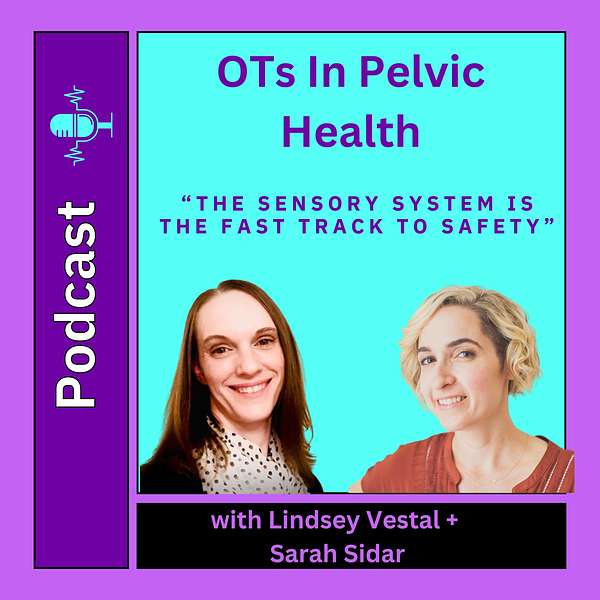
OTs In Pelvic Health
Welcome to the OTs In Pelvic Health Podcast! This show is for occupational therapists who want to become, thrive and excel as pelvic health OTs. Learn from Lindsey Vestal, a Pelvic Health OT for over 10 years and founder the first NYC pelvic health OT practice - The Functional Pelvis. Inside each episode, Lindsey shares what it takes to succeed as a pelvic health OT. From lessons learned, to overcoming imposter syndrome, to continuing education, to treatment ideas, to different populations, to getting your first job, to opening your own practice, Lindsey brings you into the exciting world of OTs in Pelvic Health and the secrets to becoming one.
OTs In Pelvic Health
The Sensory System is the Fast Track To Safety
- Pelvic OTPs United -- Lindsey's new off-line community!
- Get Lindsey's 9 page OTs Map to the World of Pelvic Health.
- Meet Lindsey on the OTs for Pelvic Health Facebook Group!
- Check Out More OT Pelvic Health Content here.
- The first ever Trauma-Informed Pelvic Health Certification by Lindsey + Lara
- Find Lindsey on IG! @functionalpelvis
Meet my guest: Sarah S. Sidar, PP-OTD, OTR/L, BCB-PMD of Balanced Pelvic Health
Where to find her on social media: FB & IG: @balancedpelvichealth and
Faculty Shenandoah University Division of Occupational Therapy
Here is an incredible companion of ideas (worksheets and research) that Sarah wants to share with you.
We chat about:
1. How do you incorporate the sensory system in your sessions with clients? Can you walk us through an example?
2. Who do you primarily see in your practice and do you use the full sensory profile assessment with them?
3. How does sensory processing impact our experience of pain, urinary & bowel symptoms?
4. Do you think we should be incorporating these principles more often into pelvic health settings?
5. Can you share evidence & research on sensory processing & pain perception?
6. What are some simple things that OTPs listening can start to do tomorrow if they are curious about adding sensory regulation tools into their setting?
7. What books are you reading or podcasts are you listening to?
8. Where do you go for pelvic health inspiration?
9. What do you love to do to recharge/ reset your nervous system?
____________________________________________________________________________________________
Pelvic OTPs United - Lindsey's off-line interactive community for $39 a month!
Inside Pelvic OTPs United you'll find:
- Weekly group mentoring calls with Lindsey. She's doing this exclusively inside this community. These aren't your boring old Zoom calls where she is a talking head. We interact, we coach, we learn from each other.
- Highly curated forums. The worst is when you post a question on FB just to have it drowned out with 10 other questions that follow it. So, she's got dedicated forums on different populations, different diagnosis, different topics (including business). Hop it, post your specific question, and get the expert advice you need.
More info here. Lindsey would love support you in this quiet corner off social media!
Lindsey Vestal My guest on today's episode is Sarah Sidar. She's been an O.T. for over 20 years in multiple practice settings, from the Nic you to retirement communities. In fact, her youngest patient was a 27 week old preemie and her oldest was 106. While she has loved being in O.T. and every practice setting she has worked in. She has truly found her calling and pelvic health over the last five years. Her other passions include teaching and supervising students and research. She is faculty at Shenandoah University's Division of O.T. and owns a mobile outpatient public health practice in northern Virginia called Balanced Pelvic health. Well, she's not geeking out about all things O.T. and Pelvic health. You can find her spending time with her husband, three kids and a cat. Now, today's topic is incredibly O.T. We're talking about sensory processing and how it impacts our experience of pain and urinary and bowel symptoms. We're also going to dive into the skills that all of us have to harness the power of our sensory system for the benefits of our clients. And a little bit on sensory processing and pain perception. You know, Lourdes, Rosie and I have our Pelvic health Trauma Informed certification coming out shortly in January 2024. And in it, we dive into all things in this sensory system. So it was such a pleasure to connect with Sarah today, because I truly believe that the sensory system is the key to trauma informed Pelvic health. And as Sarahh says, it's the fast track to safety. Sarahh has such an incredible perspective. I find her so inspiring and spot on with everything she shares today. I can't wait to share the conversation with you.
Intro New and seasoned OTs are finding their calling in Pelvic health. After all, what's more ADL than sex, peeing and poop? But here's the question. What does it take to become a successful, fulfilled and thriving O.T. in Pelvic health? How do you go from beginner to seasons and everything in between? Those are the questions and this podcast will give you the answers. We are inspired, OTs. We are out of the box, OTs. We are Pelvic health. OTs I'm your host, Lindsey Vestal and welcome to the OTs and Pelvic health Podcast.
Lindsey Vestal Sarah, I am delighted. Delighted to have you as a guest on the OTs for Pelvic health podcast to talk about something that I am obsessed with, and so I am thrilled to have you join in our conversation today. Thank you for being here to talk All Things Sensory System and pelvic health.
Sarah Sidar I am so excited. I'm absolutely honored to be here. I've been listening to the podcast recently. I've been kind of bingeing a few episodes after not listening for a while, and I'm just absolutely honored to be to be here. And and I'm so impressed with all the great knowledge that others have shared. So and I share your obsessed obsession with this topic, So I'm really excited to talk about it today.
Lindsey Vestal Awesome. Let's hit the ground running. I would love to know how do you incorporate the sensory system in your sessions with clients? Can you can you walk us through an example?
Sarah Sidar Absolutely. Absolutely. So, you know, I think like with any with any evaluation, with any initial encounter with a client, it always starts with your interview with your conversation and kind of pulling out those little threads of information. Right. So and it's definitely easier to give an example. So just thinking of a client that I've worked with who had, for example, dyspareunia, this is a very, very common diagnosis that I would kind of try to take the sensory processing approach with, you know? So I'm thinking of a woman I worked with this gender woman that I worked with a little while back whose primary complaint was just paranoia. She had a little bit of pain with gynecological exams, but really had pain with intercourse and had it had been for quite a long time. And she really it was obviously a huge disruption between her and her partner's relationship. She wanted to be able to have comfortable, penetrative intercourse. And and like with any client, it starts with a conversation, right? How long has this been going on? Have you ever had comfortable intercourse? I think a lot of the people listening at this point, maybe not everyone, but a lot of folks often know what that conversation kind of sounds like. The questions that you might ask, is it more initial penetration? Is it deeper? You know, so those are all the same questions that we might ask. But as I am asking these questions and kind of listening for this client's responses, when I look through kind of that sensory processing lens, I think about not so much, you know, what muscle specifically hurts, although I'm an anatomy geek, so I do. I do think about that a little bit, but I think about how does this person process basic sensory information, You know, how are they processing the tactile input, how are they processing the deeper proprioceptive input and how is their brain interpreting that information? And when we dig a little bit deeper, I usually ask some guiding questions about kind of general overall sensory processing. And these are very similar to questions that we might that we might ask anyhow, right? Does clitoral stimulation hurt? Does touch to the vulva, You know, is that painful? And in this client's case, no. You know, she didn't have any like vulvodynia no pain with external touch. Really. Her pain was with with penetration. And so what that tells me from a sensory processing lens kind of looking through that that lens is that she is able to process some tactile input through that lens of safety, through that, you know, that this is, this is comfortable. But when we process touch through a lens of thread, that's when we feel pain. So what I explained to my client this is how can I start to weave this sensory processing education into it is, you know, every input, every tactile input, every sensory input that we get. Our brain is constantly trying to figure out, is this safe or is this a threat? And so sometimes I'll even take their hand and I'll say, you know, I'm going to put some pressure on the palm of your hand. Does that hurt? And I'll say, well, no, of course that doesn't hurt. And I'll say, okay, that's because your brain is is processing that through a lens of safety. This tactile input right here, this is safe. But if I were to put this same amount of pressure as they were to insert a finger intra vaginally and put this same amount of pressure, you know, intra vaginally, how do you think that would feel? And she and you can sometimes you can even see the client's response before they say anything. Right? You can see their facial expression. You can see their muscles tense and they say, I don't think I could tolerate that. And so that's how I explain it. So same sensory input, but your brain is processing one through this lens of safety and this other through this lens of threat. And then we kind of continue to work through that from there. Hope that makes sense.
Lindsey Vestal Yeah. Yeah, that. That was beautiful. And I love that you're. I love the way you're explaining that to to your clients, because, you know, we could get super geeky. And I have. I have no doubt, Sarah, knowing you, that you probably do close doors. But, you know, it's that responsibility that we geek out here on the podcast and then we or never any professional circle that we're in. And then it's like, okay, some of these things like pain neuroscience and sensory processing, I mean, this stuff could get quite complex. And I just love this example of you taking their hand and we're bringing it back to this feeling of safety versus threat. And that does start to make sense. And and then they also start to recognize their parts of their body, you know, their clitoris, their vulva that are, as you said, feeling safe. But then there's something related to, in this case, penetration. That's not so I think it also starts to help them see their body, you know, in a more appreciative way, a more full spectrum way, because maybe they just start to discount all parts, you know, and go, this isn't serving me. You know, something's the matter. And I really like how, you know, for this particular client you're sharing how there's parts that didn't experience discomfort.
Sarah Sidar Yeah. Yeah. So that's where I typically start. And and it really depends. And it'll vary. Obviously, like all of our approaches, it varies from client to client, right? We tailor things to how we see our client respond. If, for example, this client had said, Well, everything hurts, right? You can't even touch my. And I've had clients that are like that, you know, and maybe a lot of us have. We've had clients. We're just they're in threat mode, right? Like they're stuck. And there's just it's very difficult to find something that feels comfortable for that person. And if that's the case, I might take a step back and kind of look at a bigger picture at the sensory system and start looking at other at other. Sensory inputs as well. You know, what about sight? What about sound? What about smell? And we can pull those things in as well. And once we can kind of figure out what kind of sensory inputs feel safe to that client there, their brain is processing as safe. Then then we've got something to work with. And when we can figure out what their brain is saying, no, this is a threat. Red alert. Send pain signals, you know, prepare for danger. Then we kind of know what to address as well.
Lindsey Vestal So this was an awesome, you know, overview of the kind of like that initial, as you said, starting off the conversation and even starting to help them understand the importance of the sensory system as it relates to why they came to see us in the first place. What's next? You know, like let's say let's say we are getting into the hands on assessment or if if you want to go to treatment or even the home exercise program, would you mind just taking us down the road a little bit more about how else you're using this sensory system in some of the next steps?
Sarah Sidar Yeah. Yeah, absolutely. So we can talk a little bit more about the evaluation because there's definitely more to that. But once we've kind of figure it out again and I like, really, you're the one that says this all the time and I reiterate it the best. Do the basics that are right. And like sometimes it's really simple, like safety versus threat. Like, let's keep this pretty simple, especially for our clients. So once we've kind of figured that out, what feels safe to you? What is threatening to you? That's when we start weaving in how we can utilize the sensory system to increase those those feelings of safety. And this is always related to whatever the client's goal is, right? So this particular client that I'm thinking of, you know, she really wanted to have comfortable penetrative intercourse with her partner. You know, other clients goals might be different, but it's always as related to that client's goal, whatever it may be. And when I think about how I approach this, I take kind of two simultaneous views in my head. And again, you know, we can really geek out on on this just to give a little, you know, a little background. One part of my mind is kind of thinking about a reading, a remediation approach. So if you dig way back into the recesses of old school and remember Ayers sensory integration kind of the brain with this was her brain child, right? And she had a whole theory that kind of postulated how we could provide sensory inputs in a very systematic way to fundamentally help alter how we change that neurological system, how the brain interprets that sensory input, and then thereby change behavior. So that's one kind of line of thought that I have. And that's one thing that, you know, that other folks can do is how can we change how your brain processes this sensory input that I am giving you with this pressure on the you know, in this client's case, on the left side of your, you know, layer, one of your pelvic floor, you know, your bubble cavernosa as your, you know, as tpy and your is your cavernous this is your brain is interpreting this as threatening. What can we do? Can we provide some different types of sensory input. What if we provide vibration? You know, what if we provided a little bit of movement? Say we mobilized your hip as we did this? What if we provided those kinds of things to alter how your brain processes that information? A different kind of approach, but but complementary. This doesn't have to be mutually exclusive. Is more founded in what would be like a compensatory approach. So again, digging back into the recesses of old school, if anybody remembers Dunn's model of sensory processing and this is what the sensory profile on the assessment tool that I like to use is founded in is is Winnie Dunn's model of of sensory processing. And this is more using other types of sensory input to improve kind of the system's regulation so that you're out of that threat of state. So like say what would happen if you said, well, I have this favorite blanket or this favorite sweater that makes me feel really good when I put it on. So what if during our next session, while we were doing some internal work or maybe while you were using a dilator or, you know, a pelvic wand, maybe you put on that favorite sweater and that altered, you know, that that sensory support kind of gave your brain what it needed to feel safe. And then you no longer saw that other sensory input as threatening. I hope that makes sense.
Lindsey Vestal Absolutely. And I really am so glad to hear you bring back up, you know, the remediation and compensatory and how you're kind of, you know, using your clinical reasoning to think, okay, what is what is my next best step? And like you said, you could you could go back and forth, you could use both. But that was a really beautiful example of, of your own clinical reasoning as you're as you're thinking about this client. I'm curious, you mentioned for the remediation of. Approach. You mentioned vibration. You mentioned a little bit of movement. What are some of the other tools you might be using there?
Sarah Sidar Yeah. So it really again, it depends on the goal. It's funny because I think we do sometimes we do a lot of the same things, but we like to call them by different names, right? And if you go to enough category education courses and if you're a clinician long enough, long enough, you start to see real distinct similarities between what one person calls one thing and what another person calls what looks like the same exact thing. And when we think about I'm so glad that you brought this up, because those examples would be very similar to kind of like your therapeutic exercise or your manual therapy techniques. But I'll tell you the twist that I put on it. And Lynne Schulz, who is at the Pelvic health Summit and was on your podcast recently, I can tell you I understand why she resonates so much with us as occupational therapists, because I think she actually and I don't know if it's intentional or she's just, you know, this is this is just something that she's naturally kind of learned and figured out on her own. I think she's actually using more of a sensory processing approach to her manual therapy techniques than I don't know if it's she does realize or maybe, you know, or maybe she just calls it by a different name. But so, for example, you know, when we use a manual therapy technique to say, you know, try to release a muscle. Right. There's two ways. Say say I could say this. Bobo Cavernosa is has a trigger point in it and I am going to mechanically put my finger on it until those muscle fibers lengthen and loosen. That's one way of looking at it, a very different way of looking at it. And that might might mean that if you do that, the client is potentially maybe having pain. Right. Because sometimes you do those like really strong trigger point releases and the client is going, ouch, ouch, ouch. And their body is really reacting. And you're thinking, I got a really like mechanically move this muscle, right? But you could do something very similar. You could still put your finger on that same muscle, on that same tender point. But taking a sensory processing approach, you might say, well, how much from a sensory processing standpoint, how much tactile and proprioceptive input can this client tolerate while still interpreting this through a lens of safety? Right. So instead of using that really aggressive approach, you might use a really gentle touch and talk through that client. What are you feeling in your body right now? You know, give me that verbal feedback. Let's give it some time and let your brain figure out. And oftentimes clients will say, well, it hurts a little bit. And I'll say, well, is it too much? And it's always they're in control, right? They can always say, nope, that's too much. And sometimes even if they'll say, no, no, no, it's okay, keep going. You can tell by your their posture and how they, you know, how they're responding, their respiratory rates increase and you're like, I'm just going to back off this pressure a little bit. Right. But what I explain to them is, you know, if it hurts just a little bit, but you're still your heart rate is still kind of level, your respiratory rate feels okay. Your facial expression is kind of more curious as opposed to to pain. Let's give your brain some time to process this information, because sometimes if you give your brain a minute, it'll go, what is this information? I'm not sure. I'm not sure. Is it a threat? I wanted it to know it's safe. And then maybe we can start to gradually increase that pressure. And that really resonates with Len's techniques of never causing pain. Right? You go where the body tells you to go. You don't have to give tons and tons of pressure. And I think a lot of what she does, aside from biomechanically really moving things to where they need to be, but she is able to move her hands and provide that tactile and proprioceptive input in a way that the brain can interpret it as safe, as safe. And that's when the body releases. That's when you feel that letting go and that relaxation.
Lindsey Vestal I think that is so key. And you just you I hope Lynn will hear this podcast. You know, it will it will resonate with her, too. I have no doubt this graded approach, this client led experience. And actually, Sarah, what you did in in that gorgeous explanation was to also help them understand pain science in such an approachable way, you know, of, of giving the body time to recognize this with the just right approach of, okay, I'm feeling this, but I'm not maybe going back into a survival. Will brain standpoint of telling myself a story of where I've had pain like this before or, you know, a lot of those, you know, very intelligent adaptations that our body has to keep us safe and instead your your really riding that experience with them, always reminding them that they're in charge, but that there's another way, that there's another another opportunity to experience and reinterpret something that potentially they've experienced in a less optimal way in the past. That's beautiful.
Sarah Sidar Yeah. Yeah, yeah. I, I, I just hearing her talk at the summit and on your podcast recently, I was like, this just aligns so well with, with my approach to, to clients. And I think that the other thing that, that I think is important to note is that there is neuroscience behind this and there is evidence behind this. So this isn't just like woo woo stuff that I'm making up here. And I, you know, I gave you this whole nice long list of references to put in the in the show notes. So I think, you know, there is sometimes with our especially with our manual therapy techniques, it is it really can be difficult to research and study. But I really firmly believe that the the key when we're doing some of these techniques is how we allow the brain to process the sensory information we're giving the client. And when the brain is allowed to process that, that tactile input, that proprioceptive input that we're providing them with that manual therapy technique, when the brain is allowed to process that safely, that's when that magic happens.
Lindsey Vestal Yeah, Yeah. I'm really like on so many levels geeking out with our conversation right now because I have a pretty strong focus in my forthcoming trauma Informed Pelvic health certification is all around the sensory system and interception. So this is, this is awesome and I will definitely include all of the references that you sent over in the show notes for for everybody to be able to, to reference. Yeah. Sarah Are there any, I don't know off, I don't want to say off the wall but are there any sort of other sensory like strategies or techniques that you have brought into sessions in the past that have kind of surprised you or were definitely an example of some out of the box thinking?
Sarah Sidar Yeah, yeah, absolutely. So one of the things that I use with my clients, once we've had this conversation around the sensory system and they kind of have this really simple rudimentary understanding of how it works from that lens, we'll talk about all of the sensory processes. And you know, you you're a kid, you learn there's five senses and then you go to old school and then you learn their seven senses. And then all of a sudden now there's eight senses because we added interception into the mix, right? So there's a lot to work with when we're looking at the sensory system. And this is where I use this is where kind of that compensatory approach comes in to where I start saying, well, we can work somewhat very directly on the thing that is the problem. You know, wherever you're having pain or if whether or sometimes I even use this approach with people who have, you know, urinary urgency that's really persistent or even constipation or that kind of thing. Certainly people who have sexual dysfunction. But I do talk to them about the whole multisensory experience of how we live our lives. So I have a worksheet that I'll go through with them where we'll talk about I really start from what is what does your sensory system feel like when you're feeling well? Because you need to have a good sense of what you feel like when you're doing okay so that you can get the early warning signs of when you're starting to feel stress or not so good. And then you also need to be able to recognize when something's just too much and you're in overwhelm. And so this worksheet kind of goes through. It lists out a bunch of different sensations or sensory inputs. And that can include that includes everything from like sight and sound and touch, but it also includes things like your heartbeat, your breathing, you know, in a reception, you know, that kind of thing. How do your muscles feeling, your body, those kinds of things. And we talk about and kind of write out what do these systems feel like? When I feel really good, when I feel really regulated? What are some early warning signs? When I'm starting to get a little bit dysregulated, I'm not in full blown, my gosh, I'm in so much pain, I can't take it or I'm in panic mode. I have to go to the bathroom right now and I'm sprinting and I'm freaking out, you know? But what are those earlier kind of subtle warning signs of, my jaw is starting to clench a little bit and my heart rate is getting a little bit faster. And you know when. And then we talk about like, okay, what? When are we at a state where this is bad? Like, okay, now I'm in eight out of ten pain or, you know, or that kind of thing. And then we talk about bringing in sensory inputs that can help calm that system. So that's when we look at our smell site, you know, taste, touch, all those kind of compensatory strategies that we can pull in to bring that safety to the brain. So like when we talk about this, when we talked about this with the same exact client kind of going with this same case example we talked about, what's the visual clutter in your room when you're trying to have intercourse? Is your room an absolute mess? And it does that really bother you from a visual processing standpoint? Because you're not going to feel happy and comfortable and safe if you're in this messy environment that is just too visually cluttered and makes you miserable, you know, are you are you hot, too hot or too cold? What's the temperature in the room? What are the smells in the room? You know, is it is there like are there like stinky sweat socks by the bed? You know, smell taps into a very deep emotional center of our brain. And I think is what sometimes we forget about about that and how powerful that can be. And so, you know, and I'm using these specific examples because these were all things that this particular client identified. Having the bedroom messy and cluttered was just she hated it. And it really frustrated her. And, you know, that really that really threw her off. And the sweat socks was an example that she gave. And so it was like, okay, so we get the sweat socks in a closed laundry basket and know your partner put on some of that like deodorant that you like the smell of before you attempt any kind of intimacy. And so these are all little things that you don't. They're things that they seem very simple and obvious, but things that you don't think about until you kind of write it all out. And that helps prepare your whole sensory system for being in a safer space, for being a space where you're less likely to have pain and more likely to enjoy something like sex.
Lindsey Vestal Phenomenal example. Thank you. Thank you for being so clear and giving us such concrete examples to work with. Yeah. So sorry you were so gracious to include the worksheet in the show notes so that all of our listeners have a chance to kind of kind of work from it. And I recognize it's something that you kind of put together and it is from it is from your brain. So thank you. Thank you for sharing that with us so that we can start to incorporate a lot of this into into our own sessions.
Sarah Sidar Yeah. Yeah. And I also have to give credit where credit's due as well. So there is a this comes a little bit more from the mental health background, but that there's something called a wellness recovery action plan, w r app rap and that kind of conceptualization of figuring out what and this is really geared more towards people who have chronic mental illness. But that concept of what I feel like when I'm doing well, what I feel like when I'm not doing so hot things that I need to do on a regular basis to keep myself well, that really comes from that training and background. And so while that's not specific to Pelvic health, it's definitely something that lent itself to me being able to apply, especially when you have someone who has had chronic pain. You know, it's kind of like someone who has chronic depression or chronic anxiety. And we know there's such a high correlation there. You know, it's like that chronic management of something that has been ongoing for such a long time. So this is kind of this worksheet comes from a number of different kind of resources that I have, sort of different things that I've learned about and then kind of all jelled together into this.
Lindsey Vestal Absolutely brilliant. I think the best things come from being a mixture of places that we've been inspired and we're all sitting on. We're all sitting on the shoulders of giants, you know, so many, so many mentors that we've all gleamed so much from. So yeah, that's awesome. Yeah. So, you know, you've given us a great example with this. Prunier and you have mentioned some of the other common pelvic floor diagnoses like urinary incontinence and constipation and things like that. Do you find that some of these tools are just as effective with those diagnoses?
Sarah Sidar Yeah. So it really depends. You know, sometimes you get that awesome like urinary urgency and urge incontinence is like one of my favorite things to treat when it's straightforward, right? Because it's like you teach them urge drills and 2 or 3 sessions and they're like, What is this magic wand that you've waved? And we're both doing a tap dance together, right? Because they're so much better. But, you know, sometimes you have that that client who it's just really persistent. Right? Are you you've had done breathing and you've done the urge drills. And so this isn't my go to for like every urinary urgency case. But when I have that person, when you've kind of done the straightforward, simple thing and it hasn't worked, that's when I start to think about, okay, what else is going on here? And a lot of the time you start peeling back these layers and you find that this is a person that does have like, for example, maybe a chronic anxiety diagnosis or some other mental health factors underlying. And so very similar in terms of how I might manage that with somebody whose primary complaint was pain. You know, we're really tailoring this towards that sense of urinary urgency. So they're looking at what their sensory system is doing when they're starting. That panic is starting to mount, you know, as they feel like they have to go to the bathroom. And what's your heart rate doing and what's your respiratory rate doing and what are your muscles doing and what can we do from a sensory processing standpoint to kind of calm down and regulate that system? And I found that I've had a few clients that this has been really effective with when that urinary urgency is just real persistent. And it's not we're not it's not responding to that traditional those traditional kind of urge suppression techniques and then constipation clients. I've definitely used this with as well. I definitely use concepts from interception for sure. But the other thing and they're, there's somebody else who you interviewed recently who I was like, she's also using a lot of sensory processing and may or may not realize it too. But as Susan Clinton, you had on not too long ago and talked about how like so a great example that she gave with her clients with constipation, a recommendation that she makes is to chew their food a lot. You know, 24 times or 40 times or. And and how that kind of elicits that that movement of the digestive system. And so what I'll talk about sometimes with my constipation clients because sometimes counting the number of times they they they have to chew their food is a very like, that's too much for them. It's overwhelming. Right. But I say, what if we just have that sensory processing experience of that food? What if you just really enjoy and tune into the texture, the different tastes as it moves around your mouth and movement of your tongue and the jaw, you know, moving up and down. So just eating in this very mindful way and you're putting your brain in this very different state. Your brain is now moving into that rest and digest state, into that safe space where the gut motility can start, can start going. And so that's an approach that I've definitely used with those clients as well.
Lindsey Vestal That's fantastic. Yeah. Great examples. So do you use the full sensory profile assessment with your clients?
Sarah Sidar It depends. Sometimes I do. Oftentimes, particularly with my pelvic pain clients, I very frequently use it with them. Unless the only time I don't is when there's a very obvious biomechanical reason, like we do an internal assessment. I put that finger on that operator, internist. They light up. We do like kind of a quick internal treatment. And there again, it's like some of these sometimes you get that great time where you're like, couple of sessions and they're, you know, again, we're all doing that tap dance up. This is so much better. But so many of my, you know, there's these more clients who have more complex pelvic pain and it's ongoing and long standing. We really do a deep dive into kind of the full sensory system. Sometimes I'll do it with my urinary urgency or constipation clients not nearly as frequently, you know, but definitely with those with those pelvic pain clients.
Lindsey Vestal Perfect. Perfect. And I feel like we've we've touched on this a little bit. But you sometimes I really like kind of summarizing or reinstating now that we've gotten into the weeds a little bit, kind of how how sensory processing, in your opinion, how does it impact our client's experiences of pain and some of the other symptoms, both from a urinary and bowel system perspective? You know, how does sensory processing really, really make its mark on those experiences?
Sarah Sidar Yeah. Yeah. So we are constantly processing and responding to sensory input. It's an ongoing process. Just all day long, day in and day out, we're getting visual input, we're getting sensory rating smell input, we're getting taste and touch and all of those things. And so you can think about this from a lot of different ways. The example that I gave just in terms of like how we choose our food and the sensory experience from that standpoint is a piece of it. But there's also how we process, how we process our tactile input, our proprioceptive input, and then that in a receptive piece to a sensation of of urinary and bowel function. Again, going back to like your urinary urgency clients who are really they're not responding to those traditional urge drills and they're really just it's not happening for them. How are they responding to that introspective experience of bladder distension of that I have to pee signal. Their brain is interpreting that signal through that lens of threat. Right. And an urge to pee should not be a threatening experience. Right? It shouldn't be a panic experience that, my gosh, this is a bad thing. Urge to be to pee should just be like, I have to pee, right? It's not good. It's not bad. It's just it's just how it is. And let me go find a bathroom sometime soon. But again, working on how we can reinterpret that if there is that symptom of urinary urgency. And and that the sensory processing experience, we get that sensory input either from the environment or from within ourselves and our brain has to find a way to interpret it. And then we're going to have some kind of a behavioral response, an emotional, a cognitive or behavioral response. So there's several kind of layers to this. And and but those those layers, it's not like this happens slowly. It happens really kind of quickly all at once. And there's some back and forth. Right. We have we might have a response, but then we might find a way to alter that sensory input. Or we might find a cognitive process that says, you know what? We might be able to verbally kind of talk in our heads and tell ourselves, you know, this is just an urge to urinate. It's not that big of a deal. You know, but but ultimately, that's all in response to that sensory experience of touch or bladder distension or rectal distension or something, you know, something along those lines. And I think this is where I kind of like to bring up, you know, I know we're talking about sensory processing. But I do like to talk about somebody else who is at the summit, the lovely Marti Smith, and she talks about the neuro sequential model. And this isn't something that I talk to about my clients, but definitely a way that I conceptualize this in terms of how our brain kind of prepares itself for engagement and for reasoning and for higher level cortical function. And she talks about kind of this hierarchy. That exists. It starts with regulate and then relate and then reason. So regulation starts at the at the brainstem. It starts at the sensory system. You know, it's where's our heart rate at? Where is our blood pressure at? Where is our respiratory at? What are our basic bodily functions? Are we in a state of threat? And then if we're regulated, then we can start to relate and build connection to to other people. And then once we're regulated and we're connected, we're related, then we can get into our thinking brain in our reasoning brain. And so I don't I don't talk about that in those specific terms to my clients. But that's definitely a model that I constantly keep in the back of my head, especially throughout the treatment process, is where are they? You know, right now, as we're doing this treatment, as I'm, you know, maybe I'm doing a manual technique or maybe we're doing a movement that has always been particularly painful for them or kind of particularly threatening or scary. And how can we get them into a state of regulation so that this client and I can connect and relate and then then we can reason and talk through what is going on in their body.
Lindsey Vestal I love that. I love those three hours. And you can really see, too, how, you know, it's not always going to be a linear process. We may go a couple of steps forward, we might go a couple steps back in that. But I really like that that model that you're bringing in as you're considering your client's next steps. I so, you know, you've given us an example with that client that we've used a couple of times. And just for the sake of continuity, you know, you mentioned that, you know, she might assess her sensory system in the bedroom, you know, her visual clutter, the sense of smell and things like that. Are there other examples? And I might consider that part of her, her home exercise program. Are there other home exercise examples that, you know, once this client is making these, you know, probably to be honest with you, you know, finding out these things about herself that perhaps she never knew and certainly didn't pause to contemplate in a rehabilitation setting. You know, what are some other ways that you're asking her to continue this journey of learning about herself from a pelvic health perspective, using the sensory system?
Sarah Sidar Yeah, that's a great question. So we going back so often, I refer back to that worksheet frequently and we talk a lot about it because sometimes it's a very specific thing. Sometimes it's like, well, you know, I don't have a lot of generalized stress or anxiety, but it's really just like this one time, like the example you gave is more like, how can I prepare my bedroom? So, you know, I feel comfortable and safe with intercourse, you know, But we have a lot of our clients have a lot of real general heavy. There's stress, there's anxiety, there's trauma history. There's, you know, other maybe social psychosocial factors going on in the background. And we talk about how we can use some of these sensory supports on a more regular basis, not just, you know, in those moments when you're feeling that urinary urgency or when you're, you know, having that like, bad gas pain from constipation. But that's when we go into what kind of things do I need to do on a pretty regular basis to help keep my body regulated? You know, am I getting enough movement in my day? Am I sitting down and taking enough time to enjoy my meals? Is that a piece of the sensory system that I need? Are there times when I'm just too overstimulated and it's too much? Am I taking the flipside of that? You know, maybe I don't need more sensory input. Maybe I need less. And this is where that sensory profile can be very useful to look and see all the things that well, these are the things that I really avoid because or I try to avoid or kind of more noxious to me, but I'm being bombarded with a lot of that sensory input on a regular basis. And maybe there are some things that I can do to actually reduce that a little bit and that can really help put the brain and the body in a better state for Pelvic health as well. Because as we know, as we reduce those stress levels, as we reduce those cortical cortisol levels, we're going to experience less pain, we're going to experience less tension and less urinary urgency and less constipation. And I think this is a really tough one. I will say, for a lot of clinicians and OTS alike, we're always looking for strategies and how do we manage this kind of underlying mental health factors, How do we manage from this true bio psychosocial approach? And and I think there's a lot of kind of easy canned answers that we find work for some but not for others. So practice mindfulness, right? Like the most annoying medical advice that anybody ever gets, you go to your doctor and they say, you have high blood pressure, practice mindfulness. And it's like, how many people really, you know, what do you even get out of that? Right? How many people actually gain something from that? But when you have a tool that you can use to help assess how someone processes sensory input, then you really have a guide for you to say, Here are some really tangible ways that you can reduce your body's stress response and bring down those cortisol levels in your brain and bring up those serotonin levels in your brain and in your body and in your gut to to address that piece of it that I think that so many clinicians find very enigmatic.
Lindsey Vestal And that is mindfulness and that's mindfulness in a client specific, customized way. Because you're exactly right. That eye rolling, that internal eye rolling. But honestly, Sarah, I even feel when people talk about mindfulness, it's like, okay, you know, we all know the science is there. Okay? We definitely know that mindfulness is good for us. But then it's like that advice that we give, exercise more. It's like, okay, what if I've lost that zest or if I lost that passion? Or what if I don't have the time? I'm a new parent, you know? And so it's like I love this constructive, clear way that in your sessions you're really giving them that blueprint, that guess what else they're going to be able to implement in so many other areas of their life? It could be recognizing they may need a sound machine now when they fall asleep at night because they're a little bit over alert to the sound of a siren going by, which is something that a lot of my New York City clients felt. You know, it's like it's just so it's so customizable. That's just that's so beautiful. I'm really geeking out right now.
Sarah Sidar Well, yeah, You know, I always say the sensory system is the fast track because we I think, you know, cognitive behavioral techniques, talk therapy, talking through a lot of these things. And now, don't get me wrong, I think a lot of these approaches can be incredibly helpful. I use these approaches in my practice. I use them for myself. But the sensory system is like the fast track. It's the fast track to threat, but it's also the fast track to safety. Sometimes those approaches, it's just too much cognitive demand, especially when you work with a population, you know, that is high stress, high anxiety. A lot of type-A and not everywhere is like that. But I live and work in a suburb of Washington, D.C., a lot of military, a lot of government, a lot of type-A personalities. And and it's there's so in their head, they're so in their head and out of their body. And instead of saying, let's give you these five, you know, things to talk to yourself about, that's a lot of just cognitive demand. You say, why don't you light this candle, you know, or what? And it's always client led, right? So I usually say, what's a smell that just I want you the first thing that pops into your head. And actually anyone who's listening right now, you know, try this is an exercise I do with my clients. I say, you know, when you think of your comfort food, just the food that is your go to when you're like, I want that. Like, just think about it in your head right now. So like Lindsay, what's your comfort food?
Lindsey Vestal Yeah. What actually just came to mind for me was like a perfectly done pasta, like a bucatini that has fresh herbal smells. And the texture of the pasta is something that almost feels like meat. You know, it's something I can really sink my teeth into.
Sarah Sidar Yeah. And I can smell that just by you describing it to me. Right. And I'm sure you can smell that, too. So that is like the fast track, right? And immediately you thought of that so quickly because it came to you. Usually that comes to be I use that example because it comes to most people right away and they can smell it. And I say, How do you feel? Just even thinking about it, it's not even there in the room with you. You're just telling me about it. And I'm like, it feels great, you know? So that's the fast track to safety. So sometimes when we're taking this kind of slow, circuitous route, it doesn't mean that there isn't value in that, because there definitely is. But if you want to get to regulation really, really quickly, it's going to be through that sensory system.
Lindsey Vestal Well, I think and that's when when they get that that that immediate feeling and they can remember because it may have been a while since they felt that or even pause to reflect on the impact that it has on them. Once they get that win, that's opening up the door to so many other strategies. And that is where some of these other techniques, you know, from from a top down approach could be really helpful. And I just have to do I have to do a shout out to Laura DeRosa, who is the person I'm creating the Pelvic health certification in, because one of the reasons why I'm just it's a match made in heaven. Sarah, in terms of creating this certification with her is that I do come from that bottom up and she comes from that top down approach and it really is a blend and it's about kind of using that chemical reasoning and firm to know when to use what strategy. And for me, hearing you talk, I very much aligned with this. It's like, okay, once we get that fast track or that quick win or that sense of safety, again, that is recreate it through definitely. I think the olfactory system. We can then move on to some other strategies that are going to be helpful and very strategic. So yeah, this is this is great. Yeah. I have a question. What are some simple things that maybe some occupational therapy practitioners listening to this can really start to do tomorrow if they're curious about adding sensory regulation tools into their setting?
Sarah Sidar Yeah. So the first thing that I want to say is that I am willing to bet that every single O.T. listening to this right now is probably doing at least some of these using some of these techniques and strategies without realizing it. And maybe some are using it very intentionally and do realize it to some extent. But I think the first thing is to give yourself credit for what you already know and what you're already doing and own your expertise as an O.T. in the sensory system, because this really is our jam as occupational therapists. And I don't think you have to be an expert in sensory processing to, you know, we all have that background that we've learned in school and to have a basic understanding of this. So, for example, a lot of our clinicians emphasize how we set up our room, the ambiance and the tone that we set right. The colors on the wall, the smell in the room. Is the room warm enough? Those are all spaces and sensory inputs that we're providing to help elicit safety with our clients. I think being intentional, there's you can now you can add the intentionality piece to it. So it's interesting because I hear this on and off in various social media groups like, you know, what kind of smells do you have in your room? And some people will do a candle and some people will do essential oils and other people will do other things. And I'm actually well, now I'm a I have a mobile clinic, so I don't have a clinic that I am in people's homes. So whatever its whatever the person's home smells like. But when I was in a clinic, I was actually very intentional about not having a specific scent because of that smell hitting that emotional center in the brain. And even though there are some smells that are considered more kind of universally pleasing or therapeutic in certain ways, you always have that client that might have that trauma history that it might not hit them in that way, you know? So that's a way that I was very intentional about it. But then we would have that conversation as a client about those things that we might pull in. So they might the next session bring something with them that had that smell to it, you know, for example, or, you know, things like the lighting in the room are you intentionally do have a dimmer you know, is is too much visual stimulation for one client not the right amount. Do you have the ability to adjust to that within your clinic space? I think that's incredibly important to some clients. They want it to be bright. They want to know what's going on and from a visual standpoint, that's they need that input and others don't. So, you know, kind of being in. All about your space and how you kind of set that tone. And I think the other the other thing, too, is really facilitating your client's ability to explore every aspect of their sensory experiences. So talking about every one of those those processes, when you're when you're talking about what to that client who has had that persistent urinary urgency or dis Peroni You know, let's let's talk about that visual system. Let's talk about that auditory system. What's going on in the background to you? Are you trying to get it on when you got like your kids playing in the next room over? Is that a distraction for you? You know, to that kind of auditory input is not going to put you in the mood? Well, you're more likely to have pain when that happens, Right? So kind of at least at the very least, touching on all of those systems. And certainly the sensory profile is an excellent tool to use. So that's another that's another one. I will say the sensory profile is at cost, but I have found it an incredibly valuable tool within my practice. And what what it helps with it helps with a couple of things. One, it kind of places clients in quadrants. So it will tell you sort of on a global level from a sensory processing standpoint, if the client has more kind of low registration and therefore tends to be a sensory seeker. So low registration and kind of the done sensory processing model terminology means that you need more sensory information to register that thing. So that's a person who like needs a lot of proprioceptive input to feel regulated. They might need more, they might need the lights higher or they might need more visual input, right? Whereas a sensory avoider and a sensory sensitive person might really be they might perceive all those things through that lens of threat. And there is some evidence to show that people who have that kind of sensory, avoidant, sensory sensitive neurological threshold and behavioral response do tend to struggle more with pain. And so, you know, exploring those on a general level. But the other thing the sensory profile does is because it breaks things down out into like visual taste and smell, auditory, etc., is it lets us start a conversation about each of those sensory processing systems in a way that is very understandable to the client. And so we can kind of break down and start digging into that nitty gritty of each of those sensory systems to figure out what works for them. I hope that one too much.
Lindsey Vestal That was awesome. And you gave us kind of a graduated a graduated example there. Everything from really simple of considering our environment, the level of our lighting, the sounds, etc., to then maybe really getting our feet wet using the sensory profile, you know? So you kind of gave us some approaches to step, step into. And, and you're right. You know, I have to admit that when I first started thinking about using sensory concepts in my pelvic health practice, you know, I was thinking about my colleagues who work with children, you know, and I thought, you know, I can't do this. You know, I'm not a sensory processing expert. You know, I don't see children in my private practice. And I felt like I was stepping out of my lane a little bit. And I felt I felt some guilt for that. And, you know, as I got more into it and I realized that at the end of the day, I actually did have that expertise. And I took some continuing meds and talked to some of my very smart colleagues. I really saw the value in this. So thank you for bringing those up and kind of helping us remember that as well. Yeah. My last question for you, Sarah, is what do you love to do to recharge or reset your own nervous system?
Sarah Sidar Yeah. So I will say that up until very recently, meaning literally up until the Pelvic health summit, I was not good about recharging at all. You know, we're so bad as clinicians where we're like, do as we say, but not as we do, right? Yep. But, but I think actually being in listening to Lynne Schultz's talk and having her hearing her talk about sweeping her bowl, it kind of triggered something in me that I was like, I am not doing this for myself. What is up with that? And so I will say in the last couple of months, since that time, I have actually been much, much more intentional about doing those things, whether it's in between clients or a day to day. One of the things that I do is I set aside time to exercise every morning before my family wakes up. So husband's still asleep, kids are still asleep, cat still asleep. And I get some sort of physical movement. And sometimes that's yoga. I've started doing Pilates recently. That was another summit inspiration. So shout out to Pam Hess and Karlyn Reum for inspiring me. But yeah, I've been I've been really intentional about that kind of movement practice every day, most recently. And then the other thing that I can say that I've been doing, I've always been a coffee drinker and loves coffee, but I've really tried to spend I'm a morning person, so I've really tried to spend like a good 10 or 15 minutes in the morning, not lugging down my coffee really quickly, but just really sitting there and enjoying it and enjoying that sensory this the smell of freshly brewed coffee and that taste and that kind of energy that it gives me to.
Lindsey Vestal Lovely, lovely. And I do think it's a great reminder as we close here to, you know, mention, I know that you've recently started your private practice and you know when we start a new endeavor and I'm, you know, speaking for my own experience here too, there's a lot of hustle there. There's a lot of desire to to prove ourselves and to make sure this choice that we, you know, made is going to be successful. And so very often I find in those situations, we are putting ourself on the back burner even more because something else has has our attention in such a full on way. And so I am I am incredibly happy to hear that the summit served as a bit of a reset for you, as I think it did for me and many others, that, you know, we can we can do all of these things. Well, you know, we it doesn't have to be a sacrifice to start a new business or become a parent or you fill in the blank, too, whatever this fits you right to. We can actually take time for ourselves in whatever capacity, smelling, tasting coffee to sweeping our own pelvic ball, to taking on a new exercise activity and and finding that intentional time and space like you're doing before your kids wake up is a perfect example of that. And so I'm I'm really I'm really glad to hear that that served as that for you.
Sarah Sidar Yeah. Yeah. Well, it was it was fantastic and inspiring and and yeah, definitely professionally, but but certainly personally. There were a couple of things that it really it really kind of turned on in me. So I'm very grateful for that.
Lindsey Vestal Awesome. Well, I would be remiss if I didn't mention that we already have our dates for the 2024. It will be August 17th and 18th in Phenix, Arizona again, and at still University. They were such a gracious host and we're so thrilled to be back there. So if you didn't join us last year or you and if you did, we would love to see you there. And I'm sure we'll have more inspiring moments like that together. Sarah, I am beyond beyond grateful that you joined us today. I really have always been so inspired by your ability to articulate, you know, concepts that can be complex into into really tangible ways. I mean, I myself have gotten so many tools and so much ideas for ways to implement some of these sensory ideas into my family, into my life, into the clients that I'm seeing. So thank you for sharing all of your wisdom with us today.
Sarah Sidar Thank you for having me again. It's been an absolute honor and it's been a ton of fun.
Outro Thanks for listening to another episode of OTs and Pelvic health. If you haven't already, hop on to Facebook and join my group OTs for Pelvic health, where we have thousands of OTs at all stages of their Pelvic health career journey. This is such an incredibly supportive community where I go live each and every week. If you love this episode, please take a screenshot of this episode on your phone and posted to IG Facebook or wherever you post your stuff and be sure to tag me and let me know why you like this episode. This will help me to create in the future what you want to hear more of. Thanks again for listening to the OTs and Pelvic health podcast.
