OTs In Pelvic Health
Welcome to the OTs In Pelvic Health Podcast! This show is for occupational therapists who want to become, thrive and excel as pelvic health OTs. Learn from Lindsey Vestal, a Pelvic Health OT for over 10 years and founder the first NYC pelvic health OT practice - The Functional Pelvis. Inside each episode, Lindsey shares what it takes to succeed as a pelvic health OT. From lessons learned, to overcoming imposter syndrome, to continuing education, to treatment ideas, to different populations, to getting your first job, to opening your own practice, Lindsey brings you into the exciting world of OTs in Pelvic Health and the secrets to becoming one.
OTs In Pelvic Health
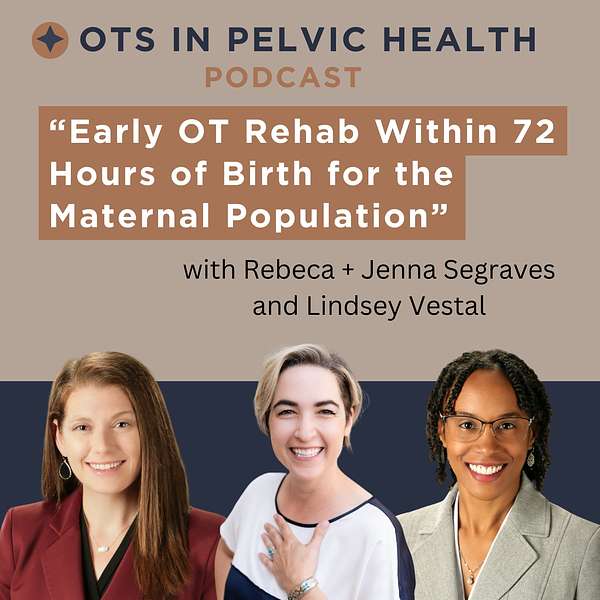
Early OT Rehab Within 72 Hours of Birth for the Maternal Population
- OT Pioneers: Intro to Pelvic Floor Therapy opens January 15-19, 2024
- We'd love to welcome you to Pelvic OTPs United - Lindsey's off social media community ($39 a month with no obligation!)
Meet my Guests
Jenna Segraves
Doctor of Physical Therapy with 8+ years of experience in physical therapy, teaching, and mentoring students. Assistant Professor for DPT students, teaching Neuroscience and Neurological Movement System I-II. Board Certified Neurologic Clinical Specialist and Certified Lymphedema Therapist, published author, and presenter at national and state physical therapy conferences. Co-creator of a 2-day continuing education course and specialist certification for occupational and physical therapists with a focus on the maternal and postpartum population to reduce the risk of neurological or wound events.
Rebeca Segraves
Dr. Rebeca Segraves, PT, DPT is an ABPTS Board-Certified Women’s Health Clinical
Specialist who practices in acute care and home health, serving individuals immediately after birth and pelvic surgery. She earned her Doctor of Physical Therapy degree from Western Carolina University and completed residency training in Women’s Health Physical Therapy at Duke University. Clinically, her focus is on standardizing inpatient and early outpatient pelvic health rehabilitation immediately after birth and pelvic surgery, including cesarean section and hysterectomy. She lectures in multi-disciplinary clinical and academic settings with an emphasis on earlier utilization of occupational and physical therapy to enhance recovery after procedures impacting public health and quality of life.
Here are the topics we discussed:
1) Currently, OT and PT services are not standard of care in maternity units in the US. What can we do to change this?
2) What’s your elevator speech when people (outside of the client) ask “what do you do with these patients as an OT?”
3) When you go in to see your patient, how do you explain this program to them?
4) If the hospital is hesitant, how would you prioritize phases to trial the program?
5) I want to ask you: How do we get referral providers to send us clients? How do we get provider or hospital buy-in? And this is clearly a hot topic because I received the following question from someone on my FB group: "We’ve presented an obstetrics rehab program to the Ob doctors and nurses and it was well-received. We provided a quick reference guide for when to refer patients to us but we just aren’t getting the referrals. Looking for suggestion
____________________________________________________________________________________________
Pelvic OTPs United - Lindsey's off-line interactive community for $39 a month!
Inside Pelvic OTPs United you'll find:
- Weekly group mentoring calls with Lindsey. She's doing this exclusively inside this community. These aren't your boring old Zoom calls where she is a talking head. We interact, we coach, we learn from each other.
- Highly curated forums. The worst is when you post a question on FB just to have it drowned out with 10 other questions that follow it. So, she's got dedicated forums on different populations, different diagnosis, different topics (including business). Hop it, post your specific question, and get the expert advice you need.
More info here. Lindsey would love support you in this quiet corner off social media!
Lindsey Vestal I have got to tell you, today's episode, early o.t rehab within 72 hours of birth for the maternal population with Rebecca and Jenna Segraves is going to knock your socks off. Now, I don't say that lightly, but I am so incredibly inspired by the work that both Jenna and Rebecca are doing. And it was such a privilege to have this conversation today where they give us such practical, tangible things that we can do in our own workplace that can help change the current state of affairs as it relates to maternal care. It was also so much fun to weave questions in from the community. I did a poll and I saw Pelvic health Facebook group asking for our community to submit questions, and Rebecca and Jenna were incredibly gracious with all of their answers. For those of you who don't know Rebecca Segraves, she is an ABPTS board certified women's health clinical specialist who practices in acute care and home health, serving individuals immediately after birth and pelvic surgery. She earned her doctor a physical therapy degree from Western Carolina University and completed residence training in women's health physical therapy at Duke University. Clinically, her focus is on standardizing inpatient and early outpatient pelvic health rehab immediately after birth and pelvic surgery, including cesarean section and hysterectomy. She lectures in multidisciplinary, clinical and academic settings with an emphasis on earlier utilization of occupational and physical therapy to enhance recovery after procedures impacting public health and quality of life. I am also incredibly honored to share that Dr. Rebecca Segraves is on our faculty for the first ever trauma informed Pelvic health certification that's being offered in 2024. Now I've also been joined by the incredible Jenna Segraves, who is a doctor of physical therapy with over eight years of experience in physical therapy, teaching and mentoring students. She's an assistant professor for DPT students teaching neuroscience and neurological movement systems one and two. She's a board certified neurologic clinical specialist and certified lymphedema therapist, a published author and a presenter at National and State Physical Therapy conferences. She's the co-creator of a two day continuing education course and specialist certification for occupational and physical therapists with a focus on the maternal and postpartum population to reduce the risk of neurological or wound events. I am honored to share our conversation with you today.
Intro New and seasoned OTs are finding their calling in Pelvic health After all, what's more adult than sex, peeing and poop? But here's the question. What does it take to become a successful, fulfilled and thriving O.T. in Pelvic health? How do you go from beginner to seasons and everything in between? Those are the questions and this podcast will give you the answers. We are inspired, OTs. We are out of the box, OTs. We are Pelvic health OTs. I'm your host, Lindsey Vestal, and welcome to the OTs and Pelvic health Podcast.
Lindsey Vestal Rebecca, Jenna, thank you so much for being a guest on the OTs for Pelvic health podcast. I event. This is like the highlight of my month of my year. Thank you for being here to talk about early OT rehab within 72 hours of birth for the maternal population.
Rebecca Segraves We're so excited to be here.
Jenna Segraves So excited to be here.
Lindsey Vestal Phenomenal. Well, I just want to get into it because I know I have more questions for you than our time together will allow. So let's just get right into it. I really think that currently OT and PT services are not the standard of care in maternity units in the United States. Rebecca Jenna, what can we do to change this?
Rebecca Segraves I personally think we just need to talk to more people. We need to communicate with more people and publicize it. Social media has kind of given this unique opportunity that everyone can have their own television show. And so pharmaceutical companies have known this for years in the United States. And I believe one other nation, New Zealand pharmaceutical companies, are able to advertise to the public. And so as therapists, we're just not necessarily all doing it. But I think if as a practice we were to do this education that's public facing, they're the biggest decision makers, not physicians, not payer sources, the consumers and the clients and the patients and the populations that are most affected by maternal health issues are the biggest decision makers. And so I strongly feel that we just need to include them in their health care and not the other way around.
Jenna Segraves I think that's a really good point, Rebecca, that just having more education, more additional platforms for what services we can actually provide as occupational and physical therapists in that early period would be so helpful for for all of those who are undergoing pregnancy and or delivery. But also, I think another important area would be allowing people who have gone through pregnancy or their own unique postpartum experiences to share what has happened and what would they now that they've been through it, What would have been helpful by allowing other people to not only share their stories, that that will help so much with others, to really learn from that experience and also to help people who have maybe, maybe didn't have a great experience to then if they try to have a child again later in the future, that they can also learn from their own experience. So hearing it from from not just PS and OTS, but also from just birth giving individuals.
Lindsey Vestal I think that's so powerful both what both of you brought up in terms of reminding ourselves that the consumer, the person who really, you know, deserves these services, ultimately does have the say and has that power. And I think that takes away some of the intimidation factor of trying to, you know, move the big needle, so to speak. It's like, you know, as empty and as empty. Connecting with your client is what we thrive on, like building that relationship and that report. If we keep that end game in mind, knowing those are the ones that actually are going to raise their hand and tell people we need these services, that just feels so much less intimidating, you know, just to keep the eye on the prize. And remember, keep that client in your mind as you move forward and continue to have these conversations. Speaking of, you know, the consumer, do you guys have any tips on how we explain this program to them? So let's imagine that we're walking into the hospital room. You know, when we go and see our patient or our client, how what how do we explain the work we're going to be doing with them?
Jenna Segraves That is such a great question. One of the one of the things that I would almost always say when I would first walk in the room to just even introduce myself, say that I'm a physical therapist. I understand that you would say this is someone who has given birth and their third child is either in the room or even recovering and saving the. So they they do have a child with them that they will be caring for. And so I come in, I introduce myself, I say I'm a physical therapist. I understand you have just given birth. I would like to go over with you strategies to help you get in and out of bed. The best way to reduce pain, to make sure that you understand some great ways, some great tips of how to position yourself when you're breastfeeding to reduce the risk of neck or shoulder strain to be able to lift your infant the best way without. Hurting yourself are these things that would be interesting that you would be interested in learning? And I've never had anyone say no. I have always had a positive reaction to that.
Rebecca Segraves Yeah. Jen, I love that you brought that up. I often will hear from a lot of just different perspectives that, you know, is this going to overwhelm the mom who just gave birth? Especially if it were a traumatic birth. And I found that doing that with what Jenna says, but then leading with. Hi, how are you? How was your birth experience? Or would you be willing to share your your birth experience with me? Now, after you've you've you've formally introduced yourself what you typically do and offer individuals on the maternity unit, if that's something that's accessible to you to do, if you're seeing individuals after pregnancy, during pregnancy, you even are in a more privileged position to prepare them for an earlier visit with an O to your p t in the hospital setting. Like, there's all of these different ways we can educate people. But the most powerful question that you can ask after someone's birth experience is how are they doing? Because that directly communicates that you're there to see them. Their baby's fine. Probably most of the providers have been cooing, cuddling their baby, but you are here to see them and address their needs and even to give them space to share what may have not gone according to plan.
Jenna Segraves Rebecca, I'm so glad you brought that up. That is extremely powerful.
Lindsey Vestal What I really hear both of you saying, which I just love, is connecting with them in real time in that moment. So, yeah. Rebecca, you if you asked that question, you would probably be the first person, not even just because they gave birth, right? You know, within the immediate proximity. But I would see clients years later that people aren't asking that question too. So right off the bat, you're helping them kind of step back into their own body, which they probably have already been, as everyone else around them has been so focused on the baby that might be new. The first time they take inventory of, Wait, how am I doing? How am I processing this? And of course, that's the start of that question, hopefully being asked frequently throughout their life. And then you, Janet, just bringing it back to those adults in such a practical way, it's like, okay, yeah, how am I going to get out of that? How am I going to lift this baby up like such like I would have loved for someone to have asked me those questions in such a practical way, because it is the next step. Those are the questions that they're sitting there going, How am I going to do this in the in the less stressful way as possible? So that's what those were just those were fantastic. So I'd love to lean a little bit more now. You know, so so I let people know in the Pelvic health Facebook group, which is 6000 members now that that I was going to have the privilege of being able to talk to you two today. And tons of questions came in. So I'm going to be weaving in the questions that the community has been dying to to chat with you both about. And, you know, there's some focus here on kind of like how we talk to other people in the community, so nursing jobs, etc.. And the question that came in was, what is your elevator speech? When when we're asked what do you do with these clients? So now not not speaking directly to the client themselves, but some of the support of staff, how would we answer that question?
Rebecca Segraves I actually was in an elevator with the chief of surgery of ObGyn I actually I where I have to be so particular. And so this is such a is I love this question because it was during a time where we could not give presentations to within grand rounds we weren't really meeting. It was definitely was at the height of the pandemic. And so I actually had to meet physicians and stairwells on the elevators chasing down the hallway and just have these very quick, like very chiseled communication bites that would just plant the seed that immediately communicated I was going to benefit them. Right. And that's anyone you talk to. That's not something that really should seem foreign to us, but it can be a little off putting if you're the provider who is kind of stuck in a place of will, they don't understand what I do. Well, that's that's something you need to work on, right? And that's kind of the stance I've had to take with therapists is don't get stuck there because that's something we need to work on. We need to communicate how we could help this population in the hospital. So the very providers who are worried about their outcomes, their surgery, their incision. The integrity of the wound. The length of stay. The patient's hemodynamic stability. And can they go home? Yes. And so I've had to actually really alter the way I communicate to be very specific to that individual. So I do background on people before I approach them. In approaching the chief of surgery of Ob-Gyn at the largest maternity hospital in Houston, Texas, was no small feat. I was in that elevator intentionally. I was not going on any floor. He was going to write or any even in that tower, you know, So I had to specifically bring up a case that I treated that was his patient. And so he had put the referral and thankfully it gave me a reason to speak to him. But how about if you're a therapist and you don't even see this population, you're not even getting orders. And so the one thing that I really encourage therapists to focus on is the elephant in the room. What is the largest surgery that's being performed in the world? That's affecting this population and is not only the largest surgery, the most commonly performed surgery. So it's a large, open, major abdominal surgery, cesarean section, and it's the most commonly performed surgery. And so why not focus your attention on that? Yes, it's a third of births. But there is not enough of us to treat individuals after c section OTs amputees combined. And so if you want to really get a surgeon in your corner, you talk about their outcomes after surgery, you talk about surgical outcomes, you talk about what you can do to improve those outcomes. And that's a great starting place.
Jenna Segraves My I'll I'll add to that. So I had to really work on what do I say in a very short, quick way because they often don't have a lot of time and you need to win them over pretty quickly. And so I'll share some an example of when I was trying to start this program. And so I was doing a lot of, I'll call it cold calls to physicians. And as Rebecca mentioned, sort of the foot in the door to working with this population for I think most hospitals will really be the cesarean section population. It's a great place to start and then grow from there. So that was our plan. We were starting with cesarean section individuals, and so I was making one of those cold calls. I was calling the physician saying, Hey, I noticed that this patient had a cesarean section. We're trying to start this program. Would we be able to put in would you be able to put an order for a physical therapy console or occupational therapy? And so many times I would get the response, well, my patients up in walking, I don't see why they need you or they would just make a blanket statement of they don't need you, you know, And instead of getting offended and wanting to just be like, How can you say they don't need me? I that's my skill set. I make that decision. That would not go well. And so I saw some of the responses I would give would first be very positive, right? I try to do a positive sandwich with with people that I'm speaking to. And so I would start by saying, I am so glad to hear that this patient is already up and walking. That is great news and I'm glad that they're passing gas. I know that those are very big milestones, but physical therapy and occupational therapy, we do not just walk our patients. Some of the things I would like to work on with this patient include simulating their bed at home, simulating some of the other tasks that they would need to do when they get home, while also assessing vitals to make sure that their blood pressure and heart rate is not going to dangerous levels. And almost always, that's enough for them to say yes. If you add on stairs, they're like, yeah, you know, we're not having results go in the stairwell. And so anything that you can sort of throw in there that, as Rebecca said, touches on, we're looking to improve outcomes. We're not trying to make things more stressful for you or for the patient. This is all for us to work together to really make sure that when this patient is discharged, we know it's now a safe discharge. And so, yeah, that's a pretty quick way to, I think in a nutshell, say some of the things we can offer that maybe they haven't thought about that. I think they do. They have these boxes for as a PT walk people like that is so little of what what I actually do as a physical therapist.
Rebecca Segraves Essentially wonderful.
Jenna Segraves What I do.
Rebecca Segraves You know. I mean, Lindsey, I have to You know, I mean, I have to say this like I. Jenna is in acute care therapies. Like she specializes in neuro. I the majority of my practice has been outpatient pelvic health. And so, you know, the first, like, continuing education course that I took out of school, that's where I met Jenna. It was a lymphedema course in the first half of it was taught by an occupational therapist. So we can't like, we can't help but think, like with her being embedded in the acute care environment, working with OTs, me being embedded in oncology and lymphedema therapy, which we didn't we didn't say it was lymphedema versus one of the damage, like it was a lymphedema therapy. I was so confused when I got to Pelvic health and I was like, What? So I just I'm going to just like insert that that I never get tired of hearing Jenna speak because everything just makes sense.
Lindsey Vestal Well, I feel that way about the view. And for anyone watching the video, just the look on Rebecca's face while Jenna was talking was just like my heart melted. She was just. really. really felt that. And I mean, yeah, I think you guys had the pleasure of we had the pleasure of being joined by both of you at our TS and Pelvic health summit this year and 2023. And, you know, it's it's these conversations. We're just so appreciative everything from these tangible tips that you're giving us to even giving a shout out, Rebecca, to the fact that there's not lymphedema, occupational therapy. You know, there's not physical therapy. It's just therapy. And so, yes, I would be remiss if I didn't call that out and say, let's call it pelvic floor therapy. Doesn't matter if you have an app in front of your name, These people need our help. And this is what our desire is. We want to serve them. So let's put all that stuff aside.
Jenna Segraves I love that.
Lindsey Vestal Quick question. So in terms of speaking about outcome measures, Rebecca, what's an example like a quick example other than saying we're going to improve outcome measures, like do you have a sample, a sample script that we could give them to kind of get them to turn their head a little bit and take notice of this comment?
I have some super exciting news for you. OT pioneers ensure that pelvic floor therapy is opening for enrollment January 13th through the 17th 2025. This is your chance to dive into a 100% online course. With lifetime access, you'll get five group mentoring calls with me and two free months inside our off social media private community. Pelvic atp's Unite. Plus, we're hosting an optional in-person lab in Cleveland on February 21st and 22nd. Please come join over 1500 other OTs who have already taken the leap. I can't wait to see you inside. O.T. Pioneers Enrollment January 13th through the 17th 2025.
Rebecca Segraves Yeah, absolutely. So in the acute care environment, there's the impact six clicks and they have really nicely delineated occupational therapy, ADLs, basic ADLs. And then, you know, for physical therapists who are using it, which there's no hard and fast rule at all that either discipline can use either outcome measure. But then the basic mobility is just how they're functioning, whether or not they can actually get out of a flat bed. There's an outcome measure for that. So you would actually have to bring a bed down and take away the rail and then also all the way up to negotiating 3 to 5 steps just to see if this person can do that much. They could probably get to their third floor walk up. If they live in an apartment, they're a single mom and they have a baby in their arms. Like there's outcome measures that exist in most hospital settings that are actually embedded in the EMR. We've worked in three hospital systems now that used Epic, and so we had the the kind of the privilege of actually having those outcome measures be embedded. And we could just rate the patient right there. And I'll even say this to the discipline of versus nurses. We're also using those same outcome measures on on what was considered, quote unquote, maybe a better outcome measure because it was mobility. And so it really is not discipline specific. It's function specific like can this person do this functional task? Can they stand at a sink and or can they bather and dress themselves? And so we had moms who were so deconditioned or had lost so much blood that they were not even functional with dressing themselves or their baby. And so their length of stay was was actually longer because they needed more rehab. And so the argument of, you know, whether or not we shorten the length of stay, you know, that may be true, but sometimes there's knee length and length of stay because we recognize using these outcome measures that this person is not safe to return home. In addition to vital signs, testing is important to note this, Lindsay. Most nurses are taking vital signs at rest across all across all populations. This is not just the OB population. This is general surgery. Jenn Med oncology floor. They're taking vital signs at rest, which means they don't really have a barometer of how this person is tolerating activity at the sink or how they're tolerating a hot shower, you know, without a grab bar or a chair to sit down on, which a lot of moms are not given. And so our disciplines that can assess vital signs with activity to assess tolerance, to assess whether or not this person could benefit from energy conservation techniques are probably the best vital signs or outcome measures that you can use during the postpartum stay.
Jenna Segraves I will add in a plug for the AMP pack. It's it's a very simple just six clicks very it tells it tells you specifically what the adult is that they're looking at and then you rate them on either they need a lot of help, some help or little or none. And so it's a very simple grading scale for that. Another outcome, I would add, and would would be pain levels. I think if we were to really assess what is their pain now and then, what is their pain after, say, OT intervenes and does their session with them, did did that make a significant change right then and there? And that would be something that I would like for us to track over time, like in the future. This is a good area of research for us to just see if that really does make make a difference.
Lindsey Vestal That's that's absolutely fantastic. I love those suggestions. I know you both had mentioned that, you know, working with an individual who's had a C-section is kind of a great entry point into starting a program like this. Are there any other ways that people listening to our conversation today could kind of prioritize phases to the next steps of the program?
Rebecca Segraves Absolutely. Yeah. I think honestly, we started the program based on C section, but our practice actually started on the high risk intrapartum unit. And so those individuals were coming in primarily as early as 24 weeks. We weren't seeing anyone before 24 weeks because that was kind of like the demarcation for fetal viability. And so we would see individuals who came in at 24 weeks of pregnancy and would be staying up until they delivered. And generally, the baby's health was at risk. Their health was at risk because they had severe pre-eclampsia that could be 34 week delivery. So they would have a C-section section. C section F 34 weeks. So to imagine someone being in an institution for ten weeks away from their family was individuals are usually pulled out of work completely unless they were working remotely and they were isolated, meaning they could have privileges to go off the unit by wheelchair mostly. But generally they weren't walking the halls, going outside for fresh air. They were in the hospital day in, day out, as healthy, relatively healthy, younger women being institutionalized. And so, yes, our foot in the door was through cesarean section because this like, obviously this person just had surgery, major surgery, and they have all these tasks that they need to do. But my biggest focus has always been the long term mental health of a population who was robbed of their function for such a long period of time, like any of us can imagine, just being relatively immobile for ten weeks and then having to care for a baby and have that energy, you know, to to give to someone else and even have family or friends that are cooing around the baby but not asking about them. To me, first and foremost, get your your foot in the door by any means necessary. But please treat this population that is silently around us. We have more moms, I think, coming forward about talking about their high risk pregnancy and their experience, but they're still unpacking that years down the road. And the biggest maternal mortality cause of maternal mortality as of 2022 has now been mental health impairments, suicide specifically, and that's exceeding hemorrhage, sepsis and cardiac dysfunction throughout the postpartum period. And so we were really focused when we started these programs on the first six weeks because hemorrhage, cardiac impairments, hypertensive disorders and sepsis. But when you look in span now over the next like months, 12 months of the postpartum experience, suicide is a leading cause of maternal mortality. So, yes, we lead with C-section, but our mission is to start intervening for women during their pregnancy, individuals who are who are pregnant.
Jenna Segraves Yeah. And it's it's hard for me to talk after that because. Rebecca, that's I mean, that's just such a good point. And also, I think you just kind of brought that realness to the conversation with that. So what I'm about to say feels very minuscule in comparison. But I think that you brought up high risk pregnancy in addition to Caesarean section, another area, too, also. So the previous institution I was at where we started and we were able to get automatic orders after cesarean section. They are now trying to implement automatic orders for large perennial tiers that are greater than agreed to. So two or greater. And I think that a reason why that is going to be successful is because the maternal care team has now seen how much therapy services have helped with the cesarean section population and it's reduced readmissions. Patient satisfaction is out the roof. And so here's this other population that also very likely had a traumatic birth. Most most individuals really don't want to have a tear. And when they do, it's usually much more painful than they would ever anticipate if they've never had one before. And that road for recovery is going to be longer. It's also a great place for therapists to step in and just open the door to them of pelvic health therapy that exists both in the home, private practice or outpatient. And so these individuals often don't even know about therapy that that it even exists for the pelvic floor. And so if we can start that conversation as early as possible while they're in the system so that they don't get missed and then they finally find you three years later and you're dealing with this chronic issue that really could have possibly been prevented in the first place had they been seen early enough. And so, as Rebecca said, get in any way that you can. The easiest that we have found has just been cesarean section. But I will say I think it's institution specific. Others may have much, much more rates of high risk pregnancies. Maybe that's something they specialize in. It could be a number of different areas. But once. Something become successful and it will it will become successful once we are in the room. Then it's just a matter of. You see this? Why don't. How about we just educate you on this other area that we could also help with, And here's how we would do that. And they're like, Yeah, let's do it now. Because now you've proven yourself to be a huge contribution to the team. You're now part of the team and we've seen what you can provide and what you can do. And so they're much more willing to add additional services or additional conditions.
Lindsey Vestal That was that was phenomenal. Both of you. Thank you. Thank you for that. So a question that I got from our OTAs for Pelvic health Facebook group is we presented an obstetrics. Can I say that word, obstetrics. We've presented obstetrics rehab program to the OB doctors and nurses and it was well received. We provided a quick reference guide for when to refer patients to us, but we're just not getting the referrals. So she is looking for suggestions of how to actually get staff to put into the referral. So kind of working towards that automatic referral system, Jenna, that you had mentioned.
Jenna Segraves And I would love to jump on this first, so congratulations to whoever that is, whatever, whatever hospital that you're at. That's the hardest part, is creating some type of service to provide some type of education. And then to hear that it was well received even better. So kudos to however that is. But yes, that can be the hardest part as they're all on board. But then life happens and they're not thinking about it anymore because now they have their crazy long list of patients. They have lots of things going on. So they need reminders. They need reminders. And one simple thing that I would give to this person and for anyone listening would be if you are at that that place where it was well received and you're just sitting by the computer waiting for those orders that come in and no one's coming and you don't understand. You gave them an algorithm of winter for, you know, it's happening. You know, there are C-sections taking place. Go to the unit. Go to the actual. If it's if it's your mom, baby unit, whatever it is, actually call it at your facility and talk to the head OB and the nurse sorry, the Chargers and just kind of say, hey, you know, we gave this presentation, it was well received and we gave this algorithm. So I'm just curious, you could even have the print out with you of. Yeah. Have do you have any, any patients here right now that have maybe had a cesarean section or that have had a hemorrhage during delivery? I would love to reach out to their physician and just, you know, kindly remind them that this is something we already talked about, trying to start and trying to see these patients to really help their recovery as much as possible, help their outcomes.
Rebecca Segraves Okay. That's gold. First of all, that is just. No, seriously, cyst. Jenna So you said bring the algorithm that they created to the unit.
Jenna Segraves Yes. I mean, is that listed for them? Like tape it somewhere, you know, just casually, like in case you forgot it.
Rebecca Segraves No, no, seriously. I mean what, what I'm dismayed about with that question is that is, is like is is something that we hear all the time that you've done all of this work, but then they're not following up and it's like it's not personal, you know? I mean like it is not personal at all. But we're not taught to be like salesy, right, as therapies. But we need to be like, we are advocating for our professions and we are the youngest professions when it comes to the medical model of care. And so we have to keep using all kinds of tactics. But that was gold. Wring the algorithm that you sold them on that you educated them on and ask if anyone fits that criteria. I just I wanted to drop the mic on that. I've nothing to add.
Lindsey Vestal All. I just want to reflect on I think I've cracked the code to Jenna's beautiful success, which is this sandwich of positivity, which I completely love to like to do myself. And I think it's you. You came in, you said, you know, it was well received. You know, we just now looking for some momentum, in fact. In fact, do you have anyone right now on a unit that I can. I just I want my.
Jenna Segraves Yeah. Yeah.
Lindsey Vestal Anyone here because I think the work is just beginning at that point. And I don't say that to discourage anyone. It's just that we don't build something and create it and then put it aside. We have to continually refresh it and, you know, sprinkle some love on it and remind people we're here and we're passionate about this. So whoever that was, keep on, keep on going because it's it's the start of an incredible, incredible relationship and incredible service. So this question is about abdominal binders. And so this OT would like to know how and when to use them immediately.
Rebecca Segraves Yeah so with an abdominal binder and this is this is something we we actually trained she was more or less the only maternal fetal medicine surgeon who was the first to initiate automatic orders after cesarean hysterectomy. And so we were basically able to just use those interventions. And, you know, most people had to be taught how to use an abdominal binder, major surgery with removing the uterus at the time of birth. And so we just continued that with the C-section population. But typically they're in the room. They're not being use when we walk in, but they're supposed to be used relatively soon. Imagine if you've ever seen someone after a knee replacement. They're already wrapped basically in the surgical operating room. Difference with C-section is they have to continually check the incision and you have to make sure that there's no internal bleeding so they don't put it on. But they should they should absolutely put it on with a barrier between the binder and the incision as soon as possible to just help with with edema and with healing. And so when we're seeing patients within the first 24 hours, that's like one of the first interventions that we teach is not only being flat in the bed like they'll be at home and then also allowing their incision to rest and heal flat. Then we'll then go into using the abdominal binder appropriately where it should be positioned, making sure it's not taking into the incision or causing more discomfort. And so that's within the first 24 hours, ideally within the first few hours, just to help with tone of the uterus. But then if not the first few hours, definitely within the first 24.
Jenna Segraves Yes. And I will add that. Usually early on, we recommend that it be on really any time that the patient is going to be doing pain provoking motions, which is usually any type of transition. So rolling over, getting, getting in and out of bed, going from sitting to standing, standing and walking. So those tend to be the most pain provoking positions. And usually any time someone standing or walking, that's when they really feel like things aren't being supported. I've I've heard multiple times people say it feels like things are going to fall out. That's just how it feels to a lot of individuals. And so the binder not only helps support and lift everything that needs to be supported, but it also provides that compression which we know will help with the swelling. It'll help with the lymphatic system and just overall wound healing. And so early, early on, if they wanted to wear it 24 seven, there's nothing wrong with them doing that. There's no safety reason that they shouldn't. It can be uncomfortable, though. I think it can get hot. And so we tell people you do not need to sleep in it, but they can if they are someone who toss and turn a lot. And that's a pain provoking motion for them, they absolutely could sleep in it if they wanted to. And if they're sitting for prolonged time, say they're feeding their infants. Take a break. Just take it off. It can get hot. Let it let it let things loose. But then before standing back up, just sit up tall, place it back on and then transition into standing. And so it's one of those things where we encourage during mobility, during transitional movements, it's okay to wear 24 seven, but try to wean off as as they recover and as the healing has, the swelling goes down.
Rebecca Segraves If you're an outpatient public health therapist and you're familiar with freedom mom. They actually have a C-section kit. And we just one of our friends actually just gave birth via her second C-section. And they have these silicone strips that are amazing in the hospital. We don't have those. They're kind of on the higher end or they would be more mostly more for wound care. So they'd be in a special section, not usually on the maternity unit. But Frida mom has these silicone strips that even just putting on underwear, the hospital underwear that are thin are like stuck in nets, are still so irritating to the cesarean incision. And so most patients are just like a little cautious, even with a binder, because they think it's going to hurt just as much as just the underwear rubbing against their incision. And so if you're an outpatient pelvic health therapists and you could actually coach your moms on including this in their gift baskets or whatever it is, that would be an amazing kind of tool, especially for individuals who know they're going to have a C section to have as a barrier between their incision in this abdominal binder, because even though it provides the support, just getting it on and off can pull a little bit after, you know, with any threads that are sticking out with any staples that might have been used with any scabs that are forming. And so it really provides just an extra layer of comfort.
Lindsey Vestal I will link to that resource in our show notes. Thank you for that. So what are the top three things you would want a home based therapist to work on with new parents early after birth?
Rebecca Segraves Sleep. Sleeping positions.
Jenna Segraves Sleeping please.
Rebecca Segraves Man. I mean, talk about the fast. That's deterioration of just cognitive and mental health is sleep deprivation. And so, again, with the abdominal binder, with positioning, with just even getting them to a prone position eventually over a lot of pillows that could help with compression and help with comfort. Anything that helps them sleep longer, getting them in a position where they're so comfortable, they're not straining their head and neck and shoulders while they're breast your chest feeding all of those early things that moms could be struggling with, especially new moms who are just like, I didn't get a handbook with this. What do I do? I don't have you know, I can't afford a lactation consultant to come to my home. To me, the provider that should be in everyone's home first week of birth is an occupational therapist that's armed with this information that can help with sleep function, that can help with newborn care, lifting, positioning, and that can help with all with even just like not that person doing the home management but actually communicating with their own. Family and friends were coming around to see baby anyway, to bring meals, to bring a broom, bring them up to help me with home management because I can't do it right now while you're also visiting my baby. And just to have them develop those skills to communicate with their support system. To me, an occupational therapist would be primarily the taking Lee, the quarterback, if you will, for this population.
Jenna Segraves Yes, Everything you said was gold. I would just also include that. Also, occupational therapy would definitely bring up would be nutrition. How, how and what are you eating? So what are you eating and how are you making it? Is it just microwavable meals or is it actual nutritious meals that will not only help you feel better mentally, physically, but it can also help with recovery, the actual recovery of postpartum. So that is something that I think a lot of physical and some it's it's growing and physical therapy. I don't think that it's it's not as nearly as often. But I have worked significantly with occupational therapists. We would coach treat all the time. They would be asking about meals. What do what do they look like? Like oh that's such a good question.
Lindsey Vestal Let's back to the it's back to the fundamentals, isn't it? Sleep and food. It didn't get more basic than that. I love it. All right. I've got just a couple more like more rapid fire kind of get to know you questions. Thank you again for this. This has just been been absolutely delightful. So I'd love to know from both of you what occupations light you up.
Jenna Segraves I think, okay, I'm going to go first. I am occupations that just I love. So I love cooking. I really do. And baking. I really enjoy that. Another thing that I really enjoy doing is being outside and particularly trail running or hiking. Those are things that just if I can do one or both of those things in in, in a day, the day is made awesome.
Rebecca Segraves I love that. I honestly so I, I, I was complaining about its agenda, but then I realized, you know, I really love this but gardening I think I get just get this from my my grandmother but it forces me to be outside and I just I love we had like an abundance of just like squash and and peppers that came in and berries and all of that. And so I just I could spend hours outside just in the backyard and just, you know, in addition, like both Jenna and I, we are more endurance athletes. And so I can mountain bike for hours. I've done a quite a lot of long distance rides and that just that kind of lights, lights, my souls anything outdoors.
Lindsey Vestal I was wondering if either one of you were going to bring up rock climbing because you both rock and Summit and you supported so many people. It was their first time climbing. And so that was that was that brought me so much joy to see that.
Jenna Segraves You know, am glad you brought that back up because that is something we enjoy doing. We just haven't been doing it lately.
Lindsey Vestal And then my my next question is, is there a recent book that you've read or podcasts that you've listened to that just, you know, you really inspired you to kind of scream from the mountaintops and you wish that, you know, people that were near and dear to you could read or listen to.
Rebecca Segraves I'm reading one now, which is so like I feel for me personally, it's more of a personal book. I, I had never read it before by James Baldwin and he was really outspoken with civil rights, a contemporary of Martin Luther King and Malcolm X. And so the book is titled I Am Not Your Negro. And for me, it's like giving me context, I think, to kind of the bigger picture of all of this is that this is such on a level of activism, right? It feels more of a movement is just not clinical practice anymore. And like we're not just talking about how to become a better therapist or utilize your skills or patient care is is is more fundamental to that. And I think that this particular book is like reminding me of like that we are playing a role in caring for one another. And that's really. What our life, I think, was meant for, whether it's caring for our children, caring for our parents, caring for our friends, caring for ourselves, like our purpose is really meant to be engaged. And so it's kind of giving me a different perspective. And and it's humbling. It's really humbling.
Lindsey Vestal It's beautiful. Thank you for sharing that, Rebecca.
Jenna Segraves My all time favorite podcast to listen to is Hidden Brain, and I recommend it to any person. So for those that haven't heard of it, it is it's all psychology related. And so any and every topic you could ever think about related to the human brain is discussed. And it is fascinating. Easy to follow, very easy to do regardless of your background. You can they take very challenging concepts and they are able to discuss it in a very easy, easily digestible matter. And every episode they're usually interviewing a different psychologist or psychiatrist or these all these different all these different disciplines. But it's it's all human brain related. Fascinating.
Lindsey Vestal I love both of those suggestions. I'll be sure to listen to it in the show notes. And I've got a drive coming up this weekend and I can't wait to see how many episodes of Hidden Brain I can get in before the kiddos raise their hand and say, Mom, can you turn it?
Jenna Segraves I don't like it. Well, I don't know if I hope they'll like it.
Lindsey Vestal I really can't thank you both enough for for joining me today and just making these topics so relatable and inspiring and tangible. And I just would love to know what you guys are up to. And in terms of us being able to kind of follow along your journey or take some of your programs, tell us where we can find you and what you guys have coming up next.
Rebecca Segraves Yeah. Well, just in a few days, actually, we're teaching our first cohort for the perinatal health specialist certification that it's been about, I want to say a solid three years and in informing. And so this kind of marks are our third year. From the first commentary Jenna and I wrote on this topic of starting acute care therapy services in the hospital after birth, specifically cesarean section. And now we're enabling therapists to do this across hospital systems in the United States and Canada. And with the certification, hopefully around the world. And we just want to just like let the audience know is that our primary focus is getting therapists really enabling them to put patients first. Again, to put people first and not payor sources and not productivity and not all the other pieces that are barriers right now, but to put people first again. And so we're really excited about the certification and just training therapists to expand their services to this population there. They're so grateful when you include them in their own care.
Lindsey Vestal That's fantastic. So I'll include include a link to that program in our in our shownotes for for future cohorts that you guys will be offering. Incredible. Thank you again. You both are such an inspiration and thank you for all the work that you do.
Jenna Segraves Thank you so much for having us Lindsey. Always a pleasure speaking with you.
Rebecca Segraves Thank you so much for having us
Outro Thanks for listening to another episode of OTs and Pelvic health. If you haven't already, hop on to Facebook and join my group OTs for Pelvic health, where we have thousands of OTs at all stages of their Pelvic health career journey. This is such an incredibly supportive community where I go live each and every week. If you love this episode, please take a screenshot of this episode on your phone and posted to IG Facebook or wherever you post your stuff and be sure to tag me and let me know why you like this episode. This will help me to create in the future what you want to hear more of. Thanks again for listening to the OTs and Pelvic health podcast.
