
Never Would Have Guessed
Never Would Have Guessed
Episode 5: How trauma impacts your relationships
Use Left/Right to seek, Home/End to jump to start or end. Hold shift to jump forward or backward.
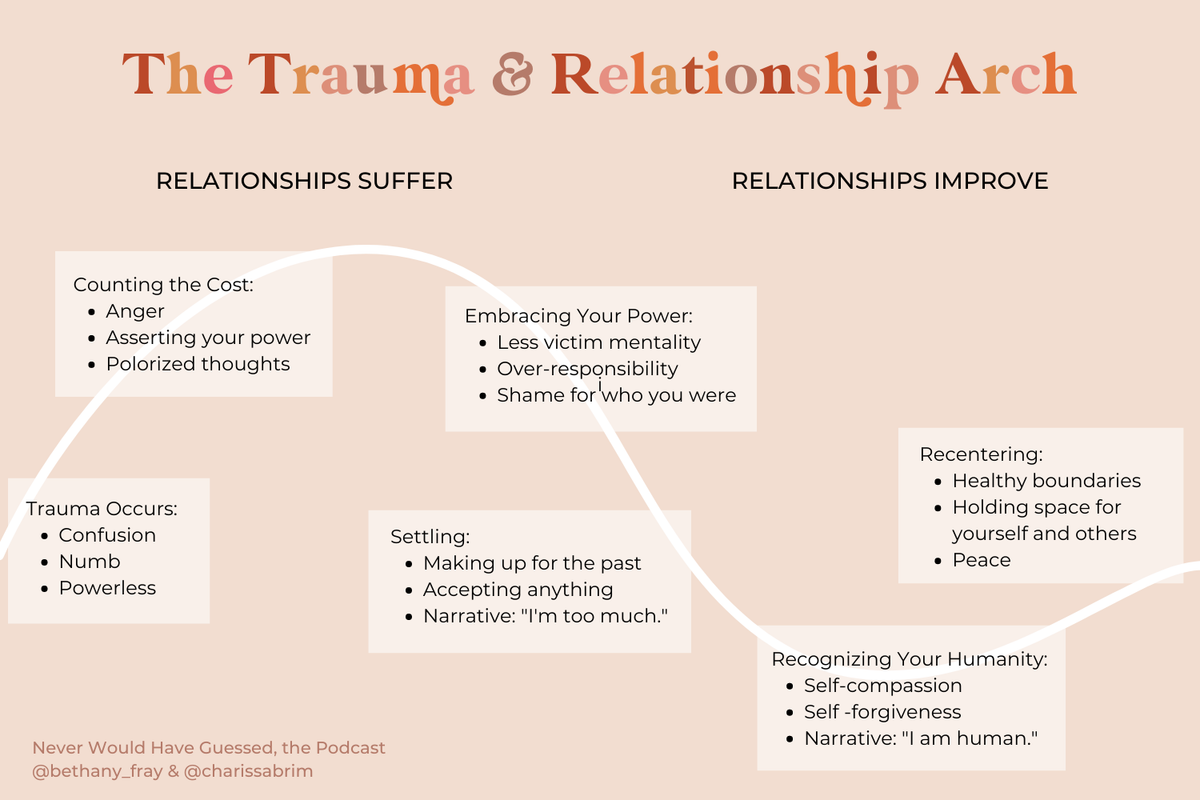
Trauma doesn't just impact you, it impacts your relationships with friends and family, too. Why does this happen, and how can we hold the tension of trauma in relationship today?
Follow us on Instagram @bethany_fray and @charissabrim and online at neverwouldhaveguessed.com
To support the podcast, visit patreon.com/neverwouldhaveguessedpodcast
Show Notes:
Link to the trauma and relationship arch below
https://i.postimg.cc/QMLH4tcv/The-Arch.png
Hello, and welcome to
Bethanynever would have guessed the
charissapodcast. I'm
Bethanyone of your hosts,
charissaBethany fray.
BethanyAnd I'm your other
charissahost Caressa brim. This is a place where we
Bethanydive into the things never would have guessed
charissaabout sexual drama. Here's
Bethanywhat we want you to
charissaNo matter
Bethanyyour relationship sexual
charissatrauma, you are conversation. And while this podcast centers around our experience, the concepts cover
Bethanymay apply other traumas as
charissawell. We are not therapist, but
Bethanyhas been
charissagame changing for of us. seen that safe conversations with trusted people
Bethanybe an anchor
charissain the healing
Bethanyprocess. We know
charissafirsthand that this can be a heavy topic. So
Bethanythis your official invitation to
charissaown your experience of this conversation.
Bethanyget minutes in
charissaand feel like your have become permanent earrings, Just hit the pause button. a breaths,
Bethanymove your body a
charissabit. Decided
Bethanytoday is a good day to enter this conversation.
charissaAnd then trust your decision
Bethanywith no
charissashame. At
Bethanythe end of every episode, we
charissawill guide you through
Bethanya two minute grounding
charissaexercise. leave you feeling
Bethanylight and empowered
charissaby honest conversation.
BethanyThank you so much for joining us. We are so glad you're here. Today in episode five, Chris and I are talking about how trauma has impacted our relationships. And not just romantic ones, but relationships with friends and family as We name what was hard. How we moved through it and what it looks like to hold the tension of trauma and relationship today. Also, we thought it would be helpful to give a little context for this episode. When Chris and I first brainstormed this topic, we were in front of a whiteboard. I drew a story arc and we filled in key parts of our experiences when it comes to healing from trauma. And it's impact on a relationship. You'll hear us reference this arc and the episode a few times. So we put a link to a graphic in the show notes. So when we were together a couple of weeks ago, we were talking about our own experiences in healing and with relationship. And as you and I were talking, we started jotting stuff down on the whiteboard and realized, oh, there's some common experiences here. And it helped us to make sense and to bring meaning to some of the confusion and pain that we've experienced in a relationship, which is what we're trying to do here today. The purpose of this episode is just to shed a little bit of light on the way that trauma has affected our own relationships cuz that in itself can feel so isolating because connectedness relationship is what helps us to heal. And so when, especially the relationship's closest to you when you are. Deep in your healing when those are off and you can't quite figure out how to make them better. It feels really heavy. Gosh,
charissathat's so true. I've heard this said quite a bit from experts on trauma or people speaking about their own experience, but it's basically what you just brought up, Bethany, which is you have the pain from the trauma, but then you also have the pain from the response to the trauma And so a lot of the like, pain from the response comes from what it looks like to be navigating trauma in community. And when it comes to sexual trauma, it's such a taboo topic. It's such an misunderstood topic for the people experiencing it and the people on the sidelines of the people experiencing it. Yeah. In that confusion, it can feel so isolating and you feel like you're just wrecking things, it's just a very confusing dynamic to navigate. So when we talk about our experiences with trauma, whatever topic it is, we are obviously speaking from our own personal experience, but the things that are most connective and the reason that it's helpful to talk about are experiences is not for the nitty gritty details of what happened when, how did I respond? How long did that respond last? When did that stop? Like those things are not necessarily as important as the overall like bird's eye view These relationships are hard. And the more that we talk about it, the more equipped we are to identify it as it plays out in our life and move forward in a way that minimizes the grip that shame has on us.
BethanyYeah. I don't think that we can say too many times in talking about healing in this podcast, healing is not linear. It's just not. Yes. So I agree with you completely. So if you kind of just picture this X like X marks the spot and
charissathis is where
Bethanythe trauma has occurred. There's confusion. There's maybe some numbness a feeling just of powerlessness. But the overarching feeling at the beginning of trauma is just that feeling of shock and not totally understanding what has just happened or what happened in the past. And then this is the part where the line goes up so I think this is where the arc part comes from. This is the moment where you start to understand the cost of what happened to you. You start to name it Oh, what happened to me was sexual abuse or sexual assault. And so the naming of that thing, first of all, some of the confusion starts to go to the side because now what your brain is really focused on is naming what happened to you and for me. And as we were talking, like for you as well, Carissa, what happened in this point of counting the cost of what happened to you, for both of us, the emotion that came in first, like with three roaring Lionhead was anger. Anger. And then there was this response to realizing that we were powerless in that situation. There's this like knee jerk reaction to assert your power. there's a common gosh analogy that we talk about and it's the pendulum swing, So it's like where you go to being No, I'm in confused. And maybe in your own mind of processing, you haven't actually named it to, I'm naming it. I felt powerless. I am angry as hell and I am gonna assert my power. Guess who are the safest people to assert your power with the ones who are closest to you. And so this is where we both named in this arc, that this was the moment that our relationships had a visible, distinct turn. And just and I'll talk about this in the rest of the trauma arc, but this is the point where we go, Oh, crap. We can all imagine it, right? Like a situation where you're trying to assert your power, you're angry that's gonna come out in healthy ways and in not healthy ways. So I'm curious for you, as I describe the peak of the arc, the asserting your power, what was that like for you in your relationships?
charissaGosh, I like get squirmy thinking about it because I still think there's a lot of shame that comes with thinking about that time, yeah. Just being really honest. I'm someone who likes to be well liked and if I could have things my way, everyone would like everything about me. sounds
Bethanylovely.
charissaand So I went from like having a super solid community that I felt like deeply entrenched in to all of a sudden feeling like an outsider. And a lot of this has to do with my own. Like out outside myself. it's tricky to talk about some of these things because I've spent so many years trying to figure out like what was mine to own and what's not mind to own. And the fact of the matter is it's just a freaking mess. it's complicated. It's complicated. And quite frankly, like nobody at the time this was 20 12, 20 13 we didn't have people talking about trauma. And so I think there's just such a lack of education around all of it. So I don't necessarily wanna assign too much like blame or shame to any party involved because it's so layered. And I don't actually know how I would've responded if I hadn't been the one. processing through the trauma. But I think what it looked like for me I liked to play by the rules. was in college when all this happened and you know, I had been a resident assistant and I had been a senator and I was in all these leadership positions and like a very responsible student. And when I came to terms with what happened, I don't think I could have given you the sentence this is what happened to me and I'm angry. Yeah. It was just like, this is what happened to me. And it's totally chill. I'm fine, but like clearly in my actions I wasn't fine. But I think I was too blind to it. I think like anger is actually like quite blinding when you're in the middle of it. Yeah. So for me it looked a lot like rebellion. It looked a lot like I think I was hiding air quote, I was hiding destructive behavior in such a way that I was almost like hoping that someone would catch me and that my actions would communicate what my words couldn't, which is I'm really not okay. And for a while that worked. But then also in doing that, eventually it was like, but I don't wanna give up these habits because I have control over how much I'm drinking. I have control over these dangerous settings that I'm putting myself in. And, it didn't feel like I could give those up in the moment. And so I think a lot of that, Anger came out at my friends who were like, Hey, we're running outta patience for this. You are difficult to be around in your recklessness, in your selfishness, in your attitude. I think the word that just comes to mind is it was a deeply chaotic time. In my life. Yeah. And
Bethanyyou, knowing what I know about your story, and like what we talked about in last episode, Purity Culture. You and I are both the oldest daughters of two girls. So big sister vibes happening. you, Wanted to be liked. You're a pleaser. You were a good kid, you were a leader. And my assumption in that is that you attracted people who were on the same trajectory. Yeah. Yeah. Then if I'm hearing you you're on this path of the do gooder and then you experience this assault and the trauma response was all of these different coping mechanisms that won a part of your life before. so the people you were in relationship with didn't know what to do with that. It was you said it yourself. It was like rebellion, even though at the time I think it was so important what you said, like I couldn't have put the sentence together. I was assaulted and I am angry about it. Cause that awareness isn't there yet. Yeah, because you just weren't there. You're processing yet, which is God, that is so sad for. People who experienced trauma, because it would be amazing if in the moment we could say, this happened. And I'm just trying to cope. I'm just like, I don't know what to do and I feel confused and I'm angry. If we could put those words together, it could be a great gift to our own healing and relationships, but we're just not there yet because our brains are quite literally in survival mode.
charissaThat is so true. And I also think an added layer is like, anger is just not an emotion that is talked about or processed through very often, especially for women. the tightness in my chest, the like heat on my cheeks, like all of these physical manifestations of. What it turns out is anger. I had no idea. All I knew was I just wanted to escape. I just wanted out. Yeah. I am a pretty communicative person. I have always had the words. And so I think there was just this added powerlessness of I don't know what thing is happening inside of me, but I am like flushed and I need out. And now I see that the risky environments and the conflict that I was stoking, that provided an outlet for that, pent up energy So it felt like this is what I have to do to work this feeling through my body. Whereas if I had just had a little bit more understanding of what is anger? How do you compassionately engage with it? How do you communicate to others How do you give yourself permission to feel anger? All of that could have been really helpful, I think. Yeah. It's not always beneficial to do the should or could or would is. Yeah. But I do think anger being such a primary emotion makes it complicated. Yeah. Yeah.
BethanyI don't know if this is true for you. It was definitely true for me. It caused me to push away some people and then it caused others to push back on me. So intensely where I was coming across as a force, but really on the inside, like there it was scaffolding that was barely holding me up. So any amount of strong response back my way was like, I couldn't bear it.
charissaOh yes, Bethany. That's exactly it. The front makes you seem so strong. But it's such a facade for what's actually happening. Mm-hmm. Speaking of a pendulum, that is such a key element. So in your experience, what did that internal scaffolding and the force that you were, like, how did that play out for you in your community?
BethanyI'm trying to think of a good way to summarize, because for me my sexual abuse came out when I was 12. So there were pieces and chunks that were dealt with over a 10 year span. And within that 10 year span, I was also a teenager in it. So some things were overnight. But for me, what's interesting, when you and I were talking, and when I picture this arc of. Hounding the cost, asserting my power, the anger. I think for me, that really kicked in like around 19, 20, 21. that's the age of Bethany that I picture. When I picture just like mad as fucking hell. And ain't nobody walking on me anymore, even though I was tender, tender, tenderhearted on the inside. That's scaffolding that I was talking about. I've alluded to this in other podcasts, but my response when I was younger was to become an a plus prude So
charissait was like I was, I just
Bethanydug my hands into the dirt of produce. Everything wonderful and good and make people love you. Which is still a surprise to me. I'm like, man, yeah, it's just an interesting response that maybe will be clear to me, like the more I impact my life as I get older. But I then nominated myself as world Justice originator and still the way that came out in relationships
charissaWas like,
BethanyI decide what is right and wrong. The world just became black and white and it was, there are evil people, there are good people, there are good intentions, there are evil. Everything was so polarized for me. You talk about a way for that just intense reaction in anger need to come outta your body. The way that I took that out was like pointing it at anything or anyone who I deemed as unjust. And so for me, like when I think back oh honestly, a graveyard just came to my mind. Like when I look back at the graveyard of my trauma response, for me it is all of the words that
charissaI said that were
Bethanyjust so harsh. To myself and to other people. And I was dishing out these statements thinking that they were gonna protect me and protect the ones I loved. But what was really happening is I was trying to put in these anchors to hold up my scaffolding, but really polarizing thinking doesn't make you feel any safer. It actually just leads you down the path of more anxiety, more war control because the world isn't black and white. There's actually very few things that are black and white.
charissaI think there's two things that you said that really resonate and are like so powerful. First of all, the black and white thinking The polarizing. Though we might have had slightly different expressions of that, I can fully identify with that. Especially when you pair that with what you said about the words that you said. To others and to yourself, the minute you start polarizing the world and you're part of that world, it is so hard not to tell yourself that you had a part in. What happened to you, And so therefore, if it's gonna be polarized, and that means you have to be bad. Mm-hmm. Oh, I'm not good, so therefore I am bad. And so the spill over onto the relationships around us originates inside. Yeah. Yeah. And that is that is the source of the chaos. And the hurt is we have the vision to see the scaffolding, like the ways that we are barely holding on. And so everything is in a front to us. Yeah. And so we have to be bigger and meaner than what we see inside. Yeah. As a way to protect ourselves.
Bethanythe feeling is that it's all out here, but yeah. The source of. The immense response of asserting power and the anger when it comes to the justice and all of that comes from the deep inadequacy we feel inside to assert our power in a healthy way. and the shame and I'm sure this is true for other traumas as well you feel so insanely out of control. Honestly, this took me about 10 years to process. I had no trust in myself. I have absolutely no trust in myself. And if you don't trust yourself, then you're walking around trying to figure out what to anchor to, thus the need to polarize the world and make it black and white, because you're like, Okay, I can't anchor to myself because I don't trust myself. And there's that deep feeling of shame. And so you're trying to find the think or the person or the system or the religion that is strong enough to anchor yourself too, so that you don't feel like you're gonna be blown away by every thing that happens in life. it is a terrifying place to be.
charissaYeah. That's a component that we haven't touched on yet is the fear, right? Because that's like the anger and fear. Go so hand in hand when you feel like you yourself are not trustworthy. When like for me, I didn't feel like a good judge of character because in my mind I'm like, why I didn't see this assault coming and I should have. And so like, I'm not trustworthy in that way. All of a sudden I can't tell who's in my corner and who's not. I can't tell who is safe, who is not. So anything that makes that internal scaffolding tremble, all of the alert systems go off. All of the fear. I just picture all of these alarms, like the movie Alien, right? You have the fog machines and the alarms and the sirens and the lights. Oh my God, that was 21 to 22, nonstop, it felt like, Oh yeah, Okay. So obviously we are not still in that place, at least not as regularly and as intensely as we were Yeah. During our early twenties. Yeah. So talk us through we have that experience. And then for you and I, what seemed to come out of that
Bethanyif you think about that as the peak and then you're slowly descending, there is a gradual embracing of your power in tangible and healthy ways. Which looked like boundary work and at this time I was just student talk therapy, which is really helpful for me. I started getting my voice a little bit of a time starting to embrace my power, which lessened the feverish search for power and the black and white thinking. it softened my mental space a little bit. What about you?
charissaThe smoke kind of cleared for me. I just casually moved to Australia, just, just a
Bethanysmall move.
charissaI was like, I'm a, I'm a get outta here with two suitcases and know where to live. It was honestly, there were a lot of people that had a lot of valid concern and it could not have been a better decision for me. Like I just needed to get out. That was helpful for just like giving me a break. And mind you this is not necessarily something I wanna go too far into, but there were some compounding traumas in that season too. So it was like, while I was processing the sexual trauma, then there were other like traumas busting in the doors as well, which I think it seems like that's somewhat of a normal occurrence, Trauma never just like sits on its own. You don't get to press pause on the rest of life just because you're like trying to figure out what happened to you. Yeah. So I think I needed to escape and then come back and I think had been so deeply wounded by the way my friendships went at the end of college, right before moving to Australia. It was so confronting, It was so different than any sort of like friendship interaction I had before. I was trying to make sense of what happened to me, what part did I play? Like why can't I fix this? There was just like so much. And so I think I almost went into overdrive of okay, I'm figuring out what happened to me. My anger isn't as strong. I'm getting back into these healing places and spaces. And so now I get a second chance, like now I get to have a do over. I'm creating new friendships, I'm moving to new spaces, I'm charting at new life. it wasn't an overnight shift cuz Australia was still kind of messy, at the beginning. But over time, especially when I moved back from the states I felt myself becoming way over accommodating in my relationships because I knew that I had been quote a lot in the relationships that I had right after the assault. And so it was almost like to prove that I'm okay. I need to to borrow your phrase, I need to soften my edges in these relationships. I need to really be extra hyper, hyper vigilant about how I'm showing up in spaces, what I'm saying, what I'm not saying. Make sure that you're super nice. Make sure that you're not taking up too much. Make sure you're not making anyone upset. Yeah. Like just. Ticker tape, right? Is that what it's called? At the bottom of a sports game? you were
Bethanyasking them wrong. I used athlete
charissaCan you tell that? Athletics dominated my entire life. Wow. To disappear quickly.
BethanySo just, Okay, so
charissamaybe subtitles would be a better, like right now? Yeah. Oh my gosh. No, it just felt like there was just this like running scroll through my head of Girl, it's your fault that these other relationships suffered. And so it's your job to tighten it down and be good. If you wanna have friends, you have to be good. That's a fascinating thing you just described, because
Bethanythere it is again, the pendulum swing. Swing or the polarization. So it's, I feel powerless, I'm angry, I'm gonna assert my power. And then it's an over responsibility. Of the emotional reactions of others to the place that you were in. mixed in with some acknowledgement, right? I don't wanna be polarizing in my description, You're not 100% in survival mode like you described. You're in a new place that's beautiful and funny. You have some fresh air, you have some really just some space to take up. And so your brain isn't only trying to survive, which naturally means you're gonna have some more capacity to think about other people and their response to who you are. So yeah, there's that mix of things there. And then perhaps a little bit of taking too much responsibility
charissawas that how it was for you? Yeah, I think so.
BethanyI have this memory I think Jordan and I had been married for two years and I had just finished a year and a half of therapy where I was going like twice a week for an hour and a half. It was extensive. My therapist at the time was reflecting back to me that I was doing pretty well in this season. She was helping me realize, Oh, I'm no longer in survival moment. I took a break from counseling for a while, and I remember sitting on the floor, we had just gotten a new puppy and I'm playing with the puppy and I, gosh, I don't even remember what Jordan and I were talking about, but I remember he responded to me this way where, Oh, you are afraid of what I'm gonna say next. And I'd never had capacity to see him before. I was only. Trying to survive. And so I remember in that moment, all of a sudden, I like, I think I even said to him in that conversation, I'm sorry, I know this has been hard. Like it's your turn. You know it, it's your turn. Like I am now the agreeable and quieter version of myself. I'm healed. It's fine. Everybody else could take up space just like
charissayou go on in I've worked through all my stuff. And what's funny is if only,
BethanyOh,
charissaif only it was a literal baton that just you could pass on and you're like, whew, glad that's outta my hands. Yeah. I can think of my own moments, I think the, clinical term for it is split functioning, right? So then all of a sudden you like enter into this space where you, like your therapist said like you're doing quite well. You're like out of survival mode. You are getting there and it feels so nice to finally get there and to not be on the receiving end of everyone's Grace and tiptoeing around it feels so nice. Okay, I'm back entering into society
BethanyI'm ok everyone.
charissaYeah. where were we? It's like, okay, where you were But yeah, so then you almost have this like surface level where you know, you're making everyone around you happy, You're playing all the games that you need to play, you're being agreeable, you're paying it forward, You're making up for what you messed up in your last relationships, but under the surface you're still healing and you're still in pain. And so you have this inauthentic existence almost. Not necessarily intentionally, like I think you're just almost subconsciously doing it where. You are fine for most of the people and maybe even some of your close friends. But then when it is you and your spouse or someone who's deeply in your inner circle, that's where they see that inner turmoil is still there and you're still super ugly to them. And I think this is where even though we're talking about the trauma arc, like this is another example of like it's cyclical like it changes shape and it changes intensity and it changes the way that it expresses itself. But within that splint functioning, you're still hard to be around with that inner circle. So your internal voice is still it's coming out of like such polarized black and white thinking, but you know this inner secret of I am not. Exactly who I am presenting as but I like have to present that way. If I'm going to make it through this life with anyone in my corner
Bethanyyeah. So then the talents of shame are still just locked deep into who you are. Because there's this realization of, Oh, I need to function a certain way. I desire to function a certain way and I can keep it together at work. I can keep it together when I'm hanging on a girl's night for the most part. But I spend so much of my energy keeping it together for the other people so that when I come home, move out of my chair because like I spent, I have spent all my good
charissacoins on everybody else and. I need to
Bethanylet my guard down I think you named something that's Oh, it's such a, it's a human response, but trauma makes us forget our humanity. And so I think it's so important to be able to name these different cycles because we need to know that we're not the only ones. And we need to be able to tell our brains, Hey, you are that person at work. And also you are this person that needs a safe haven for your most vulnerable emotions to come out, you're growing and you're learning and you're making mistakes and it is messy. And you are with roommates or a family who is, they're in the mess with you. And guess what? They're bringing their own Yeah. I remember feeling envious of other people that I was around who they were doing the same thing. And I just remember being like, I wish I was as grounded as she was. I wish I was as happy. What would it be like to have her life that's just not as anxious and like horrible where I can look at it going, I have no idea what she or he was going through. The more that we present our best selves, I think the less opportunity we have to connect. in our humanity with one another.
charissaI feel like you just knocked the wind out of me what you talked about how trauma makes us forget our humanity. But then through the examples that you've just described, like ironically, trauma is what reveals our humanity. like even birth, like our very first interaction in this world as humans is very traumatic. No one's birth story is Sam's trauma. And so I just think that's such an interesting element. in the way that we hide, in our split functioning to whatever degree that looks like, right? Whether it's With huge discrepancies or small discrepancies, we're doing it to protect ourselves that we can hold onto belonging and hold onto our place in this world. Which comes from like feeling like we were ousted from our place in this world, right? Yeah. That is such a very interesting way to put that. When we feel like we are less human because of the way that we are like showing up in this world that changes how picky we are about what we get in this world. Okay. Say more. Yeah. It's this space where all of a sudden you realize I don't deserve scraps. I am just as worthy as anyone else. I had something happen to me that was inhuman and I had a very human response, and I don't have to hold that against me for the rest of my life. And so I think you start looking around and saying what do I actually want? What is actually good for me? What feels life giving? What is really depleting. Where can I show up more authentically? Where can I let a little bit of that, like door crack into the like messiness in the middle. Yeah. Like where can I sacrifice my quote unquote good standing and replace it with authentic standing. And you start finding agency to advocate for the life and the relationships that are actually meant for you, that you actually want.
BethanyYou're able to forgive yourself for the ways you responded in your pain. And sometimes that might be a conversation, like sometimes it might be going back to a person who you need to and saying, Hey, I'm sorry. I'm sorry, I. Responded this way. I'm sorry that I held your feet to the fire in this way. Whatever apology it is that you need to make, which is not saying I'm a bad person, I'm a screw up. I think shame keeps us from doing that because we're constantly trying to prove that we're not bad because shame is screaming at us internally that we are a bad person. But once that shame starts to subside through healing, it gives you some breathing space to say, Oh yeah, that was me. And also this is me. And, Oh, wait a second. I have longings that I didn't even realize I had because now I have space to have these longings and. I'm gonna start pursuing them and here's the season I'm in. I am taking up more space than I ever did and then I ever thought I could, but it's not in this Howard full, real robust. Just hear me roar. 100%. Sometimes it's that way, right? But there's so much of my gentleness and nurturing and gosh, you could take up space in a soft life giving nurturing weight. I just didn't know that was possible. I thought it had to be one or the other. in my own healing journey. Like that's the prize. My personal belief is that living in that soft largeness is actually gonna lead other people to their own largeness. Yes.
charissaOh my gosh. Bethany, That soft largeness, that is such a beautiful picture because we've in this conversation, gone from like Things were so black and white and we were too much to okay, it's not that things are black and white and we were too much. It's that we can still occupy our natural space and there can be nuance in how we do that. And it had me thinking about my own experience, and for me it looks more like self-compassion. what are areas of my trauma arc that I can. Look back and just soften my face when I look at myself and open my arms and be like, Gosh, I'm so sorry. Just be so compassionate for the little girl and the fierce women who are just raging inside. And thank them for what they were able to do and redirect them in ways that are more helpful and beneficial. And the more that I can do that in my past, the more I'm able to do that in real time in my actual relationships. Find self-compassion, which then translates into compassion for others to yeah.
BethanyYeah. I love what you're saying about self-compassion so I've lived in a college town or college town adjacent for the last almost 10 years. And I like, it was a joke with my friends of Bethany hates the college student. I was just, I was always, it was like the college girls are taking all the good stuff out of Target and it was like, Oh, the college kids are taking all the happi hours. It was just like everything that was wrong with my town was like this, The college kids. And it was like when they left for the summer, I was like, The cottage kids are wrong. Mind you, I was like 25
charissa26. So
BethanyI'm like,
charissacrotchety
Bethanyold woman in a 20 for old body. And when you were talking about the self-compassion, I have compassion for myself and therefore I have compassion for others. There's a sister truth to that, which is look for the age of person that you had the least amount of patients for. And that might be a place where you have trouble having compassion for yourself. I. Wolf despised college, me Can we erase, just erase her? And all the decisions that she made. And so it's an interesting as that self-compassion has come in turns out I freaking love having friends in their early twenties. I, I do. It is like the biggest gift. And so that's been a surprising gift of healing is man, not only does it feel so much nicer to occupy the space within yourself, but you can have relationships with others that maybe you were closed off to before because there was so much pain or trauma in that time zone for you.
charissaThat's such a good visual for the importance of self-compassion and Yeah. I think you gave another really great visual earlier of like the talents of shame that like, just dig into us. And I think one of the most powerful ways that we can release those talents is through self-compassion Yeah. it just redirects the power, right? Like when you have compassion for yourself, then you can't also hate yourself
BethanyI wonder if you could describe what it looks like to have self-compassion. Is there an exercise, is there a practice that has helped you access that?
charissaSuch a great question. Two things come to mind. The first thing, like almost like before I could practice self-compassion, I had to just come to terms with like I might have done some things that make me feel embarrassed, but that doesn't mean that I am an embarrassing person. Or an embarrassment. when we say it out loud, it's like I, I don't think I'm an embarrassment. But those are the things that get whispered deep within that make us so prickly to those seasons and make us so hesitant to offer or accept self-compassion. just talking that out, looking at that part of your story naming what is it that makes you so afraid of honestly diving into this and then once we can do that, like Yeah, it just like for me, sometimes that always sounds hokey, but like I have had to say out loud so many times cause it like comes up, right? Cause it's related to friendships and relationships. So anytime like I have an interaction with friendships and relationships, which is all the freaking time, I'm like going back into these like painful places and it's helpful for me to say out loud to myself you were going through a lot. Mm-hmm. And also like you are so much better equipped today. The things that you did in response then. Like even if the ceiling came falling in today, You won't respond the same way. You are an evolving person and you're going to continue to evolve. to boil that down, what parts of your story feel prickly? Take a look at that. Remind yourself that those feelings don't define who you are or your worth. And give yourself the nurturing statement that you were going through a lot and You can move forward differently.
BethanyYour response to trauma is not your identity. Creating this nurturing statement allows you to expand and it allow, it brings in that humanness of, Oh yes, and I am growing and I am changing and I'm still human and I'm gonna make mistakes. And like it allows for more, it allows for that expansion of healing, which is a good stuff.
charissaAbsolutely. Absolutely. Oh, Beth, you thank you so much for Just being someone who talks through drama arcs behind the scenes and with the microphones it is amazing how unbelievably helpful it is to hear one person reflect back their own experience. It just speaking a shame, that does so much to minimize it. Yeah. So thank you. Right
Bethanyback at. Love you.
charissaLove you too.
BethanyFor our grounding exercise today, we're going to do something called E F T. Now, if you haven't heard of EFT before, or haven't practiced it, it stands for emotional freedom technique. And the goal of this tapping practice is to move negative emotion through your body and get you feeling To put it simply you'll take three fingers on your right or left hand and you'll gently tap different places on your face and chest. As you gently acknowledge the emotion that you're feeling and then move it through. I'm going to start the first exercise, but you can always listen for a minute to get the feel for it and then jump in. So starting on my forehead, I'm going to take three fingers on my right hand. And just gently tap. And I'm going to start by acknowledging the emotion that I feel. After our conversation today. This conversation brought up a lot for me. Now I'm going to take those three fingers and move them to my cheekbone. Again, just gently tapping it. Doesn't take much And I'm going to acknowledge how I'm feeling in this moment. This conversation brought up a lot for me today. I'm thinking about the relationships that have been impacted and how that has impacted me. Now I'm going to move my fingers and tap, just blow my nose and above my upper lip. I understand My responses in relationship. We're a trauma response. But it's still hard for me to take in. Now move your fingers to your chin and tap I accept that my trauma response is a part of me. And a part of being human. Now take your fingers and tap gently on your collarbone. Even though I feel fear and shame. And maybe some regret around the ways I responded. And respond in my trauma. I choose to accept and love myself. Now I'm going to move up to the top of my head. And repeat the same game with gentle tapping. Even though I don't like my trauma response. I'm afraid of abandonment. I'm afraid of what other people think of me. I choose to. Love and accept myself. And then we're going to go through that one more time. Tapping on the forehead, cheekbone upper lip and chin. This conversation has brought up some things for me. I know that. The ways I have responded to my trauma are human. And don't make me a bad person. I'm going to move from my Chico into my upper Even though I have responded in some ways. That I regret. I choose to love and accept And now moving to my I am learning and growing every day. And I am worthy of being in relationship. And now to my collarbone. I am worthy of being loved well. And I am healing. One of the keys to an effective EFT practice. Is to incorporate honesty and self truth. With the gentle tapping. So I encourage you to bring in your own truths in this exercise. You can also go onto YouTube and search EFT, tapping for lots of incredible videos On how to incorporate this practice for yourself. Friend. And thank you so much for being part of this conversation today. We value you and your story and send a warmth and light to your healing
charissaBreathing deeply. Paying attention to my body. These have all been crucial to my healing And If I'm honest Part of my healing journey has also included learning how to feel comfortable asking for what I would like. So here If you enjoyed this conversation today, please feel free to share it and rate, review, and subscribe wherever it is that you listen. You can find us on Instagram at Bethany underscore fray and at Carissa brim. Or online@neverwouldhaveguessed.com. You can also help sustain the podcast by becoming one of our Patrion subscribers. Find us at patrion.com/never would have guessed podcast.. All of this really does make a gigantic difference for us and helping these conversations. Make their way to others who need them to. Friends. Thank you so much for listening. As you go out into the rest of your day. May you feel empowered to navigate the things others never would've guessed about you. And to make room for others doing the same. We'll see you guys next week