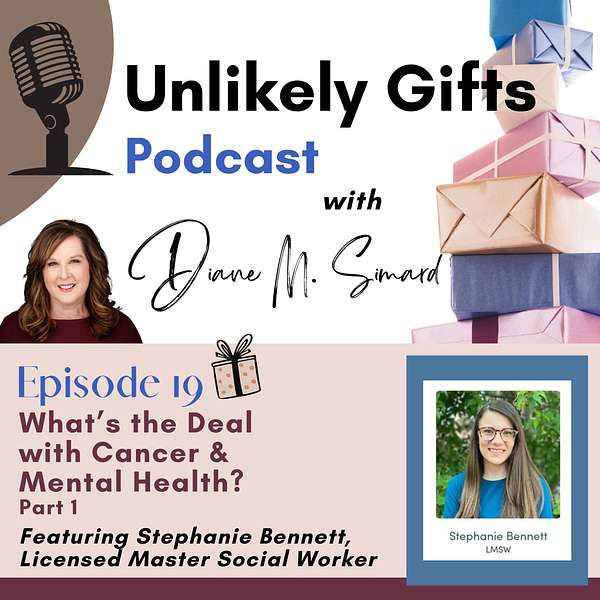
Unlikely Gifts with Diane M. Simard
Unlikely Gifts with Diane M. Simard
What’s the Deal with Cancer & Mental Health? Part 1
In Part One of this two-part series, Stephanie Bennett, a Licensed Master Social Worker, shares:
Hi, and welcome back to the Unlikely Gifts Podcast. I'm your host, Diane M. Samard, and I'm a business strategy advisor, author, blogger, and breast cancer survivor who advocates for more attention and resources for those impacted by the psychological traumas of cancer. First off, my heartfelt thanks for supporting my special 10-episode run of Monday Afternoon Club podcasts last year that focused on the importance of healing forward from the traumatic events in our lives. Beginning with this episode, I'll be continuing with the healing theme: interviewing change makers who help those traumatized by life's events. These impact leaders are driven by research fact information, offering fresh perspectives and solutions to colossal challenges. They truly are unlikely gifts. Today, I'm honored to welcome one of the most delightful, compassionate people I have ever met. Stephanie Bennett is a licensed master, social worker, and mental health therapist at LE Mental Health. Welcome to the podcast, Steph. Thanks so much for having me. Well, we're delighted to have you here. I just love how you and I met back in 2019. Would you please briefly share that story?
Stephanie Bennett:Oh, I'll try to keep it brief. I was just reflecting on um when we first met, I came to a talk that you were hosting, uh Lunch and Learn at the University of Colorado back in uh September of 2019 before COVID took over our lives. Um it was one of the most uh moving talks I had ever attended. Um, you were talking about your work uh at the University of Denver. You were talking about your book, uh the unlikely gift of breast cancer. Um, and I was so moved by that uh interaction. I went and bought your book, ripped through it, and then um had the audacity to contact you and say, Diane, tell me more, be my friend. Um and the rest is history. So um, since then, Diane, you've been nothing but a pleasure to work with. You've been a lovely friend, um, a mentor, and just an exceptional person that I'm so glad to have in my life. So um thank you again for having me today.
Diane M. Simard:Well, you are so delightful. And uh trust me, my life has never been the same since we met. So I'm curious, would you please explain your role as a mental health therapist and tell, talk about what types of clients you typically work with?
Stephanie Bennett:Sure. So um, now that uh I've gone through and gotten the schooling, I am uh by trade a licensed master social worker. So that means that I um have the capacity to work with folks in a social work way, but also I have the ability and privilege to work with folks as a mental health therapist. So we do that one-on-one talk therapy the way you imagine. Um there's not the Freudian chair. I have a very cozy office. Folks come in and we talk for 50 minutes or so about whatever issues coming about in people's lives. Um, but I specialize and I have a real spot in my heart for folks living with chronic illness, chronic injury, um, and how the medical system interacts with mental health because um health is health. It's not mental health and physical health, it's all health. So um that is where I like to spend my time. And I take folks from all walks of lives, different experiences. Um, but I got into the game uh largely because of everyone's uh different interactions with the big C or cancer. Um I feel everyone has a cancer story, and um I am no different. And um, part of what inspired me to do the work that I'm doing is um I I was reflecting on, I remember reading your book and wanting to hand that in as my um statement of here's why I'm doing what I'm doing. So it's so important to me to work with folks, not only with uh chronic illness, but especially cancer.
Diane M. Simard:Well, you are certainly speaking my language, and you are part of a much larger field of study has many names, including psychosocial oncology, also known as psychooncology, which was introduced, by the way, at Memorial Sloan Kettering Cancer Center in the 1970s by one of my personal heroes, the late Dr. Jimmy Holland. And she's considered one of the pioneers of the field, at least in our country. And this is a big, big question, but how do you define psychooncology?
Stephanie Bennett:That's a good question. Um, different answers for different people. And you're absolutely right with their different names. Some call it uh psycho oncology, some folks call it onco-psych. Um, in general, it's the intersection of how mental health and physical health come together, specifically as it relates to cancer. Oncology, of course, being the study of cancer and the treatment thereof, uh, and the psycho piece being the mental health piece to it. Um, there are different folks that use different names, so um, whatever word that you might hear or know um, that is probably going to be the same across the board.
Diane M. Simard:Well, let's dive deeper into psychooncology. This may seem like a rhetorical question, but I love, love, love your views on this topic. What is it about a cancer diagnosis that sets it apart from other health conditions?
Stephanie Bennett:It's a good question. Um, there's a huge stigma that comes along with the word cancer. As I said, the big C. Um, there are different perceptions that folks have from the outset. Um, I know that we're going to be talking a bit about the uh the trauma that can come from a diagnosis, but it can come from immediately that first statement of getting that call or getting that result. So there are different pieces to a cancer diagnosis, but um it is a chronic condition. You are a survivor from the day that you are diagnosed, and uh it looks different than other conditions because it's treated differently and there's such a huge focus on it, in addition to the fact that there is so much research going on and so many advances that are taking place uh have taken place and continue to take place.
Diane M. Simard:It's so true. And even in the almost nine years since I went through it, there's that there's been so many advances, so much more education. Thank goodness, so much more focus on mental health and cancer. And I know there's so many different causes of psychological trauma, but do you believe cancer is one of the most emotionally traumatizing experiences we human potentially face?
Stephanie Bennett:It sure can be. Um, I am definitely a believer of it, it all depends on how we choose to face the challenges that we are faced with. Um, a book recommendation that you didn't ask for that I'm going to put out there is Man's Search for Meaning. Um, it's not a cancer-related book, but it talks about an interesting experience by Victor Frankel, who was someone who uh was captured during the Holocaust and survived. And he talked about his experience using logotherapy, and it's the meaning of how we ascribe to different experiences. So to hearken that to the experience with cancer, certainly it can be a very traumatizing experience. However, we have the ability, one of the only things we have control over is how we face these issues and how we choose to deal with them in light of certain things going on. So absolutely, it can be one of the most traumatizing experiences, and I've heard that from many folks that I work with, how this was something that shook them to their core, reasonably so. However, it can be traumatizing at different times for different reasons. So, as I will continue to talk about, it is an extremely individual experience, and so how each person navigates it is up to that individual.
Diane M. Simard:Well, one of the reasons I was so terrified when I got my diagnosis was because I knew so little about breast cancer, and I always figured it was never gonna happen to me. So I never concerned myself with it. Yet yet generally speaking, treatments and early detection capabilities are rapidly improving for some types of cancer. Not all, but some. And I'm curious, what does that type of progress impact how you approach your work with your clients?
Stephanie Bennett:Sure. So um it is so wonderful. I think that it's absolutely great that we are making such advances in the medical field. Um these strides are not the same across the board. However, uh survivorship has increased in the last couple of decades, which is absolutely amazing. Um, the other side of that same coin, I'd be remiss if I didn't mention that having all of that information out there can sometimes shoot us in the foot. It can be detrimental for folks who turn to Dr. Google all of the time, spend hours researching, potentially overloading themselves with information. So I would love to caution folks to take in information and be diligent and selective with what you're taking in, but also remember to take a step back, to rely on your medical team that you feel hopefully very supported by. And if you don't, then that's an opportunity as well to find a team who hears you and sees you. But with that being said, um, it can be a double-edged sword.
Diane M. Simard:Absolutely. And and I I'm just curious, so if if a cancer diagnosis is so traumatizing, why in the world has it taken so long for our healthcare system to be even begin to address the importance of mental health when it comes to treating cancer? I mean, uh I mean the brain is part of the body.
Stephanie Bennett:It seems obvious, and that's part of the soapbox that I will stand on and preach from for forevermore. Um, I wish I had a better answer. However, um I do think that we are a medical model. The Western system um sees uh, bless our physicians, we we see things as nails if we are a hammer. So we're going to treat the disease, and the the mental health piece is going to be in the background. Fortunately, I think the tide is turning. We are beginning to bring mental health more into the fold and acknowledging that mental health is health and bringing that in. However, it is not quite there yet, but we are working on it. One of the quotes that I love so much is the best time to plant a tree was 20 years ago. The next best time is now. We should and probably could have been doing this many years ago, back when Jimmy Holland was making this uh a bigger thing back in the 70s and 80s. However, we are doing it now, and that's what heartens me.
Diane M. Simard:Me too. And and again, uh like I said, even in the nine years since I experienced this, uh heart is warmed and it is part of the conversation. In fact, um, psychosocial care is typically a part of most cancer treatment protocols now, at least ex it is acknowledged. And I I am encouraged by that. There's so much room for improvement, of course. And I was always concerned about the lack of of those who were trained specifically in this field. And that's why I keep in such close touch with therapists like Stephanie of how this field is not just uh improving but advancing. And I'm so encouraged by that. So, from your experience as a therapist, Stephanie, and your experience in oncology-related social work before that, do you think the stigma of mental health in general is fading?
Stephanie Bennett:The short answer is yes. I do think that the stigma is fading. However, of course, there's a long answer. I feel that there is a ways to go. There is more work to be done. Um, there is stigma there. There's learning and there's unlearning that really needs to be done. This is on a macro level as well as a micro level. Um, when I see folks individually, I hear interesting comments every so often of, oh, well, it's all in my head, or oh, I wasn't allowed to as a child have some of these feelings. These are generational things that we are gradually unlearning, as well as the conversation on the macro level, as mentioned, making mental health care more accessible. Um, in the news recently, I heard about how Medicare is now allowing more folks, more accessibility to receive treatment from mental health providers. And there aren't many types out there. Um, the story that I just heard recently was about how licensed practicing counselors or LPCs, as well as LMFTs, are now able to take folks with Medicare, which was previously not a thing. And this is opening more doors for more people to access care, which is part of the problem. The accessibility of care is huge, as well as the stigma around, oh, what does mental health mean? Do I actually need that? Yes, mental health is health at the end of the day.
Diane M. Simard:So that is such a great segue into my next question. Because I have become such a firm believer that our body's physical ability to heal itself depends a great deal on the state of our mental health. And I was um someone who really proved that to myself and and how important uh I needed to make sure that I was in balance and alignment emotionally before my butt was ready to take these steps and and and endure the the these brutal treatments. What what is your position on that? I I feel like I probably kind of um made that almost too easy. How do you feel? How do you feel about that statement?
Stephanie Bennett:Yeah, you set me up well for that one, Diane. I agree with you 100%. Um, if I haven't made it clear, mental health is part of our overall health. So it makes sense that our ability to heal physically is uh hand in hand with our mental health and our ability to putting good in and getting good out. So it's so important to be able to tap into good mental health resources in whatever way we're able to. And that doesn't just mean therapy. You know, coming from a therapist, of course, this is going to be a little biased, but that's not necessarily going to talk to a professional. Those are different things as far as seeking out the supports you have in your life, the family and friends, being able to ask for and accept help. That is also making sure that you're taking time to do the things that you enjoy. You know, you're not a different person with a diagnosis. You are that same person and you can still do activities of enjoyment. Perhaps they might look different now or need to look different temporarily, but it is so important to uh have some sort of semblance of normalcy amidst these different pieces. What brought you joy before, if it continues to bring you joy now, great, let's keep doing that. If we need to find other things as well, that's okay. That's an opportunity to find things that are going to sustain us and allow ourselves the ability for our bodies to heal and move down that path of health.
Diane M. Simard:Yeah, I recall again, right after my diagnosis, I my mindset was that this was such a monumental moment in my life, which it was certainly, but uh it I made it a really big deal and and I really psyched myself out. I had I was flustered because I had no idea how to do cancer right. There's no guidebooks on that. And I don't mean to make light of this topic. I really don't. All I'm saying is I just had no idea where to start. I was just so overwhelmed. Um but I'm gonna shift gears on you on uh on you a little bit here because I'd love to talk about your career field. And you explained how we met and and and why we so uh stay in close touch. But from a caregiver perspective, let's kind of you know go to the other side of the table and and would you talk to us, say someone's interested in in becoming a social worker, like you, who works predominantly with those impacted by health conditions, primarily cancer, where can they go to learn more about this career field?
Stephanie Bennett:Oh, absolutely. Um as a huge proponent of the mental health field, um, I'd be remiss if I didn't share that social work is one piece of this. You know, there are different folks out there, as I've briefly mentioned, LPCs, LMFTs, um, social workers, of course, um, psychologists. Um, as you know, Diane, that's where I started my training. Um I was going to be a psychologist back in the day before I made a pivot and realized that this spoke better to my skills and my abilities and where I really wanted to make that difference. So, with that being said, um some of the agencies that I have worked with that I'm members of include APOS, that stands for the American Psychosocial Oncology Society, as well as the Association of Oncology Social Workers, which of course is specific to social workers. So those are a couple of different agencies that provide different trainings, specializations, additional information. But I also tell people to go just higher level, that 10,000-foot view. There's nothing that Google can't bring to us. So even Googling, you know, social work oncology, or what does psychosocial oncology look like, or what does my diagnosis or my disease look like, even within the place that I'm being treated? I'm in the Kansas City area and the KU system is definitely one that is largely advertised. You know, these different cancer centers have a lot of different things to offer. So I'd also start on the ground level. Where are we at? What do I have around me? So it all just depends on where folks are at and what they're uh willing and able to take on. As I mentioned before, it's super important to be conscientious of what we're taking in and not over-inundate ourselves with things because it's very easy to get overwhelmed. There is a lot, a lot of information out there. And I'm wondering, Diana, I don't mean to interview you, but if this was a harkens true for you, where um there was so much all of a sudden that we're able to find what do we take in and what do we actually hold on to? What is meaningful to us, and what do we have to suss out as this is actually good stuff and this is stuff I can put away.
Diane M. Simard:Yeah. If I remember I I was so overwhelmed and not knowing where to park information, and and I'm so data-driven that I just started to speed read. I ordered a bunch of books on Amazon and I just started to speed read because that brought me comfort. It wasn't necessarily the information. There were a couple of books that were so technical. And um, then I found that the books that were meant to um educate gently, it it was too superficial. And so there are so many resources out there, uh, but exactly what you describe is what happened to me. It was too much. And I was trying to keep up with all the notes and all the tests, and there's just so much to do that it was overwhelming. And and I felt um, thank goodness my husband Renee was with me on all my appointments just to take notes to make sure we got all the information down. It's one thing to capture that information, it's another thing to try to understand all of this technical language when you get 10 to 15 minutes talks with your medical oncologist. And so, and and she was great. She encouraged us to write down questions and and all of that. But again, this was a whole new language, and that's really what I struggled with the most. So back to your practice and as you meet with clients, do you generally find that there are consistent misconceptions of cancer questions, you know, that you address again and again with your clients? I'm I'm just curious, sort of these traits or what kind of keeps recurring in your in your work.
Stephanie Bennett:Yeah, very much. Um, I would say it's less about the questions. You know, um, folks very fortunately, I think, do a good job of relying on their medical care team for, you know, what is my staging? What does this diagnosis mean? You know, those types of pieces. But commonly I hear the, which makes sense, right? The I hear the emotional response of, I don't know what I'm going to do next. I don't know how to organize all this information. There's just so much. Um, I I see a lot of folks who are very overwhelmed by what should I do? Where should I go? Who do I bring in? How do I move forward with this? And what I typically do is take a lot of time to create space for those folks who are dealing with so much uncertainty and do my best to allow them to put it all out there. And I very commonly tell folks, it sounds like you got a lot going on. Why don't we just write everything down? And that might sound silly, but get a big piece of paper and everything that's in your brain, because there are so many things flying around up there, put it all down on paper. And then perhaps it might feel a little more doable. Then we can do things like organize what things are related to health, what things are related to life, what things are just kind of out there in. The ether? Are there pieces that we can ask others for assistance with? A lot of folks that I talk to are afraid to ask for help, whether that's, you know, they've never done it before. Perhaps it's a pride thing. Perhaps they're not even sure who they would ask for assistance with some of these pieces. And I want to put out there, as I tell with all my people, it's okay. It's okay to ask for help. In addition to the fact that I have no doubt, I've heard from so many folks, people keep asking, what can I do? How can I help? And I can appreciate how that can be overwhelming. And I also very much encourage my folks to, when they're doing this reflection of if you're writing stuff down or even if you're just thinking about it, how can someone help? Is that picking up a kiddo from school one day so that you don't have to think about it? Is that making a dinner? Is that coming to an appointment? Just as you said, Diane, I really want to focus also on the help that folks can receive when it comes to those medical visits because this is another language. This is another situation that you are being completely thrust into, and it can be so much. Is there someone that you can bounce these ideas off of that you can talk to about? Hey, here are my questions. Does this question make sense so that when I ask my provider in that 10-minute visit that I have, it makes sense and we're able to make best use of that time? How can that be helpful for that person? And it's a very individual experience. However, I think it's also really important that we are gentle with ourselves, which is easier said than done. Completely appreciate that. But very, very important to uh try and get ourselves to a place of uh vibrating less at that high frequency, bringing it down just a bit. We're not going to dissuade all of these pieces of anxiety, but we're going to hopefully be able to walk through them a little bit more easily. And again, hopefully with help of others. And I also keep harping on how it's important to bring others in. It's also okay for this to be a private experience. You don't owe it to anyone to share what's going on unless you feel so inclined. I'm very much a person who thinks that bringing folks in can be helpful, but I also appreciate different people's experiences are all different. So do what feels right and authentic to you.
Diane M. Simard:I wish I'd had someone like you to talk to all those years ago. And I'm going to ask you, let's stay on this topic because I want to dig just a little bit deeper. As a social worker, what I'm hearing from you is that my experience with COPE, the specialty that I founded, the Center for Oncology, Psychology, Excellence at the University of Denver, those are future licensed psychologists. And refreshing to me to listen to you talk about activities, exercises, as opposed to just let's sit on the couch and talk this through, you know, what's wrong with your head. You know, that's that's a stigma statement. But help us understand what it is different about your background and your training, your approach to what you do that offers up tools and and because it it feels to me like you really listen and um help those that that you work with feel like this is an individual experience, you're focused totally on them. Tell a little bit more about your training and why your approach is different.
Stephanie Bennett:Sure. Um and this might be a bit uh specific to um, Diane, you know, my story about going from uh doing a PhD and realizing that um there's so many wonderful things about being a part of that field. This is no flack on my psychologist friends, my peers out in the field. Um, they do amazing work. And some days I find myself going, dang, maybe I should have continued doing that. But I made that switch over to social work because there is a piece about uh we can talk to someone about their experience. We can talk about, you know, how they're feeling blue with what's going on. Of course, that makes sense. Till the cows come home. I'm here to talk to you about that. But in addition to that, there are other pieces of your life experience that matter too. Um I'm thinking about a gal that I've seen recently who um, you know, she's receiving treatment for her breast cancer diagnosis and she's kicking butt. So proud of her. But she's also very much concerned with her 10-year-old son. Of course, that makes sense. She wants to know not only how to navigate her own experience, but how she's going to continue showing up for her family and being a mom and coming to field trips and all of those different pieces. So, as with any person sitting across from me in my office, it's all about you are the expert in your own experience. And each individual experience is so different that it's so important to focus on what matters to you. Where are we going with this? What's important in your form of treatment as well as what's going on in your life, because it can't just be tell me about how you feel about your cancer. It's all of it together. So it very much depends on that person and what's important to them. Um, it's also worth noting that different people want to do different forms of treatment, and that is just fine. It is your right to be able to figure out how you want to go about treatment or non-treatment. I've spoken with people at different stages of their journey and people who have recurrence. Sometimes they decide what I need to do right now is lead the most comfortable life, and that's not going to be the most intensive treatment. That's going to be leading a very meaningful next few years of my life, whatever that looks like. And that's okay. It really is up to that person. You are your own expert, and it's okay to listen to that, damned be what someone else might have to say. Everybody's going to have an opinion. They always will. And if we're going to ask other folks like the mailman and everyone else, then their mother, why? What's the why behind that? What makes you tick? What's important to you? And really listening to that, holding that value uh strongly to our hearts, which again, easier said than done, but so important to figure out what's important to you and how are we going to go there together. In addition, if you work with a clinician, a mental health provider or otherwise, and they're not seeing that, they're not seeing you. I very much encourage folks to get second or third opinions, reach out for additional help. It is so important to feel comfortable with the people that you're working with if you're able. I also appreciate that that's not something that people can always do. So I want to be conscientious when I say be sure to find your care team that you enjoy, but also be realistic with what you have going on as well.
Diane M. Simard:Well, uh I am certainly reminded every time I talk to you why I so value your approach to this topic of psychooncology. It's so enlightening, it's so refreshing, and it's so authentic and real and understandable. And I I want to thank you for that. And that that is why I absolutely wanted to have you on the podcast, because you have such a refreshing approach. And uh I'm so grateful. And and I have a feeling, um, I'm gonna throw just a quick question in asking you kind of what comes next now in this field, as far as from your perspective in the field of psychooncology, where do you see that things are going to evolve? Because as I mentioned, this is a field that has really come into its own. More people are getting trained to be therapists, but where do we go from here?
Stephanie Bennett:That's a great question. I'm excited to see where the field is going. Um, uh, an answer that you might have seen coming is we need more. Uh, there need to be more folks that are trained in this discipline. We need to have it be more accessible. I'll say it again. We need to make this so much more accessible for folks. It I um I've had the pleasure to work at different agencies where I've seen different wait periods for people. And very sadly, I've seen very long wait lists to work with psychooncologists because of their special teas. Um, it's so wonderful, but it's also so difficult to get in with them. And people need help now. People need help yesterday, and that's what gets me so much. So, what I want to try and do, uh, the work that I'm doing is making mental health accessible. Whether it's talking to a social worker or, you know, another professional who has that onko experience, great. If there's someone that you can get into mental health-wise in the meantime, great. Let's lean into that and do with what we can. But hopefully we're going to train more practitioners, increase accessibility, again, reduce the stigma, and allow folks to get access to care and open the conversation, not just about mental health and cancer, but mental health period and how it is so important in every aspect of our lives.
Diane M. Simard:Yes, yes, yes, yes, and yes. Well, I still approve your helpful views of why addressing mental health needs is so important when it comes to treating cancer. And be sure to listen in for our next episode when Steph and I are going to discuss ways to address the stress, depression, and anxiety that often impacts those dealing with cancer. And of course, that does have to include the caregivers. Plus, she'll share how to access helpful resources and give us her best helpful tips for how to navigate such a frightening experience. In the meantime, Steph, you're licensed in Kansas and Missouri. So what's the best way to reach out if someone in those locations is interested in working with you?
Stephanie Bennett:Yeah, absolutely. One of the best resources to find me or any other mental health provider is a website called Psychology Today. The name is a misnomer because it's not just psychologists, it is all mental health providers within the area. It's a wonderful tool, very much like Google, where you can type in things like your location, the type of provider you're looking for, if you're looking for someone with cancer expertise, if you'd like a male or a female provider, so on and so forth. So psychology today is very much a resource I would recommend. Uh, if you're looking for me specifically, the agencies that uh I'm involved with are Ellie Mental Health, that is a national agency, but I'm specifically in the Kansas City area. Additionally, uh, I work as a contractor at Gilda's Club Kansas City. That is another resource I would highly recommend for folks who uh have been touched by cancer, as well as just folks in general, if you're looking for a great grassroots community uh resource for folks to gain support, education, resources, uh, and connect with other folks as well. So um I can also provide my email. And if you get in touch with Diane, you can also get in touch with me.
Diane M. Simard:I will help you track that her down. We will find you. We will find you. Well, well, my dear friend, thank you so much with my whole heart for sharing your helpful wisdom on the Unlikely Gifts podcast. And I look forward to part two of our conversation. You truly are a gift to me. Before we go though, do you have no thoughts?
Stephanie Bennett:Um, you are also such a delight and a gift, Diane. Thank you so much for having me. Um, if I can leave everyone with just one piece uh of information, please don't be afraid to ask for help. It can be scary. I totally appreciate that. Um, and being vulnerable can be scary, but also vulnerability and putting ourselves out there is a huge sign of strength. And oftentimes folks are surprised by how many people are willing to help out and lend a hand. In addition, remember, you can do this. Diane, thank you so much for having me. It's been great to be here today.
Diane M. Simard:Oh, my pleasure. Always, always such an honor to speak with you. Well, my thanks to our producer Larry King, host of Larry's Sort of Fun Stories podcast and co-host of Collage Travel Radio for helping make the Unlikely Gifts podcast possible. You can stay up to date on what all I'm up to by signing up for my free monthly newsletter and blog at my website, DianeMsimard.com, or follow me on LinkedIn and Facebook. If you'd like to send me an email message, go to the contact tab on my website. And if you're interested in my award-winning books, those are available for sale on my website as well. Finally, please, please remember to nurture your mental health and your physical health. And don't ever forget, there is an unlikely gift in every circumstance. I'm Diane M. Samard, and this is the Unlikely Gifts Podcast.
.jpg)
