Unlikely Gifts with Diane M. Simard
Unlikely Gifts with Diane M. Simard
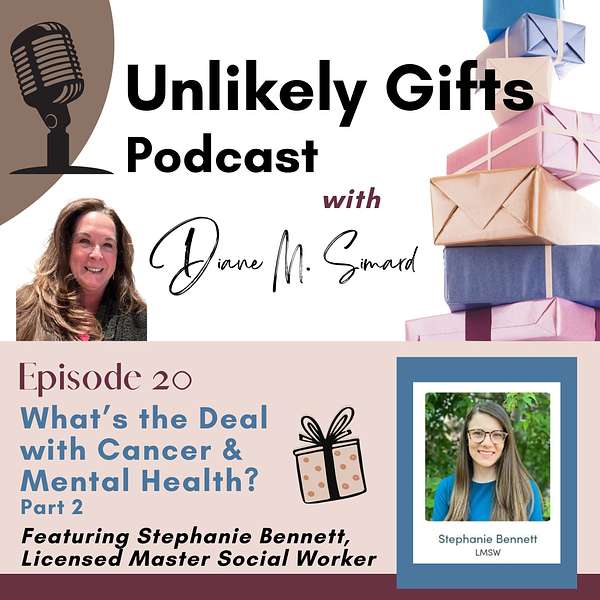
What's the Deal with Cancer and Mental Health? Part 2
In the second part of this two-part series, Stephanie Bennett, a Licensed Master Social Worker, shares:
- The significance of why and how she and Diane met
- A brief review of psycho-oncology
- Why the psychological trauma caused by a cancer experience often stays with you and how to address it
- The three symptoms of mental health concern when it comes to cancer
- Brief review of some of the free general and mental health-specific resources for cancer
- How to contact Stephanie
Diane's Information Links
LinkedIn: https://www.linkedin.com/in/diane-moravec-simard/
Facebook: https://www.facebook.com/DianeMSimard1965
Website: https://www.dianemsimard.com/
Speaker Reel: https://www.youtube.com/watch?v=jdL0q0b_nhQ
Heal Forward Book: https://www.dianemsimard.com/heal-forward/
Unlikely Gift Book: https://www.dianemsimard.com/book/
Hi, and welcome back to the Unlikely Gifts Podcast. I'm your host, Diane M. Samard, and I'm a business strategy advisor, author, blogger, and breast cancer survivor who advocates for more attention and resources for those impacted by the psychological traumas of cancer. I have been looking so forward to this episode, the conclusion of our two-part series with my dear pal Stephanie Bennett, who's a licensed master social worker and mental health therapist at LA Mental Health. Steph isn't an unlikely gift, one of the many amazing healers I have gotten to know who help address what was severely lacking in what I call the intersection of mental health and cancer, also known as the field of psychooncology, when I went through stage 3C breast cancer nine years ago. Welcome back, Steph. I still have chills from our first conversation. I could talk about today's topic for hours.
Stephanie Bennett:Honestly, same. Thanks so much again for having me, Diane.
Diane M. Simard:Well, my pleasure. Thank you. And before we launch, how about a brief review of our last podcast? Yeah, that sounds great. So I just mentioned the term psychooncology. For those who might have missed the last episode, would you please provide a quick review of the guild of psychooncology?
Stephanie Bennett:Sure. So uh psychooncology, there's several names to it. You might hear onkopsych, psycho-onk, all of those different types of things. Um, in general, psychooncology is kind of the intersection of the different aspects of an individual's experience with cancer that goes beyond the medical treatment across the cancer trajectory, including diagnosis during treatment, transitioning to and throughout survivorship, as well as approaching end of life. Uh, my own uh interpretation of psychooncology is also just how an individual reacts to the experiences of cancer as a whole, um, how they're introduced to their diagnosis, the medical system, as well as the intricacies of an individual's treatment.
Diane M. Simard:Well, thank you. That was so, so helpful. And I remain so passionate about this work that you do because of a vow that I made to God, actually, the night before my first chemo infusion of all awful nights of my life. I had never been so scared, and I can still clearly remember how sick to my eyes I felt and how I couldn't stop crying. I was so scared. So, talk to me about the type of psychological trauma caused by cancer experience that often causes it to stay with you.
Stephanie Bennett:Yeah. So uh first and foremost, everyone's experiences is so different. Diane, I think that it's important that you talk about, you know, the night before your chemo treatment, that that was a really impactful night for you. There are different experiences that are salient to different folks. I've heard of different people who are most nervous, you know, after they receive that diagnosis, the big C, as it were, after that phone call, that's when it really becomes real to them. Some people, it's at different times, different stages, and it could be a completely innocuous time as well. Um, it might have been you, Diane, or it might have been another person who tells me that um they pulled up to the cancer center before a treatment, and that's when the panic attack hit them. Um, different experiences have different uh different individuals have different experiences at different times. And um it doesn't have to make a rhyme or reason, doesn't have to make sense. Trauma can come from anywhere within the experience, including things like I've heard a lot of folks telling me their experiences of getting jerked around the medical system. That in itself can cause trauma. So uh the whole disease, the whole aspect of cancer itself can be a very traumatizing experience. And um, as the social worker in the room, very much would encourage folks to talk about their experience, not only with their disease, but also with their experience with the medical system.
Diane M. Simard:Thank you. Oh, yes, and yes, I totally agree. Um, it sounds to me like some who are impacted by cancer, which by the way, includes caregivers, that we can experience what we call post-traumatic stress or PTSD. Is that is that really true?
Stephanie Bennett:Absolutely, yes. Um, it can be the diagnosis itself, it can be uh any sort of piece along the treatment trajectory. There can absolutely be traumatic experiences. And it doesn't have to be big T trauma. I think sometimes people think of PTSD as war or, you know, those different kinds of big experiences, and then think, oh, perhaps my experience isn't the same and you know, I don't want to call it that or something like that, which I appreciate. And it also can be minimizing to our experience. If it is impactful to you, if it feels like a salient event, yes, it can absolutely be a type of PTSD. And perhaps we don't need to give a big diagnosis to it, but there can be aspects of trauma in everyone's experience, especially when it comes to a big diagnosis like cancer. It can also come about in other pieces of the medical system. So it's important to be kind with ourselves and to remember that our problems and our feelings are valid, even if they're not something like being shipped off to war or something like that. It can still be trauma.
Diane M. Simard:Thank you. Well, and it certainly can be. And as many know, for years I was writing and speaking and advocating for more resources to educate and to heal the psychological trauma that cancer often creates. And along the way, I've learned that there's commonly three symptoms of mental health concern, those being stress, depression, and anxiety. So let's talk about stress. And I can honestly say when I was first diagnosed, I didn't have any idea how or where to begin. There's no guidebook for this. I wanted to grieve and cry, and yet I needed to call all authors to make appointments and figure out how I was going to rearrange my schedule for cancer. And I also needed to determine whether I was likely gonna live or die. So, with all that, how do you recommend someone cope when they're in that much distress, especially in those first few moments after diagnosis?
Stephanie Bennett:Absolutely. Um, the first and foremost thing I'd like to put out there is it is so, so important to be kind to ourselves and keep in mind that while there are a thousand things to do, or it might feel that way, we can only do so much at any given time. So it can be important to prioritize each of these things. And as I talked about in our last episode, it's so, so important to be able to ask for help. It can feel very uncomfortable, especially as folks, perhaps Diane, you can relate, as folks who like to do things for themselves, who are very self-sufficient. It can be so difficult to lean into other folks. However, it is so important to do that if you feel comfortable doing so. Um, I also encourage folks to do their best to sit with discomfort. And that might sound like, okay, Steph, yeah, whatever you say, but it's so important to try and create the space for the knowledge that there's only so much that can be done in any one day. Um, when we get off of work and the doctor's offices are closed, that's super frustrating. What are we going to do with that time to make it useful and continue moving forward in a productive and useful way? We don't need to lament and kick ourselves for, oh, if only I had done this, the shoulda, coulda, woulda's of the world. That is so difficult to try and disengage from. But working on that psychological flexibility and being okay with, okay, this is where I'm at now. How am I going to move forward as successfully as possible is so important. As mentioned before, if you are able to and feel comfortable asking others for help, I would very, very much encourage that. In addition, when someone is trying to deal with a lot of distress, it can be such a great asset to talk to not only a mental health provider. Of course, I'm a bit biased as the social worker in the room. I would definitely encourage folks to talk to a mental health provider, but that can also look like talking to a trusted friend or family member. You don't have to give them your whole life story either. It is important that whatever your experience is that's authentic to you, you feel comfortable sharing and just letting folks know, I'm really stressed about this. Yeah, that makes sense. Of course you are, but also being able to put that out there, put it out into the world and get out of your head can be so important as well.
Diane M. Simard:Well, let's talk about distress screening for a moment. Um, my understanding is that distress screening, and that's of course when you're asked to self-identify your level of cancer-related stress, that it's a required part of cancer care in the US. Is that right? It can be. It's not across the board, but it can be, yes. So yet I didn't get asked to self-identify my stress level until I got started with chemo, which was the first part of my treatment plan, and that was at least a month after I got diagnosed. Again, that was nine years ago. But do you think our healthcare system is doing a better job of identifying stress earlier?
Stephanie Bennett:In a way, yes. I I think we're getting there. However, I'm not confident we're doing everything we need to not only identify when someone's experiencing distress, but also intervening when folks are having quite the experience. Um, it is my own personal bias here. Uh, when folks get that call, that big C word, uh, that should be uh also an immediate connection with someone to provide psychosocial support. Perhaps not that might not be the moment where someone is ready to have that conversation, but allowing that person to know we have supports. If it's today, if it's next week, if it's next month, whatever that looks like to you, we can talk about this. The distress is normal and it is okay to work through some of these pieces. Um, I think that there's something to be said for the screeners that you mentioned. They are good, but not great. It's just a Likert scale on a piece of paper. That does nothing to tell me about the breadth and the depth of what you are experiencing. As we talked about in our last podcast, uh, it's so important to not only look at that person on paper from the medical side, it's also so important to get to know the person on an individual basis. You're not just a diagnosis, you are also a whole person with different things going on in your life, and it is so important to be able to acknowledge each of those things because you are not just a single-dimensional human, you're multidimensional with a lot of pieces that go into not only treatment and recovery, but also how we're experiencing this issue.
Diane M. Simard:Thank you. And you heard it here. Let's do a better job recognizing these distress symptoms from the get-go, out of the shoot, because it starts immediately. So thank you for your affirmation on that. But let's move on to depression. And and my cancer-induced depression seemed to be triggered by, of all things, the monotony of treatment. Um, you know, feeling decent one day and then nauseous and exhausted the next. And I was so worried worried, depressed, that I was never going to feel good again. And I really got down about it. So, what are your thoughts on that?
Stephanie Bennett:You know, that's not an uncommon feeling that I hear from folks, Diane. Um, I I have a quote that it might ring hollow in this moment, but one of the quotes that I really love is nothing blooms year-round. So it's important to remember that when we are in the the bowels of treatment, you know, when we're in the trenches, that this too shall pass. I have a card in my office that says, this too shall pass. It might pass like a kidney stone, but it will pass. And the only way around truly is through. I appreciate that it might feel like things are dark and hopeless, and that is okay. That is not our destination, though. It can be a stop on the way. And I think it's important to allow folks the ability to be upset, to be sad, to feel sorry for themselves, to have those feelings. It is okay, but again, it is not our destination, and it's so important, especially before we even find ourselves in that position, or when we are there at our deepest, darkest points to reach out for help. That can also be taking the support from someone who's extending their hand. Perhaps you're not able to see it, perhaps you're unwilling, but being able to lean into the supports that are all around you, family, friends, medical providers, and your medical team to ask, hey, I'm really feeling down. Who can I talk to about this? Is there a social worker? Is there a psychologist? Is there a peer support group? People who know what I'm going through, who can relate to this experience? Who can we lean into to remember that this too shall pass, even though it's difficult and it might be like a very large kidney stone? We will get there. How are we going to make it?
Diane M. Simard:Well, I would say that in addition to feeling depressed, sometimes I felt guilty. Like I wouldn't say it was survivor's guilt just then, but I wasn't convinced I was going to survive treatment. Um, and yet I felt bad for having a type of cancer that was considered treatable despite being so brutal. Because I continued to meet patients in the infusion rooms, and then later when I was going through radiation, and I could tell they weren't were not likely going to survive. And it was an awful, awful feeling. So, what would you recommend to someone experiencing similar feelings?
Stephanie Bennett:That's an interesting question, Diane. I'm struck by um early in my graduate studies, I met with a group of individuals, all breast cancer patients, uh, survivors, I should say, and they were trading stories and diagnoses and treatments and such. And I heard a really interesting comment about someone who said, Oh, I wish I had that diagnosis instead of what they had. And I thought, I understood where she was coming from, but that was a very invalidating comment, in my opinion, because someone's struggle, regardless of what's going on elsewhere in the world, is still their struggle. That is your truth. So it's so important to acknowledge that feeling. I hear what you're saying about there was guilt. And perhaps it wasn't survivor's guilt. It was just guilt in general about different pieces of your experience. And it's okay to own that. As before, it's not that necessarily the destination, but that is an important feeling to honor and then talk to ourselves about where's this coming from? Why am I sitting with this? Is this something that I can process myself? Is this something that I can process with someone who gets it? This is very much a time where I would lean into talking to someone who has the understanding of mental health with chronic injury, illness, or cancer, something along those lines, because that can be so, so different than talking to a mental health provider who doesn't have that familiarity. So very important to acknowledge those feelings and try and examine where's this coming from? What can I do about this? Can I logic myself through it? Is this something I can garner support from others with?
Diane M. Simard:Well, thank you for referencing uh the banter. And I know, Steph, you read the unlikely gift of breast cancer, and I referred to one uh conversation that I was a part of during um chemo as Thunderdome. It happened to be a particularly caustic conversation because there were seven of us receiving chemo in this infusion room, and it was around, let's go around the circle. And um, there was a lot of judgment passed. And I I actually it was one of the lowest points uh for me because no one really understood me and the situation I was in, and they were all trying to outdo each other. It was very, very, very unhealthy. So um, so let's just stay on this topic for one more question. Do you generally find that depression symptoms reside after treatment is completed, or are there other milestones that generally result in some relief from cancer-induced depression?
Stephanie Bennett:It's a good question, Diane. And I think that uh, like most of my answers, it depends. Uh, it depends on the individual and their experience. Um, something that I have seen frequently in uh my care though is when folks are going through treatment and they've finished or they've gotten to a point where um anniversaries start coming around. I'm thinking about the anniversary of diagnosis, the date of diagnosis, um the date of our first chemo infusion, the date of our mastectomy, or whatever that is for that person. And it's different for different people. But um it I heard once that grief is like a ball bouncing around in uh like a in a box, right? And every so often it'll hit the button and grief comes about. And it's not just grief, it's any of those feelings. The ball's bouncing around. We could be living our lives on our own, and then all of a sudden that button is pushed, and we can find ourselves, I don't want to say freaking out, but enjoying the pleasures of feeling quite depressed, quite guilty, quite anxious, quite whatever that is, almost out of nowhere. Perhaps sometimes we can see it coming, but also perhaps it can be out of the blue. And we acknowledge, like, oh my gosh, this smell, taste, feeling brings me right back to that place. And that can be extremely distressing. And that is valid. So it's very important to acknowledge what's going on, not only in the here and now, but was there something that reminded me of something else that happened? What brought me into that? And how can I continue to try and make positive change to allow this, maybe not to never happen again, but to notice when it's coming and lean into my supports so that I'm not staying in that place quite as long as I once was?
Diane M. Simard:Oh, those triggers.
Stephanie Bennett:Very much.
Diane M. Simard:Yeah. And on that note, let's turn to anxiety, which is kind of the third leg of the stool. Now that one word captures exactly how cancer made me feel. But cancer aside, how do we as human beings typically respond to feelings and how can we more effectively overcome these feelings of anxiousness?
Stephanie Bennett:Yeah. Um, I think it's important to talk about anxiety and how it can be useful to us. And perhaps that might sound a bit trite, but what I'm going for here is anxiety is what kept us alive back in caveman times. It is what makes sure we don't get hit by a car when we're crossing the street, all of those types of pieces. Um it is important to have some level of anxiety. It allows us to get things done, stay alive, do all of these different pieces. However, there of course is the point where it starts to be detrimental. So it's very important to keep an eye on that. Are we noticing that there's been an uptick in how anxious we're feeling, how often we're feeling anxious, our psychosomatic responses? Are we getting sweaty and is our heart having palpitations more often than usual? There's something to be said for the anxiety that comes about with a diagnosis such as cancer. It is not uncommon for folks to receive uh psychopharmaceuticals to help with things like panic attacks, with generalized anxiety that innately comes with a big bad diagnosis that folks can have a perception towards. In addition to that, that anxiety again can help us when we're trying to make sure that we are noticing all of those things, that thousand checklists of things that we need to do. However, it's also important to try and keep that in check. So, again, this is where I'm going to be a proponent of reaching out for support. And it doesn't have to be a mental health provider. I think that there's something very therapeutic about leaning into the people that you love, the people and the activities. That doesn't just necessarily need to be a conversation with someone. That can be snuggling your cat, walking your dog, that can be doing an activity of enjoyment. In addition to all of those pieces, I think that it's important when we find ourselves in the heat of the moment, feeling really activated, whatever that is, it can be so helpful to try and down-regulate our nervous system. Easier said than done at times. Definitely get that, but it can be so important to remember to breathe. Taking a good soothing breath and engaging in mindfulness and other breathwork techniques, such as foursquare breathing, starfish breathing. Uh, there's many different resources out there. Um, give it a Google. That is not uh tried and true across the board. These are different techniques that folks can try on in order to gain a little bit more of a grasp on what we're experiencing and allow ourselves to cool our heads a little bit and use our whole brain when we're thinking so much about all of these pieces, and I'm so anxious, I don't even know where to begin. Bringing that down just a bit by trying to take a soothing breath, maybe taking a sip of water, doing an activity that's going to allow us to get better to a place of epistasis where we can move forward with a bit more logic can be so helpful.
Diane M. Simard:So good. So, so good. And you mentioned some great resources last time, but let's spend some time because I really would appreciate uh kind of a comprehensive list of these resources that you recommend. Um, and uh particularly those that are at no cost, because I know there's a lot of those that can help with really all of the things that we've talked about so far.
Stephanie Bennett:Very much. Yeah, so there's um a plethora of resources on the internet. I encourage folks to go out and do their own searches, but also be mindful of what we're consuming. Use vetted uh sources. I'm thinking about the American Cancer Society. That is a huge, wonderful resource. Um, there are specific mental health resources that um I'm a part of as an affiliate social worker. I mentioned in our last podcast uh the American Psychosocial Oncology Society, wonderful place for education, for resources, uh, for additional training for not only the consumer and caregiver, but also for professionals like myself. You can receive additional training and expertise. In addition to that, the Association of Oncology Social Workers is a wonderful resource for professionals to again get additional training and use that as a wonderful resource. In addition, there are many free resources out there that are disease-specific, of course, but there's also general resources such as Gilda's Club, the Cancer Support Community. Um, there are many different agencies that also provide free education, such as Triage Cancer. They provide educational opportunities, lots of education, and the ability for folks to connect with one another. There is something huge to be said for the peer resource abilities there. So there are more that I haven't named. Definitely give it the opportunity to see what's out there, but also be impartial. Make sure that you're using the best information that you are able to find.
Diane M. Simard:So helpful. Thank you, thank you. And aside from mental health, are there any other useful tips for navigating such a frightening experience as cancer that we just haven't covered?
Stephanie Bennett:Um, I think that one of the important pieces, if I haven't uh put it out there enough yet today, is that the only way around is through. And while it may be uncomfortable, doing your best to work through the feelings that arise in whatever way is authentic and meaningful to you is what needs to happen. Um, it is so important to, again, work through each of these pieces that we're feeling rather than shoving it away. I often use an analogy in my work where if we continue to box something up, those icky feelings, the stuff that we don't want to face, and we put it on the shelf, eventually that shelf could get so heavy that it could fall on us and cause real problems later. And that's not to say that we need to do all of the processing all at the same time. There's a time and place for some of these things because we have a lot going on in our lives. We are not just our disease. We're also parents. We have jobs, we have lives, we have all of these different pieces. So being able to put something into a box, we call that compartmentalization. Being able to put that thing on a shelf for a bit can be helpful. And then we also, when we have the time and space and ability, take it back down and work on that, either individually with a mental health professional or with whatever way feels authentic to you. I haven't mentioned religion yet. If that is an important piece to you, lean into that. That is okay. And it doesn't even have to be religion. It can be whatever piece is meaningful to you, and it can be more than one at once. We're a multifaceted individual as humans. So being able to lean into that and bring in all of the important pieces to our experience will allow us to be even more successful.
Diane M. Simard:I um I'm certainly not the trained therapist here, but one of the best suggestions I ever read was schedule worry time. To actually set aside time and to say, okay, I'm from this time to this time, I'm gonna just focus on this and think about it. And until then, I'm just gonna put all that off because I'll have special time to do that and to address that. And and I actually still do that now. Um, just time for me, really. And it's been so helpful. So I I so sincerely appreciate your insights on why we need to address certainly the mental health needs when it comes to treating cancer. And you've been so helpful. And how can someone who's interested in working with you reach out to you? Do they have to meet with you in person, for example?
Stephanie Bennett:Oh, yeah, great question. So our brave new world post-COVID has certainly allowed us to uh expand mental health access. So um currently I'm in the Kansas City area. I'm a licensed uh master social worker in both the states of Kansas and in Missouri. Um, not only can you come and see me in person, but I also offer telehealth services. So if you are in one of those two states, I'd be happy to see you uh via telehealth. And the way to get in touch with not only me, but any mental health provider, a resource I mentioned in our last podcast, is PsychologyToday or PsychologyToday.com. And that is like the Google of mental health providers. It's not just social workers, it's not just psychologists. It's pretty much any mental health provider, and you're able to search by things like location, gender, insurance coverage, specialties, for example, if you're looking for someone with a chronic illness background, uh, all of those types of pieces. So uh the other portion that I'd like to put out there, if it's me, great. If it's someone else, great. It's so important to be able to work with someone who sees you and is able to meet you where you're at. It doesn't necessarily matter who that person is as long as y'all jive and as long as it's moving in that right direction. Um, I've said it before and I'll say it again, if you're not necessarily the most comfortable with your care team, it is okay to make changes. I've heard a lot of folks who feel very um in a way about potentially offending a provider or being worried, like, oh, what might they think, or will I not receive the same care afterwards if I get a second opinion? And those are all reasonable concerns, but I'd like to also uh provide some education and let folks know it's your experience and you are allowed to make the decisions that you need for your best health. Um, I got a little off track there, but as far as working with me or otherwise, uh feel free to look folks up on psychology today. You can also get in touch with Diane if you'd like to reach out to me individually. Um, and then I would very much also encourage a resource that I mentioned before. Uh, Gilda's Club is a national agency. I'm a contractor with the Kansas City location, a wonderful resource for education and support.
Diane M. Simard:Well, thank you, my dear friend, with my whole heart for sharing this time with us and for lending your perspectives and helpful advice. You truly are a gift to so many.
Stephanie Bennett:As are you, Diane. Thank you so much for having me. It's been a pleasure. Fantastic.
Diane M. Simard:My thanks to our producer Larry King, host of Larry's Sort of Fun Stories podcast, and co-host of Collage Travel Radio, for helping make the Unlikely Gifts Podcast possible. You can stay up to date on what all I'm up to by signing up for my free monthly newsletter and blog at my website, DianMSMR.com, or follow me on LinkedIn and Facebook. If you leave me an email message, go to the contact tab on my website, and if you're interested in my award-winning books, those are available for sale on my website as well. Finally, please remember to nurture your mental health and your physical health. And don't ever forget, there's an unlikely gift in every circumstance. I'm Diane M. Samard, and this is the Unlikely Gifts Podcast.
.jpg)
