Steadfast Care Planning

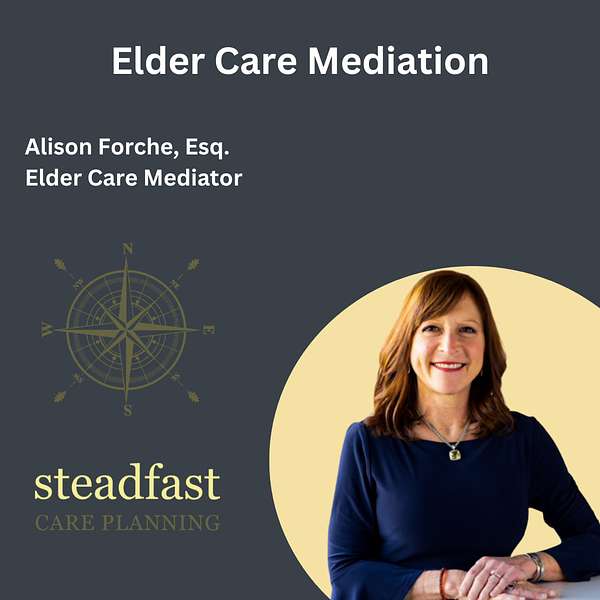
Elder Care Mediation with Alison Forche

Kelly Augspurger Season 2 Episode 14

Use Left/Right to seek, Home/End to jump to start or end. Hold shift to jump forward or backward.

0:00 | 29:46

Send a text

Join us in this heartfelt and informative episode of the Steadfast Care Planning Podcast as Kelly sits down with the esteemed family law attorney and elder care mediator, Alison Forche. Together they delve into the emotional and complex journey of elder care planning, discussing the pressing issues faced by families across the country.

Kelly and Alison explore the intricate and critical need for elder care advocacy. They underscore the challenges that come with being a supportive partner in decision-making. From the nuances of family caregiving to the invaluable guidance provided by professionals, they highlight how preparation and early conversations can make all the difference.

In this episode they covered:

🔹 The importance of being a proactive agent in elder care planning.

🔹 The role and benefits of elder care mediation in elder care planning.

🔹 How to mitigate the stress of unexpected care needs through early dialogue.

🔹 Tips for building a network of professional referral sources.

🔹 The ways in which elder care mediators can provide comfort and solutions to families.

🔹 Utilizing mediation to address family care conflicts and dynamics.

🔹 Understanding the neutrality and benefits of elder care mediation.

🔹 Elder care mediation tips and how to have constructive conversations with family members.

Connect with Alison Forche and for more information about elder care mediation message Alison through LinkedIn (https://www.linkedin.com/in/alisonforche/) or visit: https://forchelawandmediation.com
______________________________________________________________________________

➡️ Watch to this podcast:  https://youtu.be/pi58xFlXtD0

#LongTermCare #ElderCarePlanning #SteadfastCarePlanning #LongTermCareInsurance #ElderCareMediation

For additional information about Kelly, check her out on Linkedin or www.SteadfastAgents.com.

To explore your options for long-term care insurance, click here.

Steadfast Care Planning podcast is made possible by AMADA Senior Care and Steadfast Insurance LLC.

Come back next time for more helpful guidance!

Kelly Augspurger [00:00:02]:
Hey, everyone. Welcome to Steadfast Care Planning where we plan for care to live well. I'm your guide, Kelly Augspurger. With me today is Alison Forche, family law attorney, trained in family law and elder care mediation. Alison, thanks so much for being here.

Alison Forche [00:00:17]:
Thank you for having me.

Kelly Augspurger [00:00:18]:
Today we are going to be talking about elder care mediation. So, Alison, can we jump right in?

Alison Forche [00:00:24]:
Yeah.

Kelly Augspurger [00:00:24]:
Alison, can we set the stage before we get into elder care and mediation, what are some considerations when caring for a family member who is older? What do we need to think about and consider?

Alison Forche [00:00:36]:
Yeah, thank you for asking that. So it's really important to consider how your family member is aging and taking a careful look at understanding how independently they are operating at particular points in time. I always say that this is a fluid situation, not a static situation, and really understanding where they are. What plans have they made? Have they shared anything with you about their finances, about how they run their household? Are you noticing any physical changes that they may not mention and understanding whether they're getting regular health care guidance, seeing their providers, what medications they may take, and really just starting as family members who want to support your loved ones with understanding. As an observer, what, if anything, they have done to start preparing for transitions. The considerations that you're starting to notice and need to observe in your family members are what is going to help you understand what conversations are potentially conversations that you have emotions about having with them. When you're asking gentle questions and you're not getting responses, understanding that that is something that needs to be addressed and that you want to be able to address with a plan and with proactivity, and that's where an elder care mediator can be really valuable.

Kelly Augspurger [00:02:45]:
That's great. I think in order to be able to have and to meet our family members where they're at and provide the best care possible and help the situation flow in a way where everybody is cared for well, and it's not stressful, we have to know the right information up front. And so asking questions, getting information from your family members, your older adults in your life, of: "What are your wishes, what are your preferences, what are your finances." Gathering all this information up front is going to be so helpful in the long run, not just for your family member who needs care, but for you, right? And the rest of your family members understanding what your roles are in the whole dynamic and in the situation. So, Alison, tell us, what does elder care mediation mean and how can it help families?

Alison Forche [00:03:34]:
So elder care mediation can look a variety of ways, and I always am asked what is elder care mediation? And I begin by saying, "Are your parents in a position where they're still living independently?" And someone may answer, "Yes, they are." And I'll say, "Well, have you had any conversations with them of the nature that we just described regarding plans they've made and what their thoughts are about? If anything were to change in their ability to live independently or to do for themselves independently, what that would entail and what they would want to have happen financially? Have any arrangements been put in place?" You are a long term care expert. Do they have long term care insurance? Do you know those details? And then who are the family members who are going to want to be involved in the conversation and in the care plan that is created to assist your family member as he or she is aging and understanding that many of us are in the sandwich generation, so we all are in positions where we have other considerations besides just lending more support and assistance to our aging family members as they progress in their transition and as their wishes are to continue to get assistance to live as independently as possible. And that's where they start to understand that elder care mediation is having those conversations that can have emotion. What are the family dynamics? Do the siblings get along? Do all of the siblings want to be involved? Are there family dynamics from when the family was growing up together that have been parked and created tension in the family that doesn't surface on a regular basis but is kind of simmering under the surface? And that comes to the forefront when it's time to start having these emotional conversations. It's really challenging for the aging family member to potentially have conversations about their mortality or about losing their independence. And the children that are helping with those conversations may have some sibling rivalry. They may have some family dynamics that they're bringing to that conversation about what roles people should have and how much responsibility should be assumed by one or another based on their job, the demands of their own families.

Alison Forche [00:07:05]:
And so that's where you start to see, "Oh, we have some differences of opinion. And because we've not had these really important conversations, we now understand that we don't agree about how to go about it, or we don't even know where to begin, because every time we start down that road, people in the family start to get upset." And what I do as a mediator is I come in and I can ask those sensitive questions. I can make sure that everybody has a voice in the conversation. I've had mediations with family members where they called me because there was very extensive conflict between the siblings and nobody was able to get into the same room and feel safe to have the conversation with mom and dad who were already experiencing challenges and needed to have assistance. And the assistance they had in place was not effective enough for their needs. And so they said, "Alison, we need you to come help us ask our parents what their wishes are, and then help us have a conversation to help them get a really good plan in place."

Kelly Augspurger [00:08:35]:
I would imagine with larger families, this becomes even more complex because you have more voices and opinions that are speaking into the situation. And so the bigger the family, probably the more difficult it can become because of all these different voices and opinions. So if you're just a single child, no other siblings, it may be more easy in some aspects in order to resolve some issues. Whereas if you have multiple siblings, you're in different locations, you have different ideas on what mom and dad should do, shouldn't do. And so having a mediator like Alison, or someone that's an elder care mediator come in to say, "Let's diffuse the situation." Right? We know there are high emotions going on, a lot of different feelings, a lot of different opinions, asking the right questions, setting the stage, being able to have that third party who's not in the family, and I think that's really important, a third party that's not in the family to come in and say, let's work this out together. And so that's what you do, and that's what the mediation, the end goal is, to be able to get to a place where everybody is maybe not necessarily agrees on everything, Alison, and correct me if I'm wrong, but is able to come to a conclusion where it's like, "Okay, what is in the best interest of mom or dad?" Or, whoever that family member is.

Kelly Augspurger [00:09:52]:
Is that right?

Alison Forche [00:09:53]:
That's absolutely right. It is about finding the best solution at a particular point in time, because the financial constraints may not give mom or dad what they ultimately want, and how can we create some version of what they want? That is the best that we can do and is able to keep the family moving forward. It's a forward looking process, not getting stuck in the emotions that are going to prevent you from making a decision, but being able to say, "Okay, we think, and we can all support that this is the best decision, given all of the circumstances that we need to consider here." And to your point, some family members, they don't want to participate, other than to be the person who says, "I don't like what you've decided to do." I call that Monday quarterbacking, and it really feels very uncomfortable to the family members who are trying to make good decisions to support their parents. And for getting rid of that type of dynamic mediation is a great answer because even if that family member is all the way across the country, we can ask, "Hey, what can you do? Can you help us research?" And I generate opportunity in those conversations for every family member to participate in some way so that every family member has buy-in. And you mentioned if you have a smaller family. I've helped families where there was only one person making the decision.

Alison Forche [00:11:54]:
That's a very lonely space. They don't know any better what to ask. I'm helping someone now with that. "I need to move mom into assisted living. How do I best support her? How do I go about finding that and being an elder care advocate and a partner for her so that she feels supported?" Because she is the sole decision maker with her mom.

Kelly Augspurger [00:12:22]:
That's such a great point. Yeah. Even with a smaller family, you might not know what to do. You probably don't know what to do, right? These are complex situations, and we don't have a guidebook as we're growing up on, "This is what you should do." So we need to turn to professionals to be able to say, "Okay, what's next?" How do we navigate this situation to best serve our family member and to best protect ourselves, too, as either maybe the sole decision maker or the caregiver, or whatever the case may be? The Steadfast Care Planning podcast is sponsored by the Certification for Long-Term Care, CLTC, an in depth training program that gives financial advisors the education and tools they need to discuss extended care planning with their clients. Look for the CLTC designation when choosing an advisor.

Kelly Augspurger [00:13:08]:
If you're looking to become a CLTC, enroll in their masterclass and enter "Kelly" in the coupon code field for $200 off. Alison, let's talk about lack of planning. Like proactive versus reactive planning in different scenarios. What do you see? What do you recommend in these situations?

Alison Forche [00:13:28]:
Sure. So back to the elder care advocacy and the planning. There may not be conflict and asking these questions early when everything is going well, just because chronologically, it makes sense to start considering these things is what I always advocate for. The worst scenario is for something unexpected to occur and to not have a game plan and to not know where anything is because you thought that you had the gift of time on your side. And emotions are already complicated when you're having these kinds of conversations because parents may feel defensive or like, "I can take care of myself." Children are in a very vulnerable position, suggesting that they're going to need to take care of their parents, and it's a hard reality to face. But the emotions, when something does go wrong, you feel completely helpless. If you have no information, you are in a fire trying to fan the flames.

Alison Forche [00:14:47]:
You may not know who care providers are. You may not know where to look for information. In today's world with financials, if you aren't privy to whether or not your family members have put anything in place, you're blind. And it feels so vulnerable when you're already mourning that something catastrophic has occurred and you don't know what the end result is going to be, and it just blindsided you. So that is why I always advocate for planning proactively, and we can all think of a situation. I'm helping a family now where a spouse died young and there were no plans in place, and trying to help get resources and trying to sort those things out with your aging family member. Having those conversations early is really going to help you support them if something unexpected occurs.

Kelly Augspurger [00:15:57]:
Okay, so, yeah, proactive versus reactive. Big difference. We highly advocate for the proactive planning in advance, having these conversations with your family members. So you know where items are, where documents are, what their wishes are, who wants to be involved, who can be involved, all of these things so that we're really able to minimize consequences later on.

Alison Forche [00:16:17]:
Right.

Kelly Augspurger [00:16:17]:
And I think that's the end goal, is we want the best outcome, the best outcome possible. How do we do that? Well, if we proactively plan for it, then we're going to have a better outcome than if we don't. Alison, give us some tips on how we can have a successful mediation and then what kinds of conversations we should avoid due to family dynamics. I'm sure you've seen, "The Good, the Bad, and the Ugly". So what should and shouldn't we do?

Alison Forche [00:16:42]:
I think the first step is when you are sensing any resistance or any sort of emotion around these conversations, understanding that it may be a good idea to have someone neutral who understands this space, help us have a conversation to plan for mediation. I always ask, "Who needs to be a part of the conversation? Who is going to want to have a voice?" They may not want to participate, but it doesn't mean, as I said, with those situations of conflict and that Monday quarterbacking, they have a voice. And I want to get all of those voices in the room for that conversation. Planning for us to be together. What are the logistics of that? And I help each family figure that out. So if there are family members that live across the country and they aren't in a position to come and meet in person, then setting up a Zoom situation, or some virtual opportunity for family members to be in the room together, and then those that aren't able to travel to be brought into the conversation live and interactively, bringing any important information to the mediation. Or, if any of the individual family members have done any kind of research, or have questions, bring those to the mediation. I explain in my mediation conversation where I prepare the family members, we're going to have a conversation.

Alison Forche [00:18:37]:
I'm going to help you to understand what plans need to be put in place, what questions need to be asked. I'll navigate the conversation. I'll help you all keep that forward looking approach to the process. But I will also make sure that everybody has an opportunity to share their thoughts in a way that honors and respects everybody else so that we can make sure that everyone feels seen and heard and like an active participant in supporting the person who's aging, or the people.

Kelly Augspurger [00:19:19]:
Alison, this sounds a lot like counseling. Elder care mediation sounds a lot like counseling. You've got this third party coming in, right? Unrelated to the family members wanting to hear everybody's point of view, offering guidance, asking questions, offering recommendations, a lot of feelings and emotions involved. Do you consider it a form of counseling?

Alison Forche [00:19:40]:
Yes. What I always say to people with whom I'm going to mediate is I do counsel as a family mediator and as an elder care mediator. It's not therapeutic counseling. And therapeutic counseling may, or may not be something that is identified in the conversation as being needed, just as other resources, like the folks that are a part of our care planning council. What are the experts that we need to meet with and have a conversation with to best support what the aging family member needs, or what the family members need together to support taking the steps in the care plan that's created. So it very much is counseling. But I am not trained as a therapist, a mental health counselor, and the counseling is a solution oriented counseling. A mediator is a neutral party.

Alison Forche [00:20:52]:
So I'm not making the decision. I'm helping the family to find information, generate options, and they make the decision. And that distinction is really important is I'm not the one making the decision. I'm just helping them know what to consider, or what they may want to consider with the expertise I have, so that they can make the decisions.

Kelly Augspurger [00:21:24]:
Thanks for that clarification. The Steadfast Care Planning podcast is sponsored by AMADA Senior Care. AMADA provides complimentary consultation with a senior care advisor to find the right care from in-home caregiving to community care, as well as long-term care insurance, claim advocacy, and unique support partnerships for financial advisors to address family transitions and generational retention. To learn more, visit www.SteadfastWithAmada.com. Alison, how long does this type of mediation typically last? I would imagine there's a range.

Alison Forche [00:22:02]:
Yes. So the way that I plan for mediation with families is in sessions, and I have no way of knowing how many sessions it may take. It could be one session. So the way that I always approach mediation is I schedule in two hour sessions with family members. It may go a little bit longer, but typically I find that 2 hours is the length of time, given the emotion and given the fact that there may be differences of opinion that are creating a lot of exhaustion. I want the family members to feel like they can stay in the conversation and they can be effective decision makers and solution generators. And so I would rather work in smaller chunks. And then at the end of the session, speak with the family about what issues. At the outset, we set an agenda of what we felt needed to be addressed.

Alison Forche [00:23:14]:
Here are the things that we feel are important to speak about, and we go through those. We don't know how long the conversation is going to take with each of those. And so we see at the end of that session, where are we? What have we found solutions for, what items on our agenda still need to be addressed, and what do next steps look like? And we decide as a team when we meet again. And that's how we move the process forward.

Kelly Augspurger [00:23:48]:
There's no way to know for sure this is how long it's going to take. It's, "We're going to have a session, we're going to reassess. We'll see where we're at, what else still needs to be resolved, and move forward from there." Alison, tell us, where can people find elder care mediators? Is it like court appointed? Do you just go online and look? How do people find people like you?

Alison Forche [00:24:08]:
I get a lot of calls and inquiries from the Department of Aging. I have made sure that in my local area, I have connected with elder care providers of all different types and all different industries to build a really great network of referral sources, but also to help those referral sources who oftentimes say, "I had no idea someone like you existed." You know, when they have a family who needs their help that is not able to make decisions, that I'm available to help that family have the conversation in partnership with them, or they may refer them to me and say, "Please speak with them and help them get on the same page so that we can move forward with the work that they came to me to help them." Also, I have a website www.ForcheLawAndMediation.com. Yeah, it's referrals. It's the Department of Aging. It's our Care Planning Council, which is an extension of that referral network. Just really trying to engage with any organizations or local resources who are serving individuals that are going to be transitioning to know that these resources exist.

Kelly Augspurger [00:25:46]:
And to add just a little bit more detail there, she said council a couple of times. What she's talking about is we're both on the Central Ohio Elder Care Planning Council, which is actually a national organization, but we're on the board together in Central Ohio, where lots of different professionals, but all in the same industry, are really helping to provide education and resources to people that are aging and their families. And so our goal is to really offer that education to the public and be able to be a resource if they need our help. So that's what she's talking about when she talks about "the council". Alison, finally, do you have any final advice on how people can plan for care to live well?

Alison Forche [00:26:23]:
Really, it all is about not worrying about the "what if". I am the daughter of aging parents. I am navigating all of these things in my own family on a daily basis. And the last thing that you want is for things to sneak up on you and really being in the know and trying to open the lines of communication. We're filming this during the holidays, and one of the things about the holidays is everyone's together, and that's when you notice on a daily basis, you may not notice. Don't wait to have the conversations. And if you're not sure how to have the conversations, I'm happy to speak with you about doing that and really understanding and coaching around being able to create a plan that is going to fit into your life and honor the wishes of your family members on their path.

Kelly Augspurger [00:27:38]:
Great, Alison. And one more time, tell us where people can find more information about you.

Alison Forche [00:27:43]:
Yes, I have a website, www.ForcheLawAndMediation.com, and that's the best place to start. It has my contact information. It has my phone number to reach out to me. Just know that there are lots of great resources, and the most important thing is that your family has peace in this process and happiness. This should be a time when you're still savoring a lot of great opportunity to share time together as a family. And I know from personal experience with my family that helping my family and my parents through this process. I have had strained relationships with family members that have been repaired and restored and are totally different and will carry me forward in such a valuable way. So there are lots of silver linings to this process.

Kelly Augspurger [00:28:42]:
That's beautiful, Alison. Let's end on that. Well, thank you so much for your time, Alison. Really appreciate your time and your expetise, if you're dealing with loved ones right now that are aging and you're not sure how to navigate the situation, reach out to Alison, or another elder care mediator. Reach out to someone, right? Someone to offer solutions and resources.

Kelly Augspurger [00:29:03]:
There are lots of options out there, so don't be afraid to ask for help. Thanks so much, Alison. Have a great day.

Alison Forche [00:29:08]:
Thank you.