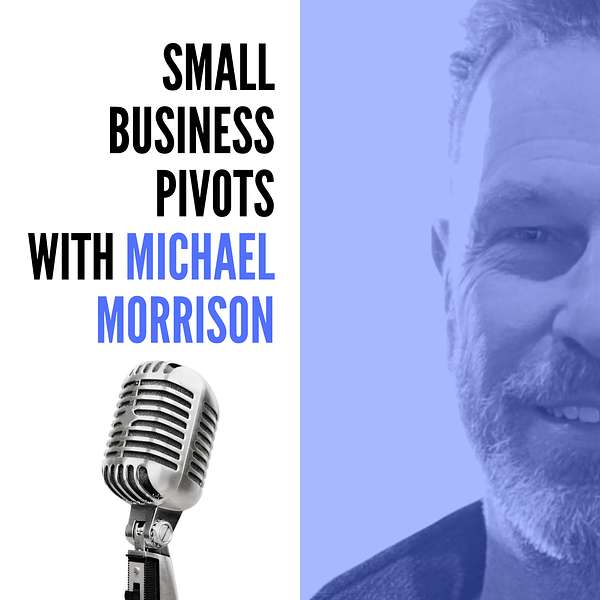
Small Business Pivots
Tired of fluff-filled business advice? Small Business Pivots delivers raw, honest conversations with entrepreneurs, content creators, and industry experts who’ve made bold pivots to grow—whether to six figures, seven, or simply the next stage of success.
Hosted by nationally recognized small business coach and BOSS founder Michael Morrison, this show shares the unfiltered stories, mindset shifts, and behind-the-scenes strategies that help real business owners overcome burnout, build momentum, and grow a business that works—without working themselves into the ground.
With over 100 episodes, Small Business Pivots is a trusted resource for small business owners who are serious about growth. From the early struggles to the key turning points, you’ll walk away with practical tools, honest encouragement, and actionable insight every week.
🎯 Sample episodes dive into:
• Small business marketing and content creation
• Building referral networks and strategic partnerships
• Mindset, burnout, and decision-making as a founder
• Time management, leadership, SOPs, hiring, and team culture
• Systemization, SOPs, and franchising
• Social media, branding, automation, and scaling strategies
Whether you're aiming for your first six figures or scaling beyond seven, this podcast gives you the real-world insight, inspiration, and community you need to take your next big step.
Subscribe now—and start making the pivots that move your business forward.
Want to visit with our host, Michael Morrison, about business coaching services for your small business? Go here: https://www.michaeldmorrison.com/consultation
Small Business Pivots
How to Scale a Service Business the Right Way — with Serial Entrepreneur Azgari Lipshy
Serial entrepreneur Azgari Lipshy reveals how to scale a service business by fixing systems, training employees, and building operations that actually work.
Are you stuck at $200K–$300K and wondering how anyone ever scales a service business to seven figures?
In this episode of Small Business Pivots, I sit down with serial entrepreneur Azgari Lipshy, who has started, bought, and sold multiple companies — including two construction businesses — and now helps first-time entrepreneurs launch and grow real, profitable service companies.
Together, we unpack:
✔ Why most service-based businesses get stuck at the same revenue ceiling
✔ The real reason you can’t find “good employees” (and what to fix instead)
✔ How systems, operations, and daily accountability drive growth
✔ Why scaling has nothing to do with working harder
✔ How to validate a business idea before wasting time and money
✔ What SBA-fundable businesses really look like
✔ Why “everything in your business is your fault” is the best mindset shift
✔ The simple way to build differentiators customers actually care about
If you’re a service-based business owner stuck in the weeds — overwhelmed, overworked, and unsure how to grow — this conversation will simplify the path forward and show you what’s actually holding you back.
🎧 Listen now to learn how to build a business that runs on systems, not stress.
Connect with Azgari Lipshy:
Website: https://azgari.com/
Facebook: https://www.facebook.com/Azgari.LLC
Instagram: https://www.instagram.com/azgari.lipshy/
LinkedIn: https://www.linkedin.com/in/azgari-lipshy/
TikTok: https://www.tiktok.com/@azgarilipshy?is_from_webapp=1&sender_device=pc
SHOW NOTES:
00:00 Welcome + intro
01:22 Azgari’s entrepreneurial background
03:10 Lessons from her first business
05:05 Why most new entrepreneurs skip crucial steps
07:40 How to validate any business idea
10:55 Why service businesses get stuck at $200K–$300K
13:30 Systems every service business needs
15:48 The truth about finding “good employees”
18:26 Operations, accountability, and owner responsibility
21:40 Why business owners run out of time
23:12 How to build differentiators
26:18 SBA funding
29:55 Financial mindset
32:44 Scaling
35:00 Partnerships + family employees
38:20 Final advice
1. Want more resources to grow your business faster?
https://www.businessownershipsimplified.com/
2. Want to connect with our Host, Founder & CEO on LinkedIn?
https://www.linkedin.com/in/michaeldmorrisonokc/
3. Want professional business coaching with our Host, Founder & CEO?
https://www.michaeldmorrison.com
4. Want to set up a FREE business consultation with our Host, Founder & CEO?
https://www.businessownershipsimplified.com/consultation
FOLLOW US ON:
- WEBSITE: https://www.businessownershipsimplified.com/
-WEBSITE: https://www.michaeldmorrison.com/
-LINKEDIN: https://www.linkedin.com/in/michaeldmorrisonokc/
-YOUTUBE: https://youtube.com/@businessownershipsimplified
All right, welcome to another Small Business Pivots where you know we bring special guests from around the world to help you, small business owners, increase the revenues, your anything that you want to do in your business. So we have other entrepreneurs come on. And today we have a special guest. But as you know, I only let the business owner introduce themselves and their business like they can. So I'll let you have the floor to do that.
SPEAKER_00:Thank you. Appreciate it. And first of all, thank you so much for having me on the show. Um, I can tell this is going to be a fun hour coming up.
SPEAKER_01:Absolutely.
SPEAKER_00:My name is Asgari Lipshe. I am a serial entrepreneur. I have started, sold, bought into multiple companies so far. And I currently have two construction companies. But my passion project is actually helping others become first-time entrepreneurs.
SPEAKER_01:Oh, fantastic. So we do have quite a few listeners that I call them entrepreneur wannabes. So they still haven't quite pulled the plug. So I hear from time to time they're like, oh, thank you for having so-and-so on the show. They really gave me that push, that nudge to feel confidence because it is a big thing to take that first step. So let's introduce the show real quick and we'll be right back. Welcome to Small Business Pivots, a podcast produced for small business owners. I'm your host, Michael Morrison, founder and CEO of Boss, where we make business ownership simplified for success. Our business is helping yours grow. Boss offers business loans with business coaching support. Apply in minutes and get approved and funded in as little as 24 to 48 hours at business ownership simplified.com. All right, welcome back to Small Business Pivots. I know our listeners like to be relatable, so they kind of like to know a little bit of background about the person they're listening to. So do you have any stories to share, maybe if you're upbringing, how you kind of got into entrepreneurship?
SPEAKER_00:Sure. Um, well, I I started when I was 16, and for me, it is the monkey see, monkey do, right? My father's an entrepreneur, my grandfather was an entrepreneur, my brother's an entrepreneur. Wow. So I, you know, the apple didn't fall too far from the tree, so to speak.
SPEAKER_01:And so did you go to college at all, get a degree, anything like that?
SPEAKER_00:I did. I I have a bachelor's in business, and I have a master's in natural homeopathic medicine, completely unrelated to business.
SPEAKER_01:I was gonna say, was where's the parallel there?
SPEAKER_00:So my my father is a doctor, but he he became obsessed with healing through nature, and he became a homeopathic herbal healer from general medicine. So, you know, growing up, it was all about how plants and the and your environment can heal your body.
SPEAKER_01:Wow.
SPEAKER_00:So that's how I ended up um studying it after.
SPEAKER_01:And I'm guessing maybe your brother was in construction of some kind.
SPEAKER_00:No, um, he's in the restaurant business. He has multiple um high-end bakeries and high-end restaurants all across Bangladesh, Thailand, and a few other parts in Asia.
SPEAKER_01:Oh, wow. Wow. So you all really kind of went your own separate way. So together, you've got a pretty powerful product uh of entrepreneurship. Well, let's let's get started with your very first business. Because I know the first time we actually take that leap. What was that like? What kind of pushed you over the edge? What made you actually do it?
SPEAKER_00:Being young and dumb.
SPEAKER_01:I well, you were smart. I was young and dumb, and I did not do smart things.
SPEAKER_00:Young, you do things without actually thinking through all of it, right? The amount of work it's gonna take, the amount of focus, the attention. You don't know any of those things. You just jump in because you're young and dumb. Sometimes it pays off.
SPEAKER_01:And it did for you. So, what were some of those first lessons that you learned in that first business?
SPEAKER_00:Um the most famous line who was this famous philosopher, I think it was Jay-Z who said crawl before you ball.
SPEAKER_01:Oh yeah, crawl before you ball. Yep, yeah, there's no walking, you just you know.
SPEAKER_00:So I I grew my sales team very rapidly before I had my distribution. So, okay, I'm getting ahead of myself. My first company was a supplement brand that I launched. And I would say the biggest mistake there was once I started getting a hang of getting larger contracts, I just went ahead and hired a large team of just sales manager supervisors, just too fast before I had my manufacturing and production downright.
SPEAKER_01:So you've you've uh started or owned quite a few businesses. So a serial entrepreneur. Can you kind of walk us through the process of the essentials that businesses need to have to grow and scale effectively?
SPEAKER_00:Having a plan, you know, measure twice, cut once does truly apply in business. And I think for people who are enthusiasts, who want to start a business, or who are first-time entrepreneurs, we get a idea stuck in our head, right? This product or this service is gonna be amazing, it's gonna do well, and we jump in. We don't actually do, we don't actually validate the idea first. Is this actually going to do well? I think this baby is gorgeous, but is it actually really ugly? And we need a lot of plastic surgery to make it better.
SPEAKER_01:Yeah, yeah. No, that's that's that's a good way, good way to put it. What uh what are some of the steps that go into a plan? Because I hear a lot of business owners go, I know I need a plan, but I don't know where to start. Because they're just you know, cobwebs in their head.
SPEAKER_00:So I would say first step is if you have an idea, right? Let's say give me an idea. Give me an idea for a business that you've heard um an entrepreneur ask you on the show.
SPEAKER_01:Well, the first one is I don't I want to be an entrepreneur, but I don't know what to do. That's one of the most common.
SPEAKER_00:Yes, that is something we get quite often. So let's say for the sake of this conversation, um, you want to do a party event planning company in your local market. You know you have a whole bunch of kids in your neighborhood, so you've decided that that's gonna do really well. Plus, you watched Cody Sanchez talk about it in some YouTube video, and now you're like, yeah, this is it. This is the cat's meow, I'm gonna go for it. Well, you just skipped like 20 steps, right? Sure, a event catering or event party management company might do great, but we have no idea if it's gonna do great in your location. We don't know how many other competitors are there. What are those competitors offering so that you can differentiate what you're gonna what's gonna differentiate you from them? Right. So all of that needs to be done in the front end right after you have an idea about something to validate. Does that make sense?
SPEAKER_01:Absolutely. And honestly, that's solid advice for current entrepreneurs because I know many entrepreneurs who don't even know that information. They just kind of maybe they're an electrician and they just go out and be an electrician and they don't know their target market, they don't know who needs them. So that could be for both an entrepreneur and someone wanting to be an entrepreneur. Is that fair?
SPEAKER_00:Yeah, absolutely. Anytime you think you want to be an entrepreneur, well, sit down and first think of what are you good at? Like honest conversation with yourself. What are you good at? What do you hate doing? That's half the battle. People have no clue what they don't like until they start a business. And a year later, they're like, I hate this, I hate doing this every day, and they quit. How often do you see that?
SPEAKER_01:Oh, yeah, often. Often. Let's talk about your uh current business. So the website is azgari.com. So I will save people the trouble of trying to how do you spell that? I just did. So what is this company all about? And how do you help people launch a real business?
SPEAKER_00:So everything that I wish I had when I opened my first few companies, I've combined and turned it into a program. And that's it, it's exactly what you said. We help people figure out what business to launch and then launch it with them. So I kind of become their temporary business wife, I guess, right? I'm there to help them launch, and then you know, we can either get a divorce or you can continue working with me to keep scaling.
SPEAKER_01:So are you similar to a business coach or no?
SPEAKER_00:It's consultancy, but done for you and done with you. So I'm not gonna sit there and just tell you to go do these things. I'm actually gonna go do them with you and hold you accountable on a day-to-day, week-to-week basis so that we can launch you effectively in a very specific timeline.
SPEAKER_01:So a lot of our clients are, I'm what looking at the website, a lot of our clients and listeners are service-based businesses, which looks like that's really what you focus on. Is that correct?
SPEAKER_00:Yes. I am not trying to reinvent the wheel. I know which businesses um I can get SBA funding for my clients for, and that's what I focus on.
SPEAKER_01:So since most of our clients are service-based businesses, I'm a business coach, and so I know most of the questions or the frustrations and challenges they have. And one of the biggest ones is employees. They just can't seem to find either good employees or enough employees. Have you got any insights on that?
SPEAKER_00:So most business, small business owners, especially, don't know how to train their employees, right? I think step one for any business owner is to accept that everything that is an F up in your business is your fault. Yeah. If you start there, then you can come to a conclusion on okay, if this is my fault, then what could I have done differently? Step one, did I train this employee properly? Did I understand their motivation for taking this job? And did I nurture them on a daily basis, weekly basis, until they met the KPIs and the standards that I want in my business? Did I have operations set up for this employee so that they're enabled in the job that they're doing? That all comes back to the business owner. Right? If you do your job as the business owner, then finding good employees becomes easier. Does that make sense?
SPEAKER_01:Yeah. So do you think it's actually finding good employees or training employees to be better?
SPEAKER_00:It's you being a good business owner and knowing how to nurture and train the people that you already hired.
SPEAKER_01:I'm a thousand percent on your side. So I'm all about systems and processes. And if you don't have them, you're uh kind of going at this blind. So one of the other questions that we hear a lot is advertising. So, how can I get all this done? How can I do all the training? How can I write all the systems and processes and market and brand my company? And and and a lot of times when we say we need you need to do these things, like what you're talking about, they're like, Yeah, but I just don't have time because I'm running day to day, and by the end of it, there's no time left. What advice do you have for those people?
SPEAKER_00:Well, that's exactly where we come in, right? So you're no longer doing it yourself. But let's say someone isn't coming to us and they are doing it themselves. It's going back to that planning, right? Before you launch, before you invest a dime, having an execution plan in place, right? The first, I'm just saying this for this conversation. Let's say the second week, you that's the week that you're gonna set up all your um advertisement, your marketing. The third week, you're setting up this type of operations. So it's having that plan of what you're gonna do up until launch, and you cater that around your, you know, if you have a day job, if you have family. That way you're not like you launched and now you're like scrambling to do marketing, to do sales and everything else. You create a timeline and a Gantt chart is perfect, right? For something like this, or even a trillo board. Let's say you make a 120-day trillo board of what are the different areas of your business you need to have set up, you need to learn, you need to train yourself, and then you launch. So you do all of this before you launch and you set them up. Does that make sense?
SPEAKER_01:Yeah, yeah, absolutely. Absolutely. Well, let's talk about the different businesses you've had because I don't for most small business owners, they can't picture past having a couple of employees. So, in other words, a ma and paw business, but the numbers that you share, that's not just a ma and paw business. So, how can one actually reach those numbers? Like, what is the timeline? What are some necessary things they need to do? So, basically, taking a startup and scaling it, what are some of those things?
SPEAKER_00:What are the numbers we're scaling towards?
SPEAKER_01:Uh, most uh people are probably doing around two or three hundred thousand a year. But if we really want to push that needle, for some reason, most people have you know a million dollars on their mind, but in their current state, they can't even picture hitting that number because they can barely do 300,000. So, what are some things that really take them to that next level?
SPEAKER_00:So it's it's um I'm gonna talk more high-level because we haven't narrowed down a particular business, right? So I'm gonna go with the assumption that we're talking about a service-based business. And if you're telling me someone is doing 200 to 300,000 and they can't seem to scale past it, it is a thousand percent because they don't have systems and operations in place. It's a thousand percent because the employees they have in place, they're not utilizing them effectively.
SPEAKER_01:So you're saying the business owner is holding them up.
SPEAKER_00:It's always the business owner holding up a business. Remember, we go back to the first rule every F up is your fault.
SPEAKER_01:That's right. That's right. You either allowed that business to happen the way it is, or you created it to be that way. One or the other. You allowed it, you're the captain, captain of the ship. What are some other things that you have that you've learned along the way in your businesses that you could share?
SPEAKER_00:Um, give me an example. There's so many.
SPEAKER_01:Yeah, let's uh let's talk construction. So we have financials, we have different facets of the business, branding, marketing. Which would you say are some of the areas the business owners should be focused on hands-on and let everybody else do their job?
SPEAKER_00:A thousand percent customers focus on your clients because as soon as you're hyper obsessed and focused on your client, your client's gonna tell you if your production manager was late to the job, or if any of your laborers didn't show up, if any of the tech, they'll tell you if you make your client your best friend, they will help you create better systems and operations. Because as they keep telling you what didn't work well, that's also a manual for you to now go back and fix so that the next client doesn't have to face it. Does that make sense?
SPEAKER_01:Yes. So in the operations and the systems and processes, a lot of business owners tell us that they don't even know where to start because they do so much. Do you have any kind of proven methodology that works for you and your services that this is where you start? These are kind of the steps. Here's some guidelines on templates or whatever. Do you have anything like that?
SPEAKER_00:Yeah, it's first just think of what you're doing. You're saying your whole day is mapped out, right? Their day is so mapped out they don't have the mental bandwidth at the end of the day. Okay. Where is that time going? Let's do an hour by hour audit. Where are you spending your time? What are you spending your time on? Then we can start narrowing down. Can I hire someone and pay them 14 bucks to do this job? Does that free up four hours of your time? You know, kind of figure out what are the low value and high time consumption activities that they're doing that's eating up their whole day and hire those out. Because if paying an employee five thousand dollars a month frees up 40, 50 hours for the business owner, guess what? Now you have the time bandwidth to expand your business. But a lot of people don't want to do that. They'll go, oh my God, I don't want to pay someone five grand.
SPEAKER_01:Yeah, yeah. They don't want to part with the money, but they'll work 14-hour days. So what um we've always heard about founders' sales. And so what part does a business owner what or how much should they participate in the sales of the business?
SPEAKER_00:Depends on the service or product. Um with service-based businesses, we always ensure that the client has enough capital to run the business for a year without the business making any money, which never happens. But the reason we do this is so that we can allocate budgets for hiring the right team members, right? We're not gonna skim on hiring top-tier sales and estimators, depending on what type of business, and have a business owner who maybe potentially never sold a thing in their life.
SPEAKER_01:For our listeners, we're kind of covering a lot of areas of the business, and the reason I feel this is necessary is because you're listening to small business pivots. This podcast is produced by my company, Boss. Our business is helping yours grow. Boss offers business loans with business coaching support. Apply in minutes and get approved and funded in as little as twenty four to forty-eight hours at business ownership simplified.com. If you're enjoying this podcast, don't forget to hit the subscribe button and share it as well. Now let's get back to our special guest. For our listeners, we're kind of covering a lot of areas of the business, and the reason I feel this is necessary is because it's kind of following the pattern of small business owners where there is no organization. And so I'm just coming at you with a fire hose of because as business coaches, we work with service-based businesses, and these are just questions after questions that they're all asking, and they're probably just wondering, oh, I hope he asked this. I hope he asked this. So branding and marketing, the name of the business. This is one of my biggest uh probably beefs, I guess, with small business owners, especially in the service-based business, is they're trying to be too creative with their name to where I don't even know or have a clue of what you do. Do you have any insights on branding, marketing, name, creation, all that stuff, website, domain, anything branding marketing related?
SPEAKER_00:Have you heard of the KISS method?
SPEAKER_01:Oh, yeah. Keep it simple, stupid, but you might have a different, you know, meaning for that.
SPEAKER_00:Well, no, it's the same meaning. But for a service-based business, um, to put it to you in polite terms, the guy whose lawn you're going to cut or the window in the house or commercial built building you're gonna service, they don't give a bad business name. Yeah, all they care about is are you reliable? Are you giving them a good price? Most likely better or in the same range as other quotes that they've gotten. And do they like the salesperson that went and hung out with them for an hour, looked at what job needs to be done, and that's it. They don't care if it's a big franchise, they don't care about the name.
SPEAKER_01:And can I add one more thing they don't care about? They don't care about you, the business owner, either. Because I see small businesses about us family-owned, blah, blah, blah, blah, blah. I don't care. Uh, all I care about is quality, you know, whatever, whatever. So let's talk about that because let's say I'm looking at your your uh list of services. So let's say a sprinkler irrigation service. Let's say 10 people come to you. Why would I pick one over the other? What differentiates them? Is there some some magic sauce or something they should consider?
SPEAKER_00:It's simple. Where do you live? Where do you want to open this business? Now let's do a deep dive on how many of these sprinkler maintenance companies are in your local market, and then go from there. We can do the same with three or four businesses and compare them side by side. Which one looks like it's going to win the first year? Where do we have the most amount of gap? So, for example, a sprinkler system company, right? That could be commercial focused, that could be government focused, that could be residential focused, and there's so many other nuances for golf courses, specializing in golf courses, or specializing in ABC. Do you get what I'm saying? So, even though you're saying sprinkler system, there's so many ways to create a niche and a differentiator for yourself, and then see what's going to do well in your market.
SPEAKER_01:So, on the differentiator, we hear that often. So, would one just pull out of the air, this is why I want to be different, or how do they define that?
SPEAKER_00:Customer discovery. Let the customer tell you what they're looking for and see what the competitors are offering, and then you create your differentiator from what's already existing in the market and what the clients are wanting. And what the clients are wanting is it's the most simple thing, but people make it the most complex. What are you trying to sell? Who would be your ideal customer? Use your two feet, walk over and go talk to them.
SPEAKER_01:Yes.
SPEAKER_00:Very strategic, you know.
SPEAKER_01:I mean, this is a PowerPoint you do not want to miss. Uh, so the differentiator. So I always share as a business coach, the first question I always ask business owners is have you asked your clients? Have you asked your clients?
SPEAKER_00:Like it's so simple, but they don't. They're die, they want to live in this fantasy world where their product, their baby is the prettiest in the whole wide world.
SPEAKER_01:Yeah, yeah. When when it can be as simple as well, I I will I will yes, walking across with your two feet. Now, I I just had a client recently that was had been discussing with their business partner for hours. I said, How many hours have you been talking about this? And they're like, Oh, at least eight. I said, Have you picked up the phone and called your customer? And they're like, Why? I'm like, because you're trying to figure out what they're gonna buy from you. Like, why not just ask them? You know, why not? The best advice I heard from one of our podcast guests, he said, the best time to find out why people pick you so you know what your differentiator is, is right when they've made the decision. In other words, ask them. Say, you I'm sure you probably had three or four options. You're trying to decide between why did you choose us by chance? And there's your answer right there. Something stood out to them. And and so that's the way to do it. I want to talk about funding because as a startup, as a new business, as a small business, you're you've mentioned SBA several times. Kind of what is that process? How can it help? Who is it for? Kind of what are the minimum requirements?
SPEAKER_00:So when you're starting a business, a lot of people think in their head, if they're doing it the first time, like, oh, I have I have 20k saved up, I have 40k saved up, that's enough. It may very well be enough, but that's not how you can plan for an entire year as a business. So, whatever that gap is, you want to ensure that you have access to the capital, even if you don't use it. So, whether if that's SBA loan or your Rob's rollover, uh 401k, whatever it is, you need to make sure you have access to it.
SPEAKER_01:So, what is the the SBA? A lot of people may misunderstand that. So, yeah, what do they what do they require? I mean, is it a long process? Does it require a lot of document? In other words, the SBA kind of gets a bad rap as far as they want so much information, it's hard to process, it takes forever.
SPEAKER_00:It does.
SPEAKER_01:Okay, so yes on all those.
SPEAKER_00:Yes on all of them.
SPEAKER_01:I wish I could be like no, it's just there's like a fast track funding or a fast track SBA, something similar. That's what is that? Do you know?
SPEAKER_00:It's not necessarily fast track, it's like if you turn everything in the right way, okay, right? The more changes that needs to be made, the longer you push your timeline. And 99% of the time when people file for an SBA loan, there's this missing, there's this, that thing missing. And every time you have something missing, it adds not only days, sometimes weeks. Because now there's a lag time between the person who's gonna open the email and from you sending it, you might take four days to get the paper ready, the one thing that you missed, or that one initial that you didn't do in the 50-page document.
SPEAKER_01:Yep, it's gonna cost you more time.
SPEAKER_00:Yeah. So filing it the right way in the right sequence, super important, and that'll fast track it. And also the businesses, right? We only work with businesses that have a preferential treatment for SBA loans.
SPEAKER_01:So we have money in the bank. How important are financials? And do you help with that side of the business?
SPEAKER_00:So you need to have the financials to even apply for the loan. So, yes, we we do the entire loan package, which by default gets you a full financial forecast, all the jazz.
SPEAKER_01:Can you share your knowledge on just kind of the basics of financials for small businesses? Because that's another area that small business owners they typically use their bank account most of the time to check the pulse of their business. If we have money in the bank, we're doing great. If we can make payroll, we're doing great. If we have extra, I'm gonna go buy a new car or a truck or something. But how important are financials? And can you kind of just explain the basics of what a business owner needs to understand in the financials, in their financials?
SPEAKER_00:Well, I mean, why are you in business if you don't think financials are important? Would be my first question.
SPEAKER_01:Yeah.
SPEAKER_00:Right? You're doing it to make money first and foremost, above everything and anything else.
SPEAKER_01:Yeah.
SPEAKER_00:So you need to get your money right.
SPEAKER_01:Yeah. I I mean that that that's it. You need to understand financials for sure. Is there anything else that we haven't covered on uh small businesses growing and scaling that you think would be insane?
SPEAKER_00:For our listeners, I would say most people are scared to either get a loan or think about big six-figure numbers when it comes to launching a business. But think of it this way: if you're using a loan, you're leveraging somebody else's money. You're not using your own liquid capital. And the money that your business is going to generate is going to service that loan. So again, it's not coming out of your pocket. It's still coming out of a well-operating business. I think that's a that's a mind shift mind shift. Mindset shift. Ooh, that was a tongue twister. That people I think need to get wrapped their head around. And number two, I would say, is stop walking over dollars to save pennies. Right? Going back to our hire the right people, pay them a little bit more money, but get someone who's the right fit for the role. And don't try to do everything yourself.
SPEAKER_01:Amen. Amen.
SPEAKER_00:That's why you have the loan. So that you know you have enough money in your bank to cover the payroll as your business ramps up.
SPEAKER_01:So as the business ramps up, what realistically is a good percentage of growth that a small business owner can kind of predict to see? So in other words, 10% year over year, is that a good growth? 20%? What's what's kind of an average on a service-based business?
SPEAKER_00:I would say that depends a thousand percent on the business owner and their ambitions, because that's going to determine what level of growth is acceptable. Because with the business, as you know, it's up to the owner. How big do you want to how big do you want to go? Or are you comfortable staying at that 300 mark because you're bringing in 120 and you're happy with that?
SPEAKER_01:So, listeners, again, I apologize for all the random questions, but these are all questions you asked me to ask. So another one is it smart to hire family and friends?
SPEAKER_00:Oh, ah, no. I know with small business, people have to get their auntie and their mammy and everybody else involved. But if you can avoid it, do it because you need your staff to listen to what you want them to do. And if if it's a family member, I don't have any family member that'll actually that I can yell at.
SPEAKER_01:Well, it really puts you in an awkward position as an owner when you have to enforce something, you know. Uh, and it also puts you in an awkward position with those that aren't family members, because now we have special treatment, or if you know the list goes on and on. What about uh another question is business partnerships? What should a business owner be looking for or stay away from in business partnerships?
SPEAKER_00:In small business, it's really difficult, right? Because in a small business, the business is in a lot of ways you. So having somebody else who has your similar work ethic, has a similar vision for how much they want to generate from the business, also exits, right? If you want to exit a business, you need to make sure your business partner is on the same page on that. Otherwise, you're gonna run into a situation where they're like, this is great, we can sell this for three mil. And you're like, no, I want to scale, I want to stay on board.
SPEAKER_01:Yes.
SPEAKER_00:So I would again go back to saying, Don't do it. Don't because especially with the small business, you don't need a business partner, really.
SPEAKER_01:Yeah, and I assure you, so listeners, it won't be easier. I know you're thinking with a business partner, it would be easier, and it's actually harder. Unfortunately, I've been divorced and I've had a bad business partnership. If someone's ever been divorced, we all know how emotional that is, and being divorced in a business partnership is a thousand times worse. Because now it's you used your little, and I'm using this because when it's a split in a partnership, it's all about money.
SPEAKER_00:Yep.
SPEAKER_01:Uh, there are no emotions, it's about money, and so that's hard to to fight over. Uh, what does a typical schedule? What should a typical schedule look like for a business owner day to day? And it's not 16, 18, 20 hour days.
SPEAKER_00:It could be if you actually enjoy what you're doing, right? I mean, for nerds like me, and you I think you're on the same boat, it's like we kind of like what we do.
SPEAKER_01:Yeah, yeah. I'm not really working. I actually feel like a professional athlete when they say I love what I do, and I but I just get paid for it.
SPEAKER_00:Yeah. I'm hanging out in my backyard literally half the day. So, like, how bad can my life be working?
SPEAKER_01:Right. It's beautiful too for those that aren't watching the video. It's you'll have to go catch it on the the YouTube channel. So, well, is there anything else? I mean, what where else can they find you on the internet? I'm sure that people have more questions than what I've asked, and I have a lot of questions, but we're kind of getting short on time. Where can people find you for more information?
SPEAKER_00:Azgari.com.
SPEAKER_01:Are you on any of the social media channels?
SPEAKER_00:Yep, Azgari Lipsheet on Instagram, TikTok, LinkedIn.
SPEAKER_01:And what kind of information do you share on those platforms?
SPEAKER_00:I I need to start sharing more business content.
SPEAKER_01:But you're so busy working on your business, helping other people grow theirs, right?
SPEAKER_00:Well, they're gonna find this. They're gonna find this podcast on my social now.
SPEAKER_01:Okay, that's awesome. That's awesome. So, what's the best place to get a hold of you if they go to the website as well?
SPEAKER_00:Yep, the website has our email, and one of our client advisors or managers will be more than happy to reach out with whatever information they need.
SPEAKER_01:Fantastic. Well, I always wrap up with one final question. If you were in front of an audience of small business owners, different sizes, different industries, what's one thing that's applicable to all of them that you haven't already mentioned? It could be a quote, a book, a tip, insight.
SPEAKER_00:I'm gonna go back to what I already say. Everything that happens in your business and in your life is your fault. So go from there and now fix it.
SPEAKER_01:Yeah, go fix yourself.
unknown:Right.
SPEAKER_01:So, well, you've been wonderful to have on the podcast. I appreciate you taking your time and sharing your information to help others.
SPEAKER_00:Absolutely. You as well. Appreciate what you're doing. Thank you.
SPEAKER_01:Thank you. Thank you for listening to Small Business Pivots. This podcast is created and produced by my company, Boss. Our business is growing yours. Boss offers flexible business loans with business coaching support. Apply in minutes and get approved and funded in as little as 24 to 48 hours at business ownership simplified.com. If you're enjoying this podcast, don't forget to hit the subscribe button and share it as well. If you need help growing your business, email me at Michael at michaeldmorson.com. We'll see you next time on Small Business Pivots.
