
The Better Semester
Rob Danzman is a licensed therapist who's worked with college students and their parents for over two decades. He's written two books: The Insider's Guide to Parenting: How to Solve Messy Problems and Build a Great Family and The Insider's Guide to College: Evidence-Based Tips, Tricks, and Strategies to Win the Semester. The Better Semester is an extension of his work and is all about providing info to parents of college students. Each episode if full of insights, strategies and tactics - all super actionable advice to get your struggling college student solid again.
How much is too much parenting when your kiddo heads off to school? How can college students find help when they're struggling? How should medication be handled while they're at college? How can parents coordinate with the university?
All of these and more are covered weekly.
The Better Semester
All About Weed at College
Use Left/Right to seek, Home/End to jump to start or end. Hold shift to jump forward or backward.
Send me your Questions and Comments
This episode is all about weed. l do a deep dive into its history, background, how students are using it now, the impact on them, and what treatment options look like if their use is getting out of hand. There's really good stuff in this episode for parents so I hope you enjoy. Please check out the show notes below for additional info I reference throughout the episode.
Show Notes
University of Central Florida substance use treatment
https://studenthealth.ucf.edu/recovery/
Stages of Change
https://www.youtube.com/channel/motivatecounseling
https://robdanzman.com/
In this podcast episode, Rob Danzman, a licensed clinical mental health counselor and national expert in college student mental health, discusses the history of marijuana use, how it affects college students, and how parents can get help for their college student.
All About Weed at College
Today I’m talking about weed and college students. I’m going over some basics and some (well, actually, a lot of background), what weed usage looks like on campus from a clinical perspective and, most importantly, what can be done to treat use and abuse. The background, while pretty boring, has some important info that really is relevant for figuring out how best to treat substance use. I’ve put some additional information in this episode’s show notes. You can also visit my blog at robdanzman.com. I also have a whole chapter in my first book Insider’s Guide to Parenting: How to Solve Messy Problems and Build a Great Family. You can find it on amazon. Ok, let’s talk about weed.
Weed, though not necessarily the “gateway drug” we were led to believe it was, is nonetheless a consistently used drug and often what parents are most concerned with. Fortunately, compared to other drugs on campus, weed is not nearly as bad as some other contenders. Its side effects are not nearly as severe or dangerous. That’s not to say there aren’t risks.
The worst drugs, though, are way more dangerous and may surprise you. They are right in your bathroom cabinet, at baseball practice, and in schools and dorm rooms. Prescription drugs are by far the biggest and scariest category of drug use ... and it’s only growing, really really fast. In a few weeks I’ll dedicate a whole future episode on prescription drugs. But for our purposes today, I’m sticking with weed. So let’s head back, way way back to understand a bit of weed’s history and how it presents today.
In the US, increased restrictions and labeling of weed as harmful began in many states in 1906. Outright prohibitions began in the 1920s and by the mid-1930s weed was regulated as a drug in every state, including 35 states that adopted the Uniform State Narcotic Drug Act. The first national regulation was the Marihuana Tax Act of 1937.
Weed was officially outlawed for any use (medical included) with the passage of the 1970 Controlled Substances Act (CSA). Multiple efforts to reschedule Weed under the CSA have failed, and the Supreme Court ruled that the federal government has a right to regulate and criminalize Weed, even for medical purposes. Despite this, states and other jurisdictions have continued to implement policies that conflict with federal law, beginning with the passage of California's Proposition 215 in 1996. By 2016 a majority of states had legalized medical Weed, and in 2012 the first two states, Colorado and Washington, legalized recreational use.
Current State of Use
When college students use weed, there’s an increased risk of reducing cognitive, memory, and learning functions. Weed also negatively impacts how the brain builds connections between the areas necessary for these functions. Short term effects include dry mouth, short term memory difficulties, red eyes and delayed motor function.
Weed is used by smoking, vaping, within food, or as an extract. As I stated above, more kids are vaping weed. There’s also a growing market for edibles, especially baked goods. Forty-four percent of college students reported using weed in the last 3 months and 11% use daily.
Tetra-hydro-canna-binol (THC) is the active chemical that produces psychoactive experience. THC is one of one of 483 known compounds found in marijuana, 65 of which are cannabinoids, a class of diverse chemical compounds that acts on cannabinoid receptors in cells that alter neurotransmitter release in the brain. Prior to the ‘90s THC concentration was less than 2%. During the 1990s it grew to 4%, and between 1995 and 2015 there has been a 212% increase in THC content in the marijuana flower. In 2017 the most popular strains found in dispensaries in places like Colorado had a range of THC content from 17–28%,
The flower or leaves that are generally smoked or vaped are only one formulation. Producers now have concentrated THC products such as oil, shatter, dab, and edibles that have been able to get the THC concentration upwards of 95%. There is absolutely no research that indicates this level of THC is beneficial for any medical condition. The purpose of these products is to produce a high, and the increased potency makes them potentially more dangerous and more likely to result in addiction.
Don’t let your kid try to convince you marijuana is risk-free, especially at these concentrations.. While they will not likely develop cancer or become an addict, there is significant research that shows a dramatic increase in car accidents while using weed. There is also loads of evidence that, as discussed earlier, memory, anxiety, and thinking is also compromised.
Another symptom of weed use that’s increased in the last few years is depersonalization. In general, Weed-induced symptoms of depersonalization and derealization are time-locked to the period of intoxication, peaking approximately 30 minutes after ingestion and subsiding within 120 minutes of exposure to the drug. However, among a subgroup of persons who use Weed, symptoms of depersonalization or derealization persist for weeks, months, or years, even after discontinuation of the substance. Those who experience prolonged symptoms may have Weed-induced depersonalization-derealization disorder.
The pathogenesis (fancy way of saying how a disorder develops) of Weed-induced depersonalization-derealization disorder can be marked by an initial dissociative disturbance with a severity that subsides but later returns in episodes that eventually become chronic. In other cases, onset can be more abrupt, with symptoms emerging during intoxication and persisting unremittingly for months or years. For other individuals, symptoms do not occur until hours or days following an episode of Weed use.
Many students use weed to help them sleep at night. Research shows that weed is helpful for sleep in certain cases. For students with certain conditions such as chronic pain, and PTSD, Weed may help them fall asleep faster, wake up less during the night, and overall improve sleep quality. Many students use weed for insomnia, anxiety, and pain. Among these users, the effectiveness of weed for sleep is more ambivalent, though a study conducted on individuals with insomnia found that many participants reported relief from their symptoms when using weed.
Many students use weed for anxiety, especially those with social anxiety disorder. THC appears to decrease anxiety at lower doses and increase anxiety at higher doses. CBD appears to decrease anxiety at all doses that have been tested. CBD, or cannabidiol, is the second most prevalent active ingredient in cannabis (marijuana). While CBD is an essential component of medical marijuana, it is derived directly from the hemp plant, which is a cousin of marijuana or weed. CBD does not cause a "high" by itself.
The research also suggests that while short term, low dose use of weed decreases anxiety, long term use increases anxiety.
Research suggests that students who use weed (especially regular or heavy users) are diagnosed with depression more often than students who don’t use. However, it doesn't appear that weed directly causes depression.
It's likely that the genetic, environmental and other factors that trigger depression also lead to weed use. Some students with depression may use weed as a way to detach from their depressive symptoms. Heavy users may appear depressed as a result of the dulling effects of weed on feelings and emotions.
There also are links between weed and other mental health conditions. Weed use may trigger schizophrenia or detachment from reality (psychosis) in people who are at higher risk of psychosis. The symptoms of diagnosed psychotic illness may be aggravated if weed use continues.
The bottom line: Weed and depression often accompany each other more often than parents may realize, but there's no clear evidence that weed directly causes depression.
Many students mix weed with tobacco. They call this a spliff. The goal is to get more high or have it last longer. The research shows that this combo increases exposure to carbon monoxide from the nicotine in tobacco results in higher THC inhalation per gram of weed.
Weed can interact with other chemicals for nasty side effects.
- Weed and Alcohol. Weed use might increase the effects of alcohol.
- Weed and Anticoagulants and antiplatelet drugs, herbs and supplements. These types of drugs, herbs and supplements reduce blood clotting. Weed might change how the body processes them, possibly increasing the risk of bleeding.
- Weed and Central Nervous System depressants (CNSs). Weed use in combination with CNS depressants might increase the sedative effect of drugs like Ambien or tranquilizers
- Weed and Protease inhibitors (antiviral drugs). When used with these, weed might reduce their effectiveness.
- And finally, Weed and SSRIs (Selective serotonin reuptake inhibitors). Mixing weed with this type of antidepressant might increase the risk of mania.
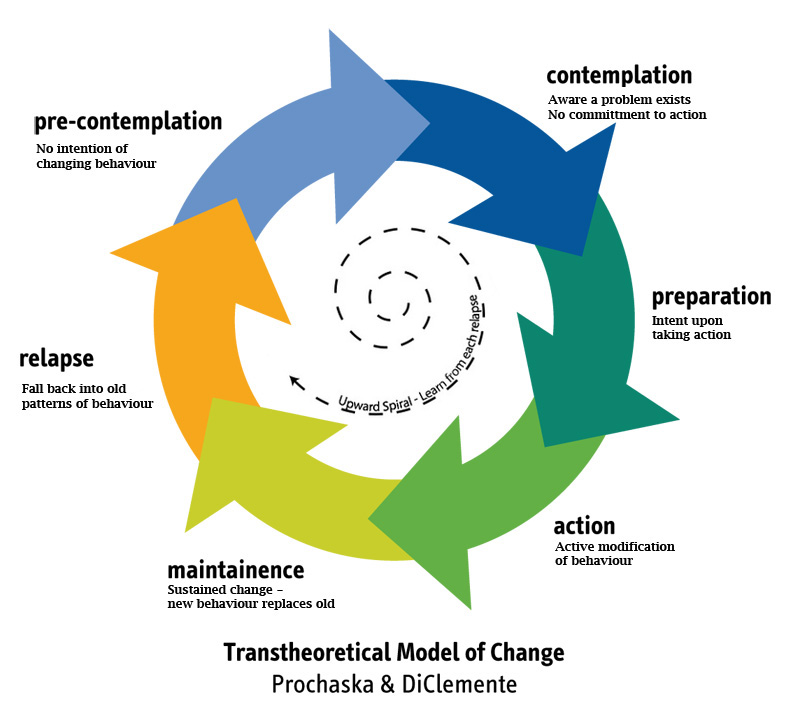
Before we talk about treatment options and how to get a college student to cut back on weed. It’s important to understand a conceptual model called Stages of Change. I have a few links dropped in the show notes for this episode. This is one way clinicians help students prepare for and ultimately embrace changing their relationship with weed. This model is not exclusive to college students smoking weed and is used with many populations with different behavioral challenges.
Stages of Change
In behavioral health, we use a model called Stages of Change to help identify a person’s level of interest and commitment to changing a behavior (e.g. drug use). Research on behavioral change has found that people move through a series of stages when changing their behavior. While the amount of time a person remains in each stage is different for each person, the tasks required to transcend to the next stage are not. Certain principles and steps of change work best at each stage to reduce resistance, facilitate progress, and prevent relapse. So what are we aiming for? Maybe sobriety. Maybe ‘reasonable use' doesn’t inhibit decent grades. If things are severe enough, sobriety is probably what we’re after. There’s just something magical that happens around 5 years of being clean. After 12 months of continuous sobriety, 43% of individuals returned to regular smoking. It wasn’tt until 5 years of sobriety that the risk for relapse dropped to 7%.
Precontemplation Stage. People in the Precontemplative stage are not even close to considering change. They do not intend to take action anytime soon even though they might talk about getting clean “someday.” Being out of touch with the consequences of one’s choices may cause a person to be in the Precontemplative stage. Another factor could be a person that has multiple unsuccessful attempts at change which leads to demoralization about his or her ability to change.
Both the uninformed, under informed and unmotivated tend to avoid considering the possible significant impact of their high-risk behaviors. They are often characterized in other theories as resistant, unmotivated, or unready for help. The fact is, traditional outpatient and residential treatment programs were not designed to meet their needs.
Contemplation Stage. Um...I’ll think about getting clean. Contemplation is the stage in which people intend to change but just are not there yet. Typically, professionals assume that if he or she states they are willing to change in the next few months, they are likely in Contemplation stage. People in this stage are likely to speak about or be more aware of the pros of changing, but are also aware of the cons, to the degree that they will not make choices towards change.
This cost-benefit-analysis of changing can produce profound ambivalence that can cause people to remain in this stage for months or years. This state of stagnancy can be frustrating to loved ones who don’t understand why someone who is aware of the benefits of changing does not actively engage in it. Would-be clients in the Contemplation stage are not ready for programs that expect participants to act immediately.
Preparation Stage. Ok, I’m (...almost) ready. Preparation stage is when people intend to take action in the immediate future, typically within the next few weeks. They have already taken some significant action in the past year either by changing friends, jobs or some other part of their life they have control over. These individuals have a plan of action (or at least are open to someone’s plan of action), such as going into treatment, working with an outpatient therapist, talking to a doctor, buying a self-help book, or relying on a self-change approach.
These actions may seem small to those who are not in distress but are an important stage for those getting their minds’ wrapped-around the idea of big changes in their life. At this stage, these clients are good candidates for treatment programs that require active-engagement of participants.
Action Stage. The action stage is the phase where people have made specific changes in the last few months. They may make changes in their environment (e.g. moving to a new dorm room or painting their bedroom) or voluntarily enroll in some type of therapeutic program. Some researchers and professionals do not believe that all modifications of behavior count as “Action” in stages of change. As someone who has worked in the field for as long as I have, I know that any action, no matter how seemingly small or unrelated to sobriety, should be viewed as a positive thing.
Maintenance Stage. Maintenance stage is the stage in which people have made specific changes to their behaviors and lifestyles with a clear dedication to prevent relapse. While in the Maintenance stage, people are less tempted to relapse and grow increasingly more confident they can continue their sobriety no matter what challenges historically triggered drug use. Most substance abuse professionals see clients in the maintenance stage anywhere from six months to about five years.
Termination Stage. Termination stage is when individuals are not tempted to use and demonstrate 100% internal locus of control (i.e. taking responsibility for ALL their choices). This is the stage when you will not hear excuses about why something couldn’t get done. No matter how depressed, anxious, bored, lonely, angry, or stressed, individuals in this stage are sure they will not return to unhealthy habits, friends or outdated coping skills.
Some professionals believe there is no such thing as termination stage for someone with deep substance abuse issues since they will always be in the maintenance stage. I’m on the fence with this one and prefer to not focus on the label of the degree to which someone is exercising self-control. Behavior is more important than category labels. If someone is sober and they want to stay sober, I judge their actions based on how they act to promote that healthier life.
Most successful clients in recovery go through these stages about three or four times before they make it all the way through the cycle without relapsing. Understanding the degree to which your son or daughter is ready to change and get clean and change their life can be one of the most effective uses of working with a professional. As with many of the obstacles discussed in the book, this is not a battle to fight alone.
Treatment
Most students I work with say they can stop using weed anytime they want, they just choose not to. But here’s where the problem is - having choice over whether they stop or not is not the best indicator of how weed is impacting grades, relationships, sleep, metabolism, and motivation. Students often need help well before they believe they do. Sometimes, treatment might be part of an informal contract with their university, court system, or parents if they get on academic probation or in legal trouble.
Here are the different types of treatment options for college students when they are ready for help. In other episodes, I go into detail about how to choose a therapist, treatment program, and higher levels of care. For today, I’m just listing out the options with a little less detail.
- University health services - while most campus health centers and counseling and psychological services (CAPS) do not provide substance use treatment, more and more universities are offering help. The University of Central Florida is a good example of a school that has invested heavily in the mental health and substance use treatment for students.
- Outpatient therapy with licensed counselor with substance use experience
- IOP/PHP options - Intensive outpatient programs and partial hospitalization programs are outpatient treatment options that typically run a few hours each day during the week. This allows college students to remain at home or on campus while receiving treatment. It can sometimes be challenging to maintain a regular courseload and participate in IOP or PHP though many schools will be flexible if the student works with the disability services team.
If those outpatient levels of care are just not enough, the college student may need to get a medical withdrawal and take a gap semester. Here are the options for higher levels of care.
- Residential Treatment - This is typically anywhere from 30 days to several months depending on the severity of use and overlapping mental health challenges. There are many fantastic programs though there are also lots of programs that are just plain garbage and prey upon naive and desperate parents and students. Part of my work with clients when a higher level of care is clearly needed is to help parents through the process of determining the quality and appropriateness of care.
- Inpatient Hospitalization - this is primarily for acute situations like if a college student overdoses or has an accident related to substance use.
Drug Testing
THC can be measured in blood, urine, hair, saliva or sweat for drug use testing or a forensic investigation of a traffic or other criminal offense. Concentrations obtained from analyses can be used to distinguish active use from passive exposure, elapsed time since use, and extent or duration of use. Many kids I work with, when a drug test comes back “positive” swear they didn’t smoke weed and that they simply were around friends that had. I talk more about drug testing later on in the episode.
When parents want to confirm (or rule out) drug use, drug testing is a pretty reliable tool. Testing can be as simple as a quick, instant urine test like the kind sold on Amazon or at CVS. It can be as complex as a lab analysis using mass spectrometry that takes several days for results. The results are unbiased, dispassionate data. I recommend drug testing to be used as a part of a larger treatment approach. If a college kid is back at home after bombing out freshman year, parents may want to have him working with a therapist for counseling, work with a psychiatrist for medication management and confirm he’s not using drugs through drug testing. Here’s a quick list of how long THC is detectable in different types of screening.
- Urine -
- Infrequent users: 7-10 Days
- Heavy users: 30 - 100 days
- Hair - < 90 days
- Blood/Saliva -
- 2 - 3 days in blood
- Up to 2 wks. in blood of heavy users. (However, it depends on whether actual THC or THC metabolites are being tested for, metabolites have a longer detection period).
- THC is detectable in saliva for 2 - 24 hrs.
Drug Testing Panels
The term “panel” refers to a drug or family of drugs included in a drug test. For example, the panel “opiates” includes morphine, codeine, and heroin. The more panels a test includes, the greater the variety of drugs it tests for. Drug tests usually come as a four panel, five panel, seven panel, ten panel or twelve panel tests. Generally, the biggest difference between the four and five panel drug test tends to be the elimination of marijuana as a tested substance. Some parents just don’t care about weed showing up on a drug test.
A seven panel drug test is often administered by companies or individuals who are concerned an employee might be abusing prescription drugs. In industries where alertness is required or heavy machinery is operated, some companies use the seven panel drug test to gauge the presence of prescription drugs with potentially fatiguing side effects – drugs that, although legal, may impair a machine operator’s ability to do their job, particularly if abused.
A standard 7 panel drug urine test typically looks for marijuana, cocaine, opiates, pcp, amphetamines, benzodiazepines, & barbiturates.
DIY Drug Testing
If you want to save money, doing drug testing at home can save you a bundle. It typically costs about $30-50 per drug test if you send your kid to a lab. Labs will often use nearly identical drug testing equipment as you can buy on Amazon (e.g. Plastic cup, lid, dip-test). Few therapists and mental health professionals do testing. If you do drug testing at home, here are some things to consider.
First, make it random. Don’t give them a head’s up you’re going to test them. You don’t want them to “accidentally” schedule work or social plans when they’re supposed to be home.
Next, make sure it’s actually their urine. Most clients I’ve worked with eventually ask “What’s the best way to get someone else’s pee?” Kids find other people’s pee. It’s gross but it happens. Urine should be at body temperature (98.6 degrees) and come directly from their body. Sounds obvious but many parents don’t think to confirm this. Labs will often offer a “direct observance” option if parents think their kid will try to sneak in a bottle of someone else’s urine.
Finally, DIY drug testing results are nearly instant. Don’t let the kid escape after they fill the cup. Have them wait for results so it can be addressed immediately.
So in summary, weed, if addressed early on, doesn’t have to ruin the semester. Though it’s difficult for parents to remotely oversee weed consumption, it’s not a bad idea to at least have some conversations around the deleterious effects. College students nearly always underestimate the impact and overestimate their ability to quit.
Ok everyone. I hope this helps you figure out the best way to help that college kid who may be struggling with weed. For more information about college student weed use and other information about drug use at college, check out my blog and sign up for my newsletter at motivatecounseling.com or my two books on amazon - just search my name Rob Danzman.
Show Notes
University of Central Florida substance use treatment
https://studenthealth.ucf.edu/recovery/
Stages of Change Map

Podcasts we love
Check out these other fine podcasts recommended by us, not an algorithm.

College Parent Central Podcast
Vicki Nelson, Lynn Abrahams, Elizabeth Hamblet
Huberman Lab
Scicomm Media
Hidden Brain
Hidden Brain, Shankar Vedantam
Lenny's Podcast: Product | Career | Growth
Lenny Rachitsky
Stanford Psychology Podcast
Stanford Psychology