Untamed Leader
Untamed Leader is a podcast for loving rebels who are ready to speak, live, and lead from the radiant pulse of their purpose—the wild-hearted ones dedicated to transforming the vibe in the room and igniting meaningful change.
Through heart-to-heart conversations, breakthrough coaching moments, solo reflections, and inspiring stories from the edge of becoming, Untamed Leader explores what it means to lead from the inside out. Host Lauri Smith weaves together three essential leadership threads: vision, creativity, and voice.
Here, leadership is a sacred art.
Intuition guides creation.
Presence shapes communication.
And your voice channels the rhythm already alive in your soul.
Whether you’re already visible—or standing at the edge of visibility—something in you knows:
It’s time to lead untamed.
Untamed Leader
Tuned In: How to Lead Without Losing Yourself
Use Left/Right to seek, Home/End to jump to start or end. Hold shift to jump forward or backward.
What if your sensitivity isn’t something to manage — but the very source of your power?
In this heart-opening conversation, Lauri sits down with Bridges and Beacons host and authentic disruptor Kelly Myerson, a leadership coach and occupational therapist who helps women step out of silence and into soul-aligned leadership.
Together, they unravel the myth that you have to harden, hustle, or people-please your way into leadership. Instead, they trace the path of staying tuned in — to your body, your boundaries, your values, and the quiet knowing at the center of your being.
Kelly shares her journey from absorbing everyone’s energy to holding space with clarity and purpose. They talk about the science and soul of regulation, the quiet superpower of empathy, and the radical idea that rest and nourishment are not indulgences, but prerequisites for meaningful influence.
If you’ve ever wondered how to stay open-hearted and grounded while using your voice for change, this conversation will feel like coming home.
TAKEAWAYS:
1. Sensitivity is a superpower — when paired with boundaries, intuition becomes guidance rather than overwhelm.
2. Leadership starts within — it’s not a role or job; it’s how you show up aligned with your values.
3. Energy speaks louder than words — cultivating grounded presence shapes every room you enter.
4. Well-being fuels impact — rest, nourishment, and joy are leadership essentials, not luxuries.
5. Purpose isn’t a job — it lives within you and flows through everything you do.
6. Intuition and science are allies — the body often knows what the mind hasn’t yet studied.
7. Boundaries create freedom — they transform people-pleasing into authentic connection.
8. Every voice matters — from children finding new ways to communicate to women reclaiming their radiance.
9. Possibility is power — staying curious opens doors to creative, compassionate leadership.
Take the Speaker Alter Ego quiz to find out which protective mask hides your natural radiance so you can learn how to get present, connect deeply, and share your vision when it matters most!
https://voice-matters.com/speaker-alter-ego-quiz/
If you love this show and you’re looking for some new shows to fill your queue, head over to feministpodcasterscollective.com to explore everything FPC has to offer.
Thank you so much for listening!
Take the free Speaker Alter Ego Quiz to find out which protective mask is hiding your wild, untamed radiance.
https://voice-matters.com/speaker-alter-ego-quiz/
Follow me on:
Instagram https://www.instagram.com/voice_matters_llc/
Linkedin https://www.linkedin.com/in/lauri-smith-voice-matters/
Meet Kelly Myerson
LauriHello, and welcome back to the Soulful Speaking podcast. Words cannot capture how excited I am to have the beautiful human that you see or will soon hear on the show. My good friend, soul sister, Kelly Myerson. Kelly Myerson hosts the Bridges to Beacons podcast, formerly the Mystic Nerd Squad podcast. More about that probably in a bit. She also coaches women to step out of silence and into leadership with confidence and heart. She's an authentic disruptor, author, and occupational therapist with over two decades of experience blending wellness, nervous system science, leadership, and strategic communication. She helps soulful women break free from people pleasing and perfectionism by mixing practical tools with deep support, empowering them to speak up, show up fully, and lead aligned with what truly matters. Through her podcast and coaching, she guides women, I'm so excited, to amplify their voice and own their power. Welcome, welcome, welcome, Kelly.
KellyIt is my greatest pleasure to be here. And I I love listening to my own bio from somebody else's speaking voice. You're sort of like, whoa, I mean, who is she anyway? She's amazing. That we all could have that kind of confidence in ourselves. But thank you. I've been so excited for this. I'm happily um grounded so I can focus and not be literally bouncing around the room. But the energy to be here is about that.
LauriYeah. Yeah. Awesome. Awesome. Well, you know where we always start, at least so far. Kelly, where did your speaking journey begin?
Origins of a speaker: the Fisher Price recorder
KellyUm, I would say that my favorite part of my speaking journey began when I didn't even realize that I was a speaker when I was little. And one of my favorite things to do, and this will give you some context as to how old I might be, I had a Fisher Price recorder. They were brown, they had a little handle at the top, they had a microphone on the side and a cassette player. And you could record your own cassette. And so I figured out that I could just grab that little guy and my microphone. And I used to make up stories, radio shows, give the weather. Um I I really embraced that and really felt connected to speaking that way. I really I seriously think I might be. And I do still have some of those cassettes that I kept. No longer the Fisher Price recorder, but I do have a boom box with a cassette player that I will never get rid of. Um, so I feel like I need to like deep dive and I need to put myself out there and announce myself that way. Um, when I went to college, I went to college and I studied occupational therapy, but any of my extra classes that I could take were all uh theater classes, communication classes. I was into it then. And so the first time I stepped onto the stage in a public speaking class, I was like, well, this is for me. I love this. Everybody else was like, I don't know if I can do this. This is so stressful. And I was like, I want to do this all the time. So I think it really was part of me when I was born. And I really recognized that in myself when I got to college. Um and I think then once I started my professional career, I started to recognize when I had opportunities to speak, to do trainings, to talk in front of a group of people. I was always the person like knocking down the tables to volunteer myself. And to this day, it's the same way. They, you know, everybody just turns and waits for me. They're like, Kelly's gonna say she wants to do it.
LauriI had moments like that when I was in a one of those more old-fashioned networking groups where I was the speaking coach and I was comfortable speaking. So when in doubt, if nobody else wanted to do it, or I think I there was even one, and this is at like 7:15 in the morning. I am a morning person, but being like dressed, and I used to eat before I would go out. Now I'm an intermittent faster. So if it's 7.15 in the morning, I the breakfast would probably be sitting there and I would eat it during, but there were times when no one showed up. Like so-and-so was supposed to speak and they're not here. And we, Lori, can you fill 10 minutes? Yes, I can. Yes, I can.
KellyYeah, that's never a problem for me.
LauriYeah.
Discovering her purpose through teaching and OT
LauriWhen and how did your speaking merge with what I would call your your calling, your purpose?
KellyI don't think I recognize that that's what it was. But when I realized as I'm standing in front of a group of teachers, of parents, of professionals, and I'm helping them understand something in a better way, came to learn, realize changing hearts and minds, standing up in front of people, and the things that you're telling them are not just for the purpose of building their awareness, but for really inspiring them to walk forward and make a change. And so I think I felt that. I just didn't know that's what it was until I started to pursue wellness and podcasting and coaching outside of the OT realm and really did all that deep dive into myself and who I am and why I'm here. And then I would say probably about a year or so ago, I started to recognize that even the work that I'm doing with children is the same purpose. It's always about helping to unlock and create comfortable spaces where people can experience transformation. So for my kiddos, it's being able to feel comfortable and confident. And many of them may not have a speaking voice, they might use alternative communication, they might have to use sign language, many different ways. But if you can give enough space and patience to be with them, they will show you their voice. They will show you who they are, what they love, what their purpose is. And I think when I realized that, it became so much more powerful for me. And it became less about I need to go do speaking gigs, I need to get on the podcast, I need to be coaching people. And more about
Purpose beyond the podium
Kellyevery day, no matter who I'm with, my purpose is being served when I'm with them. I'm able to do that in big and little ways.
LauriI love that. Uh my very first coach ever, at one point, I was teaching in a community college, teaching theater classes. I had studied voice in graduate school. I had this thing about voice, and then I got a phone call that said they were hiring a voice instructor who was going to be half funded by the music department and half funded by the theater department. And I'm not a singing coach. That's I'm not trained in that kind of voice. I'm an actor who can carry a tune. But it was like as he was telling me this, I was realizing my favorite class is gone. Like right after I finally felt like I mastered mastered the challenges with it. And I went into my session with my coach and I said, They're taking away my purpose. And she went, honey, your purpose is not a job that you do. Your purpose is within you, and you bring it to everything that you do. And it feels like when you discovered a whole bunch of stuff about yourself, now you have that with more consciousness and mastery. Like I feel like you are you, so it was happening before, but you didn't quite have the like the picture fully in focus of this is why they're all different but the same.
KellyAbsolutely. Absolutely. And I I love that you use the word mastery because I feel like that's where I am on my journey. That's where uh I'm I'm pursuing so that no matter who is in front of me, I'm giving them the best pieces of me, but in the healthiest, like boundaried way that it's it is so aligned that it flows from me. It requires no energy of the human body that I'm in.
LauriMm-hmm. I love that. Can you tell us a little bit more about what happened when you did that soul searching and you found out all this stuff about you? Can you slow that down and tell us a little more about that?
KellyYes. So
The deep dive: Human Design and self-discovery
KellyI've also always been obsessed with personal development, professional development, learning. Um, I love human design and I'm a manifesting generator. And my profile is a one-three, and the one is like all about the research. And so I'm like, that makes sense. That makes sense for my whole life. So even when we had magazines and they'd have like quizzes, and if it was like figure out something about you, I was like, I gotta do that. I gotta look at this. I loved when I was doing my master's degree and we looked at uh Strengths Finder 2.0. And then I started hearing about this thing called human design, right? Um, as I was just saying. And that was the first time that I was like, I could get so much more crystal clear about who I am, why I'm here, how I operate. And I think it was the how I operate piece that really resonated with me. Um, and I started to see the things that I thought made me different than everybody else that made me unique, not as something that was separating me from other people, but it was something that became a way for me to stand out from other people and uniquely support the world from my perspective. And suddenly I think I really gave myself a higher level of value than I ever had. I spent a lot of time as a kid feeling like I was different and there was something, quote unquote, wrong with me, and I didn't know why I felt so different. Um, I think part of that is just having a very high sensitivity. Um, you know, a lot of that informs your experiences in life and childhood. You I always perceived everything in everyone, which is really hard when you're a little child, right? Um as a big person, I can recognize the strength in that and the abilities. What it took the long time.
LauriYeah. What is the strength in that that you see?
Turning high sensitivity into a leadership strength
KellyMy strength in that is I have a gift of feeling the energy of the environment and all the people in it, and the specifics of what people are feeling, needing, experiencing, which was overwhelming. And it used to be that people-pleasing of like, I know what you need before you need it. In fact, I had a boss who was like, I love Kelly, she knows what I need before I need it, and does it before we even have to ask her. Very unhealthy relationship in that case. But I realize now it doesn't have to be about me doing anything about it, per se. It's not, because that's the people-pleasing piece, right? It's not really about you're trying to keep everybody happy. It's that you're trying to control the reactions and the energy of other people. And that's not a healthy thing because that's not our responsibility. We we are responsible for our energy. We can set the space and the tone, we can be open and help. We can, in my field, we say co-regulate with people, right? But it's not our job to change other people and certainly not require other people to have the just right tone so that our nervous system feels safe. And I think that's where it was unhealthy for me in the past. Whereas now I see it as information that is neither good nor bad. It doesn't really fall on that scale for me. It's more like, all right, I walk into a room, we're having a meeting, everybody's sitting at the table. Joan is obviously having a really bad day and probably had a fight with someone or she didn't sleep well or something's going on. It's not my job to help Joan. Unless Joan comes to me and she says, Can I talk to you? Can I tell you what's going on? Right. It's not my job to fix her. That's not my role in life. But if I'm the leader, if I'm the person who's speaking, I can certainly cultivate the conversation, the environment. I can speak to everyone, knowing what Joan needs, because maybe somebody else needs something too, and they don't have it showing on their face, right? So I can be conscious of all of the nervous systems and um set the tone. And I'm someone who has never had a problem with being seen and heard. I think there were many times I didn't want to. I've been complimented for being very visible. And can you please help other people understand that? And in that, I feel it's my responsibility because I'm more likely to be seen and heard before other people, to be aware of what's going on, to speak for them in a way that is not about let me call out Joan. She looks like she's having a bad day, everybody, but but more so to hold space for that. Um what I say and what I do and the tone that I create can make more of a match in the environment for the people in it.
LauriYeah. There's so much in that. And I think I'm making an assumption, or I have this guess that you weren't because you were comfortable and you were like, give me a microphone and let me go out there, and I'm happy to advocate for others in the room who are perhaps not as comfortable being seen and heard, that um you knew
From people-pleasing to powerful presence
Laurihow to process the energy when you were on a stage or in front of the room, and then learned how to set boundaries and let go of people pleasing in other areas rather than the other way around, or many of my clients and some of the people who probably listen to this think that if you're that sensitive, there's something wrong with you, like you sh because you're feeling everything that everyone in the room is speaking when you go up there to speak, plus your own stuff. And I believe it's a superpower. And as you you're a you're you're an example of someone who knew it was your superpower and let it be your superpower.
KellyYes. I I I think so. And I always felt a little like, oh my gosh, I'm I'm always the one that's speaking. I'm always the one that's that's up there saying something. And I would often make it like, oh gosh, why do I why can't I just sit and be quiet and listen? And I think I'm more intentional now. So it's not about I don't always have to speak, but there are times when initiating speaking feels uncomfortable for a group, and I have the ability to break that discomfort and and like move us into that. Um I didn't always realize that that's what I was doing. I think a lot of it was just intuitive, and I did it. Um I I laugh because of the therapist, like you spend years training, and like I'm always doing continuing education and like particularly working with sensory processing, which you know now we hear so much about regulating your nervous system. And I've been doing this for you know 25 years, and um I realized that I am able to see that, to see that processing piece in other people. And I always thought that it was the gift of knowledge. Like I I learned the nervous system, I understand it, but now I recognize there's so much more of that that is intuitive, that is energetics. Um I'm really great with kids who have a very high nervous system and they need to calm down. And sometimes it's literally just me sitting down next to them, crisscross applesauce, and just waiting for them to be ready to approach me for me to even offer anything to help them. It's not like me getting in their space and and physically helping them. Um so uh it's just funny to me that the skill was always there, had nothing to do necessarily with the college. I just love that there's the confirmation of what I believed I already understood by the science and uh the spirituality, which is why I'm like a total nerd for all this, because the science and the spirituality are all the same. They're they're all interwoven. It's not really two different things, it's just vocabulary and like in two different ways. Yeah. How we how we talk about it, but it really is all the same thing. Um so I think that that has been the really cool piece for me and feeling a little more solid in myself, that um I recognize that I have very strong intuition, very good at reading people. Um, I can see the potential in someone else before they can, before anybody else can. Um, and the cool and fun part about that is when I'm working with kids, and like I said, sometimes they're nonverbal. I like read them, I get them, and I'm like, I got you. We're gonna get this out of you. But there's something in there, and I feel it. Um and so uh I'm so excited to get to do that because how amazing is that to be able to see someone's potential and to create the space, the environment, choose the activities that bring that out of them. That to me is is how my purpose works when I'm working with my kids. And it's honestly not so different with adults, with women, with you know, anybody in in my life that I encounter.
LauriYeah, I remember the first time I went into a coaching class. Actually, if I'm being honest, it probably wasn't the first time because the first time I did have that like, I'm like a yipping puppy who is so excited.
Boundaries, empathy, and energetic leadership
LauriI'm hitting my head on the ceiling of the room energetically, and I completely crashed and could not move for like three days afterwards. But the second one and onward, it was like, okay, I'm gonna go in there and I'm gonna be that excited and expansive and grounded. So it was like my energy got excited and it got as much wider as it was going up. And people often, because I feel like I've got a similar thing where I'm like, I can see all the static in the way, and I can see and feel the real person underneath. And it's like people are like light bulbs on dimmers, where it's there, it's already on, and it gets brighter and brighter. And in the coaching classes, it would be like everybody comes in and the lights are like really down low in a lot of cases, and then over the course of the three-day weekend, everybody leaves, and like those light bulbs are practically on full blast. And as you're talking, it feels like when you were younger, and I have some of this too in my own way, the ability to feel what's going on energetically, the ability to feel the emotional state of each and every person in a lot of places in our lives got channeled into how can I anticipate your needs. And what society wants to do and probably taught us is if there's a need that society is not comfortable with, we're gonna try to like um anticipate your needs and make it go away before it ever happens because society doesn't know what to do with you if you're upset. And that has become for you, I feel what's happening in the room, and as a leader, I feel what's needed for the person, for the room with boundaries.
KellyYes.
LauriThat the boundaries may be in integral in the difference between I feel you and I'm gonna try to solve the problem of your stuff before it becomes a problem, or as quickly as possible after it becomes a problem. And with boundaries, it's boundaries and purpose. I feel what needs to happen next. Um, we have so many things in, you know, other things in common. I used to call myself a reluctant leader because I also found myself throughout my life, and I was shy, sensitive, less out there than you were. Except there were so many times, even when I was shy, when I remember like seeing people in a classroom, and it's like their jaws were on the floor because I was speaking up for something. And I had times where I was like, for God's sake, can someone else please go first? And then also realized sometimes what the room needs is for me not to go first. And boy, does that take a kind of patience that like my teenage self would not have had. And sometimes, like you said, the room needs me to go first because it's like I'm gonna melt a little something and make it safe for everyone else to go.
KellyYeah. Oh, yeah, I totally resonate with that. I think that that is huge. Um creating that felt safety,
Redefining leadership through equity and values
KellyI think has all also always been important to me and part of my drive. Um, and something else you said they're having, like a like my moral compass is very like like when somebody is not doing the right thing, ooh, I don't I don't have a lot of tolerance for um unkindness, like blatant unfairness. One of my favorite words is equity, not even equality, because we're not all equal. Equity is about everybody getting what they need so that that we can all thrive. And that to me is a very core value. Um, and so when I see injustice, um it's very hard for me to not fight it. Like a ready-to-ready-to-rumble kind of energy. Um however, what I will say is I've also spent a lot of time recognizing my personal power, my uh zone of influence, that there are certain things that I am not going to personally be able to touch and change. The control that I have is, you know, within the range and realm of the people that I see, my community, maybe my state, you know, maybe a little bit beyond there. Certainly when we're talking about virtual, we can reach more people. But it's more about me serving justice, kindness, equity, fairness, inclusion, uh, authenticity in the work that I do and the encounters that I have. And for me, that is a huge and important piece that we are never powerless. We always have something we can do. We always have someone we can influence and support. And that's one of my bigger missions, that we are all leaders. We all have someone to lead, at the very least, ourselves. You know, whether that's leading myself to make better habits and choices for myself, go to bed on time, whether it's uh leading your family, your children, you know, um in your community, your coworkers, you know, there are so many ways for us to show up as a leader. And it is not about a role or like you said before, it's not about a job. It's not about being a manager. It's about how you conduct yourself and how aligned with your values you are, and whether you're willing to get yourself out there and really be seen and heard speaking against or for what you think is right. You know? So I think that that is a piece that we miss in talking about leadership. That uh it's it's not about a Fortune 500 company. It's it has nothing to do with that, and it is so much more accessible than I think people realize.
LauriYeah, there it's been a theme coming up in my world this week. Um, that like the answer is inside. The answer is not always change the world, change what's going on over there. It's definitely not change another person or what they believe or what they're doing, and the be the change you wish to see in the world. That was Gandhi, right? I think so. I'm in a zone. I you know, it's been around for pretty much our entire lifetime, and I'm like, that's what that means, is to see yourself as a leader in your own life, in your own world. And like the answer is go inside, align with your values, speak up when you know it's right, be silent when you know that is what's called for. Um, and I and I know that you you guide women in particular to amplify their voice and own their power. And as you were just speaking, I was like, it feels like you're talking to them. What else do you want women in particular who you're here to serve, to work with, to meet in this lifetime? What else do you want them to know?
KellyWhat I want them to know is that your health, well-being, mental state, your uh self-care practices, rest, sleep, those are to be prioritized so that you can be effective in everything
Self-care as a leadership must-have
Kellyyou do. It is not a distraction from being a strong leader or strong at whatever it is that you're doing. It is so that you can. And we've sort of been sold this hustle lie that like work hard, you know, even like the idea of lean in, like show up, all of this like very masculine energy. Push, push, push, push yourself in, fight, fight, fight. And somewhere along the way, we forgot that our bodies need to be cared for, that it's not just about our head and everything up here. It's about our bodies, it's about well-being, it's about longevity, sustainability. If we really want to make an impact, we need to have a vessel that can take us there. So we're sleeping, we're nourishing our bodies, we're moving our bodies, we're getting out in nature, we're having relationships with people. You, you, you don't count yourself out of being a leader because you need to do those things, take care of a family, have other responsibilities. No, even more so, because you've got more influence, you've got more people counting on you. Um, and that is something like I finally feel like I'm embracing in life. That when I am just feeling that like little, like, oh, I feel a little tired. Me choosing to rest instead of you know firing off a blog to inspire people, like both of those serve the same purpose. They're not serving different purposes.
LauriYeah.
KellyBecause the version of me that shows up rested, my body feels good, I'm nourished, I'm hydrated, I get my eight hours of sleep, I do my facial care, so I feel good about myself. That version of me is not tired, she is unstoppable. You you can't stop her. She she has so much purpose, so much energy. She's grounded, so she's not even just using her own energy, she's tapped in.
LauriYeah.
KellyI mean, like Lori, I think to myself sometimes, like, just imagine for a minute. We influence a couple, a couple women in our lives to embrace that kind of life and leadership. What is going to happen? What do you envision?
LauriYeah, right? Yeah. Woo! Uh, you're making me feel very happy. Uh I'm I'm working out with weights again. I did it for many, many years, and then I hit like perimenopause and menopause. And then at some point a couple years ago, my body was so, so, so, so, so so tight that I was like, that's out, and it's all yoga and hiking and walking. And then, I don't know, about eight months ago, carrying the suitcase up the stairs was like, R-ro. And I felt called to weave it back in. And I'm working with the Nayurvedic practitioner. And I don't know, three months ago, something like that, the like I am doing it and I've found the actual way to do it. And carrying the very quickly for my age, 53, the carrying the suitcase back up the stairs actually came back more quickly than I thought it was going to, from everything I heard out there. And I'm running a business, I have a podcast, it's related to the business. I'm also directing a play, and we had rehearsal Sunday night, Monday night, Tuesday night. I slept in a little bit more this morning, and I got up and I was like, today is supposed to be a lift the weights day. And I'm not gonna. I'm gonna go for the 35-minute walk with my husband at lunchtime. And, you know, it's like I have a loose commitment in my head that unless I'm like really sick, it's one or two days a week while doing the show. And if one of them is like, it's just not happening. And I feel so energized now. I led a class before this, and I'm here with you now, and I feel that like I'm unstoppable instead of half here. You know, it's interesting because it feels like another one of the themes in what we're talking about is intuition. And then science will catch up. And I I didn't even say it earlier, but I because I'm not um, I'm a manifesting generator three five. I don't have like I remember when I was gonna do a yoga teacher training, I went to a friend of mine and I was like, I don't want to read all the books, I want to do the yoga. And she was like, a friend of mine just was like, give them a try. Like you might actually find some of these books interesting. So I did, and she was right, and I'm still, I'm not a one. Um, there are things that I know from theater that, like, now, you know, I've known them since I was 19 years old, and now the world is the science is catching up. And even with this, I feel like part of the message in this is cultivate your intuition, listen to your intuition, advocate, which you did, and the science will catch up, and the science will catch up faster if we as women are all talking about it and helping science to understand that there's a need. Yes. Um, I could talk to you for ages and ages and ages, and we will probably have more of these conversations. I'm gonna go like this. We so the sun is not as much in my face as I say. It's time to slide into our Pebo pivot. Kelly.
KellyYes.
LauriWhat is your favorite word?
KellyPossibility.
LauriWhat is your least favorite word? Can't.
Pivot Pivot: Fun lightning round questions
LauriWhat turns you on creatively, spiritually, or emotionally?
KellyEnergy and people who are like, ooh, let's see what we can figure out. Creativity.
LauriWhat turns you off?
KellyUnkindness.
LauriWhat's your favorite cuss word?
KellyOh my gosh, that's so hard because I really like them all. Um, they're gonna feel badly if I pick one. I don't know, shit. It's like such a good one. Shit.
LauriShit. Yeah. What sound or noise do you love? Kids laughing. What sound or noise do you hate? Uh high-pitched alarms. What profession other than yours would be fun to try?
KellyOh, I've always wanted to be a professor at a university.
LauriWhat profession would you not like to try?
KellyGarbage collector. I appreciate them so much, though. They do such a good job.
LauriYeah. And Kelly, what would you like people to say about you on your 100th birthday?
KellyMan, is she tired? She does a lot.
LauriNo, she's not tired because she self-regulates and she nourishes herself. Thank you so much for being here today, Kelly. It's been awesome.
KellyThank you so much for having me. I loved every minute.
LauriMe too. And I am remembering to say more this year if you loved this conversation, if you got value from it, if it made you giggle, if it made you cry, or any of those things, please, please, please subscribe, rate it, share it with a friend. And I hope to see you back here next time.
.jpg)

Podcasts we love
Check out these other fine podcasts recommended by us, not an algorithm.
Everything Is Energy with Cathy Heller
Cathy Heller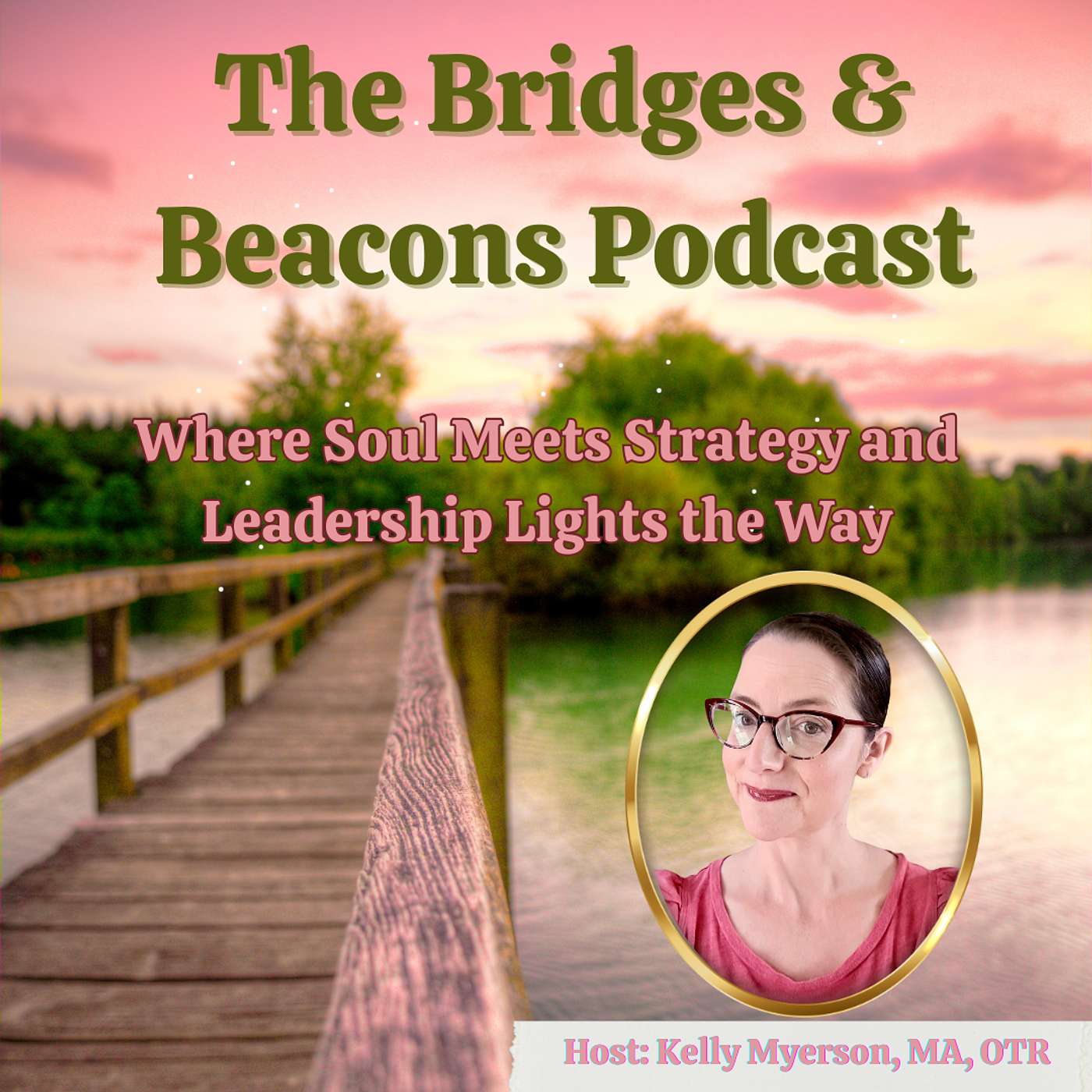
The Bridges and Beacons Podcast
Kelly Myerson