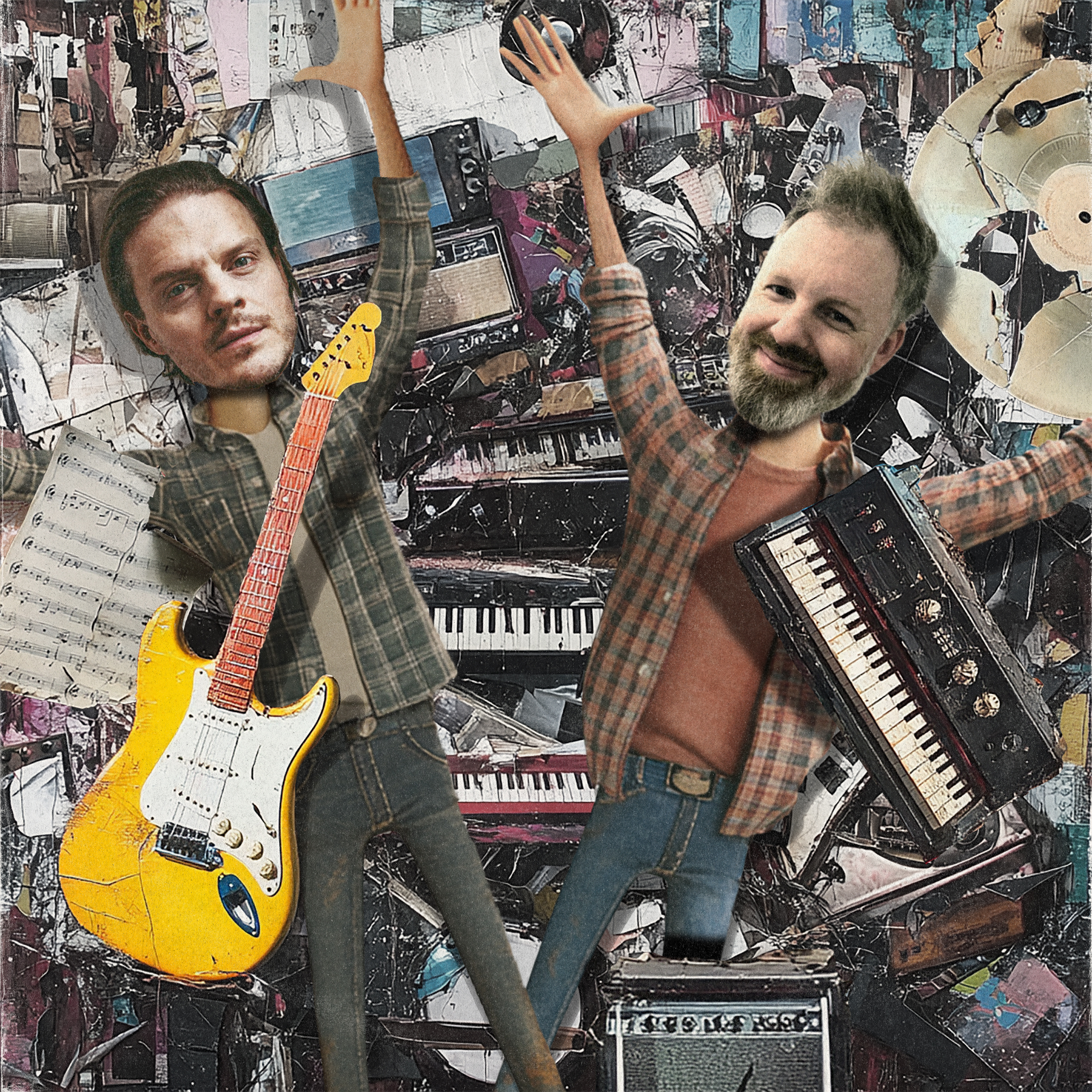
Nashville. Scratching the surface.
Emmy award winning songwriter Andrew Rollins and songwriter and broadcaster Alison Craig talk about the songs, the songwriters, the highs, lows, heartbreaks and beyond of Nashville.
Guests give their insight into the process, the town and the highs and lows within.
Andrew has 9 songs on Nashville The Show and a million stories to tell.
Find out where and how some of the best known songs in the world were written.
Meet some of the extraordinary people who are working and living there now.
40 years of songwriting experience and he lays it bare.
Subscribe to Nashville, Scratching the Surface and be sure not to miss a thing.
Nashville. Scratching the surface.
Ep. 2 Insights into songwriting in Nashville and digging deep to do so.
Use Left/Right to seek, Home/End to jump to start or end. Hold shift to jump forward or backward.
Text us here - we would love to hear from you
Chapters
We cover a lot in this episode. Some topics include
- The Journey of Songwriting
- Emotional Depth in Songwriting,
- Collaboration and Co-Writing,
- Songwriter Etiquette and Nashville Insights,
- Art of Songwriting and Inspiration,
- The Line Between Songwriting and Plagiarism,
- The Dual Paths of Songwriting and Performing,
- The Pressure of Following Up Success,
- Recognizing a Hit Song,
- The Impact of AI on Songwriting,
- The Changing Landscape of Music Distribution,
- Collaboration and Openness in writing.
Phew!
If you would like to drop us a message please do so above or if you would like to arrange a session with Andrew, cermortinmusic@gmail.com
Thanks for listening and remember please tell your follow and share this podcast if you enjoy it.
See you next time!
https://nashville.buzzsprout.com
Alison Craig (00:01)
Well, welcome along to Scratching the Surface. This is our second episode. I'm Alison Craig.
Andrew Rollins (00:06)
And I'm Andrew Rollins.
Alison Craig (00:09)
And you'll notice that there's video this time. So we decided that might be quite a nice way to go forward. Because give us a description of where you are, Andrew.
Andrew Rollins (00:19)
I am in Studio City, California, and what is that, about 4,000 miles from you?
Alison Craig (00:27)
It's a long way. I think it's more than that, actually. I know, I know. Well, I'm in Scotland as you can detect a slight accent, potentially, just north of Edinburgh in the centre of Scotland. Edinburgh, not Edinburgh, Edinburgh. But we hope you enjoyed the first podcast, because that was really hearing your story, wasn't it, Andrew?
Andrew Rollins (00:29)
just like you're in the other room.
Edinburgh. Edinburgh.
Hello man.
And a bit of my background and where I came from and just a kind of a summary of my last 69 years.
Alison Craig (01:11)
You
Andrew Rollins (01:18)
We got some great response. ⁓ And I'm looking forward to episode two.
Alison Craig (01:21)
We did. So thank you for listening to the first one.
Yeah, me too. I mean, now, obviously, you know, everybody knows that your history, we can find you on social media, can't we? ⁓ On Instagram.
Andrew Rollins (01:41)
Facebook,
Instagram, TikTok. What else?
Alison Craig (01:49)
whole thing. We'll put all this in the show notes so you can find us and keep in touch because it's always nice to know what you want us to be talking about because it's basically songwriting isn't it and that's where it's at.
Andrew Rollins (02:03)
It is what I do and
I've done for probably the last 40 plus years. ⁓
Alison Craig (02:13)
Yeah. I
mean, I think an interesting place might be to start this week, you put up a ⁓ screenshot of the number of streams that you've had in terms of, you know, some of the amazing songs that you've written and it's in the millions and millions and millions, isn't it?
Andrew Rollins (02:31)
I think we're at 22 million. And that's ⁓ just an accumulation of the last two years, which is when I started tracking my streams.
Alison Craig (02:36)
So.
Yeah.
I mean,
that's a hell, I mean, to the uninitiated that, well, to the initiated actually, that is a hell of a lot of streams. And I think.
Andrew Rollins (02:56)
It's not,
you know what, as soon as your album comes out, you're just going to blow past me.
Alison Craig (03:03)
Well let's hope so, Because it would be nice to buy a half lager if we're lucky. But in all seriousness though, because the whole thing has changed so much, I've been looking a lot at people who don't record their own music. So they're always looking for that song, aren't they? The elusive song that is going to make them, break them, whatever it is.
Andrew Rollins (03:31)
know, a really
interesting story that just happened last week. There's a singer that I've wanted to work with. I met her about 10 years ago and her name's Brenna Whitaker, and she's a great. She's got a great voice, very kind of like more on the jazz side of things, but not like.
Charlie Mingus and John Coltrane jazz. More like ⁓ Nina Simone and Joe Stafford and those traditional great female singers. Anyway, I was going down a rabbit hole. But anyway, a dear friend of mine, Eden Alpert, who has a club.
up on Mulholland ⁓ about 10 years ago introduced me to her and we threatened to write together ⁓ for years. we just kept, our schedules kept clashing and you know, life, you know, happens. And then all the medical stuff I've had in the last two years. But finally, ⁓ I would,
The other day I was on social media and I saw a new post that she had done a traditional album of classics like We're All Alone and Overjoyed by Stevie Wonder, just beautiful versions of classic songs. And so I just, I went on my phone and I said, I wonder if her number's still the same. So I called her and ⁓
Alison Craig (05:09)
which
Mm-hmm.
Andrew Rollins (05:24)
reintroduce myself and she said, well, can you send me what you've been doing? You know, and I said, well, I can send you some of the new stuff I've been doing. I so I text sent her a song. She called me back right away and just gushed over the song, just loved the song. And so we're writing. This Tuesday on Thursday.
And it's like, though I always say that things happen when they're supposed to happen or when you need them to happen. know. ⁓
And, you know, I'm always kind of a positive, cheery guy. But lately I've been I've been kind of. Down, you know, and I have to.
Alison Craig (06:21)
But do you know,
that's when your best songs tend to come out. I was watching the Billy Joel documentary last night, you because you said watch it and I was like, couldn't stop watching it. I mean, I'm only like halfway through it. I had to go to bed eventually because it was on for hours, it was, no, but it was great. It's really interesting. And he, he is a proponent of that, isn't he? That when he was at his all time lowest, he got the best songs.
Andrew Rollins (06:31)
to the pantheon theory.
Yeah. Yeah.
Right. And that's kind of...
The grace of being a songwriter is when, know, and I shudder to think if I didn't have music, where I'd be. You know, because I have music and I have this...
creative outlet as you do and as any songwriter or artist does. ⁓ We have this safety valve that, you know, when things get overwhelming for us or... ⁓
our emotions overtake us, we have this outlet that we're able to.
getting emotional now. can't, I can't. Weird. But we have this, we have this release that we have, you know, and, and, that's the, the amazing thing about it is that we have.
Alison Craig (07:48)
Well, it's very raw, that's why.
The thing that strikes me about
this is... Sorry, interrupting. Not like me. ⁓ No, was just... That I find very interesting. All the songwriters for the short period of time that I've been doing this, but particularly men, have to say, and I don't think it's just men in this part of the world, but men that write songs seem much more able to...
Andrew Rollins (08:08)
No, go ahead.
Alison Craig (08:32)
describe or to address the emotion actually, because a lot of men keep everything in and that's, they just button it up and walk away and just deal with it. I don't know how they deal with it. So it's really interesting that songwriters seem to be much more in touch with being able to dig deep and not be afraid to say what they're actually.
Andrew Rollins (08:54)
Well, you know,
from from yay high, you know, as as men, for lack of a better term, we're taught that, know, you don't cry, you don't you don't do all these things that. And I'm not this is going to sound like a sexist comment, but that women are allowed to do, and it's and it's acceptable for women to do it. But there's.
You know, there's nothing more. ⁓
You know, like I remember my grandfather used to say to me, you know, it's OK to cry when you're by yourself. And it's OK to let out those emotions if no one can see them. And, you know, we're inundated with all that masculine energy we're supposed to have.
Alison Craig (09:37)
Right
All
or what would they call
it, masculinity in some ways. Yeah. Yeah.
Andrew Rollins (09:55)
Exactly. And it is toxic because it
not only hurts the people around us, it hurts us. And, you know, I hate for this to sound like a therapy session, but that's another thing that music has always done for me. It's been my therapist. It's been my lover. It's been everything that
Alison Craig (10:12)
I love it.
Andrew Rollins (10:25)
And I'm missing those things in my life, it fulfills that, you know? Anyway, enough about that. But anyway, I'm really excited about writing with Brenna Whitaker. And for all the people that are listening to us, check her out. She's amazing.
Alison Craig (10:28)
Mm-hmm. Yeah. Yeah!
Yeah.
Absolutely. Well again we'll put
that, you know, the notes and the song that she heard of yours was Mission Bell.
Andrew Rollins (10:53)
Yeah, which I wrote with Emily West and Eve Nelson and.
Alison Craig (10:54)
And that's a new...
So that's what I'm interested
in. So Emily, will Emily not record that? Is that not? Because she's got this beautiful.
Andrew Rollins (11:03)
Well, no,
mean, Emily had, look, here's the thing about writing a song is, you know, we, ⁓ as songwriters, we each have the right, we each have equal rights with the song. You know, so.
Alison Craig (11:21)
I wasn't, you know, I was just wondering how works because it's an interesting world, know, and that's the of this podcast is to find out all the ways these things work because it is a mystery, you know.
Andrew Rollins (11:30)
Yeah.
Mystery. It is a mystery. It's a big story. But the thing I really wanted to talk about is jumping back into the Nashville side of things and.
Alison Craig (11:35)
Yeah. Yeah.
Andrew Rollins (11:48)
As a young songwriter, when I first started going to Nashville 20 plus years ago, ⁓
You you write in New York, you write in LA, you write in Miami. And we all have like different rules. Like one of the rules that really used to bother me in LA was the word counting rule. And there were some writers that would base their percentage of the song on what they mathematically figured they deserved.
Alison Craig (12:28)
Right, gosh.
Andrew Rollins (12:28)
which
I've always been the Nashville and Desmond Child, great songwriter. ⁓ Check him out if you want to hear a hip machine. ⁓ Loving an elevator, ⁓ living on a prayer, know, all the amazing rock songs, but he's also
Alison Craig (12:49)
Right, that's really interesting,
Dressman Child, because again, when you see John Bon Jovi or Aerosmith or whatever, you're thinking they wrote the songs, but is it often the case or seldom the case?
Andrew Rollins (13:04)
Well, a lot of times, you know, smart artists bring in hit writers to guarantee a hit. know, you know, Stephen, Stephen Tyler, a very Smith was really smart and his label was really smart in picking great writers to to write with.
Alison Craig (13:13)
Right.
Yeah, yeah.
All right, OK. Yeah, So that's, yeah.
Andrew Rollins (13:33)
But anyway, so
Desmond's, when I first started writing with Desmond years ago, ⁓ you sit down and you go, okay, how are we gonna do this? Because you wanna be really transparent with your co-writers. And... ⁓
know, Desmond was like, well, you know, my philosophy is there are three people in this room. We're splitting it three ways. And that's the right thing to do, because without those three people in that room, you have no idea what that song would turn into. although I might have contributed. Excuse me, I might have contributed more than my co-writers.
Alison Craig (14:13)
Sure.
Andrew Rollins (14:24)
That combination of creativity was brought about by the three people in the room.
Alison Craig (14:35)
Yeah, you know going briefly back to that Billy Jewell thing that I was watching, that was very much part of it. He's got the same guys around him now that he did when he was starting out.
Andrew Rollins (14:43)
He's got
the same band, but Billy Joel has never until recently done a co-write. Never co-writes. He writes everything himself.
Alison Craig (14:50)
really?
And he doesn't give the band a cut of his songs, because...
Andrew Rollins (14:58)
I think,
you know, I don't know. I'd be speaking out of turn and uninformed if I answered that. But I would imagine to have a band stay with you for 50 years, you take care of it.
Alison Craig (15:14)
Yeah, I love that actually about the whole story, know, the fact that he'd taken these guys along and he got a Clive Davis pitched up and offered to give him a deal and he said, was it Clive Davis I think it was, and he said
Andrew Rollins (15:30)
No, he went to George Martin.
Alison Craig (15:33)
That's it. That was that. That was a great one.
Andrew Rollins (15:34)
And George Martin
said, I love your music. I hate your band. I want to bring studio guys in. And Billy Joel said. It's a package deal. And he turned out working with George Martin, the fifth Beatle. Yeah, but the thing that the guy that produced him is a guy named Phil Ramone. ⁓
Alison Craig (15:47)
yeah, which I thought I really respect that. ⁓
Absolutely.
Oh yeah.
Is he in relation to the Ramones? Ramones? No, I just wondered. Okay. Was it really? They maybe took him then. Yeah, great.
Andrew Rollins (16:04)
No, the Ramones aren't even called the Ramones. That was a fake name. Yeah. They weren't
brothers, Joey Ramone, Dee Dee Ramone. They were that was just the band. Yeah, yeah. But yeah, so the guy that he ended up picking is a guy named Phil Ramone, who. ⁓ Was. ⁓
Alison Craig (16:19)
Was it? I have no idea. There you go.
He clearly had a huge influence on how the record
Andrew Rollins (16:34)
Absolutely. really,
Alison Craig (16:34)
sounded and yeah.
Andrew Rollins (16:37)
and Billy Joel gave him credit in the documentary, he said he'd go, you know, take this, because Billy Joel writes several songs in one song. And the way it all threads together, like moving out, you know, it goes through three different sections, much like Paul McCartney.
Alison Craig (16:48)
Yeah.
Right.
Andrew Rollins (17:03)
⁓ you know, did with the Beatles and his solo career, but, ⁓ yeah. So, Phil Ramone was really instrumental in, putting things where they needed to be, you know.
Alison Craig (17:19)
Yeah. And
listening to the magic of what Billy Jewell and his band were doing, because one of the albums was recorded as live, wasn't it, in the studio? Yeah, I think it was. I just do.
Andrew Rollins (17:28)
Yeah, I think it was the Glass Houses album.
But I mean,
that documentary is just I can't imagine it not winning every award. You know, available.
Alison Craig (17:41)
Yeah,
yeah, I agree. I mean, I haven't even seen the end of it yet, but yeah, I'm absolutely hooked. Yeah, well, I'm looking forward to the bit where he meets Christie Brinkley, obviously. That's what I remember, Eden.
Andrew Rollins (17:46)
⁓ it's so good.
Yeah, there you go.
But the thing getting back to songwriting. When I first started going to Nashville, I had, you know, I had. Songwriter etiquette. Because I'd been doing it, you know, for almost 20 years, and I knew the thing, the thing you need to learn when you when you're a young songwriter, and I don't mean.
Alison Craig (18:08)
Yeah.
Yeah.
Andrew Rollins (18:22)
Age-wise young, mean, as far as your songwriting age is, how long you've been writing songs. The thing you need to learn is etiquette, songwriter etiquette. And, you know, sometimes not knowing...
Alison Craig (18:27)
Yeah.
Andrew Rollins (18:40)
Knowing what not to do is one of the greatest tools that you can learn. know, always be... Go ahead.
Alison Craig (18:47)
Well, think...
No, I was just going to say, think, you know, if you can give a bit of advice there, because having just been through all this for the first time, as you know, I... There's nowhere to learn that other than from somebody who knows. You know, it's not like you can pick up... You can't get on the... I mean, you can read stuff online, but it's so confusing and can be misinterpreted in so many different ways. So, you know, fill in the blanks, please.
Andrew Rollins (19:14)
My rule is this. When you go into a write, doesn't matter if it's a pop or country or jazz, rap, whatever. First and foremost, have two or three ideas. Melodically and lyrically titles. Don't walk into a write and go. Because most of the time, if you're writing with a good writer, a known writer,
Alison Craig (19:33)
Mm-hmm.
Andrew Rollins (19:43)
They're going to look at the new person and go, what do you got? And if you go, I don't know, that'll be the last time you write with that person. So you go in and you go, well, I've got this title, know, the way she kissed or, you know, are we going to make it through this? You know, just and have I've got lists of titles in my phone.
Alison Craig (19:51)
Yeah.
Okay, so you get tested the minute you walk in here.
Andrew Rollins (20:13)
I'll hear someone say something and I'll go, wow, that's a good title. Or a line, you know. ⁓
Alison Craig (20:18)
Haha
point actually because I was watching this drama the other night and there was a couple of lines in the script and I wrote them down because I thought god that's you know ⁓ how does that work because it's obviously in a script you know is that stealing?
Andrew Rollins (20:40)
No, because you cannot copyright O'Leary.
Alison Craig (20:47)
You cannot copyright a lyric.
Andrew Rollins (20:50)
Right, so if I'm reading a book by F. Scott Fitzgerald, as Eric Carmen did 50 years ago when he read, there's romance in the sunset, we're boats against the current to the end. And Eric sat down and wrote a song called Boats Against the Current. Beautiful ballad. Yeah.
Alison Craig (21:11)
really?
So you can't,
so words from a published novel or a script or whatever, that's like a free for all.
Andrew Rollins (21:22)
Yeah, because the language, whether it's French, English, Scottish. ⁓
Alison Craig (21:23)
I didn't know that.
Hang on a minute, that is English.
Just as well you're the other side of the world, I dunno.
Andrew Rollins (21:35)
No, I'm just playing with you. But
if you have... ⁓
You can't copyright a language.
You know, other, know, if that were the case, French people would go, ⁓ you cannot speak our language. You know, we might butcher that language, but it's like James Taylor wrote a song called Something. I think it was called Something and the Way She Moves. It's on his very first album. Well.
Alison Craig (21:48)
Yeah.
Yeah, yeah, yeah.
That's not the
one that George Tarasin sang, is it?
Andrew Rollins (22:13)
But then George
Harrison wrote a song called Something in the Way She Moves, attracts me like the lover. And you can go online and pull up James Taylor's first version of something. And he said something in the way she moves and then he changed the story. So you can't.
Alison Craig (22:18)
All
Yeah.
Okay.
Andrew Rollins (22:39)
And when I when I when I first saw that James Taylor had written a song called Something, ⁓ I went, my God, he stole it from the Beatles.
Alison Craig (22:49)
Like I just did.
Andrew Rollins (22:51)
Exact opposite.
Alison Craig (22:53)
Right, yeah, interesting. That's really interesting.
Andrew Rollins (22:56)
Yeah, George Harrison.
But look. ⁓
I know that, look, if I have a great line for a song and someone else has said it, ⁓ I wrote a song called Drinking Through It, and it was about getting through a really hard emotional time, you know. And one of the lines, and I wrote it with Lee Bryce and Ashley McBride and Terry Joe Box, all good, very strong writers in Nashville.
a friend of mine had gone through some distress and ⁓
I went down to see him and I said, dude, you can't do this. You can't drink yourself into oblivion. can't do snort Adderall until the sun comes up. You just can't do that. And he looked at me and he said, leave me alone. I'm drinking through.
And he had gone through a really horrific thing, but I immediately went.
And I made it, I turned it into a love song, you know, you know, two people that have split up and they, you know, they're talking on the phone and the female says to him, you know, how are you doing? And the guy goes, how are you doing? And they keep going back and forth. And finally, he just goes, you know what, I'm drinking through it.
Alison Craig (24:06)
Yeah.
Andrew Rollins (24:34)
That's how I'm getting through it. And so those ideas that you come up with always be, you know, get off of this, you know. And listen to everything going on around you, and you will come up with diamonds and gems of lines if you just open your ears and listen. You know, and and and then, you know, when you walk into a room like I was saying,
Alison Craig (24:36)
Yeah.
Yeah,
Yeah. Yeah.
Andrew Rollins (25:04)
you can go, well, I've got this idea, I've got this idea drinking through it. I've got this idea, you know, are we gonna make it? You know, you know, ⁓ tears in her eyes or whatever, whatever you have in there, but always write it down because you never, you're never gonna, if you have a line in your head and you go, yeah, I gotta remember that, you will never remember.
Alison Craig (25:34)
I remember watching the Christine McVie documentary and she was talking about in middle of the night she just woke up and had songbird in her head and she was like, she was, well no she didn't have one in those days. She kind of wrote down the lyrics, she got up and she played it on the piano, she played it on the piano until the guy she knew had the studio.
Andrew Rollins (25:45)
And so she grabbed a recorder and then put that melody down.
Alison Craig (25:58)
she knew she could get into the studio and she phoned him and she said, I'm on my way, get it all set up. And she came rushing in, sat down and played it and sang it because otherwise it would have gone. And yeah.
Andrew Rollins (26:04)
Right.
Yeah. Which is
one of the greatest songs ever written. You know, it's it's and also, you know, as a songwriter. You know, be really study the masters, the people that came before you like, you know, Jackson Brown is like one of my favorite poets. You know, aside from all the great music he wrote, Leonard Cohen.
Alison Craig (26:12)
Yeah, that's what I'm, yeah.
So what,
I mean, again, Leonard Cohen was a poet, wasn't he, and Jackson Brown. So what's the difference really other than the poetry as to music, you know, between a songwriter and a poet?
Andrew Rollins (26:40)
⁓ God.
Well, if you
steal something verbatim from someone, like if I went looking at some photographs I found inside a drawer, I was taken by a photograph of you. There were one or two that I know you would have loved a little more, but they didn't show your beauty quite as true. And that's a line to a song called Fountain of Sorrow by Jackson Brown. But if I were to steal that whole thing,
Alison Craig (26:53)
Yeah.
Andrew Rollins (27:19)
That's plagiarism. if I saw, like if I went, the fountain, what a great idea. I can't be sued for that. But if you, I mean, if you steal a massive amount, then you're going to have a problem. And then plus every other songwriter is going to look at you like, you what the hell's your problem? ⁓
Alison Craig (27:20)
Yeah, yeah.
Right.
Sure.
Yeah.
Yeah, yeah,
I suppose it's like the comedian stealing somebody's juke, isn't it? You know, they're very... It's your bed and butter.
Andrew Rollins (27:48)
Yeah, exactly. Well, it's like, you know,
there these are the rules, you know, that a lot of songwriters in Nashville, knowingly or unknowingly or anyone anywhere in L.A., New York, Miami. You know, when you hear a melody over and over and over again, and if it's a great melody.
Alison Craig (27:55)
Yeah.
Andrew Rollins (28:17)
it's going to burn into your memory.
So the worst thing that could happen is you go into a write and go, wow, I've got this great melody unknowingly, and then you steal that melody. So you really have to really be.
Alison Craig (28:31)
Yeah.
Andrew Rollins (28:41)
Honorable. mean, I always say this when I talk to young songwriters. If you do the right thing, you don't have to worry about doing nothing.
Alison Craig (28:52)
It's a great line. I'm going to write that down.
Andrew Rollins (28:57)
I say it all
the time. But you it's true because.
We all like want, you know, it's like we all want to be loved with our music and our lyrics and the poetry of what we do. And so we're we're constantly, you know, all the people that like you and me and and and Emily West and and Brenna Whitaker, and we love what we do. It's it's our oxygen. You know, it's our heroin.
Alison Craig (29:33)
Yeah.
Andrew Rollins (29:34)
It's
our cigarettes. It's that thing that we can't get out of our blood and it's never gonna go away. And that's when you know.
that you were, you're a songwriter. I remember I was getting ready to go to college and, you know, I knew I would, what?
Alison Craig (29:55)
And you were, yeah, how old were you then? I mean, were
how old were you then when you were just getting ready to go to college?
Andrew Rollins (30:01)
I think, eight, yeah, 17, 18. ⁓ What?
Alison Craig (30:04)
Just saying the scene.
just setting the scene.
Andrew Rollins (30:10)
Yeah, I was young. And so I was thinking, you know, what do I want to do? You know, but I had been I had been so. ⁓
But, but bit me last night and.
Alison Craig (30:29)
That's good you don't get those in Scotland. We've got nothing here that'll kill you.
Andrew Rollins (30:34)
Yeah, but you get a Loch Ness monster.
Alison Craig (30:37)
Yeah, yeah,
he's trained to only attack songwriters from Nashville. So you're all right.
Andrew Rollins (30:45)
But anyway, so I was wrestling with this thing about what do I want to do?
I wrote down on a piece of paper.
all my choices, what I had been trained for. And the only thing that I had really been trained for.
was being a musician, which turned into being a songwriter. And if you have that in your blood, and...
Alison Craig (31:12)
Yeah.
Yeah.
Andrew Rollins (31:26)
It's you're never going to do anything else. And you'll have you'll have times where I've talked to you about I'm going to quit. Quit, but those are low, you know, momentary lapse of reason, you know.
Alison Craig (31:30)
Yeah, I mean, what I thought.
Yeah.
Yes.
⁓
Andrew Rollins (31:45)
to steal a great
line from a song by Pink Floyd. ⁓ You know, we all have those.
Alison Craig (31:49)
Right.
Absolutely, you know, was reading as you do, because all of a sudden, you know, I'm very interested in who's writing the songs rather than performing them. It's an interesting kind of, as you said to me, I think on day one, you'll be one thing. You'll either be a songwriter or you'll be an artist. But, you know, you have to go through one.
Andrew Rollins (32:09)
There's two doors. There's two doors that you can go
through. One is you're going to be an artist and the other one is you're going to be a songwriter. Which one are you going to pick? And a lot of people try to say both, but the great songwriters, the great songwriters. And there are exceptions, but are the ones that said. I'm going to go through this songwriter door, you know, a negative.
Alison Craig (32:18)
Yeah. Yeah.
You know, I-
Andrew Rollins (32:39)
at one point in their career, they might have done the, I'm gonna try and be an artist like I did. But that,
Alison Craig (32:47)
But
you've played guitar with all sorts of people for years, household names. So you did work in both sides, didn't you?
Andrew Rollins (33:02)
God, yeah. Yeah. Yeah. In the beginning. Yeah. But it takes a
Alison Craig (33:03)
Yeah.
So I guess people can try.
Andrew Rollins (33:11)
Okay, what?
Alison Craig (33:13)
People have got to try, try, you know, both maybe and see which fits and then maybe decide. I was really interested that as we were talking the other day about Tennessee whiskey, not the drink, the song. And Chris Stapleton didn't write that, but he is so synonymous to me and, you know, people that have heard that song with that song. So he is the artist and not the writer. So what I don't understand is if you're a song, if you're a singer,
Because he does write his own stuff as well, doesn't he? Yeah, so what's the incentive to sing... I suppose, would you call that a standard? I mean, it's an old song, isn't it?
Andrew Rollins (33:44)
It writes a lot of it, yeah.
Well,
here's what you have to do. You have to be really honest with yourself and go.
This is an undeniable hit.
And if you're more concerned about your songwriting ego, then be a songwriter. But if you're an artist and you're looking, know, once in a while we write a undeniable hit, a song that you hear and you just go, holy shit, this is just incredible. But that's really, really rare. You have to write a lot of songs to
Alison Craig (34:14)
Mm-hmm.
Mm-hmm.
Yeah.
Andrew Rollins (34:39)
to get those gems. there's, know, everyone always used to say this, well, how long did it take you to make your first album?
Alison Craig (34:41)
Yeah.
Andrew Rollins (34:53)
⁓ you're 25 years old. It took you 25 years to make that first album. Now, your second album, you've got a year. You got a year to write 12 more songs, go in the studio, go out on the road. So it's like you have all this time to make your first musical impression and then
Alison Craig (35:00)
Yeah.
Yeah.
Andrew Rollins (35:22)
That was the amazing thing about Billy Joel is, he came out with the album that really did it for me was Turnstiles. ⁓ And then he came out with The Stranger. Then he came out with 52nd Street. Then he came out with ⁓ nylon curtain, no, Glass Houses. And then he came out with The Nylon Curtain. He had a run for like
Alison Craig (35:33)
Yeah. ⁓
I apologize this year.
Andrew Rollins (35:51)
10 years that it was just Grammy after Grammy, Ivan Novello Award after Ivan Novello Award.
Alison Craig (35:58)
Interestingly, when he wrote Just the Way You Are, he didn't really like it.
Andrew Rollins (36:04)
He hated it.
Alison Craig (36:06)
And you think, my god, because that to me is the one, I remember probably the first time I heard that, there was just something completely different and magical about it, but he didn't hear it or see it, did he? It was...
Andrew Rollins (36:17)
No. And he said that until he was in the studio and a couple of his friends came by the studio and he played it for him. And he goes, what do you think of that? And they go, that's one of the greatest songs I've ever heard. And it was Phoebe Snow and Linda Ronstadt.
Alison Craig (36:25)
Yeah.
You
Andrew Rollins (36:39)
And that's when he decided, ⁓ yeah, I guess I should have this be on my record. But he wasn't even going to put it on record.
Alison Craig (36:44)
Well, yeah, because on his record, yeah.
But actually, the record company, put out, was it Moving Out? They put out first because they obviously, and then his wife, stroke manager, said that's going to be the second single. And everyone was like, right, OK. And then, bam.
Andrew Rollins (37:03)
Wait, did you just call her a stroke manager?
Alison Craig (37:06)
You know what mean? I liked her a lot, I have to say. I'd love to name her Plastic Throats. I was just going to say.
Andrew Rollins (37:11)
She was great. And I'll tell you what, for 70,
however old she is, 76 or so, she looked amazing.
Alison Craig (37:21)
You really did. thought bloody hell Billy, shouldn't have let that one go. anyway, it's the Billy Joel show, isn't it? But it was an extraordinary. I'm very, very excited to. So when you when you write that song, know, OK, people that are watching this or listening to this, are in tune with scratching the surface. I'm Alison Craig and this is Andrew Rollins. I mean, everybody knows, well, I knew and.
I'm sure everybody would like to hear the story. You've won some amazing awards for your songwriting over the years and when you write that song that ultimately ends up giving you an MA or another award of which you have many, do you know at that point you think this is an absolute beast of a song and we're going to be rich?
Andrew Rollins (38:10)
You know what? No. You know that there's some, and I'm just being honest, you know, when you write that song,
Alison Craig (38:12)
Right. It's a straight answer anyway.
Yes.
Andrew Rollins (38:24)
you go, wow, this is really good. you live, a rule I have is I write it and I'll probably listen to it 15 or 20 times the day I write it. And then I put it away for a day or two. And then if I can recall that melody.
and then go back and be on the money, I know it's a good song. Melodically, it's a good song. You know, it's like there are people write a lot of great songs, but a hit song is determined by the masses.
Alison Craig (38:53)
Okay. Yeah, yeah.
Yeah.
Andrew Rollins (39:05)
It's not determined by, there's not a test that you submit your song for, although there are several contests, but where it goes, wow, this is a undeniable hit. An undeniable hit is determined by the population.
Alison Craig (39:26)
Yeah. And you referred there to some of these competitions. mean, so many of them. I mean, you know, as a young, as you say, not in terms of age, but a new songwriter, would you say any of those competitions are ⁓worth doing or are they all just money making ventures? I mean, like the, you know.
Andrew Rollins (39:28)
And that
Go ahead.
Well, think there's the Grammys, there's the American Music Awards, there's the
Novello Awards, there's, you know, ⁓ there's the, you know, ASCAP Song of the Year. Those, you know, those are all, are they popularity contests? Yeah, but it's like the accolades are, like every time I walk in by my piano in the house.
Alison Craig (39:54)
Yeah.
Yeah.
Andrew Rollins (40:14)
know, my Emmy and my Talley Award and all my ⁓ plaques for...
millions of sales and streams are on my wall and I walk by them and I like for a moment I'll go, oh yeah, I remember the day I wrote that. Or I'll remember that feeling of when I won that award. If you go on my TikTok page, there's a funny thing that I posted. I found the picture of the night I won my Emmy. I brought it home.
Alison Craig (40:35)
Yeah.
Andrew Rollins (40:52)
And I put it in the bed. And it's on a pillow. the caption was, look who I got to sleep with last night. But boy, her feet were cold. Which, when I wanted, it was just kind of in the middle of the Me Too movement. So I got a lot of flack for that.
Alison Craig (41:04)
⁓ god, you'd have the PC squad out after you.
Andrew Rollins (41:21)
You know, those moments you don't forget, you know, they're make an indelible impression on you that never goes away every time.
Alison Craig (41:24)
Yeah.
Is that
a like having a very huge album or something? There's a pressure related to that though. After you win that, it's like you can win again. Well, how do you follow up? Yeah.
Andrew Rollins (41:40)
How do you, well, how do you follow it up?
It's like, yeah, I mean, that's why the Eagles broke up. It's because they had Hotel California come out and they went in the studio and they went, how the hell do we top this?
Alison Craig (41:59)
Right. I didn't know that.
Andrew Rollins (42:00)
And you don't the way you top that is you try, you know, it's like. If there was a formulaic.
Alison Craig (42:06)
Yeah.
Andrew Rollins (42:15)
If there was a formula to write a hit song, everybody would do it.
Alison Craig (42:21)
So, what's your
take on AI?
Andrew Rollins (42:27)
Oh, it's look. I mean, it's interesting. I've I've I've looked at some of this stuff, but the thing that I can't do or can't do yet. Yes.
Alison Craig (42:43)
Yeah.
Andrew Rollins (42:44)
You know, that when your heart is broken and you sit down with a pen and you write what you're feeling, you know? ⁓
Alison Craig (42:51)
Yeah.
Andrew Rollins (42:55)
that that can't be duplicated yet. I hope I don't. I hope I'm gone before that that comes to fruition. Or at least I'm sitting in a wheelchair. Dribbling food out of my mouth. ⁓ I don't want to be I really don't want to be aware of that, because that will be if that happens.
Alison Craig (42:58)
Yeah, thank you.
Nice. ⁓
Andrew Rollins (43:26)
That'll be such a sad day that people don't, if people don't create music anymore.
Alison Craig (43:28)
Yeah.
Andrew Rollins (43:35)
Man.
Alison Craig (43:35)
Yeah,
of the world as we knew it, really.
Andrew Rollins (43:38)
Yeah. Move over. need a spot on a high building or a tall bridge. know, it's like, and people don't think about that. It's like. When streaming started to happen, you know, with Napster and Pandora's Box and all that, people didn't realize what it was going to do. You know, and and that, you know.
Alison Craig (43:42)
I'm
Yeah.
Andrew Rollins (44:06)
I mean, we work really hard to create.
to put our creativity out there and then to have somebody go, well, I've got a recording of it and it should be free. No, fuck you. You, you, you.
Alison Craig (44:14)
Yeah.
Yeah, yeah, yeah, I
totally agree. mean, you know, somebody was saying yesterday, it was amazing, you know, I released my single and I got 5000 streams and I didn't want to be, you know, pissing on their chips, but there's a hundred thousand songs every day that are going out in Spotify. You just think, you know, it's the landscape is so changed and so difficult. It's a very...
Andrew Rollins (44:45)
Yeah, but the
thing about those 100,000 songs, if you were to sit down, if a computer could analyze those 100,000 songs, maybe 1 % of them had any redeemable qualities whatsoever. You know, cause that's the problem. You know, it was really when A &R people, the true A &R guys like David Geffen and Clive Davis and...
Alison Craig (44:59)
Yeah.
Andrew Rollins (45:11)
Walter Yetnikoff and Amit Erdigen, all those masters of the music business. ⁓
They loved what they did. They loved it. It was their passion. And they had a unique talent for finding amazing talent. And that's the problem. can't have, and I'm gonna sound like an old guy, which I am, but ⁓ you can't have a 25 year old kid who's a music.
Alison Craig (45:33)
Yeah, yeah.
Andrew Rollins (45:49)
business major in college know what they're doing with music. And I'm generalizing here, but it's not a thing that you either can do it or you can't. Just like playing guitar or piano, you can either make that magic when you touch an instrument or a keyboard or you shoot a basket.
Alison Craig (46:19)
Yeah. Yeah. Yeah.
Andrew Rollins (46:21)
You know, because
and you learn that, you know, it's with dedication and determination that that happens. Anyway, I've gone down a rabbit hole, but getting back to the rules of Nashville. Always walk in. With a couple ideas, lyrically, titles. Or a line or a verse or whatever. Always have a couple melodic ideas.
Alison Craig (46:36)
Yeah.
Mm-hmm.
Andrew Rollins (46:53)
and always be willing, like if you sing a melody and somebody goes, yeah, I love that, but what if we took that up a third at the end of it? Be receptive to everybody's collaboration because if you don't, they're just gonna go, well, okay, let's write something else. Everyone wants to feel, if you walk into a room with three writers,
Alison Craig (47:03)
Mm-hmm.
Andrew Rollins (47:20)
They all have egos, one. They all are usually pretty good at what they do. And you being good at what you do only broadens your horizon with what you let in and you let influence that song or that idea. So always be open.
Alison Craig (47:43)
I'm out.
Last week you were talking about when you were playing in a bar back in Cleveland and ⁓ Eric Carman came in and said to you you're a good songwriter but I could make you a great songwriter. I would love, I could teach you how to be a great
Andrew Rollins (47:57)
I could teach you how to do a great
song.
Alison Craig (48:01)
I would love
to get a few of those nuggets. So do you remember what they were, firstly? And secondly, I think that would be a great way to start our next podcast, because I think that really tickled my fancy. thought, ⁓ what did he say? Because you clearly knew your instinct was to be that songwriter, but what he said to you that just, I don't know, elevated it or made you think in a different way or...
Andrew Rollins (48:31)
I'll remember the first day that I went to Eric's.
condo.
in Cleveland because it was a hot August day. And I walked into his condo and Eric was Eric loved his room to be as cold as humanly possible. Like. I used to say to him, ⁓ my God, I can see my breath in here, you know, because it was it was it was I'm exaggerating, but.
Alison Craig (48:57)
Mmm.
Really? God, that's freezing!
Andrew Rollins (49:09)
It was cold. so he was a big iced tea drinker. And. ⁓
Alison Craig (49:10)
Yeah.
Andrew Rollins (49:18)
He made, he always made this instant Lipton iced tea. And so I would walk in and he'd go, do you like iced tea? And I go, yeah, I love iced tea. And so he'd make the iced tea and he had these huge glasses, huge glasses, and he handed me one and he had one and we sat down at his piano and he said, play a C chord. And so I played a C chord.
And he goes, okay, now play a C chord and do a descending bass line, but keep that C chord.
You know, and a lot of it was. ⁓
Sorry, I'm picking up a guitar to show what it was. A lot of it was like, and I'm tuned very weird here. Okay, so if I'm playing in this form and I went.
Alison Craig (50:03)
no, that ain't good. That's the perfect way to share.
Andrew Rollins (50:28)
Now I'm keeping, I'm descending.
But that, those top notes are staying the same. And so then he said, well, give me a melody that you, so I just like went.
Da da da da
And the thing was, know, the la da da da, la da da da. And then the third time I did it, it was very similar, but I went la da da da da. So he taught me how you build a melody line.
Alison Craig (51:21)
Okay, right.
Andrew Rollins (51:23)
And that's just a small thing that... So when I sit down and I write, a lot of times I'll do...
or just a repeating melody, know, chordally. And then, you know, and then an idea will come to me. And it's like something that, to me it's natural to, you know, I listen to the way you write and you have that thing, you have a great sense of melody. And that's another thing that a songwriter needs is,
Alison Craig (51:43)
Yeah.
Yeah.
Okay.
Andrew Rollins (52:10)
You've got to have that great sense of melody, you know, that is not, it comes from here, know, and it comes from here.
Alison Craig (52:18)
Mm-hmm.
It would be really great, I think, to have bit of interaction with the audience here to this podcast. Maybe songwriters that are just putting their first ideas down and ⁓ need a bit of feedback, would like a bit of feedback. Because the knowledge that you have and all these things you're talking about are, it's fascinating. And I think for people to be able to get a little bit of...
be their Eric Carman kind of thing. I don't mean, you know, lock you in a room for 24 hours with all the messages and whatnot. But, you know, if people are watching this and thinking, God, you know, I've got a line or I've got a cord or I've got a problem here that I would really like to solve. You know, we set up an email address. You know, would you be happy to listen and give them a bit of feedback on the next podcast?
Andrew Rollins (53:16)
absolutely. Yeah. I mean, you know, I'll brush on it, but. Look, my my time and your time is valuable. And so if it if it turns into if it turns into something, yeah, I do. You know, I do. I do online. Teaching.
Alison Craig (53:17)
Okay.
Yeah.
Of course, I just, yeah.
Yes, yeah, absolutely, which is
great. Yeah. I think I think that then it's real, you know, for ⁓ for people to apply the theory and practice to what they're working on, which I always think think is fascinating. Well, I mean, the contact details and all that will be in the show notes, so, you know, which is going to be on YouTube and also it's going to be on on our website. So have a look, get the website and yeah, great.
Andrew Rollins (53:40)
Yeah, but yeah, absolutely.
Alison Craig (54:06)
And it's always good see you picking up a guitar, have to say. No, it is though. think, you know, let's get a guitar out earlier on next time, because I love that, you know. And actually seeing it and hearing it brings, you know, what you're seeing, you know, for... I mean, got a sort of... I respond to hearing and seeing what you're actually doing and, you know, rather than just the theory, I love to hear it in reality. think it's...
Andrew Rollins (54:35)
Mm-hmm. You know, another thing we could do, Allison, is, you know, I love, and I always tell you, you know, that you do this thing where you sit down at a piano and you come up with...
Alison Craig (54:35)
It's very, very helpful.
Andrew Rollins (54:54)
ideas and yours is a little bit rarer than mine and not as disciplined, but you're like that close to perfecting it. And that's thing that, know, one of my favorite sayings, another one of them is, know, society grows when old men plant trees, knowing that they will never enjoy their shade. And that's another thing, you know,
Alison Craig (55:04)
Thanks very much.
Andrew Rollins (55:24)
like Eric did for me. He really took me under his wing and showed nothing but kindness and... ⁓
Alison Craig (55:39)
You're so generous with his time, isn't he? mean, the fact that he gave you this. Yeah. Yeah.
Andrew Rollins (55:40)
Yeah, he was really generous with his time.
that I think that's something that I, know, Eric's gone now and I, as long as I'm walking this earth, I'm going to sing his praises. Aside from what a great songwriter he was, that was ⁓ I had the pleasure of meeting with his daughter, who is a
new songwriter and I shared my story with her and she said, my God, that is just so great that my dad did.
Alison Craig (56:18)
So lovely,
lovely for her to hear that as well as you see from a dear friend, know, that propagates the story and it goes on forever really. Yeah. Yeah.
Andrew Rollins (56:24)
Yeah.
that makes, you know, that's what it's about. You know,
what do we want when when I'm gone, what do I want people to say about me? Wow, he's a great musician, but God, what an asshole. No, I won't. want people to go, wow. All he did was, know, he gave to people. that's. You know, that's what it's about as far as.
Alison Craig (56:37)
Yeah.
Ha ha!
Yeah, yeah, that's what life,
that's what life, so this is a philosophical broadcast about songwriting as well as about songwriting.
Andrew Rollins (57:00)
Yeah, and we threw some of the rules in it, but you know, in the future, we can go really deep into those rules and and and and because it's not something that you.
You just naturally remember. It takes practice. Just like getting good at your instrument. How do you get to Carnegie Hall? You go down Broadway and turn left. No, practice, practice, practice. That's, you know.
Alison Craig (57:15)
Yeah.
Sure.
Yeah.
Yeah, yeah, And that's songwriting
is. Practice, practice, practice.
Andrew Rollins (57:32)
Yeah,
putting your 10,000 hours in.
Alison Craig (57:36)
lot of arrows but it's a lot of fun yeah
Andrew Rollins (57:39)
Yeah.
And it doesn't seem like it's like ⁓ I was in a right yesterday with someone that I hadn't written with in, my God, years. And we sat down and four hours went by like that. And it just that, you know, it's like seconds, you know, sick or hours seem like seconds, you know, and.
Alison Craig (57:55)
Yeah. ⁓
Yeah,
yeah, great. What a great way to spend time. Yeah.
Andrew Rollins (58:09)
Yeah. Yeah.
So we're probably at the end of our time here.
Alison Craig (58:13)
I think we have,
yeah, yeah, it's just about an hour. So that's that's a pretty good length for a broadcast or podcast, I should say. So let's do it again soon.
Andrew Rollins (58:25)
Absolutely.
Alison Craig (58:26)
OK, well, as I say, yeah, and to you and and thank you for joining us for the podcast. All the details will be on the show notes and we'll be back soon for more nuggets of gold on everything to do with it. So thank you, Andrew. And yeah.
Andrew Rollins (58:27)
Nothing but love, Allison, nothing but love.
You're very welcome. How's
the weather in Scotland?
Alison Craig (58:50)
Actually, it's sunny and nice today. Bet that's a surprise. Yes, no, it's lovely. ⁓ We had a storm yesterday, so everything was cancelled. We had 98 mile an hour winds. It's August, just to clarify. So, the trains weren't running. know, there was trees flying past the window. So, yeah, it's all very dramatic, but it's all good today. We're kind of used to that here, you know. What about you?
Andrew Rollins (59:10)
know what I watched
the other night, and it's one of my favorite movies. It's a Mike Myers movie with called So I Married an Axe Murderer. Look at that head, it's a planet.
Alison Craig (59:22)
I knew what you're gonna say.
That just irks me, your Scottish accent isn't that bad. I'm not going to even try the American one or somebody will find me and kill me. ⁓
Andrew Rollins (59:37)
Wait till
you hear my bagpipe playing.
Alison Craig (59:41)
No,
I'm sorry, is that the time we've really got to go?
Andrew Rollins (59:44)
Do you know what I found
out? Wait, last thing. A very good friend of mine that I grew up with is in a bagpipe band in Cleveland, Ohio.
Alison Craig (59:50)
Yeah.
Really? And he's a freak?
Andrew Rollins (1:00:00)
And they
do pop songs and they do ACDC songs.
Alison Craig (1:00:03)
Bye.
love that ACDC song, that's the one time in the world that a bagpipe has been allowed. yeah, because we were saying a while back, is there a country song with a bagpipe in it? I don't think there is. Not yet. Get that guitar out.
Andrew Rollins (1:00:11)
Right.
I
Not yet.


Podcasts we love
Check out these other fine podcasts recommended by us, not an algorithm.

She Creates Noise
Sarah Nagourney