
The Slow Kitchen Podcast
The Slow Kitchen Podcast gives you simple, real-life tools to support your hormones, metabolism, mood, and energy — all in under 15 minutes.
Hosted by Cat Dillon, RHN — holistic nutritionist, former chef, and midlife metabolism expert — this show helps women 40+ ditch overwhelm, reduce stress eating, improve digestion, and feel more grounded and confident in the kitchen.
Expect practical tips, tiny habits, and nourishing ideas you can use today.
No strict rules. No guilt. No chasing perfection.
Just food wisdom, nervous system support, and small changes that add up to big shifts.
The Slow Kitchen Podcast
Episode 31: "The Simple Power of Sprouting: The Food That Grows While You Sleep"
Use Left/Right to seek, Home/End to jump to start or end. Hold shift to jump forward or backward.
🎙️ Episode: The Simple Power of Sprouting: The Food That Grows While You Sleep
What We Talked About
- Why nutrition isn't about choosing plants or protein
- The benefits of sprouts for nutrient density and plant diversity
- How sprouting increases nutrient availability
- The science behind broccoli sprouts and sulforaphane
- Why sulforaphane may support healthy aging, detoxification, and hormone metabolism
- Simple steps for growing sprouts at home
- Easy ways to add sprouts to everyday meals
- How small food habits can create a deeper connection to nourishment
📚 Resources
The Sprouting Company Complete Sprouting Set Up
Click the link to claim your 10% Discount Code:
CATDILLONREGISTEREDHOLISTICNUTRITIONIST
My Sprouting Takeaway Download
💚 Key Takeaway
- Sprouting is one of the simplest ways to grow fresh, nutrient-dense food at home.
- A handful of sprouts can add flavor, phytonutrients, and variety to your meals while reconnecting you to the process of nourishing yourself.
- Sometimes nourishment begins with something as simple as a seed, a jar, and a little daily care. 🌱
Downloads
- Constantly Hungry Over 50? It’s Not What You Think…
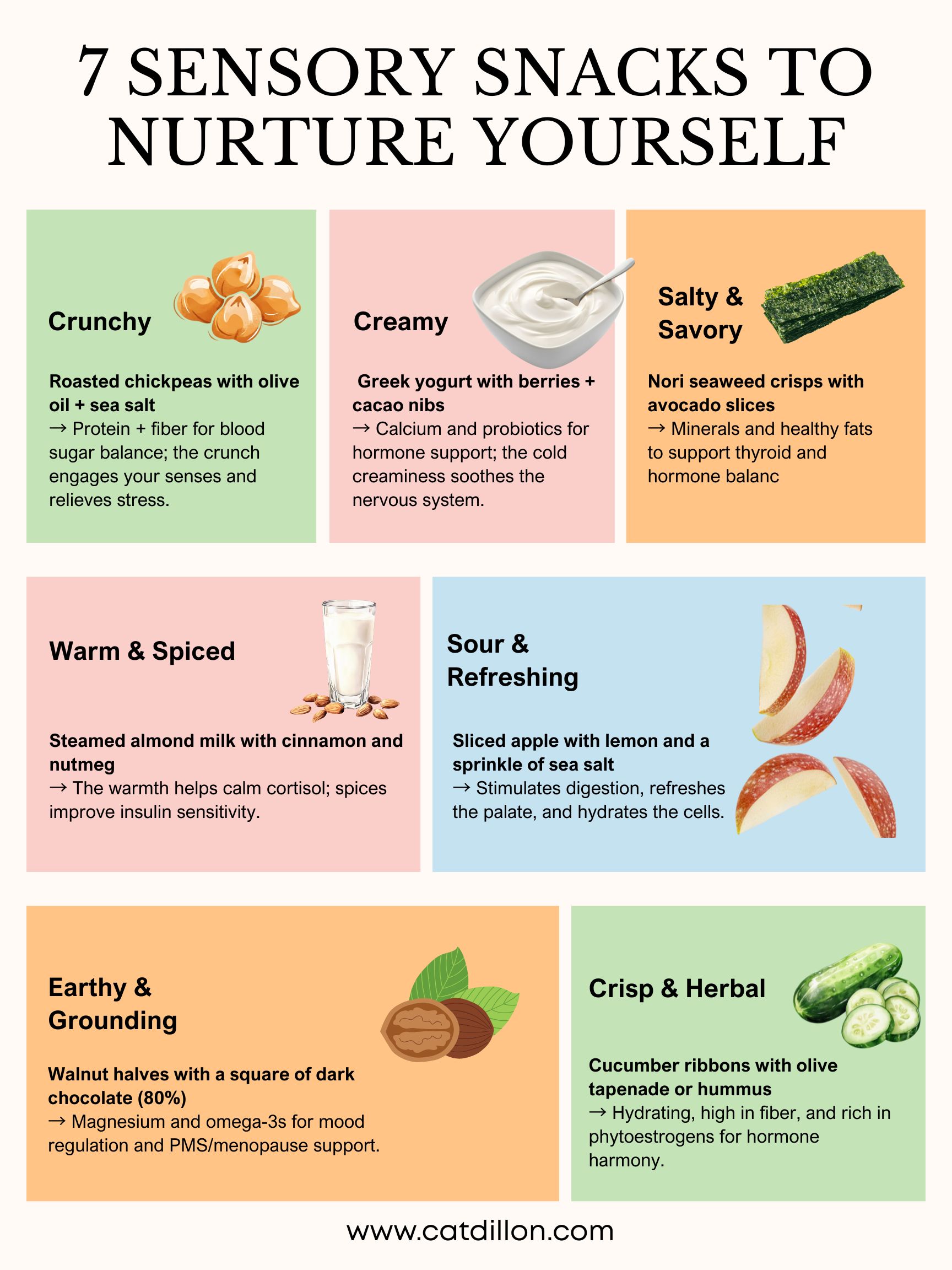
You have been doing everything right. So why are you still starving? The answer is not what you think. And it changes everything. - 7 Sensory Snacks To Nurture Yourself
- Slow Kitchen Cheat Sheet - 12 Ways to Use What You Have - Differently
- 14 Ways the Food Industry Tricks You
- The 3 AM Calming Sequence
You fell asleep just fine. Now it is 3 AM and your mind is running. Here is what is happening in your body, and exactly what to do about it. - Your Bedtime Support Steps
Sleep does not start when your head hits the pillow. The science of Andrew Huberman and Matthew Walker is clear. Sleep is built during the hours before bed. Here is how to build it right. - Your Morning Reset
The first 60 minutes of your morning set the hormonal tone for the next 24 hours. Cortisol, light, food, and color all send signals to your biology. Here is how to make those signals work for you.
More Resources for You:
- Bone Health Blindspots Guide: A clear, grounded look at what’s often missing in the conversation around bone loss, midlife metabolism, and stress.
👉 https://catdillon.com/BoneHealthBlindSpots - 💌 Inner Wisdom Eating Guided Reset
👉 https://catdillon.com/InnerWisdomEatingGuidedReset - ❓ Quiz: How Much of a Mindful Eater Are You?
👉 https://catdillon.com/MindfulEaterQuiz - 🍳 10 Craving-Busting Breakfasts
👉 https://catdillon.com/CraveBustingBreakfasts - 📄 10 Best Blood Sugar Hacks for Women 40+
👉 https://catdillon.com/10BloodSugarHacks
Connect with Me:
- Instagram: https://instagram.com/catdillonrhn/
- Facebook: https://www.facebook.com/CatDillonRHN/
- LinkedIn: https://www.linkedin.com/in/catdillonrhn/
- YouTube: https://www.youtube.com/@catdillonrhn
Hi everyone, and welcome back to the Slow Kitchen Podcast, your 15-minute space to slow down, breathe, and reconnect with nourishment that actually fits your real life. I'm Kat Dillon, a registered holistic nutritionist and former chef, and I help women simplify food in a way that tastes amazing and feels grounding and supportive from the inside out. Food is essential. It fuels us, supports healthy aging, helps prevent disease, and connects us to culture and community. But that's not the only piece. On this podcast, I explore how food, lifestyle, and nervous system health come together to help you feel more steady, nourished, and at home in your body. If you're a woman in midlife, navigating work, family, shifting hormones, cravings, mood changes, and a world that rarely slows down, this space is for you. We take the pressure out of cooking and bring the pleasure back in. Because food is more than fuel. It's connection, regulation, nervous system support, it's sensory, emotional, even spiritual. And what I see again and again is this. When we slow down, even for just a bit, before we eat or cook, something shifts. Digestion improves, food noise quiets, energy levels out, your nervous system feels more supported instead of constantly on alert. But those moments don't exist in isolation. They're shaped by the rhythm of your entire day. How you sleep, how you wake up, how you use light, how you move, and how you wind down. Because here is what I keep seeing smart, capable women who have read all the articles, follow all the accounts, and still feel confused about what to actually put on their plate. That confusion is not a character flaw, and it really is a direct result of nutrition information being stripped of all its context and handed to you as a rule. And my job today is to give the context back. Before we get into it, if this podcast has helped you in any way, please rate and review it and pass it along to a woman in your life who could use some of this. It is how we reach more people who need it. And I'm deeply grateful every time you do. So lately it seems like nutrition has become increasingly polarized, hasn't it? One group is telling us the answer is more plants, more fiber, more color, diversity on our plate. And another group is telling us that protein should be the primary focus, especially as we age. And if you're a woman in the middle trying to do the right thing, it can feel like you're constantly being pulled in different directions. Every week there seems to be a new expert telling you that you're either eating too much of something or not enough of something else. And honestly, I see this every day in my practice. In fact, I spend a surprising amount of time helping women sort through the noise. The truth is, I don't think we have to choose sides. As our bodies move through perimenopause, menopause, postmenopause, and the natural aging process. We need quality protein to support muscle, bone health, metabolism, and recovery. And at the same time, we need the fiber, phytonutrients, and microbial diversity that come from plants. And when I look at the healthiest eating patterns around the world, I don't see people arguing about teens. I see people eating a wide variety of real food. For me, nourishment has always been about quality. Quality plants, quality animal foods, thoughtful sourcing, paying attention to where our food comes from. That's probably the former chef in me, but long ago, before I studied nutrition, I was fascinated by ingredients and how food was grown, raised, harvested, and prepared. That curiosity is one of the reasons I eventually developed a recent interest in sprouting. Sprouting wasn't something I started because I thought it would solve every health issue. I just really like the idea of growing food in my own kitchen. There's something so satisfying about watching a seed transform over the course of a few days. Every morning you walk by the jar and something is changed. Tiny roots begin to emerge, then shoots, and before long you have living food sitting on your countertop. And when so much of our food arrives packaged in plastic and disconnected from its source, sprouting feels like a small way to participate in the process again. What I appreciate most about sprout is that they are so incredibly accessible. You don't need a garden, greenhouse, or a ton of space in your kitchen. You can grow them in a simple glass jar sitting on your kitchen counter. Yet despite how simple they are, sprouts contain remarkable amounts of nutrition. What makes sprouts so unique is that you're eating the entire young plant in its earliest stage of life. Think about it like the plant equivalent of no to tail movement in animal foods. Instead of consuming the leaf, the fruit or root, you're consuming the whole entire package. You're consuming the germ, which contains the plant genetic blueprint, the shoot, which becomes the stem and the leaves, and the endosperm, which is the nutrient reserve that fuels growth and the developing root. It's all there in one tiny food. This is one reason sprouts are so nutrient dense for their size, and why they offer a broad spectrum of plant compounds than many mature vegetables. Doug Evans, quite a character, author of the Sprout Book, has spent years educating people about the benefits of sprouting. When a seed begins to sprout, enzymes become active and nutrients become more bioavailable. And research suggests that sprouting can increase the availability of nutrients like amino acids, folate, magnesium, phosphorus, manganese, and even vitamin C and K. Some compounds in grains and beans that actually interfere with mineral absorption, like phytates, lectins, and oxalates, they can also decrease during the sprouting process. And this is where broccoli sprouts really shine. As they grow, they develop compounds called glucosinolates. And so when we chew or chop or blend the sprouts, those compounds are transformed into a family of beneficial plant compounds known as isothiocyanates, one of the most well-studied being sulforophine. Researchers have become interested in sulforaphine because it appears to support the body's own detox and antioxidant systems. And when I say detoxification, I am not talking about a juice cleanse. I'm talking about the everyday work your liver does to process hormones, environmental chemicals, and the natural byproducts of good old metabolism. For women in midlife, this is especially relevant. Healthy hormone balance isn't just about making hormones, it's also about how effectively we metabolize and clear them. Compounds like sulforophane may help support some of those pathways involved in estrogen metabolism while also helping the body manage oxidative stress and inflammation. If you're wondering where to start, I recommend broccoli sprouts. They're so easy to grow and they contain compounds that support that production of sulforophine that I just talked about, one of the most researched plant compounds related to healthy aging, antioxidant activity, and cellular protection. And they also happen to taste pretty darn good. I add them to my eggs, salads, soups, sandwiches, wraps, and just bowls throughout the week. Growing that is surprisingly simple. I place about a quarter cup of sprouting seeds into a glass jar, cover them with water, and let them soak for at least eight hours or overnight. The next morning I drain the water and begin rinsing and draining the seeds a couple times a day. After each rinse, I place the jar at an angle so excess water can escape. This is where you might want to have a little cup or a little saucer rather on the bottom so that the water can be eliminated. One trick that I found helpful is spreading the seeds along the sides of the jar rather than letting them sit in a damp pile at the bottom. And within four or five days, the sprouts are usually ready to harvest. One thing that often concerns people is seeing fuzzy white growth near the roots. Most of the time, these are just little root hairs and they're a pretty normal part of the sprouting process. A quick rinse will usually make them disappear temporarily. Healthy sprouts should smell fresh and clean. If something smells unpleasant, it's really best to start over. When the sprouts are ready, I give them a final rinse, remove some of the loose seed hulls that float to the top, and store them in the refrigerator. Then I simply start adding them to meals throughout the week. It's an easy habit, but one that helps me bring a little bit more freshness and variety to the plate. Now if you're thinking, this sounds great, Kat, but what am I supposed to do with the jar full of sprouts? I've got you covered. The beauty of sprouts is they don't require a recipe. Think of them as a finishing ingredient, a little nutritional upgrade that you can add to foods you're already eating. Toss them onto salads for extra crunch, add them to sandwiches, wraps, or lettuce cups, pile them on avocado toast, stir them into bowls, or use them as just garnishes on soups or anything, and just literally anything. One of my favorite ways to use broccoli sprouts is to blend them into smoothies. The flavor is mild enough so that most people don't even notice them, especially when paired with berries, citrus, or a handful of greens. You can also blend them into a pesto, chimichuri, salad dressings, dips, any sauce for a beautiful nutrient boost. If you're using broccoli sprouts, especially for the sulforophane, it's really best to use them raw. Heat can reduce the activity of the enzyme that helps create the sulforophane. That's why I like adding them at the end of cooking rather than tossing them into a hot pan. And remember, you don't need a mountain of sprouts to benefit. Even a small handful, a half a cup, added consistently to your meals can be a simple way to increase your intake of phytonutrients, fiber, and beneficial plant compounds. And I should say, my dogs love sprouts and they're so healthy for them. Before we go our own ways today, if you're enjoying the Slow Kitchen Podcast, I would be so grateful if you took a moment to lead a rating and review. It helps more women find the show and supports the conversations we're having here around nourishment, healthy aging, metabolism, hormones, and creating a healthier relationship with food. As I think about sprouting, I realize what I think I love most isn't necessarily the nutrition. It's the connection. It's a reminder that food is more than macros or nutrition labels. Food is something alive, something that grows and we participate in daily. In a culture that often asks us to choose between plant-based and protein-heavy, I think the better question is how we can create meals that include both. More quality protein along with plants, and more attention to where our food comes from. A jar of sprouts on the kitchen counter won't change everything in our life, but it might remind you that nourishing yourself does not have to be complicated. It sometimes starts with something as simple as a seed, a jar, a little water, and a few minutes of care each day. Thank you so much for spending time with me in the kitchen today. Be sure to check out the episode show notes for links and resources that I mentioned in the podcast. Until next time, take great care of yourself and keep nourishing your body and soul. Bye for now.