
Connie & Jack: A Rigged Game
All 9 Episodes Out Now. Binge the unbelievable true story of Connie & Jack.
Based on a true story, this podcast follows Connie Hawkins — a once-in-a-generation NYC basketball superstar who, in 1961, is expelled from college and later blackballed from the NBA for a crime he didn’t commit. His downfall is his association with Jack Molinas, an ex-NBA All-Star turned mob fixer.
Connie & Jack: A Rigged Game
Episode 5: Mo Molinas, Mo Problems
Use Left/Right to seek, Home/End to jump to start or end. Hold shift to jump forward or backward.
Suspended from the NBA, Jack Molinas doesn't seek redemption — he seeks action. Backed by the nation's most ruthless mobsters, he engineers a massive college basketball fixing operation. His arrogance and duplicity know no bounds. The only rule in Jack's world is to win at all costs, and soon, all his bad work begins to pay off.
CREDITS
Created by: Bo Belanger
Written and Produced by: Bo Belanger
Theme Song: "Blame" by Gabriels
Music: Bo Belanger and Udio
VO: Shawn Hawkins, Bo Belanger and ElevenLabs
Sound Design and Mix: Dave Wagg and Collin Thomas
Art: Lincoln Lopes
Special Thanks: Shawn Hawkins, Dave Wolf, Charley Rosen and Kristen Farnam Belanger
Welcome back to Connie and Jack, a rigged game. This is episode 5, Mo Malinas, Mo Problems. In this episode, we're picking back up with Jack. When we left off with him in episode 3, it was 1954, and NBA Commissioner Potilov suspended him from the league for betting on his own games. In the least surprising turn of this entire story, Jack had been up to no good since then.
SPEAKER_09Not a captive if it's well wanna be the crowd called.
SPEAKER_05It seemed clear that Commissioner Podilov and the NBA were making an example out of Jack. Though given how prevalent gambling was in the league and how cooperative Jack had been, he thought he'd get another shot in the NBA.
SPEAKER_06He said in the Wizard of Odds, Potilov seemed like he was a very understanding man. I told him I was going to go to law school and apply for reinstatement to the league when I graduate. He promised he'd do whatever he could to help me.
SPEAKER_05So Jack made the natural career pivot after breaking the bylaws of the NBA. He became a lawyer. Without cracking a book, he scored the 99th percentile on his LSATs, and then he breezed through school, even becoming president of his class at Brooklyn Law School. During this time, he tried again and again to get reinstated into the NBA. Even the press came to his defense.
SPEAKER_00The New York Post wrote, While Molinas violated the NBA rules by betting on himself, he was not a party to the kind of gambling conspiracy that did so much damage to college basketball a few years ago. In view of this, the Post asks the NBA to take Molinas back into the game. We're for giving him another chance.
SPEAKER_05The NBA made its final decision. Jack recalled this in The Wizard of Odds.
SPEAKER_06After I graduated, I applied for a reinstatement into the NBA. They turned me down. I was suspended for life, and I found out that the owner's vote had ended with a tie, four votes each way. So Potilov cast a deciding vote that banned me. At that point, I became a little bent.
SPEAKER_05Jack never squealed on any of his piston teammates, and for this, as we'll see, he was repaid. Staying quiet was something he learned from Joe Hacken, who was notoriously closed-mouthed to the police. It wasn't just Jack's NBA teammates who appreciated him staying quiet, but also the monsters running the gambling rackets. They'd protect him for years in return. While Jack was in law school, he also played hoops in the Eastern League. It was a league that launched in 1946, the same year as the NBA. Pop-up trivia, the Eastern League ran all the way until 1979 and then changed its name to what? This is a tough one. It became the Continental Basketball Association, better known as the CBA. If you got that one, well done. It was the league Eddie Simmons played in six years later. The money or run wasn't as good as the NBA, obviously, but every guy made $35 a game, which was solid supplemental income back then, the equivalent of a little over $400 today. NBA great Paul Arizen once said that the best 80 basketball players in the world are in the NBA and the next best 80 players are in the Eastern League. It made sense that it had legit talent. There were less pro teams back then, and if Talent Pool benefited from the NBA team's quota on black players, it would have been a natural pivot for Connie when he got booted from Iowa or when the ABL went belly up, but he was Connie non grata in that league as well. Tainted. But you couldn't taint Jack. He was welcomed with open arms and was a star player in the mid-50s, playing in small, smoke-filled gyms around the Northeast while also attending law school. But he was also doing something else. As he said in The Wizard of Odds.
SPEAKER_06I'd been doing this for years, but now I was really devoted to it. Sometimes I'd bet as many as 20 ball games a night. I would say that my hobbies were law school and playing ball, but my occupation was betting on basketball games.
SPEAKER_05Jack's ex-teammates on the Pistons also called him every Saturday night and told him what NBA games to bet. Obviously, Potilod's example making of Jack hadn't worked. An ex-NBA player tells a story about him and Jack sitting in the 69th Regiment Armory watching the Pistons play the Knicks. New York was favored by two and a half points, and his old teammates told Jack to bet on the Knicks, which meant the Pistons were taking a dive. The ex-NBA player recalled, There's about two minutes left in the game.
SPEAKER_00Fort Wayne was neck and neck with the Knicks, and I was shitting my BBDs. Jack, I said, we're losing. And he said, Don't worry. That was his famous saying. But nothing happened. The Pistons were still playing like they wanted to win the game. Jack, I said, there's only one minute to go and we're going to lose. Don't worry. Now there's only 30 seconds on the clock. The score was tied, and I was going crazy. I'd bet the rent money, the money for my car payment, the money for my electric bill. Jack, I said, but he was still calm as could be. Don't worry, he said. Then all of a sudden, one of the pistons was dribbling the ball in the backcourt all by himself. I mean, his defender was about 15 feet away, and the guy just kicked the ball out of bounds. It almost looked like a football player dropkicking the ball for an extra point. Now the Knicks had the ball, and another one of the pistons made a clumsy effort to steal the ball, and instead committed an obvious foul. The Knicks made both free throws, they're up by two. So the Pistons had the ball, and there seemed to be no way New York's going to cover the two and a half. The clock was ticking down. Ten. Nine. Eight. If the Pistons scored, I was a loser. If the Pistons didn't score, I still lost. Jack, I'm dying. Don't worry. There's five seconds to go when we heard somebody on the Pistons bench shout out loud, You're referee! Bang! The ref called a technical foul. The Knicks made the shot and won the game by three points, and Jack turned to me with a big shit-eating grin on his face. I told you not to worry, he said.
SPEAKER_05Jack was generous with the Pistons inside information. He gave his law school buddies the heads up on what games to bet, and they put lots of money down because it was close to a sure thing. Soon, though, Bookies wouldn't take Jack's bets because he was winning too much. He started betting through someone else, or what they call a beard, but the Pistons gravy train came to a halt at the end of the 1958 season. Commissioner Pollilov knew Piston players were betting on their own games as he continued tapping their phones, but he didn't ban them. He confronted the team, but rather than have the league take another black eye like they did with the Melinas incident, he asked the players to quietly retire at the end of the year. Check out basketball reference sometime and compare the 58 and 59 Piston rosters. It shrank by four players and only returned seven of the 16 guys. Mum was the word in the National Betting Association. The best part was that the Pistons playing it straight in 59 actually won five less games than the dudes who tank some gains in 58. Nevertheless, Jack's Piston teammates getting a quiet retirement versus his very public ban ground Jack's gears even more. He detested Parlov and did until the day he died. So what did Jack do with no more inside information? He found other ways to get an edge with his gambling, and not just in basketball. Jack was always looking for an edge and took it wherever he could get it. He was nothing if not creative. He talked about a few of his schemes in The Wizard of Odds. Betting on horses, he worked with an electrician named Red who'd reduce the wattage in the Con Edison cables so that the betting houses clocks slowed down two or three minutes every hour. Maybe the lights dimmed a bit, or they'd have to turn up their radio a little more, but they never noticed, Jack explained.
SPEAKER_06All I had to do was find a horse room in which none of the clerks wore a wristwatch. Then I'd give Red a high sign, and an hour or so later I'd have some beard waltz into the room and bet on an out-of-town race that had already run. Past posting, the practice was called. I'd have to pick my spots carefully, and I only ran a scam for a couple of weeks, but I wound up making a daily profit of above 5,000 bucks.
SPEAKER_05Another Jack classic, he'd stick electrical receivers up racehorses' anuses so that he could transmit a shock that spurred them forward, hopefully to win the race.
SPEAKER_06And then a third scheme, which Jack explained, saying, For a fee of 30 or 40 bucks a week, it was Marvin's job to provide his clientele of bookmakers with accurate starting times for college basketball and football games. He'd call up every school that was on the board just to make sure the starting time hadn't been changed. But sometimes he'd deliberately give out the wrong starting time so a game would be an hour old before he placed his own bets. There are a lot of edges in this area alone. For example, for many years the starting time of Purdue basketball games was legitimately listed at being 8 o'clock, when in actuality the opening tip-off was at 7.35 sharp. By the time he lays his bet at 8, a smart better can just about figure out how a game is going. I can remember betting a Purdue Iowa game that was Pick'em. But by the time I laid my bet just before 8 o'clock, Purdue was already leading by 12 points and I made a bundle.
SPEAKER_05Jack also had schemes in boxing and football where he'd drug fighters and teams before the fighter game started. It's hard to win if you're vomiting on the sidelines. But like a great love, Jack always came back to basketball, though he had to move beyond NBA games. Bookies were increasingly aware of how crooked NBA games were, so they took less action. Plus, there were only four games a day max. This is when Jack turned to college basketball, and he did it with gusto. He studied college basketball games as hard as his law school classmates studied their cases. In the Wizard of Odds, Charlie Rosen wrote about Jack's intensity with this new endeavor. He bought dozens of newspapers every day from all across the country at the newsstand lobby of the New York Times building in Times Square. He even paid an associated press reporter so that he could use his name to make calls to colleges and ask questions about their teams, like Hello, this is Mr.
SPEAKER_06So-and-so working for the AP out of New York, and I'd like to do a feature article on your school. Did the team play up to par in their last game? Did the other team play man or zone? Was there any dissension on the team?
SPEAKER_05He was getting injury reports behind the scenes before injury reports were a thing. Jack was the master of getting an edge, and this was the master at work. College basketball became his Mona Lisa, and he'd come out on the other side smirking. Soon, Jack was so good at determining betting lines for college games that he was brought in at the national level to help out. Back then, the national betting line on games was made by only three people. A guy in Miami, Minneapolis, and Biloxi, Mississippi, of all places. They discussed their tastes and landed on a line. Simpler times. Jack knew a guy named Shelley Thomas who helped out the guy down in Miami. He started giving Shelly lines and caught a hot streak. Jack was then brought in full-time. As he said in the Wizard of Oz.
SPEAKER_06I worked through Shelly for the entire season, and my picks were winners 62% of the time.
SPEAKER_0562% in gambling is astronomically high. A normal gambler must win 52.4% to break even. Professional gamblers rarely sustain winning above 55%. In fact, most win closer to 53 to 54% of their bets. Yet, they can make a career off that half percent to 1.5% clearance above 52.4. And then here's Jack, clearing it by almost 10%. The mob was too smart to let this golden goose get away. He was soon connected to the big operators in the country, who bet even larger sums of money. But Jack didn't settle at 62%. His days in the NBA proved there were means to raise this number even higher. This is when Jack's college basketball fixing operation was born. His team was made up of a core of four: himself, Joe Hacken, Aaron Wagman, and Joe Green, all Bronx guys who knew each other as boys back in the neighborhood. Wagman and Green approached Jack before the start of the 1957-58 season. They told him they had a couple of players on two different teams willing to fix games and asked Jack if he could put up the money to back the games. This was like asking a toddler if they wanted ice cream. Jack asked the players' names and whether their teams were, quote, on the board. Back then, you couldn't bet on all the games. If there wasn't enough interest between the two teams, or if there was heavy betting for one team and the bookmakers became suspicious, the game was taken off the board, which meant you couldn't bet on it. Remember, this was only six years after the 1951 fixing scandal, so everyone's radar was still up, making Jack's operation all the more audacious. Jack had one other request for Wagman and Green. Everything goes through Joe Hacken. He would act as Jack's agent.
SPEAKER_06As Jack explained to the guys, He knows this business backwards and forwards. He has been fixing games and so forth all his life. He is the only guy I can trust.
SPEAKER_05Wagman and Green agreed and laid out their terms to Jack. They'd each be paid $1,000 a game, and so would each participating player. Jack said yes. And just like that, they were in business. Soon Jack's 62% win rate in college basketball approached the sure thing. At a high level, here's how their operation worked. Jack and his team recruited and paid players to intentionally play poorly in their games. This was the fix, or what they call point shaving or dumping games. They tried recruiting the best players from each team because the top players had more influence over a game than a role player. Once a top player was in on the fix, or perhaps two role players, Jack sold that information to big-time gamblers, or what they called their backers. Jack and his team paid the players and pocketed the rest. The author wasn't able to pinpoint their margins, but is quite sure they'd make Apple blush. It's important to note that the players' teams did not have to lose outright. All they had to do was lose against the spread. So for example, if Bowling Green was favored to beat Dayton by 5 points, Jack and his team could make money one of two ways. They could pay a bowling green player to win by no more than four, thus bowling green loses against the spread, or they could pay a Dayton player to make sure his team lost by six or more points. Also a loss against the spread. The four men met in a cafeteria on 57th Street to draw out their plans. Wagman told them that Richie Hoffman of South Carolina and Jerry Alamo of Brown University both expressed interest. Hakken warned Wagman and Green that they should only deal with him and Jack because if it became known to the bookmakers that the game was fixed, it'd be taken off the board. Jack paid for Haken to travel to both schools to pay the players. The first game picked was in New York City on December 19th between South Carolina and New York University. They arranged to meet Hoffman on the afternoon of the game, but got frightened by a rumor of an investigation and called it off. They pivoted to South Carolina's next game against St. Bonaventure in Buffalo. Jack sent Green to pay Hoffman, but the game was taken off the board. They were now 0 for two. On December 29th, they met again in the cafeteria on 57th Street, and Jack said that he, Hakken, and Green would drive to Florida to fix a game between South Carolina and Georgia University. He instructed Wagnan to stay in New York to place various bets when they called. Game Day came and went with no phone call. The next day, Green called Wagman to say that the game worked and they won. But Jack only gave them $600 instead of $2,000. Jack and Haken traveled back to New York. Green went to Havana, where he lost all of his and Wagman's money gambling. Then Hoffman got injured. They asked him to approach another teammate to throw a game, but he declined. They contacted a lamo at Brown, but he rejected their offer. And that's how the 57-58 season ended for them. Only one successful fixed game. They innovated on their plan the following year. Knowing that many college players worked at New England summer camps, Green went up there to get a job so he could recruit players for the following season. Green came back in August with modest returns. He said Jerry Vogel of Alabama would probably be willing to dump games. Richie Hoffman at South Carolina was still in, but he got suspended from his team for a year that fall. He said he thought his teammate Mike Callahan would do business in his place, and he did. But beyond that, the recruiting process moved slowly that year. The story from their second season was how little trust there was already between all parties. This often stemmed from Jack's duplicity. Jack lied to his backers. For example, he'd tell them if they had two players in on the fix when they only had one, so that they could pocket the other thousand bucks. Jack's go-to move though was shorting the players. He did this constantly because he knew they had no recourse. They told Mike Callahan of South Carolina that he'd get $1,000 for dumping a game against Wade Forest, and Callahan was successful. He made a ton of mistakes and they lost. Jack only paid him $500 and told him the rest of the money would come. It didn't, it almost never did. Lenny Kaplan of Alabama learned this the hard way too. His teammate Jerry Vogel approached him with what he called an opportunity to make a lot of money. When Kaplan asked how, Vogel pointed to Joe Green, who was standing nearby, and said that Green was willing to pay him a thousand dollars if they didn't beat Mississippi State that night. Kaplan declined. A month later, on February 13th, he got a phone call.
SPEAKER_06The man said, My name is Jack Molinas. Have you heard of me?
SPEAKER_05Kaplan had, since Jack had been a big name in basketball. Jack said he was calling to acquire Kaplan to play on a professional team in the Eastern League and wanted to discuss it in person. When they met the next day, Molinas offered Kaplan $1,000 if Alabama won their game that night against Tulane by less than three points. Kaplan wasn't interested. According to Police Records, Jack then pointed out that it was Kaplan's senior year, and that he'd be married soon and could use the money, and that they'd be the only two who would know about the fix. Jack told him how easy it was, and after thinking it over, Kaplan accepted. He played and kept the score close. His team won by only two, and Jack won the bet. Kaplan asked Jack to keep his thousand dollars in a New York bank for him. He then successfully fixed another game for Jack on February 28th against Auburn. After graduating in June, Kaplan returned home to New York and asked Molinas for the money. Jack said, I don't have it. I'm tied up. He gave Kaplan $100 instead. Kaplan visited Jack many times in June asking for the rest of his money. Jack told him that it was invested for him in a Florida land deal. Kaplan continued to try and get his money over the next year, but Jack never gave it to him. Little did Jack know that this short changing of players would be his undoing. Jack even lied to his own team, as Wagman and Green learned during their first fix. Jack often told them that his backer didn't pay him out entirely and he'd short them. Wagman eventually got fed up with Jack. One night in February, Jack cornered Wagman and told him a lot of these games were getting hot, meaning there was too much action. He asked Wagman, Are you selling games to someone else? Wagman admitted that he sold a couple of games to a backer named Frank Cardone in Pittsburgh because he didn't like their relationship with Jack and Hakken. He also had other participating players that Jack didn't know about. Jack didn't get mad. He told Wagman he also had relationships with cooperating players at Wichita, Connecticut, and the University of California. Jack said he also had a backer, Dave Goldberg in St. Louis.
SPEAKER_06He told Wagman, We could pull our two backers and we can double back all these games. You and I can pick up double money on each game that is fixed.
SPEAKER_05This was risky for two reasons. First, a double back game was more likely to be taken off the books. Second, they had an understanding with each backer that these games weren't being sold to anyone else. Nevertheless, they arranged to fix an Alabama-Georgia game that night with the help of Daniel Quendazi of Alabama. But the plans fell through. Jack was undeterred. He convinced Wagman that they both call their backers anyway.
SPEAKER_06He said, In other words, it won't be fixed, but we will be telling the backers the game is fixed. If the game wins, we will split all the money, the players' money, plus our Own money.
SPEAKER_05It was an outrageous gamble. They both called their backers. Cardone told Wagman he was in. Jack told Wagman that Goldberg refused due to short notice and said, We will just have to split what your backer is going to pay. Later that night, they heard on the radio that Alabama had won by less than seven points. Their wild gamble paid off. This was classic Jack. Rather than getting upset with Wagman for selling their games to another backer, he got even with him by pulling a fast one on him. The effect of Jack's lying, however, was that it infected everyone else. The trust eroded. Even the players began cheating each other. Frank Majowski of St. Joseph's talked two teammates into fixing games, Jack Egan and Vince Kempton. Wagman and Green traveled to Philadelphia to meet the new players. Majowski showed up to Wagman's hotel alone and explained that he offered his teammates only $500 for the game instead of a thousand. He said he'd pocket the difference. Wagman compromised and said he'd pay Egan and Kempton, the team's best players, $750 apiece and Majowski $500. Majowski agreed, and St. Joseph's won the game for their backers. Despite all the double crossings, Jack's operations slowly grew. Going into their third year of the 59-60 season, Green again went to work at a summer camp, this time in upstate New York. Jack also began recruiting players. This idea came from his backer in St. Louis, Dave Goldberg, a big-time gambling operator.
SPEAKER_03Goldberg told Jack, Say Jack, I know you play ball with plenty of pros, but do you play with any college players?
SPEAKER_05Jack said he did. He played against a lot of them in summer tournaments. Goldberg responded, Now we're talking.
SPEAKER_03Maybe some of these college players could use a little extra cash, you know? Why don't you pal around with these guys, take them out to dinner, slip them a C note, just to make them feel obligated to you? Spend as much money as you want to, Jack, and send me the tab. If any of these players happen to ask a leading question, well, then find out if they're willing to do business.
SPEAKER_05Jack told Hacken and Wagman the plan, and since many college players played at a playground in Ripperdale, that's where Jack started. This is when Connie and Jack's lives intersected. Connie was one of the players that Jack tried recruiting while playing pickup in New York.
SPEAKER_01As the New York Times wrote years later, Molinas, who always remained an outstanding playground player, used the playgrounds to meet and influence players. It appeared anything but unnatural to the young athletes when the older Molinas would take them to dinner, let them use his automobiles, and introduce him to beautiful women. Connie said, I just thought Jack was a nice guy.
SPEAKER_04He'd buy us food, drive us home from the beach, lend us his car. One time, he told me he knew how difficult it was for poor kids in their first year at school. And if I needed help or money, just let him know. He said he liked me.
SPEAKER_05Jack was looking for two things in a player: talent and financial insecurity.
SPEAKER_08As Charles Hirschberg wrote in Sports Illustrated, nothing delighted Jack more than to discover a college kid who was struggling to pay the medical bills for his wife's miscarriage or his baby brother's cerebral palsy, to give but two examples.
SPEAKER_05They discovered about two-thirds of players agreed to their pitch. They got so big in their third season that players approached them, including an NYU player who made a basket in the wrong hoop to make sure his team won against the spread. As their operation took off, more powerful backers wanted in on the action. In late November, Molinas, Hakken, and Green drove to West Virginia to fix a December 1st game between West Virginia and Tennessee. They were joined by Tony Di Charante, aka Tony D of Chicago, who Jack described as a very dangerous guy. Tony D's backing in Chicago went all the way to the top to Frank Lefty Rosenthal, who was portrayed by Robert De Niro in Casino. Tony D was a narcotics man by trade, but wanted in on Jack's action and backed them for the West Virginia Tennessee game with Dick Fisher, Tennessee's center, in on the fix. Tennessee had to lose by 19 or more for them to win the bet. Things looked good early. Tennessee was losing by 31, but then Fisher filed out. His team then made a furious comeback with him on the bench, and they only lost by 15, which meant Jack had lost Tony D's money. Wagman courageously asked Tony to pay Fisher anyway, saying, Fisher did a real good job.
SPEAKER_11He made a lot of mistakes. I think he deserves the money.
SPEAKER_05Tony D surprised everyone and agreed to pay Fisher, but Jack knew Tony D wouldn't be as generous next time. Continuing to hone his illegal craft, Jack found another edge. Again, the idea came from Goldberg. Charlie Rosen wrote that after Jack confirmed he knew a lot of referees, Goldberg told him, Why don't you get a little friendly with the refs?
SPEAKER_03If you want, tell them that I'll gladly wager $2,500 on their behalf on either side of whatever college game they're working on. They pick the team, and I make the bet and take all the risks, and they get the winnings. Naturally, they'll have to blow the whistle once or twice to help us out.
SPEAKER_05He told Jack that he already had a Missouri Valley Conference ref in his pocket and how they'd made bundles of money together. Jack began approaching refs, and soon all his bad work paid off. By their fourth year, the 1960s-61 season, things were in full swing. They had players and refs fixing games. They also had more money coming in from bigger backers. Jack and Company now worked with the upper echelons of the New York mafia, like Chief Tommy Ebely, who eventually became acting boss of one of the five families in New York, the Genabezes, and Jack and Hack and brought in Ralph Giganti, brother of Capo Vincent the Chin Giganti, who eventually became the boss of the same crime family in New York from 1981 to 2005. Serious dudes. According to Paul Brandt, Jack's teammate for eight years at Columbia and Stuyvesant High School, Jack never liked being associated with the mob.
SPEAKER_02But as Brandt said, It came with the action. For him, it was the adverse side.
SPEAKER_05It certainly made for unpleasant company at times. Once an angry monster broke Jack's hand with a hammer. Another time they dangled him by his legs outside of a 15th-floor hotel room. You know, just your normal Tuesday afternoon sort of stuff. The party was short-lived though for these new backers. New York County District Attorney Frank Hogan's investigation into Jack's fixing operation was underway by the end of 1960. Hogan knew the financiers were spread out from Pittsburgh with Frank Cardone and Morris Meyesson, to St. Louis with Dave Goldberg and Steve Lacka Matros, to Chicago with Frank Lefty Rosenthal, and he knew of the other co-conspirators too, Tony D. of Chicago and Ralph Giganti and Paul Walker of New York. In total, across four seasons, Jack and Company solicited 34 players to influence scores, and 30 of them accepted bribes. In actuality, the number was higher, but these are the people they had evidence against that would hold up in court. By the 60-61 season, they had multiple fixed games on the same day. On January 7th, they fixed four games in one night. As soon as it got really good for Jack, it was over. In December of 1960, Grant tipped off Jack that the DA's office was building a case against him. Jack said that he was in too deep with dangerous people to get out. Even Hakken told Jack to slow down, but Jack didn't listen.
SPEAKER_06He said to Hakken, Let me tell you something, Joe. I'm only gonna live once, and if this is the end, then I'm gonna go out in style. That's my philosophy in life, my friend. Hacken responded, You're crazy, Jack. I never realized just how crazy you really are.
SPEAKER_05There was another reason Jack wasn't concerned about the investigation, as he said, We knew the cops weren't going to arrest us.
SPEAKER_06They found out which games were rigged, and they'd bet on those games.
SPEAKER_05It was true. The cops tapped his phones during the investigation, then turned around and bet on the games. It was the same hypocrisy from the police that Jack saw as a kid on Coney Island when the cops squeezed his dad.
SPEAKER_02As Brandt said, It was a funny chain of events. Ostensibly they were getting evidence to prosecute, but really they were attempting to benefit. Who's right and who's wrong? They were just different degrees of immorality.
SPEAKER_05It certainly pissed Jack off. He called them lieges, and it got to the point where the cops were borrowing money to make bigger and bigger bets. He told Brent one night that he was gonna throw them a curveball. He knew it would probably cost him in the end, but that was Jack. He couldn't help himself.
SPEAKER_06He told the story in Charlie Rosen's The Wizard of Odds, saying, North Carolina State was playing LaSalle in Philadelphia, and I decided to fix one last game to teach those dumb cops a lesson they'd not soon forget. We had control of three players on NC State and a guy on LaSalle. I warned Joe Hacking beforehand that I was gonna pull a fast one. Then I called him from my home phone, knowing the cops were listening in. Joe, I said, just bursting with enthusiasm, we've got an all-time lock on this game. We've got three players on North Carolina State, one on LaSalle and one of the officials. The early line has LaSalle favored by four, but we're going to bank on North Carolina State. This looks like a triple bet, Joe. We can't lose. This is gonna be our biggest score ever. Before we knew it, the cops' money had moved the game to a pick'em. So Joe and I arranged to have the North Carolina players take a dive. In fact, our instruction to all parties was to keep the game as close as possible until the very end. And then we started betting heavily on LaSalle. It was LaSalle, LaSalle, LaSalle with every New York bookie who'd take our action. We wound up getting 25,000 down. So we all took the train down to Philly to watch the show. I recognized a handful of plainclothes cops from New York in the crowd. I found out later that one of them raised his betting money by taking a second mortgage out on his house. As the game started, I was more interested in watching the expressions on the cops' faces than on following the play. I felt like I was in charge of a huge military campaign. What a thrill. The score was tied 30 all at the half, and it remained tight until LaSalle put on a surge with about five minutes to go in the game. LaSalle won the game by 15, and everybody won their bets, except the cops. After the game, a detective came up to me, gave me a dirty look, and then walked away. I'd say this game was the most enjoyable fix of my entire career.
SPEAKER_05It was also one of his last. In March, Jack flew to Washington, D.C. to give a speech at a touchdown club dinner. The speech's title was The Integrity of College Basketball. One year later, after a 22-month investigation that spanned 51 cities and 22 states, which we'll cover in the eighth episode, Frank Hogan finally arrested Jack. On the first day of the trial, Jack walked up to Hogan and said, I'll bet you $10,000 that you won't convict me.
SPEAKER_10In the next episode, we're back with Connie. Despite being one of the best basketball players on the planet, he's in need of a job again after the ABL went belly up. He gets one, but as you can probably guess, it's not in the NBA.
Podcasts we love
Check out these other fine podcasts recommended by us, not an algorithm.
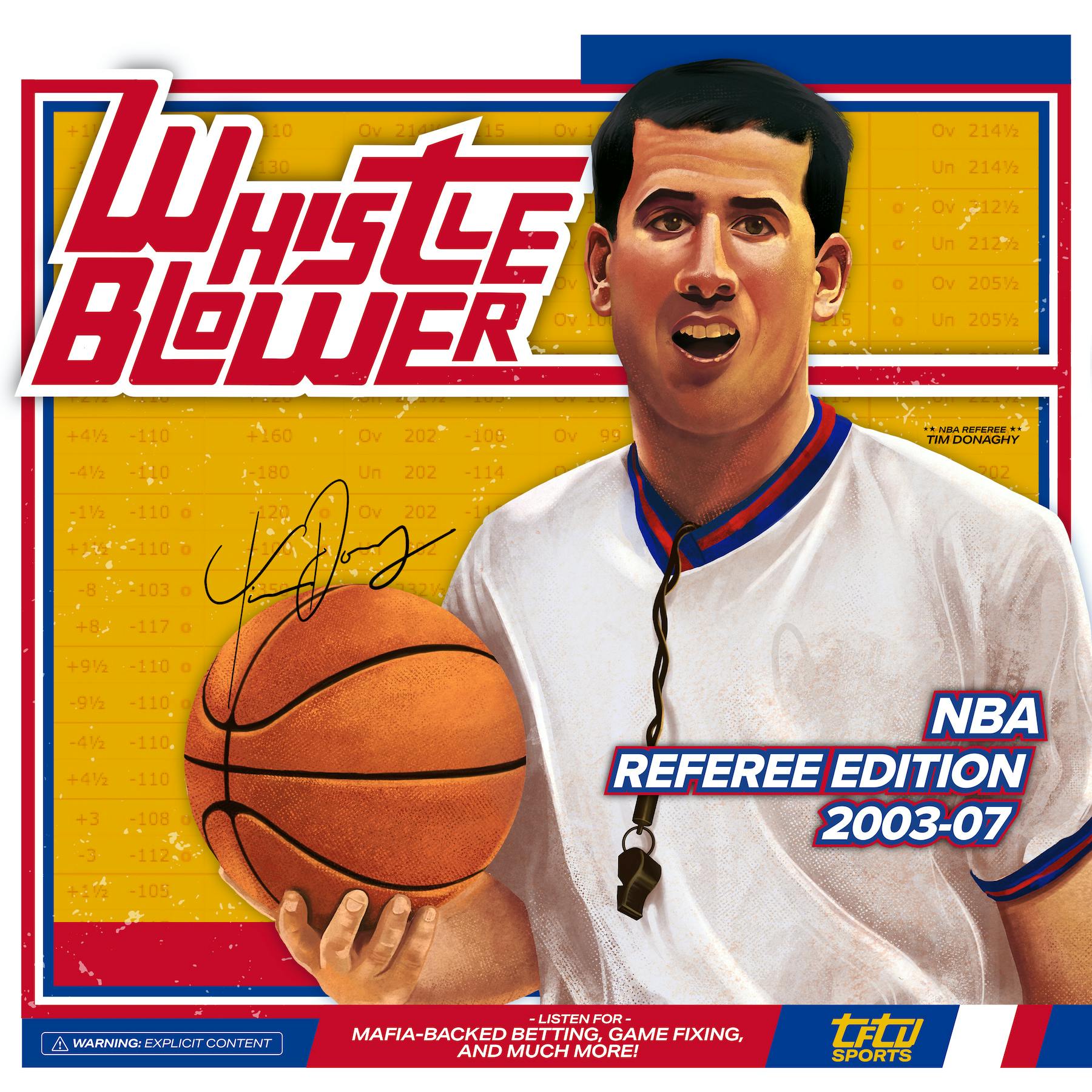
Whistleblower
Tenderfoot TV & Audacy
30 for 30 Podcasts
ESPN
Book of Basketball 2.0
The Ringer
Basketball History 101
Rick Loayza