
The AI Mum Podcast
The AI Mum Podcast is here to empower parents navigating the AI world with and for their children. Honest conversations with experts and practical guidance - no jargon, no panic.
The AI Mum Podcast
AI Is Already in Your 5 to 10-Year-Old's World. Here's How to Be There With Them.
Use Left/Right to seek, Home/End to jump to start or end. Hold shift to jump forward or backward.
If you have a child between five and ten years old, this episode is for you.
AI is already in your young child's world — in their Google searches, their YouTube recommendations, their voice assistants, and their learning platforms. The question is not whether they will encounter it. The question is whether you are there with them when they do.
In this episode Florence sits down with Sonny Sharma, an education leader with over ten years of classroom experience — including some of the toughest inner city schools in the UK — and a dad of three children aged six, seventeen, and twenty-one. He is living this conversation in real time, and he has thought about it more carefully than most.
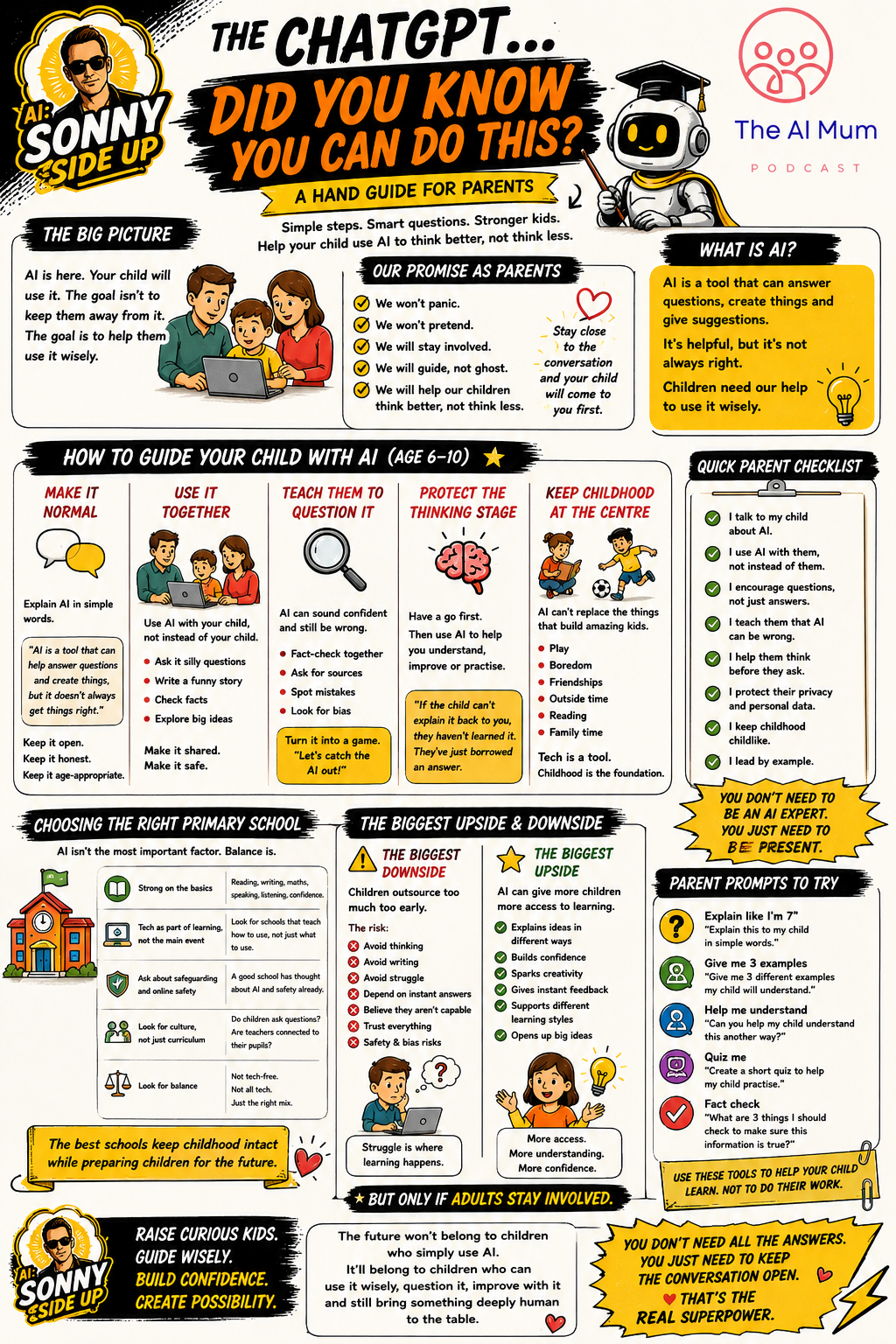
Sonny shares a practical five-point roadmap for parents of young children navigating AI — from how to demystify it without making it frightening, to why you should be sitting alongside your child every time they use it, to how to turn catching AI out into a game that builds healthy scepticism without fear.
Florence also raises the school choice question head on. Should parents be impressed when a primary school puts AI at the centre of its pitch? Sonny's answer might surprise you. And he gives parents the exact question to ask any school about safeguarding — one that will immediately tell you whether they have genuinely thought about it.
This is one of the most practical and genuinely hopeful conversations The AI Mum has had. By the end of it you will have five things you can do differently this week — without making AI feel like a threat in your home.
📋 Click here to access Sonny's Handy Guide for Parents. Simple steps, smart questions, stronger kids.
🎙️ Listen on Apple Podcasts — podcasts.apple.com/gb/podcast/the-ai-mum-podcast/id1892893748
Instagram: @theaimumpodcast
The first thing that I do is to not make AI mysterious. I can already see it in my daughter. She sees it as being this little magical thing.
SPEAKER_00They hear us speaking about chat claudia. They're like, who are these people? It's actually simple, but so important.
SPEAKER_01When it comes to choosing a primary school, I'd say just because it's says it's doing AI probably isn't the best reason to go to that primary school. I think it's really important to ask about safeguarding. Not in a confrontational way, but just like how do you approach AI and online safety with the younger children? In terms of the upside, it's around this personalization piece. We have the ability to personalize learning in a way that we've never been able to do before. Any child can have a world-class expert coach simply using a chatbot.
SPEAKER_00Welcome to the AI Mom Podcast. Today we are joined by Sonny Sharma, who works with leaders in the education sector who make confident decisions on AI and digital transformation. He has over 10 years of experience as a teacher himself and is the dad of three wonderful children aged 6, 17, and 21. So he's really in the thick of it when it comes to raising children in the AI world. In today's episode, we are focusing on young children's use of AI. The 5 to 10-year-old ranch who are already exposed to it, willingly or not, even through a simple Google search. Sony is going to give us a practical roadmap on how to guide them with five key principles and a discussion about how to select the right school for them at that early age, which will have a big impact on how they use the technology going forward. Hi Sunny, thanks for being with us today.
SPEAKER_01Thanks for having me.
SPEAKER_00Could we start with your recent article on LinkedIn about the difference between what your parents told you as a life advice when you were a kid and what you would tell your children today?
SPEAKER_01So look, the article came from something that I'd been thinking about as a dad. My parents' advice to me was work hard, get a good education, go to university, and if you can, get a stable job and build secure lives. And to be fair, it came from a place of love, right? It came from sacrifice, it came from a generation where security really mattered. The challenge now is that I don't think I can give my children the same advice because it doesn't matter in the same way. The world they're growing up in is changing so quickly. Simply saying learn this, get this qualification, do this job for the next 40 years doesn't feel like the full answer anymore. I think the advice that I'd give my kids will be slightly different, actually. I'd still say work hard and having that kind of ethos is quite important. I'd still say be kind and I'd still say learn properly, but I'd also say learn how to adapt. And I think that's going to be one of the biggest skill sets for a young person going into the future. Learn how to ask better questions, learn how to use tools, learn how to build things, learn how to communicate. Even learning how to spot the nonsense is going to be quite important. These are skills that at the moment typically aren't the skills that are taught in schools. And I think those are the kind of skills that really we've got to get young people attuned to so that as they go into the future, it's something they start to understand and so that they can also stay quite grounded.
SPEAKER_00Just to play David's advocate here, there's also a lot of teachers who still focus on knowledge and data. Is there a balance between knowledge and soft skills, especially in a world where all the knowledge is concentrated in iPhone and now you have AI on top of it?
SPEAKER_01So I spent the best part of 13 years teaching full times. Most of my teaching was inner city secondary. So hard schools are not always the levels of parental engagement that you'd like to have or parental support. Particularly my last school, which was inner city Nottingham, one thing we did get right was the balance between curriculum, knowledge, and then nurture. It was a very big school, you know, 2,000 plus pupils, lots and lots of uh deprivation in those areas. And actually, what we found was that the nurturing bit is the bit that often schools don't have time for. And now, some of this is because of the way in which the curriculum is mandated, some of it's because there's just a lot to do and a lot to squeeze into what feels like a long period of time, but actually it's quite a short period of time. Now, the reality is any child can have an expert coach, a world-class expert coach that doesn't get tired, doesn't get irritated, simply using a chatbot. You could build that with some clever prompts in about 30 minutes inside ChatGPT. And actually, there's already examples of countries where that's happening. I was reading an article over the weekend where they were talking about how in Estonia every student in a classroom now has a learning coach. And actually, the purpose of that coach is to help them to learn how to learn, not necessarily about disseminating huge amounts of knowledge. So, what it's doing is that it's helping to break down the knowledge into a way that is well suited for that child. So I think as we go into that world, we've got to think about it quite differently.
SPEAKER_00The concept of nurturing is so important, much more than knowledge, even and soft skills. Just to go back on the customized teaching code chatbots you were referring to. And I think Claude also just rolled out this type of program that is more for universities and schools to help children learn rather than give them the answer directly. It would be good to understand what type of safeguarding is built around it and how children-friendly those are.
SPEAKER_01Yeah, absolutely. They've basically embraced it in a way that ensures that there are guardrails and that also it's not doing all of the thinking. So actually, it's designed to support students and learning to learn. And if I think back to, you know, again, my time in education, but also just thinking about my own children, really, the biggest challenge is how do you take all of the knowledge they're acquiring and present it in a meaningful format to that child? So we already know that some students learn well through the use of flashcards and some learn well through gamification. Others can jump onto Minecraft and learn about maths. What's really interesting is that with AI, the ability to shape content in a way that suits a young person's way of learning, I don't think we've seen that before. And I think that's really where we've got one area that AI can have a big impact.
SPEAKER_00That's actually such a hopeful and positive point you're making here. Thank you for sharing with us. Because as parents, we're really mainly hearing the negatives of AI in the headlines and being able to foresee a future where potentially AI can support our children in a more customized way and a safeguarded way is really empowering. Just to go back on this age tranche we are focused on today, the five to ten years old. How are they exposed to AI at such an early age? What is your advice to parents of young children to guide them in that AI world?
SPEAKER_01The first thing that I do is to not make AI mysterious. I can already see it in my daughter. She sees it as being this little magical thing. If I want a story and I want to co-write that story with somebody that isn't a human, she knows that something exists now where I can co-write that story. I was walking to school a few days ago, and as we walk to school, we're always making up these different stories, and we talk about this ant family. It's like a mile walk and it's quite rural. And we talk about a little ant family because she once threw a Cheerio in the air that she had in her pocket. We spoke about how if an ant found that, he would take it home to his family. Anyway, we've done that for years. And what's really interesting, I did this the last time we were doing story, is by the time we'd got to school, I'd created a comic strip of the ant family where the father ant had taken home a cheerio that he found on the floor. And it was a fully designed comic strip. Now, that's where the power of AI is driving conversations in a completely different way. So I think what I'd say is that children are already surrounded by it. Yeah. It's in search, YouTube recommendation, it's in voice assistance, it's in learning platform. So rather than making it this big scary thing, I'd try and explain it quite simply.
SPEAKER_00They hear us speaking about ChatGPT claude. They're like, who are these people? You know, so educated. It's actually simple but so important.
SPEAKER_01That's right. And I'd say something like AI is a tool that can help to answer questions and create things, but it doesn't always get things right. And actually, it's that one sentence that is probably more useful than a long technical explanation. I just want to give you one example here, right? So if you go to Chat GPT and you go to the voice option and you say, How many days of the week have the letter D in them? Right? Now, ChatGPT will come back and say two or three. It won't say seven, it will say two or three. It will say something like, Well, you got Tuesday and Wednesday. And so how about Thursday? And says, You're right, and Thursday, so that's three. And you say, How about Saturday? And it's like, Yeah, you're right. Now, what's interesting is ChatGPT is amazing, right? AI chatbots are absolutely amazing, but the simplest little question can trip them over. And it's one of the most powerful ways of showing a young person that AI can get it wrong. So, yes, look, I think the first one is that we've got to stop it feeling like this mysterious thing. I think that's quite important. So the second one is to use it with them before they use it alone. So for children between five and ten, I don't think AI should be a private experience. Now we already know for some of them, they're going to interact with it from a Google search. For example, if they get access to applications like Snapchat, number one platform for children aged from about secondary outputs, with some of them getting access before they get to secondary as well. So probably year six in primary, it should be something that you sit alongside with them and do. You know, ask them to write a silly story, ask them to explain why the mean changes shape, ask it for three facts about dinosaurs, that kind of stuff. And I think if you're using it in that way, it just means that you're doing it in a more measured way and they're not just beginning to rely on it. So, for example, if you speak to my six-year-old and you ask her to name an AI chatbot, she will say Grok. And what's interesting is that Grok definitely isn't one of those ones that we come across in day-to-day life, right? Particularly if you're a young person, tends to be ChatGPT or Gemini or something like that. Now, I have a Tesla and they rolled out Grok onto all cars about a month ago. I don't know if you remember the program with David Hasseloff in the 80s called Night Rider. That's my life. So I now drive my car and I have a full-blown chatbot integrated into the car. Now, it's been integrated in a really clever way. What it also has is it has a storyteller mode and it has kids' jokes and things like that. And what's really interesting is that we we now can't do a journey without my daughter saying something like, Can we have a conversation with Grok about this or about this? She now thinks that there is this talking chatbot that lives in the car. Yes. And for her, she sees Grok as a car thing, not Grok as something that you can get on your mobile phone or your desktop. Now, what's interesting is that we use it to do funny stories. And actually, all it's done is that it's given me somebody else that I can banter with when I'm developing those stories when I'm driving a car with just me and her. So she's beginning to understand AI, but in a very different context, it's something that sits in the car. She never asks me for Grok inside of the car. So I would say finding small ways to integrate it is probably going to be quite important. So I think anything you can do to kind of demystify that now would be quite important.
SPEAKER_00Yeah, I mean like your approach, like the idea of using it in a way that is not what we see in the media in front of them, I think is very powerful because what we see in the media is all the bad things like the deep fakes, but using it just as a tool that has limits, and for example, this is only in the car or this is only to do stories is a good mindset. There are people who are like, I don't want my kid to be around any kind of screen or technology as long as possible. Whereas what I'm hearing for you is that technology is here, so whenever I'm using it, it's how I use it that matters.
SPEAKER_01Yeah, and look, I have a 21-year-old, as you said at the beginning, and a 16-year-old, right? So I'm blessed in lots of different ways. And of course, screen time has been an issue for my 21-year-old, probably about since the age of about six. Most of us didn't speak about screen time until the iPad came along. So the iPad was a thing that caused us a whole conversation around screen time. Now the iPad's been around for the best part of 15 years. So my teenager, we've always had a conversation around screen time. And often that conversation has been around restricting screen time, it's been around managing apps, it's been around managing content and things like that as well. We're moving into a slightly different space now, I think. Screen time is still going to continue to be a challenge. It's a conversation that plagues the education sector day in, day out. I don't think that conversation is going to go away. I also don't think we've done a particularly good job of managing it, either as educators, sometimes as parents, but also just as the UK as a whole. But I think with AI, there are bigger challenges because actually, even a small amount of screen time with AI being used in the wrong way, means that we start to erode things like critical thinking. So, actually, how do we now manage a world where even small amounts of screen time, where we now know that AI is going to feature in every single interaction, whether it's watching a video on YouTube or whether it's doing a Google search, we have new challenges. Probably the most important thing we can do here is continue to deal with the issue of hand screen time and how that can be managed on the family-by-family level. But also at the same time, start to think about how we ensure that when they use AI, that it doesn't just take over the thinking for them. That brings me to my third point, which is around it's important to teach young people that AI can sound confident and still be wrong. This is probably one of the most important issues, is that children will often assume that if something sounds official, it must be true. But AI can produce answers that sound brilliant that are completely wrong. We know that hallucination is one of the biggest things that we need to be aware of when we're using AI chatbots, whether it's ChatGPT or Gemini or whichever one it is. I'd turn it into a game. I'd say, let's see if we can catch the AI out. And this builds healthy skepticism without making them fearful. So again, going back to my example about how many days of the week have the letter D in them. Uh that's a good way to get young people to understand that AI isn't always right. Also, just reflecting on something I was reading over the weekend, there was an article about how human ability to know if an image is AI generated is slowly disappearing.
SPEAKER_00Yes.
SPEAKER_01It was a really interesting article because it was coming back to the idea of history. For a long time, if you opened up a history textbook and you looked at an image, the fact that they'd taken the time to source the image, put it into that context, get it printed, get it distributed, get it into schools, kind of made you fairly confident. And when you open the book, that was the correct image. We now live in a world where anyone can generate images based off a source image in seconds. That for me, I think, is one of the biggest challenges that we're going to face. There's going to be a lot of AI images that continue to be generated. The biggest challenge is going to be distinguishing between history and AI and images that depict history that aren't true. So I think anything you can do to get young people to understand just how quickly you can alter an image is quite important. And it feels like we're teaching them skills that we don't want them to have. But actually, they need to know that this is what's going on. So actually, you need to be more aware of that.
SPEAKER_00Teaching kids to catch AI-generated images is such a good skill, especially now with all the deep fake stories we're hearing. Even here in the UK, there's been a school that's been threatened with an AI-generated video of their girls' football team. And it's a such a big topic, and empowering the children themselves to catch what is an AI-generated picture, even for their friends, is a great advice. Thank you for that.
SPEAKER_01I think the fourth one is about protecting the thinking stage. And actually, this is a big one for homework, which I do talk about a lot. So I wouldn't want a child to go straight to AI and say, do this for me. So that absolutely happens today. And there are examples of that in education where teacher will open a book for a child in year five and go, yesterday you couldn't write a sentence. Today you can write five paragraphs. It's already happening, right? And actually, what's happening there is that there was just a genuine lack of guidance for parents around how to mitigate that at home. So I think for me, I'd be comfortable with them saying things like, Can you explain this in a different way? Or can you give me another example? Students use AI to make their learning easier, as in compressed in a way that they can understand, but also presented in a way that helps them to learn it better. So the rule in the house would be have a go first, then use AI to help you understand or improve your practice. And it's kind of working in that way because look, if the child can't explain it back to you, then they haven't learned it. And I think that's the bit that we need to do more of. So it's not just going, have you done your homework? It's I'd like you to explain the homework back to me. And then that way we can start to put in these guardrails that ensure that they're not just going chat GPT, submit. One of the biggest issues in schools that they talk about, which I don't think is the biggest issue at all, they talk about plagiarism. Now, young people have always been able to plagiarize, right? So I used to do when I was a student, I wouldn't do my homework. And as I was walking to school, I'd copy my friend's homework and I'd hand it in and I'd make a few variations, but that was pure plagiarism, right? It just happens now that when I copied my friend's homework, he hadn't done it particularly well. So we both now had two pieces of bad homework. Now with AI, there is no bad homework. Everything's amazing. Plagiarism is a big issue in schools, but I think it's because we're relying too much on students doing large volumes of work. That doesn't test their thinking, it does test their ability to get words on the piece of paper. So it's really important to ensure that they haven't just borrowed the answer. That's really a score that we need to try and teach quite early on.
SPEAKER_00And I think it ties up with what you were saying before about being present when they're using AI. So that means the cost of AI is that we need to be more present when they're doing their homework, when they're using it, just to make sure that we understand what they're getting from it and how they're exposing themselves to it and what they're understanding. And I think that is critical. So it makes a lot of sense.
SPEAKER_01And look, I think the last one is around just keeping the human stuff at the center. Children still need boredom, they still need play, they still need arguments, they still need to feel like they have to try hard at something. We've all done it now, right? Where you've got to the end of the end of the day and you've got a report to submit. And the easy thing is just to get Chat GPT to essentially produce the report for you, and then you go in and add a few edits and then submit it. We've reached that point. There's no going back from that. It is feels magical, it feels super productive, but actually, even at work, we know that's not the right way to operate using AI chatbots. And I think it's really important that we keep the human bit in the center. So again, I've used AI with my daughter, where I've just run out of ideas on how to keep her amused, right, during the holidays. And then I've asked her what she wants to do. And then we've had a conversation with ChatGPT, and ChatGPT has come back with two things that we can do using stuff that we've got in a house. Now, actually, that's like me picking a phone up to the greatest uh holiday club. So, you know, I think what's really important is that we've gone from AI into doing something that's very human-focused, where we're not looking at screens and we're not relying on technologies. I'd say to parents that don't obsess whether your child is behind an AI, but focus on whether they're still curious, whether they're still confident, and whether they are able to think. I think it's so important going forward that we continue to ask our kids how they've learned something and actually what they've learned. And to do it without them looking through a book, stand up, present it. That's gonna be a skill that I think will be really important in the future.
SPEAKER_00And actually being creative in using AI, I think is also what might change the direction of AI and they could change it. It's really empowering. Thank you very much for this very comprehensive uh guideline for parents. I'm sure it's gonna be very useful. And I think it's very positive. A lot of talk about AI is around fear, and rightly so, but it's also here to stay, as you said. So we need to be able to use it in the right way. Uh, more the UK-specific questions for our audience. As an educator for more than 10 years, what's your view on the UK schools and AI today? And are they integrating all the challenges we talked about in their curriculum, in their safeguards, in policy? What's your take on that?
SPEAKER_01The reality is that the UK education system is always a little bit behind. For example, you know, I'd say AI has been fairly dominant in the media and the narrative in terms of what's going on day to day. But we're only now, and it hasn't even started, begin to see changes to the curriculum to enable teachers and young people to start having good conversations about AI use and what AI looks like in the future, particularly with a move towards a kind of new digital literacy curriculum that's probably less focused on computing and coding and more focused on just getting young people ready for this kind of future. The thing is that by the time it arrives, it will be too late, but uh but like a lot will already have been done. So I think when it comes to choosing a primary school, I'd say just because it says it's doing AI probably isn't the best reason to go to that primary school. In fact, I'd be a little bit wary if the whole pitch was around shiny technology anyway. So, you know, I was very fortunate in the mid-naugeties to be part of a school trust where we had the most cutting-edge innovative school in the UK. It was an inner city Nottingham. I would go as far as saying that technology played a big part in driving up standards, improving parental engagement, and also beginning to look at the way in which technology can shape learning for young people. But we've seen lots of examples since where actually giving young people access to technology doesn't necessarily improve their learning outcomes. So for me, the better question is does the school have a healthy relationship with technology? And I'd be looking for a few things. So, first of all, are they strong in the basics? Right? Reading, writing, math speaking, listening, that kind of confidence, I think, is number one. You know, AI doesn't replace those things, it just makes them more important. Yeah. Second, do they think about technology as a part of learning, not as a gimmick? So I'd be more impressed with a school that says we're teaching children how to question information and use technology safely than one saying we've got lots of AI talks. I work with a lot of schools and trusts. And what I'm finding at the moment is that it feels like headless chickens. Everyone's running around. You know, everyone wants to use all of this AI stuff because they can see that suddenly we can reduce workload, improve teacher well-being, we can better differentiate learning for young pupils, particularly if they've got special educational needs, or if they're autistic, or SEMH, you know, those kinds of challenges that young people face day to day. But there's very little governance around it. So what's happening is that it's like we're going to use this, but we're not going to use this. And it's becoming a you can't use ChatGPT, but you can use Copilot. Or you can't use Gemini, but you can use Notebook LM. That's what that's the conversation that's happening right now. Because schools are very good at banning things. They're not very good at governing things, particularly when it comes to technology. So social media can't control it, ban it. Mobile phones can't control it, ban it. We're already seeing examples of AI where they've just gone, we'll just ban it. And for me, there's a real challenge with that because for most people, school finishes around three o'clock and then they've got access to everything that they want to get access to. So I think at the moment, there's not a lot of examples of education organizations in the UK where they're embracing AI in a way that benefits the students. I think for me it's about benefiting the staff, and that's a good place to start.
SPEAKER_00Well, it's such a live discussion. The children are spending so much time at school, you would like them to be accompanied by their teacher on how to use it as well.
SPEAKER_01Just one more thing to answer that, Ashley. So I think it's really important to ask about safeguarding. I'm not in a confrontational way, but just like how do you approach AI and online safety with the younger children? Because if they've thought about that, you'll kind of hear it in the answer. One of the biggest, biggest challenges around AI is going to be around safeguarding. If we think about how easy it is for a young person to build a relationship with an AI chatbot using applications like character.ai, we're moving to a space where we haven't even thought about those safeguarding challenges. You know, often it's about limiting access to inappropriate websites. Having a conversation with AI chatbot is not the same as that. So I think safeguarding needs to be paramount in the conversation around AI inside schools as well.
SPEAKER_00So do you think that right now the safeguarding policies have AI in them?
SPEAKER_01So it's beginning to happen. And what you're finding in educational organizations is that they will have AI policies. And you know, we're almost, what, three and a half years since ChatGPT was launched? There are still lots and lots, hundreds and thousands of schools that don't have an AI policy. So what we're finding is that they are building an AI policy, however, they're not necessarily building it into the other policies. Because, for example, it needs to go into the acceptable use policy, it needs to go into the behavior policy. What if a child hands in the piece of work that's been generated through the use of AI without any change? How is that dealt with at the moment inside schools? Safeguarding is obviously another policy where that needs to tie in. But for example, the new guidance coming out from the government in September. So this is the Cuping Children's Safe and Education Guidance 2026. There is a whole section in that around AI now. And they're beginning to understand that actually there is a real need to link it to safeguarding as much as to AI as a standalone policy itself. So it's beginning to change, but we're three and a half years after the launch of ChatGPT. It's almost like it's not consumed enough. But I am confident that the conversation is now beginning to happen. It's taken a long time to get to this point, but we're definitely beginning to hear the right noises from schools and trusts about how do we govern this new innovation, this new technology in terms of artificial intelligence? How do we govern it? But at the same time, how do we ensure that it doesn't restrict our capability to do everything from reducing teacher workload and improving well-being all the way through to providing such a personalized, tailored learning experience for students that actually is going to change the shape of learning forever? You know, we've never been able to give every child such a tailored curriculum because of the amount of time it takes and the amount of data that he's processing and those touch points. And with AI, that will change dramatically in the next kind of five years or so.
SPEAKER_00I think you answered my last question. So it's the question I asked all my guests about what's the biggest downside and the biggest upside of AI for children in your view today.
SPEAKER_01I think the biggest downside is that children outsource too much too early. That really is the biggest risk. So if a child uses AI to avoid thinking, to avoid writing, to avoid struggling, to avoid making mistakes, then we've got a problem. Because it's the struggle where learning often happens. All of us have been there, right? You know, just through the pain of having to learn something or cram for an exam, suddenly you succeed and it just feels like you've done more to get to that point. Now, we all know with AI that there were so many shortcuts. So I worry about children becoming too dependent on instant answers, and not because the answers are bad, but because the confidence comes from asking things and from kind of working things out. So if everything is solved for you, then you just start to believe that you're not capable without the tool. And that's already happening. I'm already hugely reliant on the multitude of agents that work for me on a day-to-day basis. Like I'm so reliant on those, it's unbelievable. And if a few of them stop working, I would feel like some of my creativity is being hampered. But I'm using it in a way where I can just amplify my productivity in ways I've never been able to do before. So I think that's the bit that needs handling the most carefully. Um, I think in terms of the upside, it's around this personalization piece.
unknownYes.
SPEAKER_01We have the ability to personalize learning in a way that we've never been able to do before. If I go back to when I was a teacher, personalization would look like me asking a student to come in over lunchtime or come in after school and to sit with them one-to-one and to work through various topics and things that they didn't understand. In many cases, they couldn't even articulate what they didn't understand. So I'd be making some estimates, but I'd be doing it on a one-to-one basis. Now, with AI, we have the ability to do that with all of the pupils that are in a school and to do it in a way that never gets tired. So that's probably the most powerful thing that I think is going to come from this in terms of the education space and teaching and learning.
SPEAKER_00So thanks, Sonny. And that's such a good way to end this conversation on a positive note. I really think the discussion was very uplifting. And it would be great to hear from other parents what they think about this personalized way to coach children at school, thanks to AI. And I hope this episode was helpful for you to domestify AI for your children at a young age, be with them when they're using it as long as possible, and also just hear from another parent who is confronted on a day-to-day basis to this subject with their own children. Thanks again, Sonny, for your time today, and we really appreciate you sharing all this insight with us.
SPEAKER_01Thank you so much for having me.