
Truth Behind The Mike with Mike Stone
Truth Behind the Mike with Mike Stone exists to bring calm, biblical clarity to a loud and confusing world.
If you’ve ever felt overwhelmed by faith debates, confused by Scripture, or unsure what to believe anymore, you’re not alone—and you’re not crazy. This channel helps you slow down, think clearly, and rediscover what the Bible actually says.
Here you’ll find thoughtful, curiosity-driven teaching that uncovers the truth behind common misconceptions, cultural pressure, and misused Scripture—without outrage, politics, or hype.
New podcasts explore:
• Why Christians feel divided and confused
• What the Bible actually teaches (and what it doesn’t)
• How culture reshapes belief without us noticing
• How to follow Jesus with confidence, humility, and clarity
This podcast isn’t about winning arguments.
It’s about understanding truth—and living it.
Subscribe if you’re ready for clarity instead of noise.
👉 Subscribe today and discover hope, one story at a time.
Send your questions or topics to Mike@BehindTheMike.net
The podcast is also available on YouTube at
https://youtube.com/@truthbehindthemike
Truth Behind The Mike with Mike Stone
Is Belief in Jesus Blind Faith… or Is There Evidence?
Use Left/Right to seek, Home/End to jump to start or end. Hold shift to jump forward or backward.
Is belief in Jesus Christ based on blind faith… or credible evidence?
In this video, we examine the historical, scientific, and philosophical evidence surrounding Christianity and the resurrection of Jesus. From the origin of the universe and the fine-tuning of physical laws to the historical case for the resurrection, we explore arguments that many historians, scientists, and philosophers take seriously.
This video examines:
• The origin of the universe and the Kalam Cosmological Argument
• Fine-tuning in the laws of physics
• The mystery of DNA and biological information
• Historical evidence for Jesus of Nazareth
• Non-Christian sources like Tacitus and Josephus
• Gary Habermas’ Minimal Facts argument for the resurrection
• N.T. Wright’s historical analysis of the early Christian movement
• Why the resurrection of Jesus remains one of the most debated events in history
Christianity stands or falls on the resurrection of Jesus. If it happened, it changes everything.
Whether you’re a believer, skeptic, or simply curious, this video invites you to explore the evidence and decide for yourself.
⸻
📚 Sources discussed include:
William Lane Craig – Reasonable Faith
Gary Habermas – Resurrection research
N.T. Wright – The Resurrection of the Son of God
Lee Strobel – The Case for Christ
Stephen Meyer – Signature in the Cell
⸻
If this video made you think, share your perspective in the comments — even if you disagree.
Subscribe for more thoughtful conversations about faith, culture, and truth.
#apologetics #faith #Jesus #ChristianFaith #isthebibletrue
Time-Stamped Chapters
00:00 — Something Strange About the First Followers of Jesus
00:30 — Why Would Anyone Die for a Lie?
01:01 — Is Belief in Jesus Just Blind Faith?
02:01 — Faith vs. Evidence: A False Choice
03:01 — The Cosmological Argument: Why Does Anything Exist?
03:56 — The Fine-Tuning of the Universe
05:01 — The Probability Problem
06:00 — The Universe Points Somewhere
07:00 — Historical Evidence for Jesus Outside the Bible
07:34 — The Crucifixion of Jesus
08:00 — Pliny the Younger and Early Christian Worship
08:47 — The Claim That Changed Everything: The Resurrection
09:05 — The Empty Tomb
10:00 — What Happened to the Disciples After the Cross?
11:00 — Evidence Leads to a Decision
11:45 — The Invitation
You know, history records something unusual about the first followers of Jesus after his execution. They didn't immediately become bold missionaries. They hid. They locked themselves behind doors, terrified that they would be next. These weren't powerful men. They weren't political leaders. They were ordinary people, just like you and me, who had just watched their teacher publicly tortured and executed. And by every historical expectation, the movement around Jesus should have died with him. But it didn't. Within weeks, those same frightened followers began publicly declaring something that would cost many of them their lives. They claimed Jesus was alive. For much of my life, I never seriously questioned those claims. I grew up in church. I knew all the stories, but faith felt like something to lean on, not to live out. I assumed Christianity was mostly emotional, something that people leaned on during difficult seasons of life. But eventually I became curious. Could the claims of Christianity actually withstand serious investigation? That question has fascinated thinkers for centuries. In fact, journalist Lee Strobel once set out to disprove Christianity entirely. Instead, after examining the historical evidence, he concluded the case for Jesus was far stronger than he expected. That made me wonder, what does the evidence actually show? Well, there are three historical facts about Jesus that even many skeptical scholars agree that actually happened. And if those facts are true, they force one of the most important questions in human history. Was Jesus simply a teacher, or was he exactly who he claimed to be? For centuries, many scientists believe the universe had always existed. But modern cosmology changed that. The discovery of cosmic expansion led scientists to conclude that the universe had an actual beginning, what we now call the Big Bang. And that means space, time, and matter all began to exist at a specific moment. That creates a profound question. If the universe began to exist, what caused it? Well, philosopher William Lane Craig summarized his idea in what's called the Kalam Cosmological Argument. Whatever begins to exist has a cause the universe began to exist. Therefore, the universe has a cause. Makes sense. Right? But the cause of the universe would have to be extraordinary, because it would need to exist outside of space, outside of time, and beyond matter. In other words, something timeless, immaterial, and incredibly powerful. Studying this doesn't automatically prove Christianity, but it does challenge the assumption that belief in a creator is intellectually weak. Scientists also have discovered something remarkable about the laws of physics. The universe appears to be extraordinarily fine tuned for life. And think about this. Physicist Paul Davies has pointed out that the fundamental constants of physics appear carefully balanced. This is getting in over my head. If the strength of gravity were slightly different, stars would either collapse or never form. If the electromagnetic force were slightly stronger or weaker, atoms themselves could not exist. And without atoms, there's no chemistry, no planets, no life. Physicist Roger Penrose once estimated the odds of a life permitting universe as roughly 1 in 10, to the power of ten to the 123rd power. I'm not a math guy by any means, but that number is so large it's almost impossible to comprehend. So to illustrate, imagine covering the entire universe with coins stacked billions of light years deep. Now I'm going to ask you to pick one coin that has a red mark on it. Well, the odds of randomly selecting that single coin would still be far better than the odds of a life permitting universe forming by chance. That doesn't automatically prove God exists, either, but it raises a fascinating question. Does the universe reflect accident or design? Then there's the question of life itself. Well, this gets fascinating to me. Inside every living cell is DNA. Deoxyribonucleic acid functions like a language, a biological code that contains instructions for life. That blows my mind. Biologist Steven Meyer has pointed out that DNA contains massive amounts of information in an every other context. We know information comes from intelligence. Look, books come from authors. Computer code comes from programmers. Languages come from minds. Yet within biology, we find one of the most complex information systems in existence. Scientists still debate how life first originated, but the origin of biological information remains one of the most challenging puzzles in science. Exploring these questions made the origin of life feel far more mysterious than I had previously assumed. DNA tells us not just the color of our eyes and our skin tone, and our hair color, and all of those specific things, but it tells us where our eyes should go, where our fingers should go. It tells us where everything should be placed. And you look at the world around us and it's so incredibly complex. Now here's where Christianity becomes unique. It doesn't simply claim that God exists. It makes a historical claim about a specific person, Jesus of Nazareth. And interestingly, even many secular historians agree on several facts about Jesus. Nearly all historians agree that Jesus existed. They agree he was crucified under Roman governor Pontius Pilate. And these facts are actually supported not only by the New Testament, but also by non-Christian sources. The Roman historian Tacitus wrote about Jesus execution. Jewish historian Josephus referenced Jesus in his historical works. The Works of Josephus. Roman governor Pliny the Younger wrote about early Christians who worship Jesus as God. In other words, Jesus was not a mythological figure. He's one of the most well documented individuals in the ancient world. But something happened after his execution that changed history. Shortly after Jesus died, his followers began claiming that he had risen from the dead. Not symbolically, not metaphorically. They claimed they saw him alive. They spoke with him. They ate meals with him. And those claims appear very early in historical records. So New Testament scholar Gary Habermas has spent decades studying the historical evidence for the resurrection. He developed what is called the minimal facts argument. These are facts accepted by the vast majority of historians, including many skeptics. Those facts include Jesus was crucified. His tomb was reported empty. His followers believed they saw him alive afterward. And that belief transformed the early Christian movement, according to Habermas research. The resurrection remains one of the best explanations for those facts. New Testament historian N.T. Wright spent years studying the resurrection in the context of ancient history. In his massive work, The Resurrection of the Son of God, he argues that the rise of Christianity is extremely difficult to explain without the resurrection event itself. Because something dramatic happened. The disciples went from fear to bold public proclamation. They did so in the very city where Jesus had been executed. Before the crucifixion, the disciples were afraid. Peter even denied knowing Jesus. Others scattered. Yet weeks later, they were publicly declaring his resurrection, and many of them paid with a heavy price for that claim. Imprisonment, persecution. And in many cases, execution. People will die for something they believe is true, but people rarely die for something they know is false. If the resurrection were a fabrication, the disciples themselves would have known. Yet they maintain their testimony even under persecution. Something happened that convinced them Jesus was alive. So after exploring these questions, I began to realize something many people assume Christianity requires ignoring evidence, but historically speaking, Christianity actually invites investigation. One of the earliest Christian records quotes Jesus saying, seek and you will find. In other words, ask questions. Pursue truth. Examine the evidence. Because if the claims of Jesus are true, they aren't just historical ideas. They become deeply personal. If Jesus truly rose from the dead, that isn't just a religious claim that changes everything about life purpose and eternity. Look, I'm not asking you to ignore the doubts. I'm simply inviting you to examine them honestly. Because if Jesus is alive, he's not just someone to debate. He's someone to know. Look, faith isn't believing without evidence. It's trusting where the evidence leads. I'm Mike Stone. This is Truth Behind the Mike. Thank you for watching. Thank you for listening. Make sure that you hit the subscribe button to join us on all of our episodes, all of our shows, on podcast audio and on YouTube video. Thanks for watching. We'll see you next time.


Podcasts we love
Check out these other fine podcasts recommended by us, not an algorithm.

The Covenant Eyes Podcast
Covenant Eyes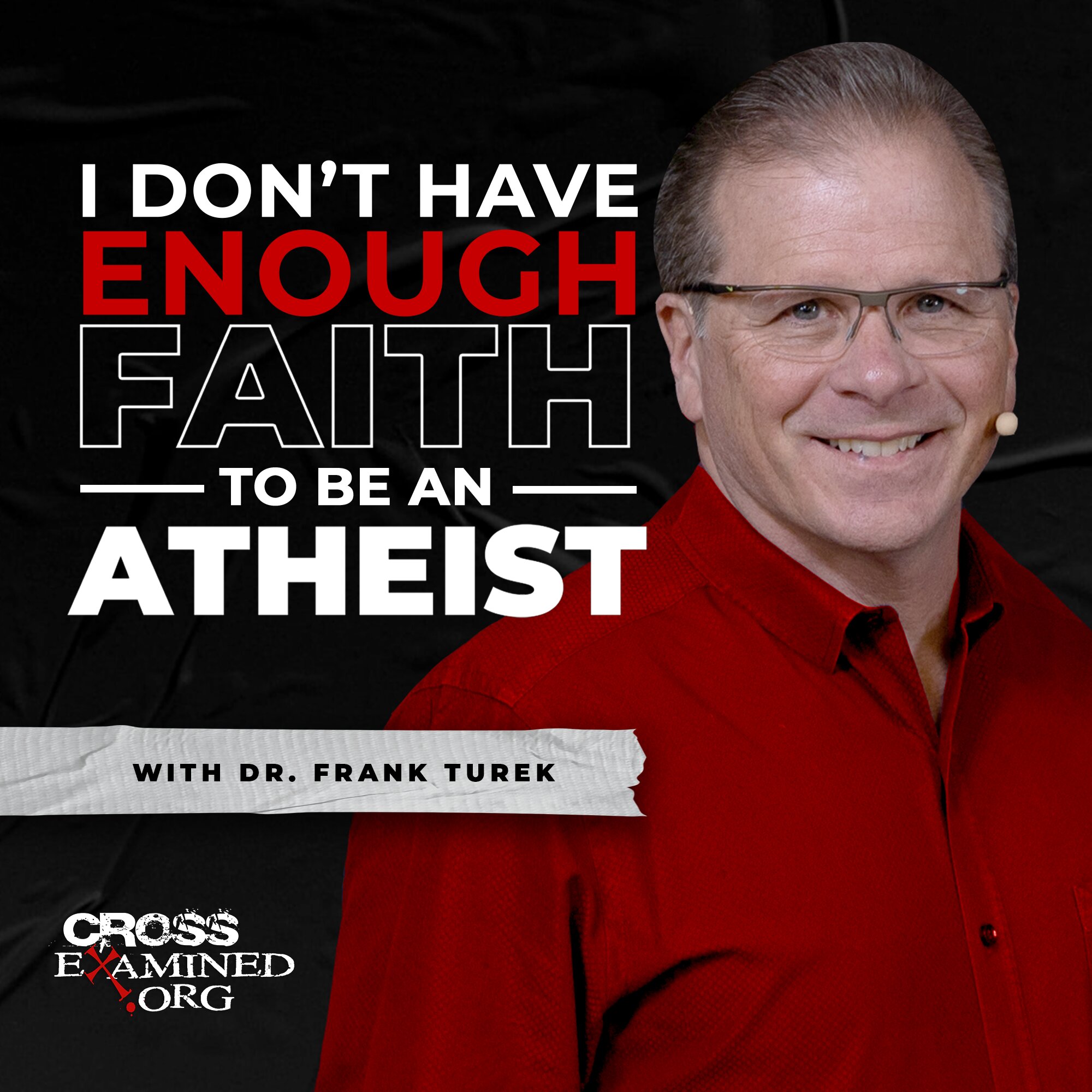
I Don't Have Enough FAITH to Be an ATHEIST
Dr. Frank Turek