ASH CLOUD
ASH CLOUD
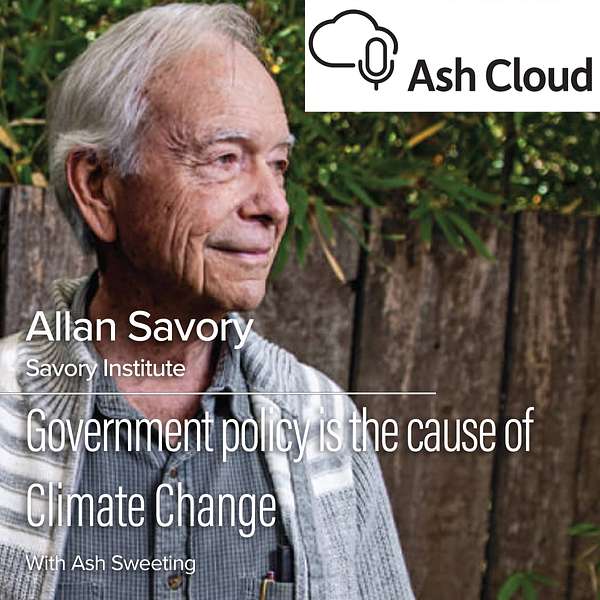
Allan Savory, Government policy is the cause of climate change
Humans are the cause of climate change. Climate change is also biodiversity loss, desertification, mega fires and climate change that are all feeding off each other and spiralling out of control.
The way humans manage fossil fuels, livestock, and the the environment is what is leading to the continual degradation of the natural world.
In the 1960's Allan initiated an elephant culling program in an effort to protect native habitats in Rhodesia (Zimbabwe today) from over grazing. The results were devastating. Not only were thousands of elephants killed, but the land degradation became worse. This led Allan to the conclusion that grazing animals were a critical component of all grassland systems. In fact, there is nothing available in the world that can reverse desertification other than livestock. In 1983, Allan and 2000 scientists from across the world identified that universal reductionist management was the key driver of climate change and developed the holistic framework. In 2009 Allan founded the Savory Institute to facilitate regeneration of the world's grasslands and the livelihoods of their inhabitants through holistic management.
Reductionist management ignores the complexity of our societies, economies, and nature and focuses primarily on addressing symptoms rather than the root cause. Reductionist management of our resources has led over thousands of years to the ever increasing degradation of the natural life support systems we all rely on for our survival. According to Allan government policies that cut fossil fuel use and livestock numbers will do little to address climate change if they are developed holistically.
The reason governments as so critical to our ability to combat climate change is that governments are the only institutions that can manage at scale. To address the unintended environmental consequences of our current managements of all natural resources policies need to be implemented at the scale required to achieve real impact.
I recently caught up with Allan to hear more about his work, you can listen to a short summary followed by our full conversation here.
In these series of conversations, we'll be discussing global sustainability with GIFs to bring a deep understanding of the environmental and cultural challenges facing our society and creative ideas on how to address them. I am Adam Twayting and welcome to the Act Club. Today we are joined by Alan Stavri, an ecologist plan, pharmaceutical and politician, and the founder of the Snaibury Institute, where he advocates the holistic management of the planet's natural resources and planning systems. Halistic management is about managing complexity, and Alan sees livestock as the most impactful tool available. Since the 1960s, Alan has dedicated his career to reverting the impact we humans have on the environment and climate. There's much more to our food and environmental sustainability challenges than climate change.
SPEAKER_01:Climate change has been really not just fossil fuels. It's biodiversity loss, desertification, megaphares, and climate change, which are all feeding on each other now and spiraling out of control. Humans are the ultimate cause of climate change. And if humans are causing climate change, then livestock aren't. Fossil fuels aren't. You cannot have two things causing it. So if humans are causing it, it is how we manage livestock and how we manage fossil fuels and resources. Governments are critical to achieve impact at scale. You say, all right, then why government policies? And the reason I say that is because management is at two levels. You and I can manage our families, our small businesses, our farms, whatever, all right. But um neither you nor I can manage at scale. Addressing the symptoms is not enough. And you look at uh climate change, as we're talking about. Governments can do all they like about cutting fossil fuels and not eating livestock and whatever, but it's the way they're developing policy that's causing the problem. So it'll continue. And people are discussing all the symptoms, all the problems. Nobody is discussing the cause of the problem. Now, again, science is logical. If you don't address the cause of a problem, you have no hope of solving it.
SPEAKER_02:Understanding the difference between what we produce and what we manage is critical.
SPEAKER_01:In managing holistically, there are two um real paradigm shifts or new concepts. And one is this what we do is we produce millions of things, but we only manage three things. Everything we produce isn't complex. It stops if we stop producing it, stops if a battery runs out, or fuel runs out. It's not self-organizing, not complex, has no emergent properties. They don't do unexpected things that they weren't designed to do when they were produced. All right, so that's millions of things. Now, what the hell do we manage then that is causing the problem? We only manage three things. Now, through managing ourselves, and depending on scale, institutions, and the economy, we manage nature or our life-supporting environment to produce every single thing that humans produce. Comes from nature, goes back to nature. So you're only managing three things. But these three things you cannot manage independent of each other.
SPEAKER_02:All attempts to ignore complexity are bound to fail.
SPEAKER_01:Now, if you're only managing three things and they're extremely complex, you cannot reduce that complexity to your reason and context for your actions or your policy to meeting a need, a desire, or solving a problem. That's reductionist. You're taking that incredible complexity beyond human understanding, and you're reducing it to one of three things. And that's why we have unintended consequences.
SPEAKER_02:Business as usual is not an option.
SPEAKER_01:The future is predictable. Uh, if we continue with biodiversity loss, desertification, megafires, climate change spiraling out of control as they are today, every year it's going to get worse and worse and worse. More and more poverty, more and more violence, more and more emigration to Europe and to America, changing the political face of these countries, more and more and more of this. It's going to keep going. And you're not going to uh it's no good telling our grandchildren to adapt to it. That's like telling the frog in slowly boiled water, just hang in there and adapt.
SPEAKER_02:There has been success on a small scale, but institutional involvement is critical for real impact.
SPEAKER_01:Hundreds, probably thousands of ranchers have worked with me and are beginning to manage holistically around the world. Not a single cattleman's or ranchers organization in the world has ever supported us. They've opposed. Now, the first people to latch on to what we're doing, because it produces such a rapid recovery of biodiversity, just unbelievable. That's been documented in films and everything else. But an environmentalists of individuals who worked with me developing that over the years, not a single environmental organization in the world has done anything except oppose it. What can we all do? I I just uh hope that somebody listening doesn't say, oh, that's nice, but takes action.
SPEAKER_02:What is holistic management?
SPEAKER_01:We had to call it a holistic context. And all that is, is the people who are involved or developing the policy decide how do they want their lives to be, then we tie that to their life-supporting environment, remember, which is where everything is coming from, not as it is today, but in the condition or state it'll have to be three, four, five hundred years from now for their descendants to live a similar life.
SPEAKER_02:Good morning, Alan. Thank you very much for joining me today.
SPEAKER_01:Well, thank you for having me along to chat.
SPEAKER_02:My pleasure. Could you please share your thoughts and your experience uh in terms of how how that is?
SPEAKER_01:Yeah, um, as you know, uh, well, I I think all your listeners know, um climate change has been is is really not just fossil fuels. It's biodiversity loss, desertification, megaphares, and climate change, which are all feeding on each other now and spiraling out of control. Um now the biodiversity loss, the desertification, part of that, we've had 10,000 years of humans blaming that on too many sheep, cattle, goats, livestock. You can go back in ancient texts. The part of it connected with fossil fuels, greenhouse gases from them, we've had decades of denial from corporations, scientists, etc. If you if you watch the last couple of years, every sane scientist has acknowledged that humans are causing climate change. That acknowledgement is profound, and the media have missed it, the scientists are missing it, the public is missing it, and it's one of the most profound acknowledgments we can imagine, because it means if science is logical, and if humans are causing climate change, then livestock aren't. Fossil fuels aren't. You cannot have two things causing it. So if humans are causing it, it is how we manage livestock and how we manage fossil fuels and resources. You see, we're not blaming water for causing it or trees for causing it. We're just picking some of the resources and blaming them. Now, the so once we acknowledge that management is a cause of climate change, now we can begin to look at the science, look at what is wrong in management that is doing this. It's been doing it for 10,000 years. It's not new. Uh, by accident, no wisdom. Uh, by accident, uh I describe that in my memoirs, which I will publish shortly. Uh, I changed my whole career and began to focus on that in the 1950s when I saw biodiversity loss occurring in national parks in Africa, where we couldn't blame livestock, couldn't blame fossil fuel, couldn't blame any of the things. We couldn't blame poaching, couldn't blame corruption, couldn't blame politics, couldn't blame colonialism, you know, all the things humans blame. We couldn't blame any of them. These these were protected national parks, and the the biodiversity loss is still occurring in them. So that became the focus of my life's work to try to solve that problem. And now, after you know, I've had 60 years of uh actually a lot of abuse uh because of my views. Now finally all of us were aligned if scientists acknowledge the significance of that comment or that acknowledgement that management is causing it. So that then actually would bring us to the point where you say, all right, then why government policies? And the reason I say that is because management is at two levels. You and I can manage our families, our small businesses, our farms, whatever, all right, but um neither you nor I can manage at scale. No individual can go to war, no individual can manage the whole economy, no individual can manage the whole agricultural production, whatever. Even a toothbrush today is made by a corporation. Most humans couldn't even make a toothbrush, couldn't even make a pencil. It's made by a company. So you've got management at two levels. One is what I call the human scale, that's you and I and everybody listening. The other is the institutional scale. And that is governments, environmental organizations, universities, corporations, churches, even religion. You'll notice individuals can practice their religion, but it's managed at by churches, by organizations. So everything we look at is like that. So when we look at management causing climate change, causing that biodiversity, the national parks I talked about, the only thing we could attribute it to, and I was attributing to was our own management as professional people. We didn't really know what the hell we were doing. We were reluctant to admit that. Scientists don't want to admit that. Professional people don't want to admit that. In fact, I got severely criticized for admitting that we'd shot 40,000 elephants based on my research, just doing what all scientists do, confirming what we believed. So, anyway, because the management at scale is by governments, that's why government policies are causing the problem. Government policies, environmental organization policies are causing the biodiversity loss, desertification in national parks in America, uh, and in Africa around where I live, where there are 30 national parks. And we can't blame that on anything except our management as professional people through the policies of environmental organizations and government. And it's exactly the same with climate change because climate change is biodiversity loss, desertification, megaphires. Um, it's not uh just happening up in the sky.
SPEAKER_02:As humans, we like to, we do tend to like to blame people or things other than ourselves. It's possibly part of human nature, and and really it's more a matter of looking in the mirror and saying, what are we as humans doing rather than looking at, as you said, the farming systems or livestock or the timber industry or any one particular group of people or the fossil fuel industry. In terms of thinking about that, where do you see do you see that obviously there's been 10,000 years of of um human societies you know in the agricultural age? And so this is a situation that compounded slowly to start off with, and then ever increasingly, especially post-industrial revolution. And do you see as uh a need to transition our thinking from what we've done in the past, or is it more we need to have a blank sheet of paper and and start from scratch?
SPEAKER_01:No, we just uh we we we've got two alternatives. We can go on bickering and arguing and blaming resources and blaming each other as is going on all the time, and we can do that for the next 200 years. Um, I've been 60 years at it already. Um, or I'm making a suggestion to the world, and that's the one I made at COP26, and I got no criticism from anybody in the world on that, but I got no action, total apathy. Uh, and what I suggested is why don't we just stop blaming each other, pull together as team humanity, because we're all in this boat together, and why don't we just get one small government or one issue like national parks? Everybody wants national parks, they're good, they're there, there's nothing wrong with them, but they shouldn't be contributing to climate change. So why don't we take an issue like that and just have uh the Royal Society, the Royal Foundation, uh the US Academy of Sciences, whatever, to sponsor it, and just get one government, get the government of my country, to agree to carry on as they are, don't take any political risk, and just let us develop policy with the environmental organizations, all the experts, and everything, and just develop policy in a different way that does address the cause. And we can do that, and we could we could do that in uh in a month or two, and then the world can see okay, we can see what is possible. It's possible to begin reversing this desertification, biodiversity loss in complete harmony without any argument. Nobody is to blame. We didn't know what was causing it. We didn't know that that reductionist management was universal and that there was a different way of doing it. We discovered that in 1983, and it was 2,000 scientists working with me, commissioned by the US government, Soil Conservation Service, and they enabled me to break through with that because over two years we worked together and gradually hammered it out until we developed the holistic framework. So we could we could do that, and I'm suggesting that. Okay. Uh let me do so. In managing holistically, there are two um real paradigm shifts or new concepts. And one is this that I'm talking to you about now. The the belief amongst all humans and scientists is that we make decisions in millions of different ways as we manage our lives and and do everything. And that belief we found was false. What we do is we produce millions of things, but we only manage three things. Now that's new thinking to humans. So let me explain it to you. We produce food, beef, wine, whatever. We produce cell phones, we produce music, we produce computers, we produce bombs, we produce space exploration vehicles, we produce millions of things from food to art to buildings to cities to sustain civilization. Everything we produce, we can produce a cell phone or music, milk or cheese. We can choose what to produce. They're not indivisible. Everything we produce isn't complex. It stops if we stop producing it, stops if a battery runs out, or fuel runs out. It's not self-organizing, not complex, has no emergent properties. Food feeds you, a clock, a watch tells you the time, a computer computes. They don't do unexpected things that they weren't designed to do when they were produced. All right, so that's millions of things. Now, what the hell do we manage then that is causing the problem? We only manage three things. We manage humans, we manage our lives based on our culture and our beliefs and everything else, and we manage at scale through institutions, as I mentioned earlier. All right. So now, once we're managing our lives, our farms, our families, whatever it is, and our companies or institutions, the next thing we manage is financing them, economy. Because if you go broke, you're you're out of the business, you're out of the game. So we have to finance those. So we manage the economy. Now, through managing ourselves, and depending on scale, institutions, and the economy, we manage nature or our life-supporting environment to produce every single thing that humans produce. Comes from nature, goes back to nature. So you're only managing three things. But these three things you cannot manage independent of each other. You can't manage your family if you breathe oxygen independent of the of nature. You can't manage your family if you if you're broke. Um you can't pick and choose. What in every action, every day, you unknowingly are managing these three things. They're indivisible, absolutely indivisible. Now, these three things are all complex. Humans, economy, and nature, they are what is defined as complex. They are self-organizing, millions of people can die in a company or whatever, and you carry on. We kill millions of people in a war or whatever, we carry on. If you take nature, millions of species can die. We kill out whole lines. Nature continues in changed form. If you take economies, whole currencies can collapse, as in my country, with the highest inflation ever in the history of the world. The country didn't collapse. We just carried on with the more honest black market. Um and still carry on. So these three things are complex, they're self-organizing, and they have emergent properties. That means they do what we believe they do or are doing, but they also do unexpected things. So if you just take a simple example, if you put look at oxygen and you know everything there is to know about oxygen, and you look at hydrogen, and you know everything there is to know about hydrogen, and I said to you, let's have a look at water, you'd say, What the hell is that? You wouldn't know that that's just oxygen and nitrogen, but they've changed form completely. So that's it's an emergent property, if you like, just to give you an idea. So I mentioned that we manage at scale. Organizations, institutions are complex, therefore they have emergent properties. So we we need them, we have to have them, because they're our most efficient way of doing things, but they also do things they're not expected to. So, for example, um common one I look at is religion. Once uh, if we look at uh just take one religion, you could take any of them, but just take one. Um, many of our listeners will be Christians, and many Christians have been able to practice love and caring and whatever the basic message is, all right. But the moment we ran religion at scale through churches, what happened? Just looking at that one religion, we ended up with over 2,000 different churches in the world and for centuries killing each other, maiming each other, going to war, and uh protecting priests and not innocent children. These are not, nobody's being bad. That's what's called a emergent wicked problem of a complex organization. So these are complex, the three things we manage. And what we discovered was that we do only manage those three things, and how we do it is reductionist. So let me let me explain that as simply as I can. You and I, and everybody listening to us, even though I've I'm only seeing you on the uh uh screen today, I know how you made every conscious decision in your life. Now I'm no magician. How the hell could I know that? Tell me if I'm wrong. Haven't you made every conscious decision in your life to meet a need you had, to meet a desire you had, or to solve a problem you had? Yeah, that's correct. So has every human. So is every government policy developed that way. Now, if you're only managing three things and they're extremely complex, you cannot reduce that complexity to your reason and context for your actions or your policy to meeting a need, a desire, or solving a problem. That's reductionist. You're taking that incredible complexity beyond human understanding, and you're reducing it to one of three things. And that's why we have unintended consequences. Um, that's that's why if I just take COVID, I'm told or read that in the first four months, I think it was, um COVID uh did more uh global economic damage than World War II did in four years. How the hell can a virus do that? Don't be silly. No virus can do that. What did that was the way the governments formed policy. It was policy that did the damage. And you look at uh climate change, as we're talking about. Governments can do all they like about cutting fossil fuels and not eating livestock and whatever, but it's the way they're developing policy that's causing the problem. So it'll continue. You can look at COP25, COP27, 26, you can go to as many meetings as you like, you can go to Davos, everywhere, and people are discussing all the symptoms, all the problems. Nobody is discussing the cause of the problem. Now, again, science is logical. If you don't address the cause of a problem, you have no hope of solving it. So this is why I'm suggesting why don't we try taking one case, national parks, international observation of it, and just let the people there develop a policy holistically.
SPEAKER_02:So as humans, and all you've said makes complete sense. How how does our thinking because I get I guess to take a step back, to to if I understand this correctly, as we've managed these different our economies, our lives, um, and our resources over centuries, the emergent issues are things like climate change, because we've been managing a forest to produce timber, not to be a vibrant ecosystem that fosters biodiversity or whatever it you know we manage our fossil fuels to drive the economy rather than considering the other emergent properties of the role fossil fuels have in nature. Um how does our thinking as humans have to change to address these emergent properties? And then obviously, how does the thinking of governments have to change to address these emergent properties?
SPEAKER_01:Uh it's there's no good changing the thinking. That's not going to help. Um, we would be arrogant if we thought we were the first people to think more holistically. There's evidence here in America, apparently, of some of the what they call the Native American tribes trying to think seven generations ahead, whereas they made decisions. Um, they had taboos in place of laws because they'd observed the damage they were doing to the environment. Humans here had killed out over 80% of the large mammals, replaced their role with fire, and they'd seen the damage this was causing. So it didn't help. The land just continued uh deteriorating. It doesn't matter where you look in the world, right? So it's not gonna help to change our thinking and think holistically. I'm not being crude, but look at it a little bit like pregnancy. It's no good thinking pregnancy if you get married and a couple of you are thinking pregnancy. It's not gonna happen. You you're gonna you've got to get pregnant or not. You can't be a little bit pregnant, you can't just think about it. And it's it's the same with resources. All we need to do is just manage holistically. And then that's very easy to do. We can train people to do that in a week. Um, we did, as I said, in 1983, when I was commissioned to train 2,000 scientists, that's when we broke through with it. And those uh people coming from universities, all the main government agencies of America, etc., were doing a week's training. By the end of it, we're looking at hundreds of their own policies. They made a statement, not me, which I recorded in our textbook, where they said we now recognize that unsound resource management is universal in the United States. That's after just a week of training. These are professional people. And it's the same in every country. Now we knew that in 1983. So so, really, the the problem is why aren't we doing it? Because that's the problem, and and let me try and explain that to you. It took me decades to understand it. Why so much resistance to what I say? Why, when we had reached that point in 1983 with the US government, it was that all training was then banned. Why did this happen? We couldn't understand that. We because we didn't know about the wicked problems and the complexity of institutions. That's what we didn't know about. Now, there are two types of discoveries. There are new discoveries and there are heresies. Now, in the history of the world, if you look at it, anytime somebody discovers something new where everybody can see this is new, all right, it can generate a lot of controversy. The controversy may go on for decades. There's argument back and forth, uh, there's testing of the idea, the scientific hypothesis, blah, blah, blah. And then it's accepted. And once it's accepted, institutions are the very first to do so. So you go, humans believe in technology, go into any organization, and you'll see they have the latest software, the latest cell phones, the latest software, uh computers, everything because they believe in it. All right. Humans believe in planting trees. So we give a Nobel Prize to somebody for planting trees. And China's planting trillions of trees and it's failing. And UAE planted$30 billion of trees that I went and looked at, and the desert sand is just blowing through. But we just keep doing it because we believe it, and it's led by our institutions. All right, so that's what happens with new discoveries. Now, periodically, and very few times in history, you get a discovery that the is new, but the institutions and all the world's experts know it's not new. They know it's wrong. Because it goes against thousands of years of human belief, and institutions always defend the beliefs of the society in which they formed. So every time you get a discovery that is considered heresy by the experts, now it takes up to 200 to 300 years before it's accepted by institutions.
SPEAKER_02:So that's like Darwinism versus Genesis or the world being round versus being flat, that kind of sort of yeah.
SPEAKER_01:They went against the beliefs of everybody. Everybody got to see the world was flat. How the hell can you tell me it's round? Now it's the same. For 10,000 years, we could see that livestock were causing desertification. I believed it. That's why I made that terrible blunder that led to shooting 40,000 elephants, because I was trained as a scientist in the beliefs of society. And I was wrong. We were all wrong. Okay, so so we've seen that for thousands of years that livestock caused desertification. So when I discovered in the 1960s, that oh my God, nothing is available in the world to reverse desertification over two-thirds of the world's land, except livestock. You see, that was heresy, and that began, that was like throwing a pork chop in a synagogue. That began the decades of my life of criticism, abuse, ridicule, and opposition that I've had, and it's still going on. So it it nobody's being bad. It's just how institutions lead the ridicule and experts lead the ridicule against heresy. Now, the second heresy, and that's the tragedy of managing holistically, it involves two terribly simple ideas that 10-year-old children can understand immediately. Um, the second heresy in it is I began this talk with it. I said, for thousands of years, every human, billions of humans, believed there were thousands of ways of making decisions. And then I said, I knew how you made your decisions. No, for the last million years, every human has been making decisions to meet needs, desires, or solve problems in a world that is holistic and complex. Now that's heresy. So we got we've got resistance to it.
SPEAKER_02:How do you see ideas or mechanisms to just to take a step back and uh you know wherever I've worked in the world and be that developing world or the developed world, what something that's been frequently reinforced continuously is that the social, cultural, and political challenges are much, much greater than the technical challenges. Not saying technical challenges are easy, but the, you know, and the UAE is an example of that. They had resources, they had um finances, they could pay for things, but because of the cultural diversity of the teams and the country when I was working there, um getting anything to change was very, very difficult. So, you know, there's eight billion of us, and we're all making decisions through those three, through one of those three reasons, as your you said, to address climate change, we need, we don't need a handful of people doing that. We need lots of people changing to holistic management. How do we what are your thoughts on terms of accelerating that process and overcoming those social, cultural, and political or or the heresy type um, as you said, hurdles?
SPEAKER_01:Okay, it's uh what we need to do is amazingly simple. We just need to get governments developing a policy. It can be energy, it can be agriculture, it can be national parks, immigration, whatever you like. But developing agriculture is the most logical one to do. Developing a policy in what we call a national holistic context. In other words, says we will always have the same needs, desires, and problem solving. You'll never change that. That that will continue, but it must no longer be the context for our decisions or our policies, it needs to be the reason for them. Right now, that left us where we didn't know, well, then what is the context? And that we solved with those 2,000 scientists I was working with, and economists and others in 83. And we developed a new concept that's not in any branch of science, religion, or philosophy. And it we had to call it a holistic context. And all that is, is the people who are involved or developing the policy, whatever, decide how the people in that culture, that society, that family, whatever it is, how they want their lives to be, based on their deepest cultural, spiritual values, beliefs, whatever. How do they want their lives to be? Then we tie that to their life-supporting environment, remember, which is where everything is coming from, not as it is today, but in the condition or state it'll have to be three, four, five hundred years from now for their descendants to live a similar life. And then we tie to our behavior because we're always dealing with other people, etc. And there's certain guidelines in developing that. You can't have any prejudice against an action or whatever. And that becomes now the holistic context for our actions. And we've got all the knowledge we need. Uh, each time we do this in training exercises with professional people or politicians or anybody, we find we've got all the knowledge we need in the room. We're not lacking knowledge, we've got an immense amount of knowledge, and nobody's to blame. That's why we've got to stop blaming each other. And the moment you manage in that context, using all available science, and then we, with anything affecting the environment, we assume we're wrong and we complete a feedback loop or decide what to monitor, and that's it. So it's it is that simple. Now, how do we bring that about? That that is the issue we we're all grappling with. Uh, and there's only one known way, and that is more and more people do it, more and more people talk about it, more and more people demonstrate it, and uh you get documentary films out and one thing another, and that's what we're doing. And as you do that, the movement grows. All right, and while you're doing that, other people are opposing it. So while we've been developing that with individuals and individual people within institutions, universities, environmental organizations, we've been doing that and we've spread around the world amazingly well. But all that time it has been opposed. So by the institutions. So, for example, hundreds, probably thousands of ranchers have worked with me and are beginning to manage holistically around the world. Not a single cattleman's or ranchers organization in the world has ever supported us. They've opposed. Now, the first people to latch on to what we're doing, because it produces such a rapid recovery of biodiversity, just unbelievable. That's been documented in films and everything else. But an environmentalists of individuals have worked with me developing that over the years, not a single environmental organization in the world has done anything except oppose it. So that's what slows us up. Now it's beginning that some branches of some environmental organizations are beginning to support us. And this is how change occurs. And when two heresies are involved, as in this case, that's why if you look at the research of somebody like Lord Ashby, Eric Ashby, Looked at Britain and America over the last 200 years, and how does truly new knowledge like this get into society? He found that there's no way of doing it. It takes 200 years. It just incrementally you do it. So we're doing that. And what I'm doing, uh just personally, because I've only got, you know, when I buy something today and they tell me it's got a five-year guarantee, I say, thank God, that's a lifetime guarantee for me. Uh, because I'm in the departure lounge at my age. Okay, so I've only got a few more years here. So what I'm doing is supporting the people who are doing that, including my own organization, the Savory Institute, which younger people have taken over and doing a wonderful job. I support them fully, but it is incremental change. And so I keep warning people we're doing the best we can, but we represent maybe 0.5 or 1% of 7 billion people. Uh, so if 50 years from now we represent 10%, we'd have done incredibly well. This is why it takes 200 years until an institution develops policy holistically. So, personally, what I'm doing is what I suggested to you. I'd putting out a suggestion to the world. Why don't we keep doing that? Because it's the only way known. And why don't we try something that's never been tried in the history of the world? And if I'm right, it will cut our time from 200 years down to four or five. We'll save billions of lives, we'll save trillions of dollars, we'll save whole cities from collapsing. And the that's the upside. The downside, if I'm wrong, is uh we'll have wasted a few thousand dollars in a year. Ah what I need is people listening to us like this to say, damn it, this makes sense. Why don't we try this? Just taking the issue of national parks. Why don't we get a million people to sign a petition, send it to the government of Zimbabwe or Botswana and the government of or the Royal Society of Britain, the Royal Foundation there, the US Academy of Sciences, the French Academy of Sciences, get them to support it, that idea.
SPEAKER_02:You mentioned um just before we started recording that when you produced that film for for COP, it was 26 I read, if I remember correctly, you had no, not a single iota of criticism, but also no support. And you mentioned how it was very bizarre to get no response either way. Um, have you any thoughts on why you think it's sort of it slipped it it was in that kind of no man's land, I guess, where it didn't get any criticism or uh but also no response?
SPEAKER_01:No, I did get response. I got a lot of positive response, but no action.
SPEAKER_02:Okay, so action is what I meant.
SPEAKER_01:But no criticism at all, which was amazing. That's a good sign. That I got no action is normal because people say they like it, but they don't do anything. So I had thousands of people say, Oh, incredible, amazing, blah, blah, blah, blah, blah. But they did nothing. What it needs is somebody to act like I talked of just now and say, hey, this makes sense, why don't we help this fellow and see if we can get this done? Why don't a thousand of us sign a petition to the authorities to do it? Because it can only be done by institutions. So if those institutions get a thousand or a million signatures and a petition saying, why don't we do this? Then they can do it. Now, if we do it, it'll be complete harmony, no conflict at all. That I promise, you know, because we've done this so often in exercises, even where people were in complete conflict. The moment we developed a holistic context, suddenly it was a different atmosphere. We've never done this. Remember, it's a new concept.
SPEAKER_02:There's tens, probably hundreds of millions of people across the world who are deeply concerned about climate change, the impact on nature and the environment and their lives and their families' lives. And they're so there's a lot of, and whilst as you know, and even in within governments as well, within institutions, there are people that are passionate, there's a lot of energy out there that can be harnessed um towards solving these complex problems. And I think it goes back to what you said about um the way we think and the way we solve problems. And if we we take technology for an example, we people say, okay, you look at genomics and AI and how that's affected things like cancer treatment. There's amazing technologies that have produced some real good for society. And it's like, well, let's how do we use what's worked to solve some of our problems in the past to solve this problem? And in terms of harnessing that energy and the passion people have to solving their problems, is there any thoughts in terms of how they could slightly refocus that energy to be, you know, are people are people more be more effective if they start lobbying to the institutions rather than trying to use cancer technology to solve an environmental problem? Where's the balance in that side of things?
SPEAKER_01:Uh Ash, I wouldn't think like that at all. That's that's how we do think, and that's why it takes 200 years. Uh, these all these good, passionate people, and many of them, I mean, as I mentioned earlier, are in the institutions. Those are the guys that help me, and the girls that help me. All right. So every time you, if you get passionate and you campaign and everything, you campaign for some action, all right, like organic agriculture or regenerative agriculture, and you've got people who campaign for something else. And so you've got conflict because both sides are in reductionist management. They're trying to solve a problem without a context. Both sides are doing it. So even the people who support me are like friendly bulls in the China shop, doing as much damage as an angry bull in the china shop. Because they're just furthering the conflict. So I keep saying, no, let's stop bickering, let's stop arguing, and why don't we focus on one thing and just together manage one situation at scale by developing policy together so that we can all see what is possible if we work as team humanity together, and then that will start a domino effect. Because most people are good, most people are very sincere, they're doing their best, they don't understand that it's the reductionist management that everybody's engaged in that is causing the conflict, the arguments, and the problem.
SPEAKER_02:That makes a lot of sense. Um I guess one more one more question. And whilst I completely agree with you that most people are sincere and good people, there are people out there who have different motivations. And and I think the most the recent example that comes to mind is the situation in Ukraine where um food, um, I guess over the last 10 years, 15 years, since the beginning of the Syrian war, um, you know, Putin and Russia have weaponized refugees, they've revised food, they've weaponized energy. Um there's little evidence that they're actually looking at the the greater good of humanity and the world. And how I guess when with the the disruptive power of violence in that regard, of war and everything like that, and you have a very small minority of people trying to disrupt things, how how does that threaten um the holistic approach?
SPEAKER_01:Well, it it helps slow it up. I mean, we that's what we have. We have genuine people who are not trying to be bad, they're genuinely confused and adding to the conflict. And then you you always get evil people. I'm having it right now. Only yesterday I looked on uh Twitter. Now, my public record is open and available to anybody. It's well known. I'm writing my memoir about it all and spent a year fact-checking. And my record of uh posing the generals in Rhodesia, opposing Ian Smith's racism, leading uh leading the opposition, eventually being exiled. That's what took me to America. That that's all public record. And I was probably one of the most prominent people in the country doing that. And that's why I got exiled. Now, yesterday uh I see there's a website and there's a group of people. I don't know what their motive is, but they are really attacking me and our whole organization, and they're claiming that uh my record shows that I um was uh supporting white supremacy and I committed genocide. I mean, it's it's it's horrific stuff, it's sick minds. So you'll never stop that. You're gonna get some people like that, and so I I just got to ignore it and try and carry on. So you you we can't stop that. We what we've got to do is work with the majority of people who are good and well-meaning and and stop blaming each other. And I don't want to repeat myself, but let's just try one example together. Because if we don't do that, the future is predictable. Uh, if we continue with biodiversity loss, desertification, megaphires, climate change spiraling out of control as they are today, every year it's gonna get worse and worse and worse. More and more poverty, more and more violence, more and more emigration to Europe and to America, changing the political face of these countries, more and more and more of this. It's it's gonna keep going. And you're not gonna uh it's no good telling our grandchildren to adapt to it. That's like telling the frog in slowly boiled water, just hang in there and adapt. That's nonsense. So that's the future. That is the future, and it's going to be horrific. So I'm offering more hope than the world can even dream of with one simple exercise that we just bury the hatchet and do together and have it internationally observed. All I need is enough people to support that idea, and I get lots say, oh, we love that idea, but we're not prepared to do anything. That's human nature.
SPEAKER_02:No criticism, lots of support, but no action.
SPEAKER_01:Yeah, that's how we are.
SPEAKER_02:You've you've had a very uh broad set of experiences, um, and you you've been, I guess, privileged to live on many continents and and see and experience many things. And obviously the the situation with the elephants is one of the key moments in terms of changing your thinking. Uh, are there any other particularly strong key moments that you'd like to share or you could share with us that kind of affected the way you saw the world or that was was you know something that was deeply important for you?
SPEAKER_01:Yeah, there are two I can share with you. One was when I was a young um biologist, ecologist, game ranger, I was in charge of a very large area of Africa, many game reserves that were to become national parks. And I had Sir Frank Fraser Darling, he wasn't knighted at the time, but he was one of the world's best known ecologists. He was sent out by the colonial office, and uh Frank spent uh six weeks with me, and I was a 21-year-old. Uh, he was the top, one of the top ecologists in the world. And I was showing him the biodiversity loss, the degradation in these areas that we were making national parks, and he had no solution. All he could say to me is, Alan, you've only got two options. You you'll either go back to university, do your research, publish your papers, build a reputation, status, become the world's expert on whatever. He said, or you'll go into politics. I said, I won't do either. Well, he was damn well right. I did go into politics to try and do it. So that was a turning moment because what I did then was I changed my whole career. I stopped my pursuit of what I loved, I stopped my pursuit of what I loved in sports, uh, and just said, I'm going to dedicate my life to solving this problem. That was a turning moment. And then there was another one where, uh, and I've spoken about it a number of times, where I was uh on my own, um, again as a young man, but by then I was about 30, 35, I think, on the banks of the Yamzingwani River in what was then Rhodesia. And the river came down in flood, muddy water, dead coats, donkeys, trees floating by. And I was on my own, and grown men don't cry, as you know, and I just burst out crying. I sobbed my bloody heart out. That was my country. That that was more dangerous than any war ever fought. And I thought to myself, why am I in the army? Why am I fighting a war for politicians I don't believe in? For politics I don't believe in, for racism I don't believe in. Why am I prepared to spend my risk my life for something I don't believe in? Aren't I prepared to risk my life to solve this problem? And that moment, I just sounds dramatic, but I just said even if it costs my life, nothing is going to stop me. I'm going to solve this problem. So those were turning moments for me.
SPEAKER_02:And thank you for all of the the the passion, the energy, the dedication you have put into solving this problem over that intervening period and before that. It's from my perspective, and I think from many perspective, people's perspective, that's that your dedication and passion is greatly appreciated.
SPEAKER_01:Well, thanks for your help in getting the word out there.
SPEAKER_02:Thanks, um Is there is there anything else that we haven't discussed that you'd like to add?
SPEAKER_01:No, I think we've said the main things that matter. I I just uh hope that somebody listening doesn't say, oh, that's nice, but takes action.
SPEAKER_02:Alan, thank you so very, very much for joining me today. It's been an absolute pleasure.
SPEAKER_01:Well, my pleasure. Thank you, Ash.
SPEAKER_02:You've been listening to the AshCloud with me, and sweeting in conversation with Alan Savory, recorded in California in May 2023.