
The Insurance Producers Guild
The Insurance Producers Guild is a strategic briefing for insurance professionals, focused on Medicare, ACA, life insurance, and the evolving insurance landscape. Each episode distills complex industry changes into clear, practical intelligence.
AI was used in the making of these podcasts.
The Insurance Producers Guild
EP4 The 8% Edge - Agents Using AI Will Win
Use Left/Right to seek, Home/End to jump to start or end. Hold shift to jump forward or backward.
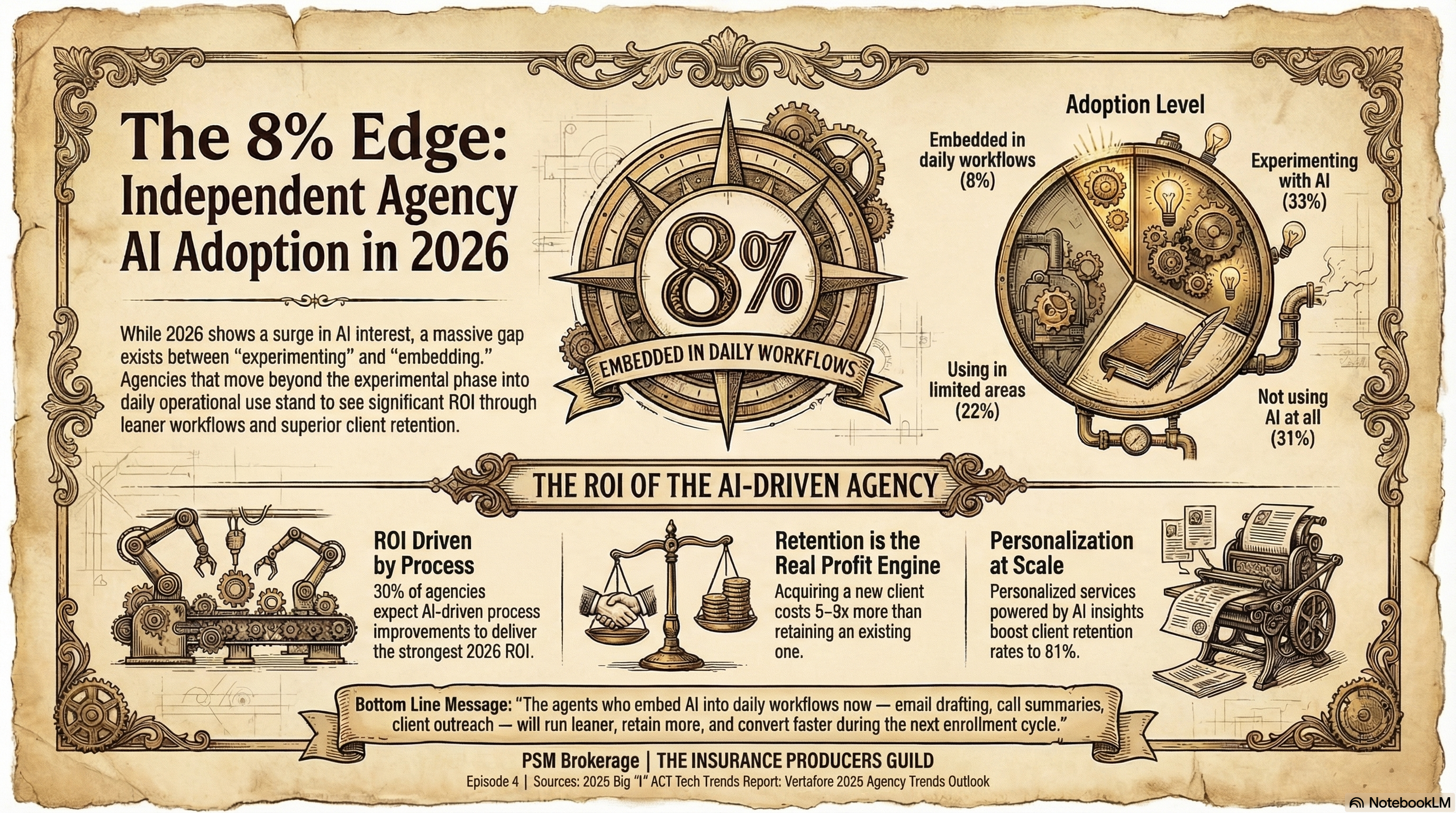
Only 8% of independent insurance agencies have embedded AI into their daily workflows — while 31% aren't using it at all. According to the 2026 Big "I" ACT Tech Trends Report and Vertafore's survey of 1,300+ agency professionals, two-thirds of agencies plan to increase AI use this year. The gap between intent and execution is the biggest competitive window in the independent agency channel right now.
In this Agency Builder episode, two veteran agents break down exactly where to start: the repetitive, manual tasks that eat your day (email drafting, call summaries, document review) and how agents embedding AI into these workflows are freeing up hours for the retention calls that actually protect their books. With Medicare premiums rising and carriers exiting markets, the math is clear — acquiring a new client costs 5-9x more than retaining one, and personalized services boost retention rates to 81%.
The episode includes a specific retention call script, the "don't buy shiny — activate what you have" principle, and a concrete Go-Do for agents at any stage of AI adoption. Produced by PSM Brokerage — Precision Senior Marketing.
🔑 Key Topics Covered
- Only 8% of agencies have embedded AI into daily workflows. 31% aren't using it at all. The window is wide open.
- Where Agencies Stand on AI" — Visual breakdown: 33% experimenting, 22% limited, 8% embedded, 31% none. Source: 2026 Big "I" ACT Tech Trends Report.
- The Retention Math" — Acquiring a new client costs 5-9x more than retaining one. Personalized services boost retention to 81%. Every hour saved on admin = an hour for retention calls.
- Your Go-Do This Week" — Pick ONE repetitive task (email drafting, call summaries, or client review scheduling). Use AI for it every day this week. Measure time saved. Scale from there. PSM's business coaching can help you build the plan.
Infographic: https://www.psmbrokerage.com/hubfs/The%20Insurance%20Producers%20Guild/IPG-EP4-Infographic.png
Slideshow: https://www.psmbrokerage.com/hubfs/The%20Insurance%20Producers%20Guild/IPG-EP4-Slideshow.pdf
🔗 Sources
2026 Big "I" ACT Tech Trends Report (via InsuranceNewsNet)
https://insurancenewsnet.com/innarticle/two-thirds-of-independent-agencies-plan-to-increase-ai-use-this-year
Vertafore 2026 Agency Trends Outlook (via Insurance Thought Leadership)
https://www.insurancethoughtleadership.com/agent-broker/independent-agencies-top-priorities-2026
Vertafore — AI Is Helping Independent Agencies Keep the Human Touch
https://www.vertafore.com/resources/blog/ai-helping-independent-agencies-keep-human-touch
The Insurance Producers Guild Podcast delivers intelligence for insurance agents looking to stay ahead of industry trends.
Follow the show and connect with PSM Brokerage to access tools, training, and support designed to help you grow your business.
Learn more: https://www.psmbrokerage.com
Look, if you're uh if you're feeling a little behind on this whole AI revolution right now, just take a breath.
SPEAKER_01Yeah, seriously. Because ninety-two percent of your competitors are just staring at their screens, completely paralyzed.
SPEAKER_00Exactly. I mean, they're reading the same industry newsletters you are, hearing all the same buzzwords, you know, machine learning algorithms, and they're just frozen.
SPEAKER_01Aaron Powell Frozen by the fear of making the wrong move.
SPEAKER_00Right. So today, we're going to show you how to exploit that hesitation. Welcome to our deep dive, a production of PSM brokerage serving independent agents across all 50 states.
SPEAKER_01Aaron Powell Because while the rest of the market is, you know, dealing with this professional panic, the actual data tells a completely different story.
SPEAKER_00Aaron Powell It really does. And as veteran agents ourselves, I mean, PSM agents see this dynamic unfolding in real time across the industry.
SPEAKER_01Aaron Powell Oh, absolutely. We have the 2026 Big IAGents Council for Technology or ACT Tech Trends Report in front of us. And the core statistic is really the only thing you need to focus on right now.
SPEAKER_00Lay it out for them.
SPEAKER_01Only 8% of independent agencies have actually embedded AI into their daily workflows. Just 8%.
SPEAKER_00Wow. Which means the window to gain a massive structural advantage is wide open. Our mission today is to break down exactly how you can join that top 8% and absolutely own the next enrollment cycle.
SPEAKER_01And we're doing that by combining that ACT survey with the VertiFour 2026 agency trends outlook. That one gives us the perspective of over 1,300 agency professionals.
SPEAKER_00So we aren't looking at what uh Silicon Valley thinks insurance agents should do.
SPEAKER_01No, not at all.
SPEAKER_00We're looking at what the most profitable agencies are actually doing today to scale their books of business. And look, I've been sitting at kitchen tables building my book for over 25 years.
SPEAKER_01You've seen a few of these cycles.
SPEAKER_00I have. And looking at this data, the pattern is just unmistakable. This feels exactly like when the first web-based CRMs and electronic applications rolled out back in the early 2000s.
SPEAKER_01Oh man, the panic back then.
SPEAKER_00It was crazy. I remember sitting in an agency in like 2004 with literal filing cabinets lining the walls. Agents were terrified.
SPEAKER_01Right. They were asking, where does the data go?
SPEAKER_00Exactly. What if the server crashes? My clients want to sign paper. So they spent hours handwriting applications. But the agents who moved past the fear and adopted the tech first, they didn't just survive. They bomb and new. They used the hours they saved to prospect the exact agents who were too busy doing paperwork. They locked in the best clients for the next two decades.
SPEAKER_01Yeah.
SPEAKER_00It is the exact same movie, just with new technology.
SPEAKER_01It really is. And just like with those early CRMs, this transition isn't about replacing you, the agent. No. It is entirely about clearing the administrative brush so you can close more business today. It's about taking the friction out of your daily operations.
SPEAKER_00Aaron Powell But that top 8% didn't just flip a switch overnight, right? So what is the actual mechanical difference between the 33% of agencies in this report who are, you know, just experimenting?
SPEAKER_01Aaron Powell Right, the dabblers.
SPEAKER_00Trevor Burrus, Jr.: Yeah, the dabbles. What's the difference between them and the 8% who are actively cashing in on this right now?
SPEAKER_01Aaron Powell Well, when you look at the agencies successfully ramping up, they're driven by one primary, basically ruthless goal, and that's operational efficiency. Aaron Powell. They aren't trying to build like a robot agent to talk to clients. They're looking at their highest friction tasks. Let me ground this in a specific reality. Think about the annual client review process.
SPEAKER_00Oh, yeah. The slog.
SPEAKER_01Exactly. Well, I recently used an AI tool integrated right into my CRM to draft 40 personalized client review emails for my Medicare book.
SPEAKER_0040 emails.
SPEAKER_0140 of them. It pulled in the specific plan details, noted the premium changes for the upcoming year, and customized the greeting based on my last meeting notes. And that entire process took exactly 20 minutes. Previously, drafting 40 personalized compliant emails was an eight-hour full-day chore.
SPEAKER_00Wait, wait, let me stop you there because 20 minutes for 40 emails means you spend about 30 seconds reviewing each one before hitting send.
SPEAKER_01How are you catching errors or hallucinations in that timeframe? I mean, how does the machine actually know the difference between a standard premium increase and say a critical drop in coverage for a specific prescription drug?
SPEAKER_00That is the exact right question. And it goes to the mechanics of how the top 8% are using this tech. They aren't using open-ended AI like a creative writing prompt.
SPEAKER_01Right. You're not just saying, hey, write a nice email to John about his new Humana plan.
SPEAKER_00Exactly. If you do that, the AI will hallucinate because it's just trying to guess what you want it to say. Instead, the top agencies use constrained prompts.
SPEAKER_01Constrained prompts. Okay, what does a constrained prompt actually look like on the screen for an agent?
SPEAKER_00It's essentially a strict set of rules. You type something like system instruction. You are a Medicare data extraction tool. Analyze the attached 2026 Annual Notice of Change PDF.
SPEAKER_01Very specific. Extremely. Then you say, extract strictly the following four fields: 2026 monthly premium, primary care copay, inpatient hospital copay, and maximum out-of-pocket. Insert these four fields into the bracketed sections of my standard review email template. Oh, I see. The AI is acting as a data extractor, not a ghostwriter. It's strictly bound by the rules you set.
SPEAKER_00Aaron Powell So it's not like hiring a creative assistant who might, you know, make up a story. It's like having a dedicated translator. It takes the carrier's dense, 40-page technical jargon and just translates it into the concise conversational tone you already use with your clients. Trevor Burrus, Jr.
SPEAKER_01Precisely. You are just verifying the data points, which takes seconds rather than typing out the whole narrative from scratch.
SPEAKER_00Aaron Powell And this directly addresses what Casey Connors, the executive director of ACT, highlights in the report. She emphasizes that agencies must treat this as an operational evolution to enhance, not replace, the trusted advisor relationship. Trevor Burrus, Jr.
SPEAKER_01Exactly. The AI does the heavy lifting of structuring the data, you review it, maybe add that one personal touch about uh their family or the specific health provider.
SPEAKER_00Aaron Powell Right. How's your grandson doing?
SPEAKER_01Yeah, exactly. And then you click send. It tees you up to maintain the relationship at a scale that is humanly impossible otherwise.
SPEAKER_00Aaron Powell But the agencies holding back usually cite data privacy and compliance risks, which makes perfect sense, obviously. I mean, in the Medicare and Life space, compliance isn't just a suggestion. Trevor Burrus, Jr.
SPEAKER_01It's your license on the line.
SPEAKER_00Right.
SPEAKER_01And they hold completely valid concerns. But the top 8% figure out the guardrails while everyone else is still debating whether to get on the track at all.
SPEAKER_00They just solve it.
SPEAKER_01Yeah. They use localized AI tools or enterprise grade CRM features where the client data isn't used to train public models. They solve the security question first, and then they execute.
SPEAKER_00Okay. So you've built this constrained prompt, you've eliminated the hallucinations, and you've reclaimed an entire Tuesday.
SPEAKER_01A whole day back.
SPEAKER_00You traded 20 minutes of oversight for eight hours of administrative slog. But an empty calendar doesn't automatically generate revenue. No, it doesn't. How does that save time actually map to a measurable increase in commissions? Because freeing up time is only half the equation, right? Monetizing it is the other.
SPEAKER_01It translates directly through retention. If you want to talk about where the real money is made in a life or Medicare book, it's in keeping the business you already fought so hard to win.
SPEAKER_00100%.
SPEAKER_01We have to look at the vertifort research here, paired with data from Forbes and the Harvard Business Review. Acquiring a new insurance customer costs five to nine times more than retaining an existing one.
SPEAKER_00Five to nine times. I mean, think about the marketing dollars, the lead buying, the hours spent educating a cold prospect versus calling someone who already trusts you.
SPEAKER_01Exactly. And the average industry retention rate right now sits at 84%.
SPEAKER_00Let's do the math on that. 16% of the average book walks out the door every single year. Just gone.
SPEAKER_01Yep.
SPEAKER_00If you have a book of 500 Medicare clients and you lose 16%, that is 80 clients walking out the back door.
SPEAKER_0180 clients.
SPEAKER_00At an average renewal commission of around $300, that is $24,000 in pure recurring revenue evaporating every year. Oof. Gone. Just to replace that revenue, you have to spend marketing dollars to acquire 80 new clients at five to nine times the cost. You're starting every January in a massive hole just to break even.
SPEAKER_01And that's just the baseline loss. That doesn't even account for the ancillary products they take with them or the referrals they won't make.
SPEAKER_00Good point.
SPEAKER_01But here is where the data gets incredibly optionable. The Vertifor report notes that personalized services boost that retention rate to 81% across the board. And referred clients, they renew at a staggering 92%.
SPEAKER_0092%. So the mechanism of growth becomes obvious. Every single hour you save on data entry by using that AI translator we talked about needs to be aggressively redirected into retention calls.
SPEAKER_01Regressively.
SPEAKER_00Doing manual data entry when you could automate it isn't just inefficient. It's actively costing you the time you need to protect your book. That is where the money lives.
SPEAKER_01And if you have that extra time, you don't just sit back. You make the call. As someone who focuses heavily on the closing mechanics, here is exactly what you say word for word when you make that retention call. You ready?
SPEAKER_00We'll hear it.
SPEAKER_01Hey John, I saw your Medicare Advantage plan premiums one up for next year. I've already pulled three alternatives from the market. Can we spend 15 minutes this Thursday to review them?
SPEAKER_00Man, that framing is brilliant.
SPEAKER_01Yeah.
SPEAKER_00You just took a carrier premium increase, which most agents absolutely dread discussing, right? They actively avoid it.
SPEAKER_01They hide from it.
SPEAKER_00And you turned it into a hero moment. You aren't complaining about the carrier's pricing. You're stepping in proactively as the expert who's already shopping the market on their behalf.
SPEAKER_01Exactly.
SPEAKER_00You're turning a negative trigger into a demonstration of immense value.
SPEAKER_01You prove your worth before they even open their mail and have a chance to get frustrated. And think about the economics of this. That simple 15-minute call protects a $300 to $500 annual commission. If you do five of those daily, instead of reeking data from a PDF into your CRM, your annual revenue trajectory absolutely explodes.
SPEAKER_00And mechanically, this perfectly sets up the cross-cell.
SPEAKER_01Oh, big time.
SPEAKER_00You're already on the phone resolving their Medicare Advantage premium increase. You've secured the core policy. But because you had the AI prep their file, you also know exactly where their coverage falls short. Right. Let's say the AI flagged that their new plan has a $400 per day copay for days one through five of an inpatient hospital stay.
SPEAKER_01A huge gap.
SPEAKER_00You bring that up naturally during the 15-minute call. You just say up, John, your premium went up slightly, but more importantly, your hospital exposure increased. I've already prepared a hospital indemnity quote that covers that exact gap for 30 bucks a month.
SPEAKER_01The AI found the gap. You provided the solution. You're seamlessly adding an ancillary product to their portfolio. You're filling their coverage gaps, increasing their stickiness to your agency, and doubling your commission opportunity.
SPEAKER_00And it's entirely because you had the operational bandwidth to make a proactive call.
SPEAKER_01Yes. It's a compounding effect. Efficiency creates time, time creates proactive outreach, outreach creates retention, and retention creates cross-sell opportunities.
SPEAKER_00And you don't even have to build the outreach materials from scratching to do this.
SPEAKER_01Trevor Burrus, Jr. Right. To make this frictionless, the PSM Brokerage Marketing Hub has co-branded retention materials ready to go. The emails, the talking points, they're just there for you to deploy today. That's huge. Plus, PSM's training for cross-selling gives you the exact pivot scripts to move from that Medicare review right into an ancillary or life insurance discussion.
SPEAKER_00Aaron Ross Powell But okay, if the math is this obvious and the scripts are this clear, why are 39% of agencies spending this entire year just exploring use cases? And they're completely paralyzed by indecision.
SPEAKER_01Yeah.
SPEAKER_00What is the actual hurdle for that 31% of agents who aren't using AI at all?
SPEAKER_01It's software fatigue. It really is. It's the shiny object syndrome. We see it all the time. The Vertiforce survey highlights a critical finding here. Two-thirds of brokers believe insert tech vendors overstate their ROI promises. Let that sink in. Two-thirds of your peers think the software salespeople are just exaggerating.
SPEAKER_00And they aren't necessarily wrong to be skeptical. If a vendor tells you their platform is going to magically run your entire agency, they are overstating it.
SPEAKER_01Exactly. Which is why Casey Connor's framework in the ACT report is so powerful. Her advice is to start stupid simple.
SPEAKER_00Stupid simple.
SPEAKER_01Focus on highly repetitive, low variance tasks. Do not try to automate your entire agency overnight. Look at email drafting, like we discussed. Look at call summaries.
SPEAKER_00Oh, call summaries are great.
SPEAKER_01Right. When you finish a client call, instead of spending 10 minutes typing out notes, an AI transcription tool summarizes the action items and logs them right in the client file. Love that. Generate basic marketing content, do back office document review. Those are your strong early wins because they are rules-based.
SPEAKER_00But there is another layer to this hesitation. The Verticor survey points out this fascinating confidence gap.
SPEAKER_01Well, the staff issue.
SPEAKER_00Yeah. Agency owners and principals want the AI efficiency, they want the higher margins, but the staff, the people actually doing the daily account management, feel completely unprepared to execute it. And there's a deep psychology to this.
SPEAKER_01Let's break that psychology down.
SPEAKER_00Okay, so the agency owner goes to a conference, gets all hyped up, buys a $500 a month AI platform, and comes back and tells the staff, use this.
SPEAKER_01Yep. Every time.
SPEAKER_00The staff logs in, but it doesn't talk to their current CRM. The login requires two-factor authentication every single time. The interface is clunky, and they have to copy and paste data between three different screens.
SPEAKER_01Context switching.
SPEAKER_00That is called context switching. Research shows it takes over 20 minutes to regain deep focus after switching tasks. The staff isn't being stubborn, they're being practical.
SPEAKER_01They're trying to get their jobs done.
SPEAKER_00The new tool is literally slowing them down. Every time they open a new tab, you lose productivity.
SPEAKER_01Which leads to staff actively rejecting new tools. They just go back to manually typing because it feels safer and faster in the short term.
SPEAKER_00Exactly. So my mandate to any agency owner listening is this do not buy a shiny new standalone platform that your staff will refuse to use.
SPEAKER_01Seriously.
SPEAKER_00It is a waste of capital and it burns your team's goodwill. Instead, activate the AI features in the management systems and CRMs you already pay for.
SPEAKER_01That is the ultimate strategy for this week. Look at your workflow right now and pick just one friction point. Let's take pulling data from carrier documents. Good one. How many hours a week does your team spend reading a carrier PDF and manually retyping that client data into your system? Pilot a solution just for that one task. Stop hunting through carrier portals and let the embedded AI extract the information.
SPEAKER_00You're basically changing the agency's mindset from data entry to data review. You let the machine do the typing and you use your licensed expertise to verify it's correct.
SPEAKER_01Exactly.
SPEAKER_00But I know what veteran agents are thinking right now. We touched on it earlier. Compliance.
SPEAKER_01Always compliance.
SPEAKER_00Always. If a machine drafts a client communication, how do you know it isn't violating a CMS marketing rule or a State Department of Insurance regulation?
SPEAKER_01It's the most valid concern an agent can have, especially with the velocity of regulatory changes we've seen recently.
SPEAKER_00But you don't have to guess if your AI generated emails are compliant because PSM's compliance team reviews your outreach. You have that safety net built in.
SPEAKER_01Right.
SPEAKER_00You can leverage the speed of the technology without taking on the regulatory risk yourself.
SPEAKER_01And if you're sitting there right now thinking, okay, I buy into the 8% edge, I want the time back, I understand the retention math, but I literally do not know what button to push first, you don't have to figure it out alone. Nope. PSM Brokerages Business Coaching will literally build a custom AI adoption plan for your practice. They will look at your specific book of business, whether it's heavy on annuities, ACA, life, or Medicare, and map out exactly which manual processes you should eliminate first to get the highest return on your time.
SPEAKER_00This has been incredibly tactical. We've covered a massive amount of ground today, and the goal was to give you the exact blueprint to join that top 8% of agencies. Let's recap the core takeaways from this deep dive so you can start executing today. Number one.
SPEAKER_01Number one, understand the massive advantage of the 8% gap. 92% of your competitors are frozen by skepticism, software fatigue, or overwhelm. Moving now, even in small steps, gives you a structural advantage that compounds over time.
SPEAKER_00And number two, use the time you save to drive the retention multiplier. Stop rekeying data, get those hours back, and make the proactive calls about premium increases. Frame the call as a high-value service, save the business, and use that trust to cross-sell ancillary products like hospital indemnity or dental.
SPEAKER_01And number three, start stupid simple. Do not buy a complex new system that forces your team to constantly context switch. Pick one repetitive task, activate the tools already sitting dormant in your current CRM, and lean on your partners to ensure the output is compliant.
SPEAKER_00Before we wrap up, I want to leave you with a final thought to mull over, building directly on that vertifort data. We established that referred clients are the holy grail of this industry. Oh, yeah. They renew at a staggering 92%. That is the highest quality, most profitable business you can possibly write. It is the absolute foundation of a legacy agency.
SPEAKER_01So consider the mechanics of this. What happens when you use AI to automate a highly personalized referral request precisely 48 hours after you successfully resolve a client's complex claim, or right after you finish a particularly smooth enrollment?
SPEAKER_00That's the peak moment.
SPEAKER_01The client is at peak satisfaction. The AI monitors the CRM status, sees the resolve tag, and ensures the request goes out flawlessly, incorporating details from the interaction without you ever having to remember to send it.
SPEAKER_00Amazing.
SPEAKER_01You capture that goodwill instantly at the exact psychological moment the client is most grateful. That is how you turn simple operational efficiency into an absolutely unstoppable growth engine.
SPEAKER_00That is exactly how you pull away from the pack. That's this Thursday's The Insurance Producers Guild. Stay tuned for the next episode, more actionable intelligence you can use right away. If you're not with PSM Brokerage, this is the kind of daily insight our agents get. Talk to us about contracting support.