
The Insurance Producers Guild
The Insurance Producers Guild is a strategic briefing for insurance professionals, focused on Medicare, ACA, life insurance, and the evolving insurance landscape. Each episode distills complex industry changes into clear, practical intelligence.
AI was used in the making of these podcasts.
The Insurance Producers Guild
EP10 The 84% Retention Trap
Use Left/Right to seek, Home/End to jump to start or end. Hold shift to jump forward or backward.
In this episode, we break down why client retention is one of the biggest drivers of agency profitability — and how even small improvements can lead to major long-term growth.
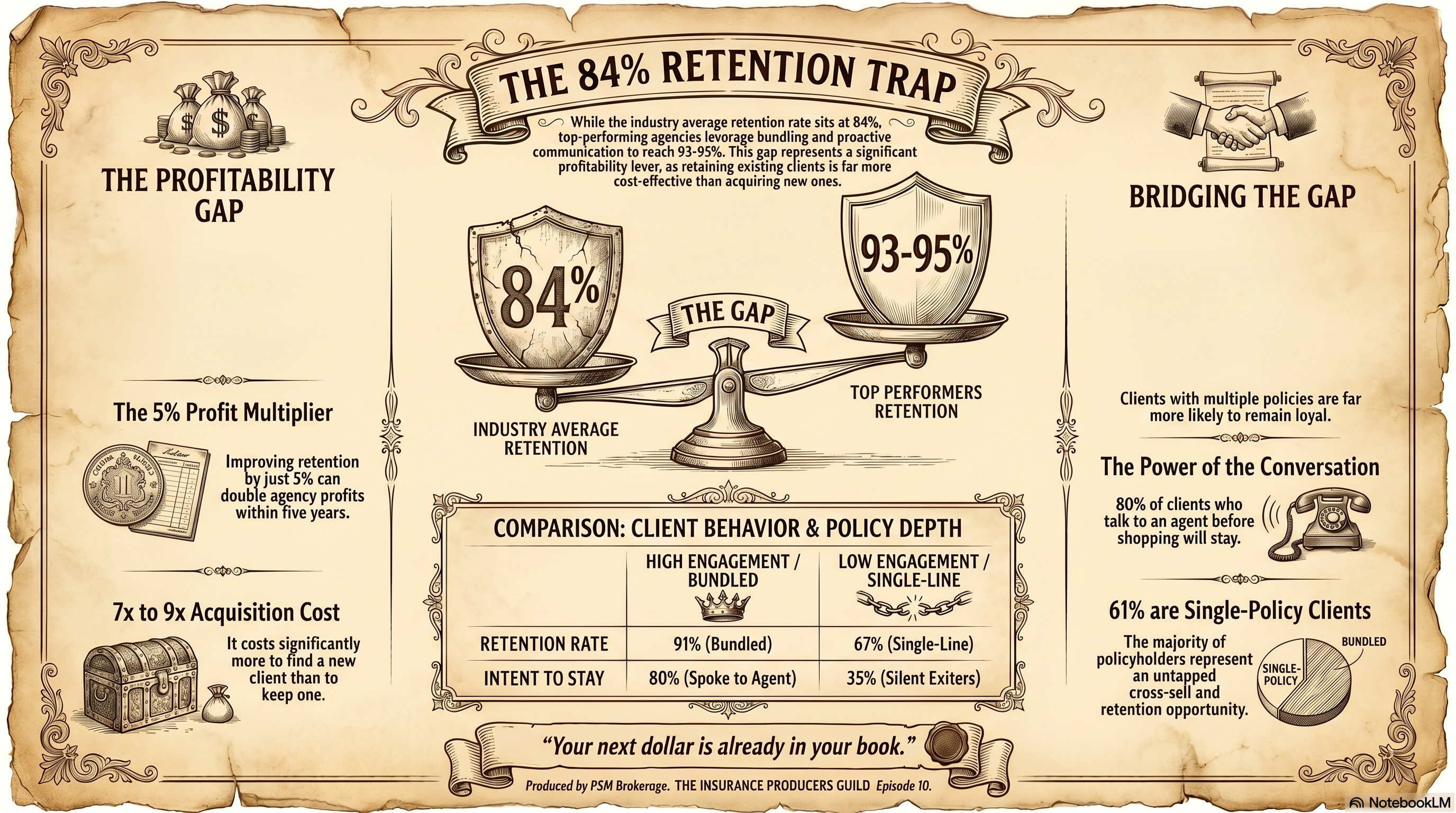
Most agencies retain about 84% of clients, while top performers reach 93–95%. That gap may seem small, but it can double profits over time. We explore why retention is often overlooked, why most clients leave without ever speaking to their agent, and how to fix it.
You’ll learn how to turn retention into a system using proactive annual reviews, cross-selling strategies, and referral workflows that strengthen both loyalty and growth.
🔑 Key Topics Covered
• Average vs. top-tier retention rates (84% vs. 93–95%)
• Why 65% of clients leave without contacting their agent
• How annual reviews improve retention (80% vs. 65%)
• Cross-sell opportunities (61% of clients only have one policy)
• Bundling impact (91% retention vs. 67%)
• Referral workflows that drive 92% retention
🎯 What This Means for Agents
• Retention is one of the fastest ways to increase profitability
• Annual reviews should be a consistent, proactive process
• Cross-selling strengthens both revenue and client loyalty
• Bundled clients stay longer and are more valuable
• Referral systems can boost both retention and new business
• Systemizing retention beats relying on reactive service
Infographic: https://www.psmbrokerage.com/hubfs/The%20Insurance%20Producers%20Guild/IPG_EP10_Infographic.png
Slides: https://www.psmbrokerage.com/hubfs/The%20Insurance%20Producers%20Guild/IPG_EP10_Slides.pdf
🔗 Sources
• PIA Southern Alliance
• Gitnux Insurance Retention Report
• Nationwide Agency Forward
The Insurance Producers Guild Podcast delivers intelligence for insurance agents looking to stay ahead of industry trends.
Follow the show and connect with PSM Brokerage to access tools, training, and support designed to help you grow your business.
Learn more: https://www.psmbrokerage.com
I mean, imagine you spend, I do know, $500 acquiring a new Medicare client. You know, you buy the lead, you make the calls.
SPEAKER_00Right. You do the paperwork, you shake their hand, you just celebrate the win. You think you have that client for life.
SPEAKER_01Exactly. But then uh three years later, they get a glossy flyer in the mail from a competitor and they just switch. Just like that.
SPEAKER_00Aaron Powell Yeah. And they never even called you to ask if you could match it or you know, review their options.
SPEAKER_01Nope. And why? Well, because you never called them. You think you are losing your clients to the guy down the street, but you are not losing your clients to competitors, you are losing them to silence.
SPEAKER_00Aaron Powell Most agents, uh, when they hear the word retention, they immediately tune out. They think they already have it handled, right? They assume their clients just love them.
SPEAKER_01Oh, I have been through this before. Over 25 years in this business, I have seen this exact pattern. We spend all our energy looking out the front door for new prospects.
SPEAKER_00Meanwhile, your most valuable assets are just quietly walking out the back door. We need to shatter that assumption right now.
SPEAKER_01Please do, because it is a massive blind spot.
SPEAKER_00Okay, so according to the professional insurance agents, Southern Alliance, 65% of clients who leave never even spoke to their agent first. They just disappear.
SPEAKER_01Wow. 65%? That is wild.
SPEAKER_00Right. You do not even get the chance to save the business because you are completely unaware the business is even at risk.
SPEAKER_01And that right there is the biggest revenue opportunity sitting in front of you today. Silence is incredibly expensive. But breaking that silence, that is highly profitable.
SPEAKER_00We are not just talking about keeping your numbers stable either. We are talking about the difference between scraping by and literally doubling your profit over the next five years.
SPEAKER_01So let us look at the baseline reality of agency operations right now. The average agency out there is retaining about 84% of their clients every year.
SPEAKER_00Which sounds acceptable to a lot of people until you look at the top performers.
SPEAKER_01Yeah, exactly. The top performing agencies are hitting 93 to 95% retention consistently. Now, if you are working specifically in life insurance or with seniors over 65%, your retention naturally sits a bit higher.
SPEAKER_00Right. The data shows those markets run around 91.3 to 91.5%.
SPEAKER_01Aaron Powell But that 84% average across the broader industry, I mean, it is a massive trap. I spent years aggressively chasing new leads. I bought lists, I did seminars.
SPEAKER_00And all the while your best clients were quietly walking out the back door.
SPEAKER_01Yes, because I simply was not paying attention to them. It is like spending your entire budget buying expensive water just to pour it into a bucket with a hole in the bottom.
SPEAKER_00We really have to break down the math on this because the financial impact of that leaky bucket is just staggering. It costs seven to nine times more to acquire a new customer than it does to keep an existing one.
SPEAKER_01Seven to nine times. That is a huge margin.
SPEAKER_00Exactly. Think about the capital, the time, the energy you spend on marketing. You have the cost of the lead, the gas money, the hour at the kitchen table. All of that is a front-loaded cost.
SPEAKER_01Right. Your profit margin in year one is incredibly thin. You might even be taking a loss.
SPEAKER_00Yeah, but a typical client lifetime value runs $15,000 to $25,000 in premiums. And here is the critical part. Earning a client's loyalty for five years generates nearly three times more profit than a first-year client.
SPEAKER_01Three times the profit just for keeping them in your book. Because in year two and year three, those renewal commissions are almost pure profit.
SPEAKER_00Exactly. The acquisition cost has dropped to zero. So every time a client leaves in year two, the cost of acquiring them basically ate your entire margin.
SPEAKER_01You did all the heavy lifting for just a fraction of the payoff.
SPEAKER_00Which brings us to the concept of compound retention. If you close that gap between the 84% average and the 93% top performers, you are keeping clients in those high margin years.
SPEAKER_01And that is how you literally double your profit. It is just the mathematical reality of keeping the back door closed.
SPEAKER_00Yeah. Your next sale is sitting in your book right now. You do not need to buy another lead to find them.
SPEAKER_01And this is exactly why agents using PSM brokerage are hitting those higher retention numbers. The PSM system literally flags the retention risks for you, so you are not guessing who needs a call. They give you the retention tools and the cross-cell resources to plug the leaks.
SPEAKER_00Because, you know, you cannot fix a leak if you do not have the right tools in your hands. Finding out who to call first is half the battle.
SPEAKER_01So, okay, we know who to call. We know silence causes churn. The logical solution is to break that silence, right? Right.
SPEAKER_00We need to look at the structural risk in your book of business right now.
SPEAKER_01According to nationwide data, 61% of policyholders have only one policy with their agent.
SPEAKER_00Aaron Powell Wait, over 60%? That is huge.
SPEAKER_01It is. Over 60% of your book relies on a single thread. Only 29% have two policies, and a mere 10% have three or more.
SPEAKER_00And every single one of those single policy clients is a massive retention risk.
SPEAKER_01Aaron Powell Exactly. But they are also a massive cross-sell opportunity for Medicare, life, annuities, or ancillary products. We need to explain why that single policy client is such a high risk in the first place.
SPEAKER_00Well, because to them, you are not really an advisor. You are just a utility bill. You are a line item on their bank statement. If they find a cheaper utility, they just switch.
SPEAKER_01Yeah, they do not feel a real relationship with you.
SPEAKER_00Right. But when you bundle their coverage, when you handle their Medicare and their life insurance, or maybe their Medicare and a dental plan, you become an advisor. The numbers completely prove it out.
SPEAKER_01Oh, they definitely do. Bundled clients retain at 91%. Compare that to 67% for single-line policies.
SPEAKER_00That is a 24-point gap in retention, just from having a second conversation. It is crazy.
SPEAKER_01And implementing a formal renewal review program makes retention jump 1.5 to two points within just six months. A staggering 80% of clients who talk to an agent before shopping around will stay. Okay, so how do we do it? Because I know agents are thinking if I call out of the blue, the client thinks I'm just trying to sell them something.
SPEAKER_00Right. The walls go up instantly. So here is the exact word-for-word script you should use to get past that defense. You pick up the phone and say, Hey, John, I do a quick coverage check with all my clients once a year. Takes 10 minutes. I want to make sure nothing has changed and you are not overpaying anywhere. Homeworks for you.
SPEAKER_01Oh, I like that. You are lowering their resistance immediately by focusing entirely on their benefit.
SPEAKER_00Exactly. You mentioned it takes 10 minutes, which respects their time. And you mentioned making sure they are not overpaying, which triggers their desire to save money.
SPEAKER_01You frame it as a routine administrative task, not a targeted sales pitch.
SPEAKER_00Yeah. Once you are on that call, your focus shifts to life changes. Did they retire? Did they get married? Did a spouse pass away?
SPEAKER_01Those events naturally trigger the need for a review of their Medicare options, their life insurance, or maybe an annuity to protect their retirement savings.
SPEAKER_00Right. You are basically doing them a disservice if you are not asking these questions. The life event is the catalyst, not some hard sales push.
SPEAKER_01That makes perfect sense. And reaching out across different channels matters tremendously as well, right? Multi-channel support raises senior retention by 26%.
SPEAKER_00Yeah, you cannot rely on just one method. People consume information differently, especially in the senior market. An email might go to spam, a phone call gets screened, but a physical letter sits right on their kitchen counter.
SPEAKER_01You definitely need a comprehensive approach. And just to make this easy, PSM provides plug-and-play annual review templates to make this entire process totally frictionless.
SPEAKER_00They give you the emails, the call scripts, and the letters.
SPEAKER_01Yeah.
SPEAKER_00You are not staring at a blank screen trying to figure out what to say. You just execute the system.
SPEAKER_01So, okay. We have the client on the phone. We have done the review. We verified their Medicare plan is still the best fit, or we updated their life insurance, we plugged the leak.
SPEAKER_00But that annual review does not just lock in the current client, it acts as the primary engine for your highest quality new acquisition channel.
SPEAKER_01We are talking about referrals now, right?
SPEAKER_00Yes. This is where you transform your agency from a constant grind of buying expensive leads into a self-sustaining machine. The data from Limera shows that strong agent relationships reduce lapse rates by 40%.
SPEAKER_0140% is massive. But what happens when those strong relationships start working for you to get new clients?
SPEAKER_00That is the real magic. Referred customers retain at 92% versus 67% from other acquisition channels.
SPEAKER_01Referrals are not a favor. I need every agent to adopt this mindset. Referrals are not a favor someone is doing for you. They are the highest retention clients you will ever get.
SPEAKER_00Absolutely. They come into your book of business already trusting you because that trust transferred from their friend or family member.
SPEAKER_01But the problem is agents hate asking for referrals. They feel awkward. They feel like they are begging for leads after doing a good job.
SPEAKER_00That is because they are asking the wrong way. They make it sound like a desperate plea for business. You have to make the referral, ask an automatic, non-negotiable step in every single annual review.
SPEAKER_01So how do you phrase it without sounding desperate?
SPEAKER_00You frame it as a service. It happens right at the end of the conversation. After every annual review, you say, You mentioned your neighbor just retired. Would it help if I ran a quick comparison for them too?
SPEAKER_01Oh wow. That feels like a very natural extension of the help you just provided. You're not saying, hey, do you know anyone who wants to buy insurance?
SPEAKER_00Exactly. You are actively listening during the review for life events happening to people in their circle. You are just offering to solve a problem for someone they care about.
SPEAKER_01It is completely organic. You are just offering to extend your professional expertise.
SPEAKER_00And if you make this 10-second question a mandatory part of every annual review, your book will transform. You stop chasing cold leads, you start working entirely by warm introduction.
SPEAKER_01The clients you bring in will stay longer, buy more products, and refer even more people. It is a compounding loop of high-quality business.
SPEAKER_00Yeah. And as you scale this up, as you start bringing in more referrals and cross-selling more products, you have to make sure you are doing it safely. The regulatory environment around Medicare and life insurance is strict.
SPEAKER_01That is exactly why the PSM compliance team supports compliant referral workflows. They ensure agents can grow aggressively while following all regulations. You get the growth without the structural risk of doing something wrong.
SPEAKER_00Right. So before you spend another dollar trying to find a stranger to buy from you, look at your own client list. Ask yourself who is sitting in silence right now, just waiting for a reason to stay.
SPEAKER_01That is this episode of the Insurance Producers Guild. If you are not already with PSM Brokerage, this is the kind of actionable intelligence our agents get. Talk to us about contracting.