
The Insurance Producers Guild
The Insurance Producers Guild is a strategic briefing for insurance professionals, focused on Medicare, ACA, life insurance, and the evolving insurance landscape. Each episode distills complex industry changes into clear, practical intelligence.
AI was used in the making of these podcasts.
The Insurance Producers Guild
EP15 The Great Reshuffle - 4.8 Million Clients Up For Grabs
Use Left/Right to seek, Home/End to jump to start or end. Hold shift to jump forward or backward.
📝 Episode Description (Buzzsprout)
In this episode of The Insurance Producers Guild, we break down the major 2026 Medicare Advantage and Part D updates agents need to know.
CMS has finalized payment increases for Medicare Advantage plans while also introducing new operational guardrails affecting plan management, supplemental benefits, and prescription drug processes. We also review early 2026 plan design trends, including $0 premium availability and benefit changes that may shape client conversations heading into the next enrollment cycle.
🔑 Key Topics Covered
- 2026 Medicare Advantage payment increases and CMS rate updates
- New operational rules impacting plans, providers, and compliance
- Changes to supplemental benefits and Part D processes
- 2026 premium trends, $0 plans, and plan availability
🎯 What This Means for Agents
- Payment increases may support continued plan stability in many markets
- Compliance, documentation, and client education remain critical
- Benefit changes require clearer conversations around value and fit
- Agents who understand policy and product shifts can better guide clients
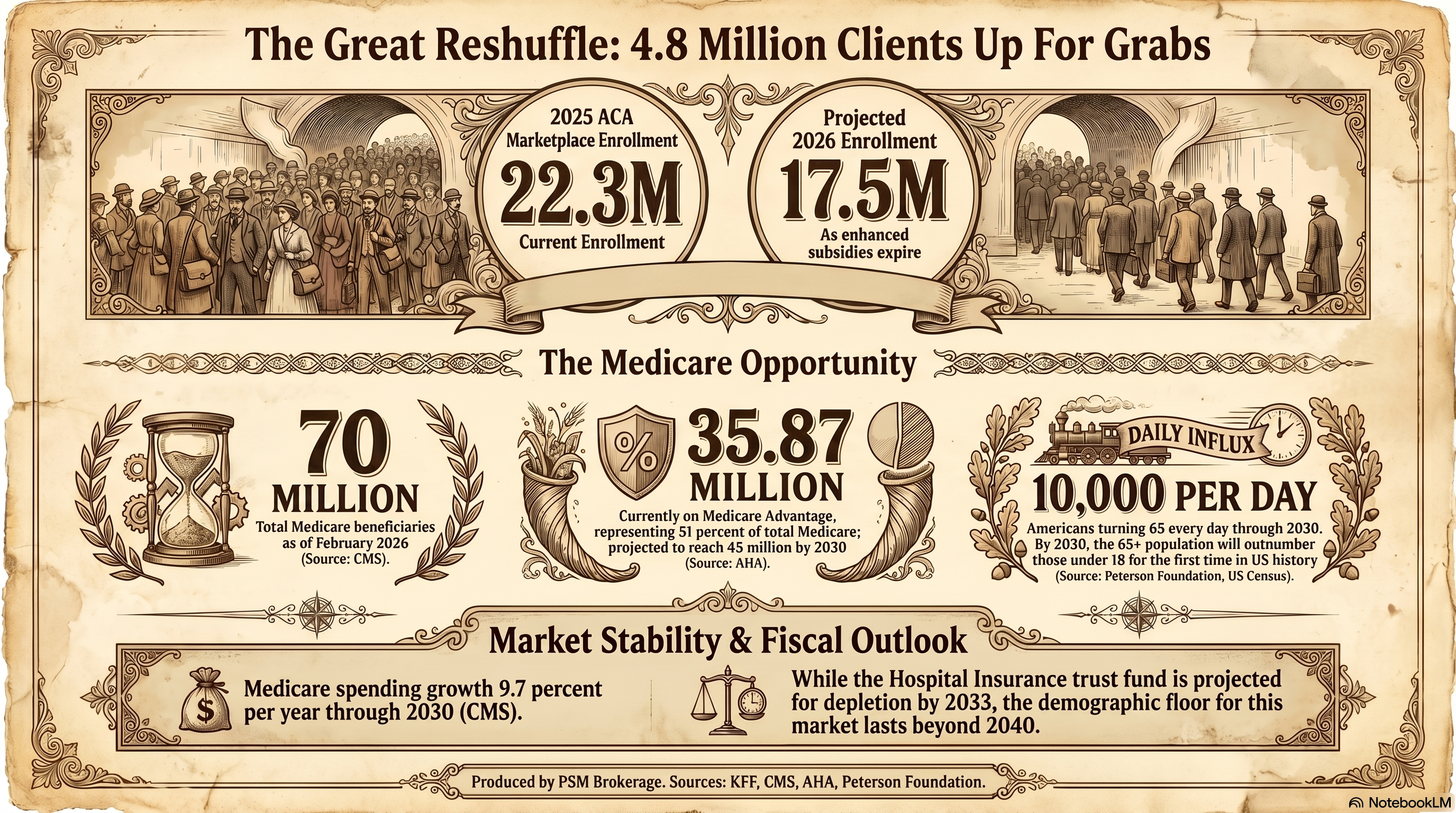
Infographic: https://www.psmbrokerage.com/hubfs/The%20Insurance%20Producers%20Guild/IPG_EP15_Infographic.png
Slides: https://www.psmbrokerage.com/hubfs/The%20Insurance%20Producers%20Guild/IPG_EP15_Slides.pdf
✅ Go-Do
Within the next 48 hours, pull two CRM lists and schedule follow-ups for next week:
- ACA clients above 300% FPL
Call to review their 2026 premium and deductible, then discuss Hospital Indemnity or Accident coverage as a gap-filling option. - Prospects turning 65 in the next 6–9 months
Build a 3-touch sequence: personal call, aging-in mailer, and Medicare planning follow-up. Run new messaging through compliance before sending.
The agents who start these conversations now will be best positioned to keep those households long term.
🔗 Sources
CMS 2026 Rate Announcement:
https://www.cms.gov/newsroom/press-releases/cms-finalizes-2026-payment-policy-updates-medicare-advantage-and-part-d-programs
CMS Contract Year 2026 Final Rule:
https://www.cms.gov/newsroom/fact-sheets/contract-year-2026-policy-and-technical-changes-medicare-advantage-program-medicare-prescription-final
KFF Medicare Advantage 2026 Spotlight:
https://www.kff.org/medicare/medicare-advantage-2026-spotlight-a-first-look-at-plan-premiums-and-benefits/
The Insurance Producers Guild Podcast delivers intelligence for insurance agents looking to stay ahead of industry trends.
Follow the show and connect with PSM Brokerage to access tools, training, and support designed to help you grow your business.
Learn more: https://www.psmbrokerage.com
Imagine sitting across the kitchen table from a couple you have worked with for years. They just opened the renewal notice.
SPEAKER_01Oh man, I know exactly where this is going.
SPEAKER_00Right. They find out their health insurance premium just jumped 58% overnight.
SPEAKER_01Yeah. And they are angry.
SPEAKER_00Exactly. They are ready to drop their coverage entirely. And suddenly your commission is on the line.
SPEAKER_01Yep.
SPEAKER_00Right now, across the industry, independent agents are looking at these headlines. Millions of people leaving the ACA marketplaces, and they are feeling a very specific type of anxiety.
SPEAKER_01Aaron Powell The immediate reaction is fear. It really is.
SPEAKER_00Aaron Powell It feels like your book of business might just shrink right in front of your eyes.
SPEAKER_01Aaron Powell Look, I understand that fear. I mean when you see projections of 4.8 million people dropping coverage, it sounds terrifying. It does. But you know, I have been doing this for over 25 years. I saw the market before the Affordable Care Act. I navigated the initial rollout.
SPEAKER_00Aaron Powell So you have seen this pattern before.
SPEAKER_01Exactly. We are not looking at a shrinking market right now. We are looking at a reshuffling market.
SPEAKER_00A reshuffling market.
SPEAKER_01Okay. Yeah. What the headlines are calling a crisis is actually it is the biggest opportunity window we have seen in a generation.
SPEAKER_00Aaron Powell Well, I want to see what you are seeing because sitting at that kitchen table feels incredibly volatile right now.
SPEAKER_01Absolutely. It is volatile if you do not know the play.
SPEAKER_00So for this deep dive, we need to break down the reality of this 2026 ACA exit. We need to look at the massive Medicare floor that is catching this transition. Right. And we need to go over the exact scripts and strategies we can use to just own the next decade.
SPEAKER_01I love it. Because to understand how to position your book of business, you first have to grasp the mechanics of the disruption.
SPEAKER_00Right, in the under 65 market.
SPEAKER_01Exactly. So the Kaiser Family Foundation just released their 2026 data. And we knew this was coming. The enhanced premium tax credits from 2021 were expiring at the end of 2025.
SPEAKER_00And now we are seeing the structural fallout of that expiration.
SPEAKER_01We really are. Plan signups fell from 22.3 million in 2025 down to an expected enrollment of around 17.5 million in 2026.
SPEAKER_00Which is just a massive drop. Wakeley Consulting Group actually estimates a potential drop of up to 4.8 million people.
SPEAKER_01It is huge.
SPEAKER_00And the cost burden is where that kitchen table conversation gets so difficult. Premium payments rose by an average of 58% across all consumers. Yeah, that hurts. We went from an average of $113 to $178 per month. Plus, the average ACA marketplace deductibles increased by over $1,000 per person. Right. They hit a record $3,786 in 2026.
SPEAKER_01See, that deductible number is the critical part. This is a multi-year structural change.
SPEAKER_00But um, I have to ask a basic question here. I am looking at these numbers and I am honestly a bit confused about the consumer behavior.
SPEAKER_01What do you mean?
SPEAKER_00Well, if someone actually needs health insurance, why walk away completely over a premium bump? I mean, shouldn't they just adjust their budget and pay the difference to keep the coverage?
SPEAKER_01You have to look at the mechanics of the subsidy cliff to understand why they literally cannot just pay the difference. Think of it like uh waiting in a swimming pool. You were in the shallow end and you are comfortably supported by the water.
SPEAKER_00Right. And the water represents the enhanced subsidies.
SPEAKER_01Exactly. Those subsidies capped premiums at 8.5% of your household income, regardless of how much you made. But when those expired, the old rules came back.
SPEAKER_00So the floor drops out.
SPEAKER_01Completely. If your income goes even one single dollar over 400% of the federal poverty level, you step off the ledge into the deep end. You lose all subsidy support instantly.
SPEAKER_00Oh wow. So it is not a gradual increase at all.
SPEAKER_01No, not at all. They are suddenly paying the full unsubsidized sticker price of the plan.
SPEAKER_00That is jarring.
SPEAKER_01The data shows the brutal impact of that sudden drop-off. Consumers sitting above that 400% cliff made up only 7% of the total 2025 enrollment.
SPEAKER_00Okay, 7%.
SPEAKER_01Yet they accounted for 48% of the total decline in planned selections for 2026.
SPEAKER_00Wait, really? Almost half the decline came from that tiny group.
SPEAKER_01Yeah. Signups for people in that specific 400 to 500% ban fell by 44%. Over 321,000 people in that bracket just walked away.
SPEAKER_00Because these are people making a decent living, but the true cost of health care suddenly became equivalent to a car payment or even a mortgage. Exactly. So how do we handle this when we are face to face with them? They are staring at a massive premium hike and a $3,786 deductible. They are frustrated, and they are blaming the insurance companies.
SPEAKER_01Well, first, you never blame the carriers. Right. The carriers are simply adjusting their pricing to match the new legislative reality without federal support. Instead, you have to separate the emotional shock of the price from the logical necessity of the coverage.
SPEAKER_00Okay, so what do you actually say?
SPEAKER_01You look them right in the eye and say, your subsidy changed, but your medical risk did not.
SPEAKER_00Oh, I like that approach. Your subsidy changed, but your medical risk did not. It acknowledges the financial pain while reminding them why they bought the policy in the first place.
SPEAKER_01Exactly. Then you solve the structural problem. Well, the Kaiser Family Foundation data shows a massive migration to bronze plans. People are taking on more out-of-pocket exposure just to lower their monthly premiums.
SPEAKER_00Right. The share of people selecting bronze plans rose from 30% to 40%.
SPEAKER_01So you frame that $3,786 deductible not as a crisis, but as a solvable gap. You step in and position hospital indemnity and accident plans to bridge that exact deductible.
SPEAKER_00Okay. So you protect their downside while keeping their core coverage intact. Let us walk through how that actually works in practice. A client moves to a bronze plan to save on the monthly premium, but now they have this nearly $4,000 exposure if they end up in the hospital. Trevor Burrus, Jr.
SPEAKER_01Yep. A massive gap.
SPEAKER_00So by selling them a hospital indemnity plan, you are creating a payout mechanism. If they are admitted, the indemnity plan pays them directly, and they use those funds to satisfy the ACA deductible. Trevor Burrus, Jr.
SPEAKER_01You are building a custom health care package, and honestly, it functions better than a standalone, highly priced silver or gold plan.
SPEAKER_00Aaron Powell You secure their physical health with the core ACA plan, and you secure their financial health with the ancillary product.
SPEAKER_01That is exactly the play.
SPEAKER_00Okay. That handles the immediate ACA panic. But um building a business purely on bridging deductibles in a volatile market sounds a bit exhausting.
SPEAKER_01It would be.
SPEAKER_00So where do we find long-term stability amidst all this reshuffling?
SPEAKER_01Aaron Powell You look just over the horizon to the over 65 market.
SPEAKER_00Ah, okay.
SPEAKER_01Those clients leaving the ACA or aging out of the workforce, they need a secure place to land. And that landing pad is Medicare.
SPEAKER_00And the numbers there are staggering. The February 2026 CMS data reveals a monumental milestone. Total Medicare beneficiaries just broke 70 million.
SPEAKER_0170 million people. It is incredible.
SPEAKER_00The makeup of that group is shifting dramatically, though, isn't it?
SPEAKER_01It is a completely different landscape than it was a decade ago. Medicare Advantage is now sitting at 35.87 million enrollees.
SPEAKER_00That is over 51% of the total market.
SPEAKER_01Yeah, it is no longer an alternative option. It is the default choice for new Medicare enrollees. Wow. Let me give you some historical context. In 1986, Medicare Advantage covered only 2.8% of total Medicare enrollment.
SPEAKER_00Just 2.8%.
SPEAKER_01Right. By 2010, when the ACA passed, it was around one in four enrollees. Now the American Hospital Association project's MA enrollment will hit approximately 45 million by 2030.
SPEAKER_00Roughly 10% of the entire United States population will depend on Medicare Advantage within four years. The scale of that is just hard to comprehend.
SPEAKER_01The base market just keeps expanding. I mean, we have 10,000 Americans turning 65 every single day through 2030.
SPEAKER_0010,000 a day.
SPEAKER_01In 25 plus years, I have never seen a client base this large growing this consistently. It provides a demographic certainty that the under 65 market simply does not have right now.
SPEAKER_00So if 10,000 people are aging in every day, how do we get in front of them before they make a decision?
SPEAKER_01That is the real challenge.
SPEAKER_00Because I know from experience that if you wait for them to turn 65, you are already way too late. Their mailbox has been full of marketing materials for months.
SPEAKER_01Oh, absolutely. You have to start the conversation six months before they turn 65.
SPEAKER_00Okay. What is the approach?
SPEAKER_01You use a very specific referral script with your current clients. You ask them, who else do you know turning 65 who is overwhelmed by this massive stack of mail?
SPEAKER_00That hits the exact pain point perfectly.
SPEAKER_01It really does.
SPEAKER_00Because every person turning 65 is completely overwhelmed by the confusion of the process. Carrier brochures, federal guides, supplement comparisons, it literally looks like a phone book.
SPEAKER_01Yeah. They are drowning in paper. You are offering to be their guide through that chaos. And once you guide them, then your focus has to shift entirely to retention and cross-selling. Like if a client chooses a Medicare supplement instead of Advantage, MedSup Persistency remains the strongest retention product available.
SPEAKER_00Let us unpack why MedSup Persistency is so strong. Once a senior passes medical underwriting and secures a supplement, they rarely switch.
SPEAKER_01Almost never.
SPEAKER_00Because they know their medical conditions might prevent them from getting approved elsewhere. It essentially anchors them to your agency for life.
SPEAKER_01Exactly. And then you use this aging in wave to cross-sell final expense and fixed annuities for longevity protection.
SPEAKER_00So you are securing their health costs, covering their final expenses, and ensuring they do not outlive their income.
SPEAKER_01You elevate yourself from an insurance salesperson to a retirement architect.
SPEAKER_00I love that. But um doing this manually for a large book of business is a logistical nightmare.
SPEAKER_01Oh, it is impossible.
SPEAKER_00Tracking birthdays, sending the right mailers at the six-month mark, following up. It is way too much to juggle while also putting out fires in the ACA market.
SPEAKER_01Which is exactly why you have to automate your prospecting. If you are going after the aging wave, utilizing tools like the PSM Brokerage Marketing Hub makes a massive difference.
SPEAKER_00Okay, so you automate it.
SPEAKER_01Yeah, you can automate and deploy those aging and mailers efficiently. You consistently put your message in front of prospects while you focus on the actual advising and selling.
SPEAKER_00Okay, so we have a strategy to bridge the ACA deductibles today, and we have a system to capture the Medicare wave over the next few months.
SPEAKER_01Right.
SPEAKER_00I want to pull the lens back even further. What happens when we look two, three, or even five years down the road?
SPEAKER_01Well, we are looking at a permanent structural shift in the United States economy.
SPEAKER_00How so?
SPEAKER_01The Peter G. Peterson Foundation report lays it out very clearly. By 2030, for the first time in U.S. history, Americans 65 and older will outnumber those under 18.
SPEAKER_00The economic balance of the country is completely inverting.
SPEAKER_01Exactly. It changes the entire funding mechanism of the system. Look, in 1965, there were 4.0 workers for every Social Security beneficiary.
SPEAKER_00Okay.
SPEAKER_01The Social Security Administration projects that the worker to beneficiary ratio is collapsing toward 2.2 by 2045.
SPEAKER_00Wow, that is a huge drop.
SPEAKER_01And as a direct result, the Medicare Hospital Insurance Trust Fund is projected to be depleted by 2033.
SPEAKER_00You know, I hear agents panic over this trust fund depletion all the time.
SPEAKER_01Oh, constantly.
SPEAKER_00Clients read these headlines about automatic payment reductions and trust funds running dry. And they just assume the whole system is collapsing.
SPEAKER_01Yeah, they panic.
SPEAKER_00And I honestly struggle with how to frame this without sounding like an alarmist. Like, if the trust fund is depleting, why wouldn't the government just raise taxes? Why does it automatically mean the consumer pays more?
SPEAKER_01Look, the fear is natural, but you have to understand the mechanics of what depletion actually means.
SPEAKER_00Okay, break it down.
SPEAKER_01Even if legislative action occurs, the math dictates a change in structure. Without action, a depleted trust fund would trigger an 11% reduction in payments for inpatient and skilled nursing services.
SPEAKER_00And the government does not just close up shop.
SPEAKER_01Right. When hospitals face an 11% reduction in federal payments, they have to make up that revenue somewhere else.
SPEAKER_00So the rising fiscal pressure simply means the cost burden shifts from the federal level down to the private market and ultimately to the consumer.
SPEAKER_01Exactly. As the government covers less of the bill, the individual is forced to cover more out of pocket, either through higher copays or increased premiums for supplemental coverage.
SPEAKER_00And when that cost burden shifts, private supplemental coverage, life insurance, and annuities become structurally more valuable.
SPEAKER_01It is no longer a luxury to have a robust supplemental plan or a fixed annuity. It becomes a mandatory survival mechanism for their retirement.
SPEAKER_00That makes total sense.
SPEAKER_01We have a permanently larger senior population facing rising healthcare costs per enrollee. We are entering a multi-decade window where private solutions are their only defense against longevity risk.
SPEAKER_00So the mission for an independent agent right now is to just build a fortress around Medicare, life, and ancillary products. Yep. You want to make sure your clients have every single gap covered.
SPEAKER_01And you take those cross-cell scripts we discussed and you lock them in. But before you deploy them at scale, you run them through PSM, brokerage compliance, and legal review.
SPEAKER_00That is crucial. The regulatory environment is incredibly strict right now.
SPEAKER_01Very strict. Your messaging has to be bulletproof and totally compliant. Compliance is not a hurdle, it is your shield.
SPEAKER_00But you also need the right tools in your bag. I mean, there's no point having a perfect script if you cannot actually write the policy.
SPEAKER_01Exactly. Agents need to review their current carrier alignments today.
SPEAKER_00Do they actually have the right medsup, MA, hospital indemnity, and annuity contracts to offer a complete solution?
SPEAKER_01So you use PSM brokerage contracting support to get fully aligned. You need the exact portfolio required to handle a client who is losing their ACA subsidy today, transitioning to Medicare tomorrow, and terrified about living their money next year.
SPEAKER_00Because the ACA volatility and the Medicare expansion are not isolated events.
SPEAKER_01No, not at all.
SPEAKER_00They are the exact same timeline for your client. The client dropping their ACA plan because of the subsidy cliff is the exact same person who will need Medicare guidance very soon.
SPEAKER_01Exactly. If we solve their deductible pain with an indemnity plan right now, we earn the right to handle their Medicare enrollment later.
SPEAKER_00That is the pattern recognition we really need.
SPEAKER_01But it requires discipline to see that pattern. You have to stop reacting to the daily news cycle and start building processes.
SPEAKER_00Right.
SPEAKER_01Because the 10,000 people turning 65 today, they do not care about trust fund depletion mechanics or KFF data. They care about their personal security.
SPEAKER_00They are asking how to pay for a hospital stay, how to protect their spouse, and how to guarantee their income.
SPEAKER_01And every single one of those questions is answered by the portfolio we just built.
SPEAKER_00The market is handing agents a historic wealth transfer. The professionals who figure out how to bridge the gap between ACA coverage losses and Medicare gains today are the ones who will completely own the next 20 years of this industry. That's this episode of the Insurance Producers Guild. Stay tuned for the next episode. If you're not already with PSM Brokerage, this is the kind of actionable intelligence our agents get. Talk to us about contracting.