
The Insurance Producers Guild
The Insurance Producers Guild is a strategic briefing for insurance professionals, focused on Medicare, ACA, life insurance, and the evolving insurance landscape. Each episode distills complex industry changes into clear, practical intelligence.
The Insurance Producers Guild
EP19 2027 Medicare Rules - Faster Sales, More Liability
Use Left/Right to seek, Home/End to jump to start or end. Hold shift to jump forward or backward.
CMS’s 2027 Medicare Final Rule removes the 48-hour Scope of Appointment waiting period and the 12-hour educational-to-sales gap beginning October 1, 2026. Updated TPMO disclaimer timing also gives agents more flexibility when opening conversations.
Faster sales create greater individual accountability. Marketing and sales call retention drops to six years, while enrollment records remain subject to longer retention requirements. Agents must classify mixed calls correctly, document every lead source, and retain marketing created by vendors.
In Episode 19 we explain the new workflow, client language, recordkeeping risks, and practical steps agents should complete before AEP.
🔑 Key Topics Covered
- Same-day Scope of Appointment workflow
- Revised TPMO disclaimer timing
- Split call-retention requirements
- Vendor and lead-source accountability
🎯 What This Means for Agents
- Faster appointments require disciplined documentation
- Mixed calls need accurate retention classification
- Agents remain responsible for purchased leads
- Vendor marketing belongs in your compliance file
🔗 Sources
Federal Register
https://www.federalregister.gov/documents/2026/04/06/2026-06600/
CMS
https://www.cms.gov/newsroom/fact-sheets/contract-year-2027-medicare-advantage-part-d-final-rule
Electronic Code of Federal Regulations
https://www.ecfr.gov/current/title-45/subtitle-A/subchapter-B/part-155/subpart-C/section-155.220
📌 GO-DO: Build Your Compliance Defense File
Create one retrievable compliance folder within 48 hours. Add current Scope of Appointment procedures, call-recording scripts, retention instructions, lead-source documentation, landing pages, forms, emails, and sales scripts. Label each item by owner, vendor, effective date, and required retention period, then submit questionable materials for compliance review.
Infographic: https://www.psmbrokerage.com/hubfs/The%20Insurance%20Producers%20Guild/IPG_EP19_Infographic.png
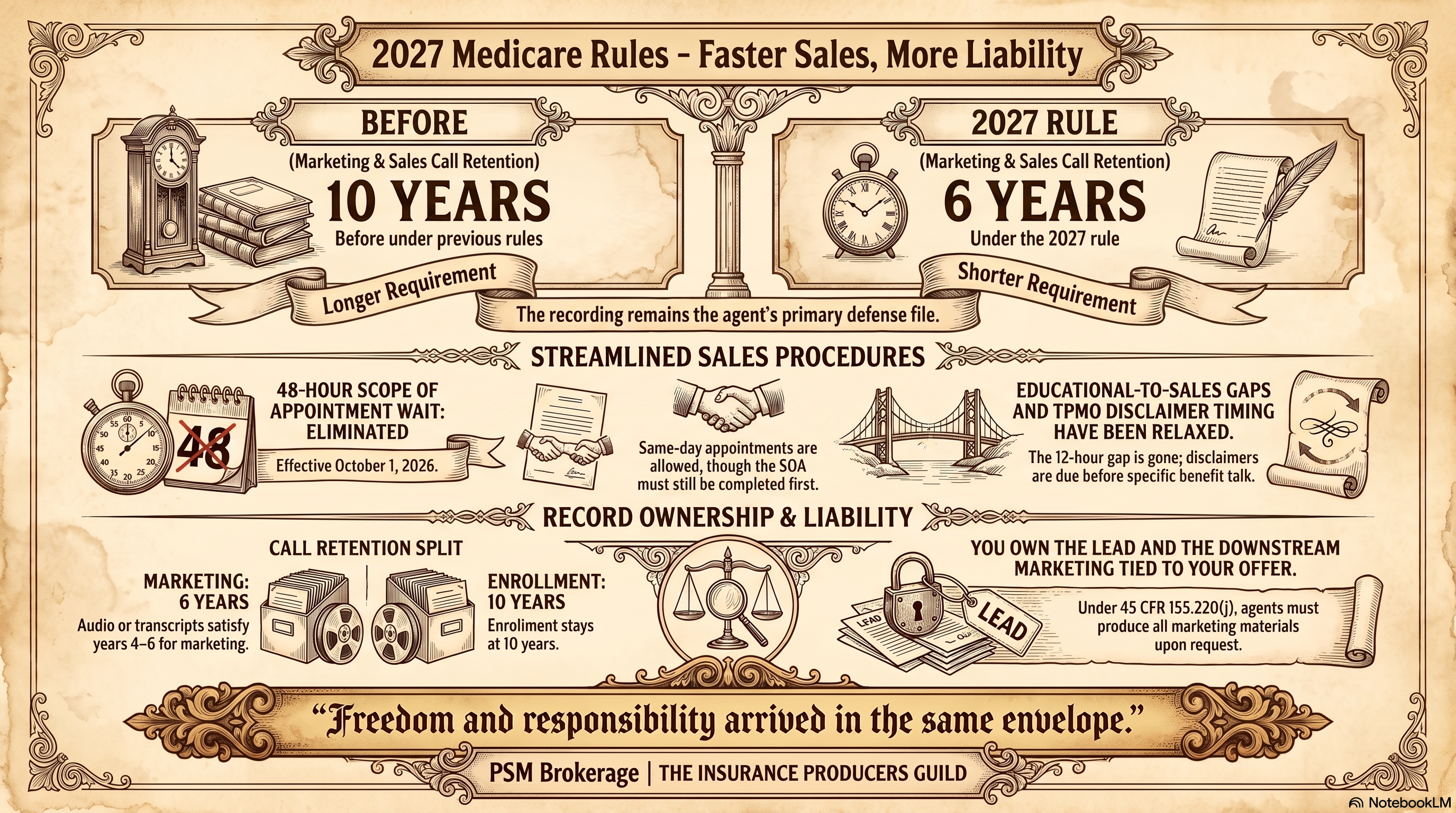
Slides: https://www.psmbrokerage.com/hubfs/The%20Insurance%20Producers%20Guild/IPG_EP19_Slides.pdf
The Insurance Producers Guild Podcast delivers intelligence for insurance agents looking to stay ahead of industry trends.
Follow the show and connect with PSM Brokerage to access tools, training, and support designed to help you grow your business.
Learn more: https://www.psmbrokerage.com
I know exactly what your biggest fear is right now. You are sitting at your desk looking at the changing regulatory landscape, and you have this uh this heavy pervasive worry sitting right on your chest.
SPEAKER_00Oh, absolutely. I hear it from agents every single day.
SPEAKER_01Right. Because the rules just changed. And, you know, you are terrified that getting it wrong on like one single complaint or one random audit could put your license and your whole book of business at absolute risk.
SPEAKER_00Yeah, but that is exactly what we need to reframe today because, well, it is a massive misconception. The rules actually got easier, not harder.
SPEAKER_01Exactly. Our mission for this analysis is to break down the 2027 rule book for independent agents. We are going to uncover what you must do right now to leverage these new freedoms while keeping your business entirely protected.
SPEAKER_00Aaron Powell I love that. Freedom to use, you know, not a trap to fall into. The agent who understands where the new boundaries are drawn is going to operate much faster and honestly much safer.
SPEAKER_01And as someone who has been in the Medicare and life space for over 25 years, I look for patterns. The pattern here is that the regulatory procedures got lighter, but the accountability moved entirely to the individual agent.
SPEAKER_00Yeah. And coming from my background, you know, starting out knocking on doors to now running a multi-line agency focusing on closing techniques, I look at how we can monetize this today. We need to apply this urgency to your immediate sales.
SPEAKER_01So let us get into the actual text. This hits on October 1st, 2026.
SPEAKER_00Right before AEP.
SPEAKER_01Exactly, right before AEP. And the most massive shift here is the total elimination of the 48-hour scope of appointment weight.
SPEAKER_00It is huge. I mean, think about the old friction. You would have a senior call you completely stressed out about a notice in the mail, ready to buy, and you had to basically tell them, uh, sorry, I cannot legally help you for two full days.
SPEAKER_01It was terrible for momentum. And honestly, it delayed care for consumers who needed immediate help. But under the 2027 rules, that weight is gone. You can collect the SOA and hold the appointment on the exact same day.
SPEAKER_00Which completely changes the game. When a client has the intent to buy, you do not have to artificially stall the relationship anymore. You capture that momentum instantly.
SPEAKER_01And this speed applies to educational events now, too.
SPEAKER_00Yes, it does. So previously there was that mandatory 12-hour gap. Right. You had to wait between hosting a Medicare 101 seminar and actually having a sales conversation with an attendee.
SPEAKER_01Which was so awkward.
SPEAKER_00Extremely awkward. But that gap is gone now. You can transition directly from the educational session into a sales conversation right there on the spot.
SPEAKER_01Wow. So no more sending people away just to call them the next morning.
SPEAKER_00Exactly. You just have to inform the attendees that the switch is happening and you know, give them a chance to leave the room if they do not want to be part of the sales portion. And you can legally collect the scope of appointment forms right there at the event.
SPEAKER_01Okay. So the pattern is speed, but we also have to talk about the TPMO disclaimer, because that was another massive roadblock to just having a normal human conversation.
SPEAKER_00Oh, the 60-second rule, it was a nightmare for building rapport.
SPEAKER_01Right. You had to read this robotic, legally mandated script in the very first minute of the call.
SPEAKER_00Yeah. Imagine you are a 72-year-old consumer. You answer the phone, and before the agent even asks how your day is, they start reciting a 35-word legal disclaimer. I mean, defenses go up instantly. It sounds like a robocall.
SPEAKER_01So how does the 2027 rule fix that specific issue?
SPEAKER_00Well, the disclaimer is no longer bound to the first 60 seconds. It is now only due before you start discussing specific plan benefits.
SPEAKER_01Oh, that is a huge relief.
SPEAKER_00It really is. It restores your ability to actually act like a human being. You know, you asked about their family, establish their needs, build trust, and then right as you pivot to plan details, you just drop the disclaimer in naturally.
SPEAKER_01Okay, but here is the pattern I need every agent listening to recognize. The process gay faster, yes. But the scope of appointment is still a non-negotiable requirement. Always.
SPEAKER_00Absolutely.
SPEAKER_01You have to use this same-day speed to your advantage, but you must never, ever skip getting that form signed before you get into plan-specific talk. Speed is a liability if you abandon the compliance steps.
SPEAKER_00I could not agree more. And uh, if you are working with an infrastructure like PSM brokerage, their training programs actually cover this exact updated SOA and disclaimer workflow.
SPEAKER_01Right, which makes it a habit.
SPEAKER_00Exactly. You learn to integrate the speed smoothly into your daily routine without missing a beat.
SPEAKER_01So that brings us to a very logical pivot. We know how to generate the business faster, but we had to transition to defending it. Selling faster means nothing if you cannot protect those commissions.
SPEAKER_00Yeah, the recording is your armor.
SPEAKER_01CMS cut the retention requirement for marketing and sales calls, right? Yeah. It went from 10 years down to a minimum of six years.
SPEAKER_00Yes. So for years one through three, you need the actual audio. For years four through six, you can keep the audio, or you can have a precise written transcript.
SPEAKER_01But there is a trap there, isn't there?
SPEAKER_00A huge trap. Because enrollment records and scope of appointment records remain on a strict tenure track.
SPEAKER_01Okay, so think about how a normal call flows. You might start with a sales presentation, which falls under the six-year rule, but then the client says yes, and that exact same phone call turns into an enrollment.
SPEAKER_00Exactly. And because that single continuous call contains enrollment activity or a verbal SOA, the entire mixed call defaults to the strict 10-year standard.
SPEAKER_01Wow. So you have to classify these mixed calls incredibly carefully in your CRM.
SPEAKER_00You do, because if an auditor asked for an enrollment record from seven years ago and you deleted it because you thought the whole file was just a sales call under the six-year rule, you are in major trouble.
SPEAKER_01And just to clarify, every marketing and sales call still requires recording. Even the audio from video meetings like Zoom, that requirement did not go away.
SPEAKER_00Not at all.
SPEAKER_01Only the retention timeline changed. And this is where we have to shift the agent mindset. So many agents view recording as this annoying compliance box. But as a veteran in this industry, I tell agents constantly, it is your personal defense file.
SPEAKER_00It is your armor.
SPEAKER_01Exactly. When a complaint lands, say an adult child gets mad that their parents switch plans and they claim you misled them. Without a recording, you lose that battle. You lose your license.
SPEAKER_00Yeah, it is your word against theirs.
SPEAKER_01But if you have a clean, dated recording, proving you explained the network limitations perfectly, that recording protects your commission.
SPEAKER_00Which is why you have to stop apologizing to clients for recording them. You know, compliance actually builds trust if you frame it right.
SPEAKER_01Okay, so you are the closing specialist. Give me the word-for-word script. What do you say to the client?
SPEAKER_00I use this every time. I say I record our calls and keep them on file. That protects you and it protects me, so we both always have the exact record of what we agreed to.
SPEAKER_01I record our calls and keep them on file. That protects you and it protects me, so we both always have the exact record of what we agreed to.
SPEAKER_00I love that. It works perfectly.
SPEAKER_01But let me push back a little. Do clients ever get defensive when you say that? Seniors can be very private.
SPEAKER_00Well, it is all in the delivery right. If you sound nervous, they will get suspicious. But if you say it with absolute confidence, it actually accelerates the close.
SPEAKER_01Because it shows transparency.
SPEAKER_00Exactly. They realize they are dealing with a professional who stands by their word. It makes compliance feel like high-end customer service.
SPEAKER_01Aaron Powell That is a brilliant technique. Okay, so we know how to protect the conversation. Now we have to look backward at where that conversation originated in the first place.
SPEAKER_00Yes, the downstream liability. This is massive.
SPEAKER_01Because accountability has shifted squarely onto the individual agents' shoulders. Whether you are selling Medicare or ACA under 65, the 2027 marketing standard at 45 CFR 155.22 SER, which hits July 20, 2026, says you own the lead.
SPEAKER_00You own the lead and you own the liability of how it was generated, period.
SPEAKER_01You are like the general contractor. If your subcontractor messes up the wiring, the city finds you.
SPEAKER_00Exactly. You must be ready to produce the scope of appointment, but you also have to prove exactly how that lead originated. You have to keep all marketing materials upon request.
SPEAKER_01And when we say marketing materials, we mean everything, right? Ads, landing pages, lead forms, scripts.
SPEAKER_00Everything. And this is the danger zone because you are responsible for any marketing run on your behalf by a vendor or an affiliate.
SPEAKER_01Let us say a vendor uses AI to make a fake video promising benefits that do not exist. A client clicks it, the vendor sells you the lead, and you make the sale.
SPEAKER_00Under the old rules, you can just say, hey, the vendor did it, I just bought the data. That defense is completely invalid now.
SPEAKER_01Wow.
SPEAKER_00Yeah, because you dialed the number, the exposure belongs to you.
SPEAKER_01So the required action this week, before AEP, is to rushlessly vet all your lid sources. If you cannot trace a lead's clear origin, you do not dial the number.
SPEAKER_00You literally cannot afford to dial it. You have to audit your landing pages and your vendors today.
SPEAKER_01This is exactly where your FMO partner becomes critical. You need an FMO that acts as a defensive shield.
SPEAKER_00Yeah, like what PSM brokerage provides.
SPEAKER_01Right. Their compliance and legal department actually reviews agent marketing before it goes live. You do not have to guess if your ad is compliant.
SPEAKER_00Which is incredible peace of mind. And their marketing hub only utilizes vetted lead vendors. So they remove that blind risk for you. Right.
SPEAKER_01You let their compliance infrastructure handle the downstream risk and you just focus on selling. So let us synthesize this. The core dynamic of the 2027 rules is a trade-off.
SPEAKER_00Yep. The burden of procedure is lifted, so you can close deals seamlessly, but the burden of proof rests entirely on you, your records, and your vendors.
SPEAKER_01Which leads me to one final, slightly provocative thought I want you to consider. We talked a lot about human auditors, but think about AI. Oh, that is terrifying. It really is. Look at your pipeline right now and ask yourself if CMS used an AI tomorrow to instantly screen share audit 10,000 of your recorded calls in five seconds, would every single mead source survive? If not, it is time to clean house.
SPEAKER_00The margin for error is gone. You have to be audit proof by design.
SPEAKER_01That's this episode of the Insurance Producers Guild. If you're not already with PSM brokerage, this is the kind of actionable intelligence our agents get. Talk to us about contracting.