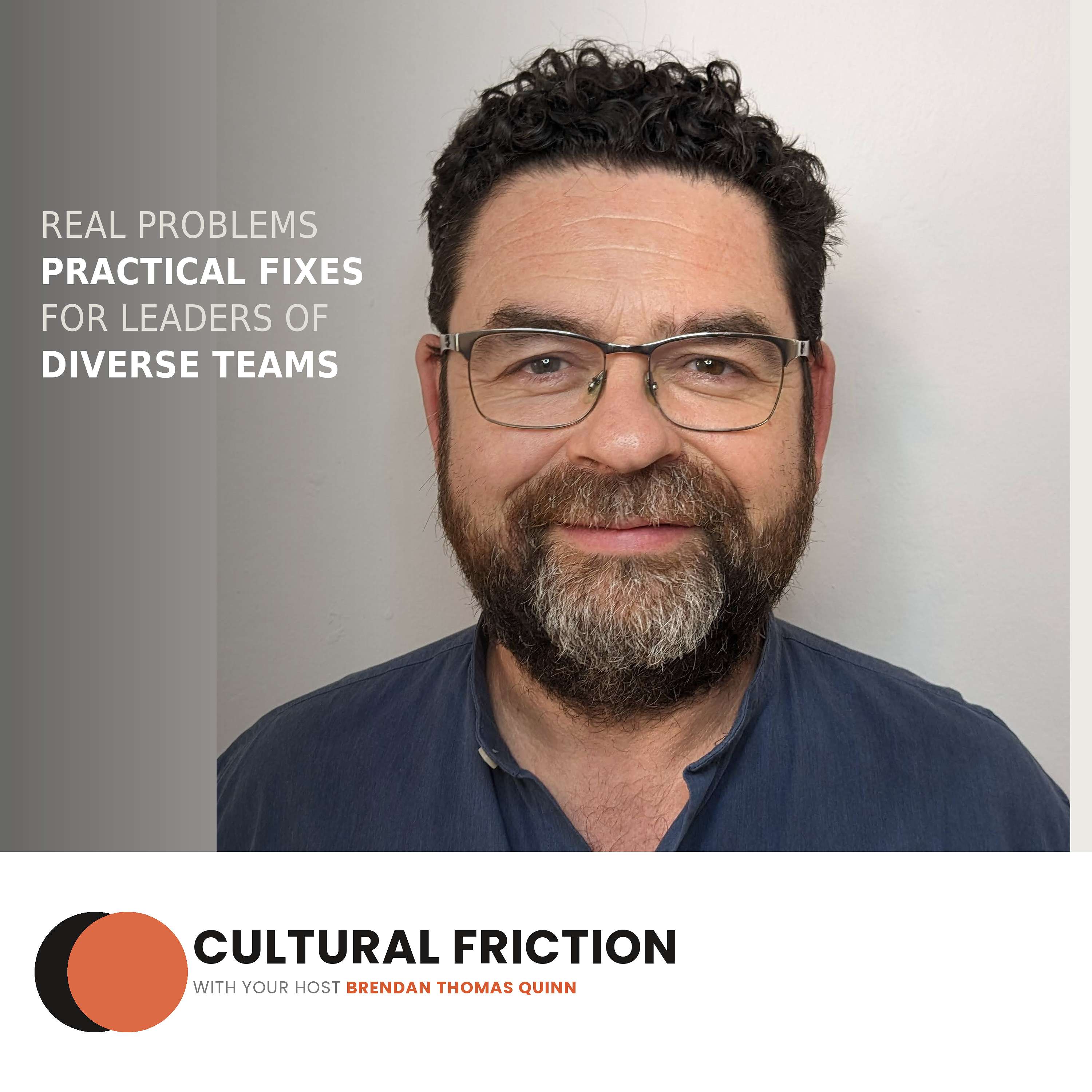
Cultural Friction
Cultural Friction is a podcast for managers and executives who lead international, multicultural teams — and want fewer miscommunications, misunderstandings, and conflict getting in the way of good work.
Each episode breaks down a real workplace friction point in 20 minutes or less: what's really going on beneath the surface, why it happens across cultures, and what to do about it. No theory for its own sake — practical fixes you can use with your team today.
Hosted by Brendan Thomas Quinn, a cross-cultural consultant based in Barcelona with 25+ years of intercultural experience, including nine years leading NGOs in West Africa. Brendan helps international organisations reduce cultural friction through cross-cultural training, workshops, coaching, and advisory, and lectures in Cross-Cultural Communication at SBS Swiss Business School.
If your teams span cultures, time zones, or both, this show is for you.
Learn more, read the show notes, or work with Brendan: https://brendanthomasquinn.com
Cultural Friction
001 - Your Team Trusted Each Other on Day One. Here's Why That Won't Last.
Use Left/Right to seek, Home/End to jump to start or end. Hold shift to jump forward or backward.
New international teams often feel easy at first — warm, generous, quick to assume good intent. That goodwill is called "swift trust," and it's provisional by nature. If it isn't reinforced, it quietly decays, usually around month two or three. In this episode: what swift trust is, why dispersed and multicultural teams are especially vulnerable to losing it, and four concrete things you can do to actively reinforce it before it drains away.
IN THIS EPISODE
(1:00) The friction: why the warmth on a new international team quietly cools by month two or three
(6:30) Why it happens: "swift trust" — trust extended on credit, before there's evidence to back it
(6:30) How high-context vs. low-context communication styles get misread as something's wrong
(6:30) The hidden language-fluency dynamic that silently erodes trust in meetings
(12:30) What to do #1: front-load face-to-face contact — even one early meeting outweighs months of calls
(12:30) What to do #2: don't let silence get filled in by assumption — ask, don't infer
(12:30) What to do #3: watch the fluency dynamic specifically — quiet in meetings is rarely a lack of ideas
(12:30) What to do #4: name the pattern to your team directly — it removes the mystery and the anxiety
(18:00) The one thing: trust is a loan, not a milestone — your job is to actively repay it
"Swift trust is trust extended on credit. Like any credit, it has to be repaid — and in dispersed teams, the moments that would normally repay it are often the ones missing."
THIS WEEK'S QUESTION
Where has your team's trust actually been reinforced since month one — and where has it just been assumed?
WORK WITH BRENDAN
If trust on your team feels harder to hold onto than it used to — that's exactly the kind of dynamic I work through with leaders one-to-one. Find out more or book a conversation at brendanthomasquinn.com
SOURCES REFERENCED
Crisp, C. B. & Jarvenpaa, S. L. (2013). Swift trust in global virtual teams: trusting beliefs and normative actions. Journal of Personnel Psychology.
Jarvenpaa, S. L. & Leidner, D. E. (1999). Communication and trust in global virtual teams. Organization Science.
Gibson, C. B. & Manuel, J. A. (2003). Building trust: effective multicultural communication processes in virtual teams. In Gibson & Cohen (Eds.), Virtual Teams That Work. Jossey-Bass.
Tenzer, H., Pudelko, M. & Harzing, A-W. (2014). The impact of language barriers on trust formation in multinational teams. Journal of International Business Studies.
Subscribe to the newsletter: brendanthomasquinn.com/cultural-friction
Cultural Friction is hosted by Brendan Thomas Quinn who works with leaders and teams navigating cultural friction within teams that work together or are dispersed around the world — as an advisor, coach, and workshop facilitator, and as Adjunct Lecturer on an International Business Masters programme teaching Cross-Cultural Communication, Cultural Friction brings that same real-world, research-backed approach to your ears in 20 minutes.
Enjoying the show? A quick rating on Apple Podcasts or Spotify genuinely helps other leaders find it.
And, if you have comments or would like to suggest future topics to be discussed, let us know, we'd love to hear from you.
Your new international team just kicked off. Everyone's warm, generous, quick to give the others the benefit of the doubt when a message lands badly or a deadline slips. Three months later, that warmth has gone. People are double-checking each other's work. Messages that used to be casual all of a sudden are becoming formal. Meetings that used to run loose now feel guarded. Nobody can point to the exact day it happened, that warmth just drained away quietly in the background while everyone was getting on with their work. If that sounds familiar, you haven't imagined it. And it's not a sign that your team was never gelling. There's a name for what happened, and it's been studied for decades. And once you understand the mechanism behind it, you can actually catch it happening in real time, instead of just noticing three months in that something's off. 20 minutes or thereabouts, one real problem, and what you can actually do about it. Today, why the trust in your new international team is more fragile than it feels, and what to do before it quietly drains away. Let's go. Okay, so here's the pattern that I see constantly with new international teams. The first few weeks feel easy, almost deceptively easy. People assume good intent, they fill in the gaps generously, and if someone's message is short or nobody reads into it, they just take it at face value and move on. If a deadline slips, nobody's first thought is this person is unreliable. There's a kind of default charity running underneath everything. And then somewhere around month two or month three, it changes. Not with a big blow-up or a huge catastrophe. Usually there isn't one single moment that you can point to. Messages get a bit more formal. People start CCing more people on things that they never used to CC people in on before. Work that used to be taken on faith starts getting double-checked before it goes out the door. If you're a leader watching this happen, it's genuinely confusing. Nothing went wrong exactly. There was no incident, there's nothing that you can point to and say, ah, it was this or it's that person or whatever. There's no conflict that you can highlight. But there's definitely some shift in the vibe, in the atmosphere, and in the way that people are working together. And most leaders read this as well, I guess the honeymoon phase has ended. Like it's an inevitable part of teams just getting together. Bad look or proof that the team never really gelled in the first place. Maybe you even start wondering if you hired the wrong mix of people or if this particular group doesn't just have that chemistry that they need. Let me make this concrete because it's easy to nod along to this in the abstract and not actually recognize it happening in your own team. Let's take a scenario. Let's take a product team. A couple of engineers in Munich, a designer in Osaka, a project manager in Sao Paulo. Week one. Everyone's in the group chat constantly. Quick replies, a lot of exclamation points, generous read of every message. By week eight, the Munich engineers have started sending longer, more formal status updates than they used to. Because a couple of times a short update got followed by an anxious check-in from an Osaka project manager asking if everything was okay. It seems like a kind of a natural response. The Osaka designer, for their part, has just started saying less in the meetings because two rounds of blunt direct feedback from Munich landed harder than they intended. Nobody has done anything wrong. Nobody's a bad actor here. But in six weeks, the whole team is communicating more cautiously than it did on day one. And everyone assumes that's just what happens as a team settles in. But the truth is, it isn't. That's Swift Trust. It's only paid, quietly converting into distance. So I want to push back on all of this, you know, this is just what happens, kind of framing, because none of it's actually inevitable. This is a well-documented, well-understood pattern with an actual name, Swift Trust. It's not mysterious, it's not bad luck. Um, it's well known, it's out there, it's been out there for many years. And once you understand how this mechanism works, you can see it happening in real time in your own team, which means critically that you can actually do something about it while it's happening instead of just noticing the damage after the fact. So, why does this happen? Here's the actual mechanism, and it's worth understanding this properly because it does change what you do about it. So, conventional wisdom says that trust is built slowly. We all know this. We all know that trust takes a long time to build and then just a single second to break. So this is not new, and and trust is built with repeated positive experiences over time until you get to that point where you're like, actually, I trust this person. This person's got my back, I know they're going to do what they say they're going to do, quality of their work is good. Um, and and so that trust that's built slowly over time is brilliant, and it's the way that trust is built, but unfortunately, it assumes that you have time and it assumes that you're working with people that you'll get to know gradually. International dispersed teams usually don't have that luxury. They get assembled fast and they're expected to perform immediately and sometimes within days of being put together. So instead, something else kicks in. Team members extend what researchers call SWIFT trust. It's this provisional, almost role-based trust given automatically just because you've been placed in the same team. You assume that your new colleague is competent and well-intentioned, not because you verified it yourself, but because the organization, through their knowledge, through their wisdom, uh, and you assume that they know what they're doing, because that organization has put them there in the team with you. So it's trust, but it's based on credit. It's extended in advance of any actual evidence. And let me just be clear here: this isn't a flaw in the system. Swift Trust is actually really genuinely useful. Um, and it's actually why newly formed international teams can often move fast in the first few weeks, while a team without this mechanism might spend that same time cautiously circling each other, waiting to see who's reliable before committing to anything. So Swift Trust is a real asset. The problem isn't that Swift Trust exists, the problem is what happens to it next. And here's the part that matters the most. Like any credit, and we know we all know how credit works, you borrow something, and at some point that is going to have to be paid back. And just like uh credit, Swift Trust has to be repaid, and if it isn't, it gets pulled back quietly, without anybody making any real noise about it, but it gets pulled back. So in a normal, co-located office, that repayment happens constantly and almost invisibly. Like things like a shared coffee, reading somebody's body language in a meeting, all of these small social cues that quietly confirm, yep, this person is who I thought they were. Yep, this person is operating in a way that I understand. Yes, this person gets the stuff done when they say they're going to do it, and the quality is really, really, really good. So, face-to-face contact in particular has been shown repeatedly to matter enormously for sustaining trust because it carries exactly that kind of information that a Slack message, a WhatsApp message, or an email just can't carry. Now, dispersed multicultural teams are often missing exactly that. You're communicating over email, chat, video calls, all of these channels that strip out all of these really important cues, all of the tone, the nuance that we kind of reinforce our belief that this person is trustworthy, that they're going to do what they say they're going to do. And this is where culture adds a second layer on top. Someone from a lower context communication background. So we're going to talk about low context and high context and communication styles in in future podcasts, but let's just run with this for now. So someone from a uh a lower context communication background sends a short, efficient message to them, that's just efficient, nothing more. It says exactly what it's supposed to say, nothing more, nothing less. The words are there. Um, but a colleague from a higher context background reads that same message and thinks, hang on, there's there's something wrong here. Um, this person must be upset with me. Neither of them is misreading the words that's on the screen. What they're doing is that is they're reading the missing context completely differently. And without the chance to check that reading face to face, the way you would if you were in the same room, these small misinterpretations just accumulate one after another. Now, add a language fluency gap into that mix and it sharpens even further. So most fluent speakers can start, usually completely unconsciously, reading less fluent colleagues as being less capable. There's research to prove this, and also accents also influence how capable we think people are. Now, there's no real evidence to say that this particular person is not as capable as me or whatever, but just because they're slower or they have to use a lot more effort to communicate, it feels like it's signaling something about competence, even when it doesn't. Meanwhile, less fluent team members, sensing that gap, become more cautious about them. They say less things than they actually think. And neither of those reactions has anything to do with the real skill or the competence of the individuals, but both of them quietly drain the trust that was so freely given at the start. So that early goodwill on your team, it's not a milestone that you've reached and can now relax into. It's a resource with a shelf life. And what determines whether it turns into real durable trust or just quietly drains away over the next few months is what you as the leader do in response. Okay, so what do you actually do with this? Um, I've come up with four things that I think are really useful. Um make a note of these if you can, and if not, we're going to put these all in the show notes anyway, so you'll have them afterwards to be able to download and look at them in your own time. So, number one, front load face-to-face contact. If there's any way to get your team in the same room, even once, even briefly, early in its life, then that has to be a core critical thing that needs to happen. That investment does more for a long-term trust than months of calls afterwards. And it's not about the agenda of that meeting, it's about people getting a chance to pick up on all of those small cues that on a screen or an old message that they just get stripped out. If travel is genuinely not possible, at minimum, if you're doing video meetings, then cameras really should all be on consistently for those first few weeks. Audio only and text only both underperform here, specifically because they carry so little of that information that reinforces our understanding of trust. So going back to that Munich and Osaka Sao Paulo team, even one kickoff week together in person before that project actually ramps up would have given the Munich engineers and the Osaka designer a much better read on each other than eight weeks of slack ever could. So that's number one. Number two, don't let the silence get filled by assumption. So this is a big one. When somebody in your team goes quiet, they reply more slowly, they send a message that reads unusually short, the instinct is to privately decide what that means. They're annoyed, they've checked out, they don't respect the deadline, they don't know, they're incompetent. We need to reset that judgment because in a team with mixed communication styles, the most likely explanation is a difference in norms, not a change in commitment. So ask rather than infer. A simple, hey, just checking in, everything okay on your end, it does a lot more to protect trust than any amount of private speculation. So that's exactly the move that would have stopped the Osaka designer from quietly disengaging in our example. One direct low pressure check-in instead of two more rounds of unintentionally blunt feedback. And number three, watch the fluency dynamics specifically. So if your team has a real spread in language proficiency, pay close attention to who's gone quiet in the meetings. It's almost never a lack of ideas. It's much more often someone who's become cautious about contributing in a second or third language in real time in front of colleagues who are more fluent. Creating space for written input as an alternative or simply slowing the meeting down and checking in with that person directly, that keeps the imbalance from hardening into a real trust gap. And then finally, number four, name the pattern out loud to the team. Knowledge is everything, and this is one of the simplest and most underused. Just tell your team what Swift Trust is so that they know that at the moment they are operating within this concept. Tell them the warmth they're feeling right now is provisional by design, and that's completely normal. Not a sign that anything's wrong, and not something to panic about. People are often already sensing this shift happening and simply don't have the language for it. A team that understands this together is far more likely to actively invest in maintaining trust than one that's just left to assume it'll hold on its own. Okay, so those are our four uh kind of um recommendations on how to maintain this trust. And I guess if there's one thing that I would like you to take away from this episode, if there's one thing that you remember, it's this that the trust in your team, the trust that your team has right now was given to you on credit. Your job is to spend the next few months actively repaying it, not just hoping that it holds. And that's the whole shift. Stop treating early trust as a milestone that you've reached. Yeah, great, we're here, we're working great, we're doing amazing, wow, we've we've achieved some really great things. But we need to start treating it as a loan that we're responsible for paying back through contact, through asking, instead of assuming and through noticing who's going quiet and why. And of course, this isn't just a hunch, um, this is a pattern that researchers have been documenting in global virtual teams since the late 90s. I'll drop a list of those studies in the show notes if you want to go deeper. Okay, so a quick recap. Swift Trust gets extended fast on international teams, but there's no time to build it the slow way. It has to be reinforced through real contact or it decays, and dispersed teams are often missing exactly the cues that would normally do that reinforcing. Four things to actually do: front load face-to-face time. Don't fill silence with assumptions, watch for the fluency dynamic specifically, and name the pattern to your team directly. And here's what I'd actually tried this week. Think about your team's first month versus right now. Where has trust actually been reinforced with real contact and where has it just been assumed? That gap is usually where the problem is hiding. I'm Brendan Quinn and this is Cultural Friction. I really look forward to seeing you next time, and I hope that you found this episode helpful. If this is a live issue for your team right now, that's exactly the kind of thing I work through one-to-one with leaders, through advisory, through coaching, and through workshops. You can find out more about the work that I do by visiting brennanhomasquinn.com, and you can also find me on LinkedIn.
Podcasts we love
Check out these other fine podcasts recommended by us, not an algorithm.