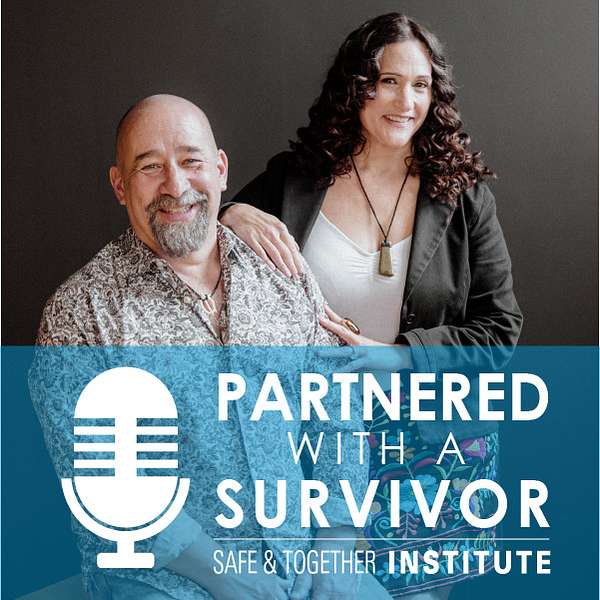
Partnered with a Survivor: David Mandel and Ruth Reymundo Mandel
This podcast is a series of conversations.
What started as a series of intimate conversations between Ruth and David that ranged from personal to professional experiences around violence, relationships, abuse, and system and professional responses which harm, not help, has now become a global conversation about systems and culture change. In many episodes, David and Ruth are joined by a global leader in different areas like child safety, men and masculinity, and, of course, partnering with survivors. Each episode is a deep dive into complex topics like how systems fail domestic abuse survivors and their children, societal views of masculinity and violence, and how intersectionalities such as cultural beliefs, religious beliefs, and unique vulnerabilities impact how we respond to abuse and violence. These far-ranging discussions offer an insider look into how we navigate the world together as professionals, as parents, and as partners. During these podcasts, David and Ruth challenge the notions which keep all of us from moving forward collectively as systems, as cultures, and as families into safety, nurturance, and healing.
We hope you join us.
Have an idea for a podcast? Tell about it here: https://share.hsforms.com/1l329DGB1TH6AFndCFfB7aA3a1w1
Partnered with a Survivor: David Mandel and Ruth Reymundo Mandel
Season 7 Episode 1: No, You Can’t Arrest Your Way to Healing and Healthy Relationships with Nneka MacGregor
We are starting our 7th season and asking the question: "What if love wasn’t the soft side of this work, but the method that makes healing possible?"
We chat again with Nneka MacGregor—co-founder and executive director of WomenatthecentrE, survivor, advocate, and visionary—to explore how love, joy, gratitude, and community connection can transform responses to gender-based violence. Instead of centering punishment that rarely repairs harm or teaches nurturing protective behavior, we examine a path where boundaries are love, accountability restores dignity, and systems are redesigned to reduce violence at its roots.
Nneka shares the personal story of surviving an attempted femicide and the vow that shaped her leadership: to live with gratitude, choose joy, and build a world where women and children are safer. From there, we dig into transformative justice—what it is, how it works, and why carceral reflexes often disconnect people from community, dull empathy, and compound and reproduce harm. You’ll hear a clear case for accountability that tells the truth, makes repair, and supports real change without throwing people away.
Nneka also introduce three bold frameworks that flip misogyny and misogynoir on their heads: amourgyny (love of women, girls, trans, and gender-diverse people), amourgynoir (centering love for Black women, girls, and gender-diverse folks), and amourgenous (centering love for Indigenous women, girls, and two-spirit people). These ideas are already influencing policy in Canada, offering a practical language for institutions to move beyond retribution into more behaviorally grounded and care-centered design. Along the way, we redefine power as something you hold upright and share—strong, embodied, and unentangled from coercion, control, and violence.
If you’re a practitioner, policymaker, survivor, or ally, this episode offers a grounded blueprint: lead with love, pair it with firm boundaries, build accountability that repairs, and design systems that center those most harmed. Subscribe, share with a colleague, and leave a review with your take: where should love show up first in your world?
Now available! Mapping the Perpetrator’s Pattern: A Practitioner’s Tool for Improving Assessment, Intervention, and Outcomes The web-based Perpetrator Pattern Mapping Tool is a virtual practice tool for improving assessment, intervention, and outcomes through a perpetrator pattern-based approach. The tool allows practitioners to apply the Model’s critical concepts and principles to their current case load in real
Check out David Mandel's new book Stop Blaming Mothers and Ignoring Fathers: How to Transform the Way We Keep Children Safe from Domestic Violence.
Visit the Safe & Together Institute website.
Start taking Safe & Together Institute courses.
Check out Safe & Together Institute upcoming events.
And we're back.
David Mandel :And we're back.
Ruth Reymundo:Look at that.
David Mandel :I I think we are.
Ruth Reymundo:It's like magic.
David Mandel :It just showed up here again.
Ruth Reymundo:We didn't exist prior to the podcast. We were only here as a podcast. We materialized fully conscious. There you go. Now you already know this is going to be a very interesting episode, by the way. We started. Yes.
David Mandel :We are partnered with Survivor, and I am David Mandel.
Ruth Reymundo:Oh, wait. And you are David Mandel of the CEO and the founder of the Zivugler Institute. And I'm Ruth Raimundo Mandel, and I am the co-owner and chief business development officer.
David Mandel :And for our land acknowledgement today, we we we still love the tungsten masako land we are on.
Ruth Reymundo:Yes.
David Mandel :And it is gifting us with very cold weather. Tundric. Tundric weather. It's going to be eight degrees Fahrenheit this weekend, which is like something like minus 50 Celsius or something.
Ruth Reymundo:Not from here.
David Mandel :And so we've got some beautiful snow coverage. And it's we just want to honor the traditional custodians of the land here, the owners, the tungsten Masako people, and any Indigenous elders past, present or emerging. Yes. So we have a return. So we we're doing more of these, by the way. I think we have a few of these where we've had a guest.
Ruth Reymundo:Yes.
David Mandel :And I think actually NECA may be the first, third time, third time. Like, you know how they give jackets for Saturday Night Live?
Ruth Reymundo:Yeah.
David Mandel :For like if they've done five or more hostings.
Ruth Reymundo:Oh, do they? Yeah.
David Mandel :So we may need to start doing. So we've got a good friend, Nekka MacGregor, joining us from a colder place. Okay. And we just wanted her back on.
Ruth Reymundo:Yeah.
David Mandel :And so we'd actually just decided what to talk about, like pulling the screen back. Two seconds ago. Two seconds ago. Because we just were like, let's get NECA on the show. We love talking to her. We think our audience, I hope you love listening to us talk to her. So NECA, welcome back.
Nekka MacGregor:Welcome, NECA. What a delicious introduction. And just just being here with the two of you is the joy of my display. Oh my gosh. Yeah. I'm I'm zooming in from I I talk about it being stolen indigenous lands belonging to the Hoden Ashoni, the Huron Wendat, Miss Suggs of the Credit, Many Metis, and Inuit people in a place that is now called Toronto. People call it Takaronto, but it's actually pronounced Gatalundo in Ontario, Canada. And I am just grinning. If you could see what I am seeing, David and Ruthie here looking like hardcore rockers. And I was just saying the way David looks at Ruth just makes my heart bloom. It makes my heart blossom.
Ruth Reymundo:So I gotta, I gotta say, we love you so much. You know, being in an industry where you're a survivor, as you understand, uh, you know, you are women at the center with your group of survivors that do amazing research and amazing advocacy globally, it can be really heavy. But it also can be so joyful to meet people who totally understand through experience the challenges of being a survivor, but also the immense joy and connection that comes from sharing our experience with other people, really truly, in vulnerability, in honesty, with that desire just for people to be well, for people to be safe, for people to have freedom and liberty to live their life and explore who they are in their journey. So we just I admire you so much and love you so much. And we share some art stories back and forth because Nekka is a beautiful artist as well. So I get the benefit of seeing her art when she shares it with me, and it makes me so happy. So we decided, Nekka, that you wanted to speak about. You want to tell everybody our topic for the day?
Speaker:Yeah. So when we arrange this next round of conversations, and I'm I am interested in my jacket, David. I will hold you to that. Okay.
David Mandel :Third time on the show, you get a jacket. That's what we're gonna tell people.
Nekka MacGregor:I'm here for that. I'm here for that. But when when we were talking like a couple of weeks ago about, you know, what are we gonna, what are we going to actually discuss? We we didn't land on anything, and it was only we started this conversation about 15 minutes ago. So I think 16 minutes ago. Exactly. Exactly. We're going to talk about love and joy and just celebrating life and all the goods, because the work, as you said, Ruth, so beautifully can be filled with negativity and sadness. But to bring joy back into our lives, I think, is part of the part of the mission, right? Part of our life's work. So it's about love.
Ruth Reymundo:Yeah, it is. You know, I've been so, so grateful lately. I was hooked up with meditation group in my hometown, and my hometown is Santa Rosa, California. It's got one of the highest rates of nonprofits and community engagement because it's got a very beautiful ethos of community. And I have really been blessed with a lot of healing through connection with the land that I came from, the people who have lived on that land for tens of thousands of years, and them sharing not just their history, which is of genocide, it is of violence, it is of harm, it is of abuse, if systemic and intentional abuse, but them sharing their joy, their love, the meaning of connection and relationship. And that has been such a healing force for me. So, how do we bring that to people working in these environments, NECA, who constantly have to endure a lot of traumatic information and exposure to violence, to the consequences of that violence in people's lives, to the pain of that violence. What are your thoughts about that and your strategies?
Nekka MacGregor:That is such a beautiful and huge question. I look at so to take a step back, if anybody's heard me talk about my lived experience in the past and how I got into the advocacy work, is that I'm a survivor of all forms of gender-based violence, but in an intimate partner context. And I think on the spectrum of the violence that I experienced, I think everybody would agree with me that the most serious and dangerous and life-threatening was I view myself as a survivor of an attempted intimate partner femicide because on Mother's Day 2003, my after sort of talking about we're getting a divorce, was when the violence actually escalated, as happens with a lot of women. And to have that near-death experience on Mother's Day of all days, and have it witnessed by my three children who at the time were my my oldest was 15, my daughter, my oldest daughter was 15, my son was 10, and my baby was just five. All of them witnessed this incident. And I remember in the moment thinking about I was actually negotiating with the goddesses and sort of saying, if I if you allow me to live through this, if you allow me to keep my life and my you know my sanity and everything intact, that I I I I promised that I was going to use the everyday of that life that I had to live, number one, live with gratitude, number two, live with joy, and number three, use all my energies, all my skills, all my talents, all my resources to create in a world where women and their children were not experiencing this. And so the goddesses listened, which is why I'm here, right? 2003, 20 something years after. And so every morning when I wake up to answer your question, I lead, I try to lead by example, right? I am you know that be the light that you want to see shine in, be the example that I try to lead by example. And I lead with gratitude. This uh, you know, every morning I wake up. Secondly, I look at my kids. We we talked briefly about children, I look at my three children who are the most I call them my three wishes. I've always called them my three wishes. That uh the the gift that these kids have given me in being who they are, wonderful human beings. And then they've given me grandchildren, which is like you know, the icing. How could you not be filled with love and joy when you have that love and joy in your life? So to me, I lead with gratitude, I lead with with love and joy. And then when I step into spaces, I hope that people can can see that uh authentic, genuineness in me. It doesn't mean that I'm I don't get angry. I have I have my moments of righteous indignation and outrage. Yeah, but that's not you know how I show up in the work.
Speaker 3:Yeah, yeah. There's a real difference, in my opinion, between anger and that reaching out past yourself to punish others or the world for for the for the reality of violence. And, you know, it's very interesting to me as a person who is family separated and grew up in a very exclusively white environment, that that impulse seems to be deeply ingrained in a lot of people and it really subverts gratitude, joy, and love. Okay, yeah. So do you I like go on that, go hard on that, Neka.
Speaker:I completely, completely agree with you. And I think about as a as a black woman, as uh I'm Nigerian by birth and by ancestry, very, very proud. I was raised, I was born in Nigeria at the time we there was a civil war in in the mid-late 60s, and left Nigeria in the middle of the civil war to go to England where my parents were. My father was studying at the time. So I was born in Nigeria and then was raised in the land of the colonizer, right, where white supremacy reigned. And then I came in sort of my adult life in my late 20s with my children, my ex-husband, we came to Canada again in the land that was ravaged by white supremacy. And I agree with you, it's difficult to center yourself, to ground yourself in love when all around you are messages of you know racism and hatred and violence. So to me, it's a radical act, right? To be like a black woman, an indigenous woman, a racialized woman in uh uh uh the context of white supremacy and still show up smiling. I mean what the actual yeah it's it's it's ultimate, it is the ultimate F you to white supremacy when you show up and you're not broken, it hasn't, it hasn't beaten you, even though the system has uh tried its darndest to break and erase. You we continue to rise and shine and and love and you know give of ourselves in ways that confounds.
Speaker 3:Yeah, it is confounding to people, isn't it? Yes, it's really confounding to people. You know, one of the things that I experience a lot is people asking me why I would want to have connection with my mother or my father, who both institutionalized me and facilitated a lot of abuse. And even when I was a little girl, I knew that they were trying to sever my relationships from my family. And I held them so closely inside me, even silently, because I wasn't allowed to call my mother mother. I had to call her by her religious name. She became a nun, right? And I said to myself, as a little girl, they will never take my love of my family away from me. I don't know where that came from, but it was so deeply protected inside of me. And there's a lot of emphasis on severing our relationships because people have done harm to us. And yes, we do have to do that sometimes often for our safety and for our sanity. But in myself, I really worked hard to preserve my love of my family from that full frontal attack and that separation and that demonization of my Latino side of the family. And I don't even know where that came from. I can only imagine that came from my family, you know, somewhere in me. But I think that preservation of that love is actually a beautiful act of resistance, a beautiful boundary between that wounding and that hatred and that violence. That's how I experienced it in myself. I'm not sure if you have an experience of that as well, Nick.
Speaker:I I can so relate. I can so relate. Not in terms of the familial, the biological parent. Because I I'm I my my dad, my mother died when I was 12. And my father raised us again in very racist violent England, but he was amazing. He was the first fan feminist in my life. He raised me. I I talk about this all the time. My dad used to say that his daughter Nekka was I was five foot nothing with a six-foot mouth. Which I keep promising I'm going to put on a t-shirt.
Speaker 3:I love it. Maybe that's the t-shirt we need to get to.
Speaker:That's a t-shirt.
Speaker 2:Yeah.
Speaker:Yeah, but I I I was raised in a really, really loving, fiercely loving, committed uh family. But the the where I relate to you is where society expects me, that space where society expects me to see my ex who uh committed all these uh egregious uh violence towards me. People expect me to uh hate him. Right. And I've I realize that the act of not hating is actually a sense of it's about self-love, right? It's self-care. Because if I if I didn't protect, as you said, if I didn't, if you don't protect that part of you that it's like the roots, it's a seed that from which everything else about you, your humanity springs. If you don't protect that, then you become that which you don't want to become, right? So I I I completely relate. I completely relate.
David Mandel :I you know it's I've been sitting here thinking about and listening. I mean, first thing to do is listening to both of you. And just I could just listen to both of you and just you know, people are probably thinking, like, is David there? I'm like, yes, I'm here and I'm listening. And and and and thinking a little bit, but mostly listening and not thinking and feeling. And and but neck, what you just said lines up really with one of my teachers, you know, and I have in-person teachers, and we all I have, you know, people you've never met who are teachers, you know, your books or what, and Tik Not Han. I'm thinking about Tik Nod Han and Bell Hooks. Right, and Tik Nod Han is was, I think he's passed recently, a Buddhist monk, a Vietnamese Buddhist monk who protested the US war in Vietnam, talking about colonization of the war. And I remember reading how he he said, Look, you know, people asked him about the kind of the same question. Why don't you hate the United States? And I'm paraphrasing, you know, from memory, you know, and he says, Because if I hate the United States, I become hate. I am hate. That's me. I that I'm anger. You know, you know, you could say, well, you've you have a right to be angry or it's righteous anger, but it's still the hate is still what you become. And so he he his he was a passionate advocate for social justice his entire life, but he he moved from love. And and to me, I you know, Belle Hooks, who's a a black American feminist, amazing, and also a Buddhist, actually, who's also I got to meet once actually at university.
Speaker:Really?
David Mandel :Yeah, I did, yeah. Yeah, I did, yeah. Like in a little auditorium, like, you know, at Wesley and Wesley and University. Like, like it was, she was probably early in her career, it was in the 80s, and you know, and and she was talking about actually men and at that point, even she's talking about men and violence and and you know, making space for men who had been violent and not hating them. And she's talking about racism, and she's talking about you know lots of things. But she also talked about moving from love, you know, and she wrote about it. And and I I think it's a it's a radical act, especially in a field where there's so much trauma, there's so much violence, there's so much good reason to be angry, to keep rededicating, and this this is my commitment as well. I think it looks a maybe a little bit different, but to to move from love.
Speaker 3:It's really challenging, you know, especially in an environment where retribution, punishment, revenge, lashing out to cause pain because one was caused pain, are really the supportive and reflexive actions. And that's even reflected in our responses to domestic abuse. And and I really truly believe that at the heart of victim blaming is a real intentional attempt to sever love in relationships because we don't know how to help people who are violent. So we blame care, we blame empathy, we blame love, we blame victims who can see with their hearts and their eyes. And it's terrible, it's terrible to pathologize care. Care and relationship and love, as if that is the problem, instead of the behaviors that sever us, that cause trauma, that destroy our trust, that destroy our relationships. And I think that that focus is very ingrained and very intentional and multi-generational. You know, as a person who's mixed ethnic, I have my Anglo parts. My mother is an Anglo woman and an Anglophile. So I grew up learning British spelling and she had corgis because of the Queen, and the Queen was the mother. If you want to see any violent reflexive responses in me, just uh just be the centered on that. That was my mom, right? Who institutionalized me, who severed me, thinking that that was better for my relationships, for my development, to be in an institution separated from my family. And I wonder about that wounding. I wonder when I see the righteous anger of survivors who really truly actually do want to punish in very severe ways, not only in people but the institutions that are failing. And I I feel that impulse in me arise sometimes. And I've really come to learn that when that energy comes up in me and I feel very righteous about it, that I need some self-examination to really keep my own relationships and my integrity intact. And it can be very difficult because violence is horrific. You know, you want you want to respond to it, you want to stop it, you want to put a boundary around it. You know what I mean? So it's it's confusing as how to action that, how to do that both in a personal way, but then in an institutional way. So I'd love to hear your thoughts on that because I know that you action this in your work. You action this at women at the center.
Speaker:You literally do it. We we do. We do do it. And I really appreciate everything you both said and the intentionality, right? It's a it's a purposeful daily reminder, a minute-by-minute reminder to yourself whenever you are confronted. So I I I love you for that, and I see it because it reflects it reflects the way I I move through the world as well. In terms of how it's actioned, part of what you were saying, Ruth, about the you know survivors are not a monolith, we we know this. Survivors and our righteous indignation is not a one-stop destination. There are it's on a continuum that because there are times when you are justified in feeling the it comes up, and whenever it does come up for me, I I don't try to stifle it. I I move through it. I I I look at it, I I analyze where it's coming from, and I it's like a wave. I I move through it. But how we action actionize it, we actually I've actually created a framework. Actually, there are three in one. It's a framework that just bear with me, because this is gonna take a minute. So for years I've been thinking about why all the money speaking in the Canadian context, all the money that the federal provincial governments have invested towards ending, you know, initially it was violence against women, now it's gender-based violence, all the money that's been invested, all the time and energy, and it's not a lot when you consider it's not a lot, but it's been something. Why has femicides, for example, not ended? Why has intimate partner violence, sexual, you know, rapes, why have they not ended? Why have we not made the types of advances that one would expect considering all the brilliant minds and heartfelt energy that's going into eradicating it, right? Why isn't it? And then I I realized like one morning I woke up and it was like a flash of light that this is this is by design. The systems that we have by are by design. And when you talk about the retribution, when you look at the criminal law, criminal code across all jurisdictions, it is retributive form of violence. It's about you you lock people in a in a in a cage, you separate them, and it comes back to your point about disconnecting people from community. You separate them from community, which is separating them from humanity, right? The rest of society. And that cutting off you separate yourself from your humanity, and therefore you're not able to see the humanity in others. You you the system is systematically removing our empathy, the empathy gene, it's dull in it, right? By design. And so that type of system, that type of framework that is designed to be retributive justice, it doesn't care about justice, it doesn't care about healing or accountability. The that system will produce violence, yeah, and it will continue. So, how do you disrupt such a system? And so I started, I was thinking, thinking, thinking about it. I I started writing an article about it. It's been about you know seven, eight, nine years now. And then in 2019, I do my best thinking in the shower. In 2019, I'm in the shower, and I thought, I wonder if there's a framework that actively disrupts, is is the diametric opposite of patriarchy, for example, right? The patriarchal framework that is the basis on which it's the blueprint that criminal legal system responses, child welfare responses, you know, racism, all of it is embedded in. And I started looking, couldn't come up, find anything. And my dad, who is my hero, I keep saying, he's passed away now. My father used to say, if you're looking for something and it's not there, then it was waiting for you to create.
unknown:Yeah.
Speaker 2:It was waiting for you.
Speaker:So I thought, okay, I'm gonna come up with my own word and I'm gonna develop a framework that will be this diametric opposite to this very, very harmful way that the systems have been established and are enacting. And so I came up with the word amorgeny, right? Which is you've heard of misogyny, so miss being against the feminine women and girls and two spirit, etc., and gender diverse people. What is the opposite of hatred of women and girls and gender diverse and two spirit? Is love for, and so being you know, in Canada, two official languages, English and French. I thought, okay, I'm gonna use amour, which is love in French. So the love of women and girls and gender diverse. So I I came up with this word emogeny. I love it.
David Mandel :I can we do a mic drop in the middle of this, like I know you want to get to the end, but like I want to I want to do a mic drop in the middle of it. Anyway, go ahead. That's just mic drops just to share that, just to sure to share with the audience because you can't see us. Anyway, go ahead. Just just I'm loving the just I'm loving the the whole thing. Keep going.
Speaker:Thank you. So I as I was thinking about a Mogeny being to center love for women, girls, gender diverse, trans, two-spirit uh communities. I then started thinking about the the racism, right? The anti-indigenous and anti-black racism that indigenous women, black women in particular, right, uh experience. And so I thought of a more genoir because you you know the beautiful and brilliant Dr. Moya Bailey, who is a black leading scholar in America. I think she's out in Chicago, and I met her. Oh, I fangirl, I fangl. You band girl her.
David Mandel :You fangirl.
Speaker:Yeah. So Dr. Moya Bailey had come up with the term misogynoir, which is specifically about black women, and I know her intention was around the experiences, right? Disrupting the experiences, the the disgusting way that black women were represented in like hip-hop and stuff. Yeah. So her term misogynois, I was thinking about that. Well, how do we what is the diametric opposite of misogynois? And I thought, okay, we can expand the term and now have emotionois, which is centering black women, black girls, black gender diverse, and black trans. And then looking at again the anti-gendered racism that targets indigenous women, girls, and to spirit. So the third was emogenous around. I love those three. All right, that's great.
Speaker 3:Really, truly, that is that what a wonderful way to recenter the conversation about love and appreciation, and so real, NECA. So real. I almost started crying when you started talking about it. Because what if imagine we lived in a world where that love was directed towards those three groups and how the groups that are not those people would benefit. Seriously, it's not about excluding people that are not of those groups, but the way that we love and empathize with those that we may not be able to directly identify with is so indicative of how we can love ourselves and our own families and the world around us. Oh my goodness. I love it, NECA. I love it.
Speaker:Well, I'm I'm really glad because it generally gets this positive response when I talk about it. And so much so that five years ago, the federal government, the Canadian federal government, under the Liberal Justin Trudeau leadership, they gave us $2.5 million, gave my organization $2.5 million, specifically to develop the emotion noir framework around centering black women, black girls, black trans, black gender diverse communities. And it was the first time any government on planet Earth had ever given money to do the work around centering, right, advancing gender equity for the community that I belong to.
Speaker 3:So you did. You did what your dad said to do. Yes!
Speaker:So we've been working for the past five years to build that among genoir framework, right? And and then with with that framework developed, the government had committed that they're going to actually use it to sort of re-redefine policy. Let's look at how we we create policies, law reform that actually centers love and kindness and compassion. And it also ties in very nicely with sort of my work. Ruth, when you were talking about uh retributive justice, I am I'm an abolitionist, I am an anti-carcerial feminist. I don't believe that prison is the way we we bring accountability and we change uh you know hearts and minds. And so my work has been following on the the shoulders of the amazing black women activist states who have they developed the transformative justice framework that looks at systemically, right? How do we, as a community again, how do we center, we don't throw each other away, we center those who've been harmed, as well as bringing in those who have caused harm into our fold, because we can't throw each other each other away. So I'm a believer and a practitioner of transformative justice and accountability, and I think in in keeping with the conversation, right, the theme of today, it is transformative justice is about love, it's about community, it's about accountability. Accountability is about love, right? Truthfulness is about truth telling is about love, and then wrapping one another is about love. And I think that's the only way we can reverse the drama of this.
Speaker 3:Yeah, absolutely.
David Mandel :You know, it's uh so much I'm thinking about as I and feeling is listening to NECA talk, and and one is you know, this feels so inclusive to me on so many levels. And I think it's the antithesis of objectifying women, of of turning them into things or treating them as functional objects of sort of care or you know, or or of work or labor or reproduction. Reproduction.
Speaker 3:Domestic, domestic.
David Mandel :You know, and it but it but it also speaks to something I've been I I don't think I've said out loud very much or ever really. You know, I came up in the domestic violence movement where I was really exposed to the amazing work out of Duluth, Minnesota, and Ellen Pence, who's a tremendous I met Ellen because I did too. I mean, I'm going back to the 90s, and she was she was a hero of mine, and they they did some amazing work. She's very survivor-centered, and they the model was really was based on listening to survivors and their experiences and kind of translating them into liberatory education. That's a whole other part of their work. And I always, you know, so people there's a ubiquitous parent control wheel, and it was paired with this respect wheel. And I always had a place of that not quite working for the respect part, never quite working. And I want to finish this thought because that sounds bad, but it felt not sufficient, it felt not encompassing enough because for me the answer was the the you have power and control on one side, you you have love on the other side, and love in in has to hold respect to be true love, right? So so love to me was the bigger term, and I kept looking at that word going, you know, I don't I don't know how to say this because respect is important. I want people to misunderstand, but but it it's it's it's it's love, yeah. You know, and and so for me, I I've really used that love as a guiding principle for me in my work, even though I don't talk about it very much. It is deeply it's a deeply held value. It's it's I hope it shows up in my work. Uh when I did work with men who are violent, you know, I would try to see their highest self, but still not accept their behavior. So there was, I I I associate that with love. When I sit down with child protection workers and and in these brutal systems, brutal for them, brutal for the families in many ways, contradictory gaslighting. We're here to save kids and we do these things, right? You know, and and the and the workers' experience, so they are often kind of confused and compromised and asked to do things that violate their values. Now we talk about moral injury. And I'd sit down with them and and I'd say they'd come to me with a problem in the case, in a scary case around domestic abuse, and say, Well, tell me what you did right in this case or what's going well. They'll go, What what do you mean? Like, I'm here to like for you to fix what's wrong. I go, I go, Well, we'll get there. But I want to start our relationship with tell me what you think you've done right in this case. And when they would tell me things, I'd say, okay, that sounds like if she told you these things, if she said she told you some of her truths and her experiences and things like that, then you must have done something to help her feel safe enough to do that. And they're like, No, I didn't. I go, let's slow it down. And so for me, that's these are examples of love and action, you know, and that it it's not, you know, it's not the uh rom-com love. I think we think of the, you know, sort of this sort of like, you know, whatever. Yeah, but I think it's really that that that and I think there's an allergy or fear that in the in the domestic violence movement, and I'll just call it out to talk about love because because people have weaponized love against people, yeah, both individual users of violence, but culture has like you said before therapists, therapists, you know, you you love too much, women who love too much. You know, there's just sort of there's a there's a there's a there's an industry about sort of saying love is dangerous. Love is dangerous. People will hurt people in the context of intimate relationships. That's what I mean by love is dangerous. Love is scary, love is risk-taking, vulnerable, vulnerable, but I think there's it's an interesting. I love this topic because I think our sector, our field, our I would love to see us be embrace what you're talking about. Yeah, you know, the conversation about love.
Speaker 3:I feel like a lot of times the pushback is because people don't understand that love also encompasses loving boundaries. And that is, is I really truly believe neck is like she's in praise.
Speaker:Another microphone right now.
Speaker 3:I don't feel like a lot of people recognize that that love is also containing a person in their in their in their worst inclinations and saying that is not gonna lead to our connection. That is not gonna facilitate trust. That's gonna destroy this relationship that we have. That is a loving act. Telling men and women about the behaviors that they've been taught. Like, let's just land there for a second. Let's really feel that. That they've been taught by their parents and their teachers and by institutions. When they use those strategies, it's because those are the ones that they've been given as strategies. So it is a loving act for us to look at a person and say that that behavior they're engaging in is gonna destroy their connections and relationships with the people that they love and want to be connected to and with themselves.
David Mandel :So I'm I'm gonna make this conversation maybe even a little bit bigger. Oh, whoa. If I you know, which is because your Ruth, you're getting me to think about that. This is at the same time, this conversation about love is also the Conversation about the nature of power.
Speaker 2:Yeah.
David Mandel :And what it means to be powerful without being violent. Because when I hear what you said, because that's my attitude when I said boundaries. And people, people, I get, I'm getting more of this online in LinkedIn. You know, I post a lot about men and men's responsibility and men harming women and girls, but also boys and impacting boys and men's health. And and I get called out as being today, I was I was actually called out as being feminine. I somehow have no shame. I mean, there's lots of things recently I've been called. And and what is, I don't think I expect to communicate this, you know, which to some people, but for me, that calling out is about helping people be men being powerful in a way that's not abusive. If you're using violence, you're not you're not setting up the conditions where you experience connection with yourself, with other people, where you feel truly strong, not strong in a power over way, but strong in a I'm upright, I'm I'm a person, I'm here. I can I can take criticism, I can offer strength, I can be confused, I can move through life in a way that that is I I think of it now as sort of upright adult.
Speaker 3:Yeah.
David Mandel :Like I can do that.
Speaker 3:Fully embodied.
David Mandel :Yeah, fully embodied. And so if you're acting out of violence, that's some some false sense of power that involves hurting somebody else. And you know, unless you're up eaten truly in threat, you know, you're truly being threatened. But so I this conversation about love is also for me a conversation about the nature of being powerful. Because it for me, that's been part of the journey as a man is is how do I live in in and experience myself and the world in in a loving way, and how do I have be an impactful, effective human being without using power over? You know, that sort of how do I sort of disavow like mission impossible? How do I disavow that privilege, you know, as much as I can. Somebody you can't disavow because it's just kind of like people keep giving it to you. They're like, no, I don't want that, you know. But like, yeah.
Speaker 3:What are your thoughts on that? Nick, I'd be so interested to hear about power and yeah, so maybe a little bigger.
David Mandel :Now we're not gonna now we're not just doing a show on love, we're doing a show on love and power.
Speaker:Well, I think I think they are synonymous, honestly. And and David, I want to go back a little bit. When we first met, I I don't know if you remember this.
David Mandel :I of course I do.
Speaker:Of course I do. Of course I remember. You missed it.
David Mandel :I did yes, you decided not to fly away because you wanted to hear my the rest of my presentation.
Speaker:This man was on fire. And so, two things about love and power, and I said that I I find them to be not even opposite sides, they're on the same side of the same of a coin. Because it is love is a powerful thing, it's a powerful tool, it's a powerful feeling, and if misused, then it becomes right harmful. And so, two things I want to say about love and power, and you specifically, David, you was that um so the first time we met, we were at a conference. This is for people who haven't heard the last the first uh podcast. We're both speaking at a at a conference, and I remember when David asked a question, right? Somebody else, I think maybe I was speaking, right? Somebody else is speaking, David asked a question, and then it was the way you contextualized the question before the question was posed. And I thought that was such a brilliant, brilliant thing, right? Didn't know who you were for a blade of grass. And then the fact that he was this white white man speaking on a sector that is overwhelmingly led by white women who I'm gonna just be very honest, can't some of whom can be very, very harmful. They use the language of feminists, right, as an umbrella catch all, but they there's a lot of lateral violence in the sector. And so to see this white man in a space that is talking about accountability of men, regardless of the skin they're in, was really intriguing to me. And I'd been my board, we have a portfolio on our board about engaging men and boys, and we've been talking, myself and and my board had been talking for years about well, whose responsibility is it to engage men and boys? Is it women, us as women, is it us as survivors to engage men? And we all agreed bloody well wasn't it's it's men need to do this.
Speaker 2:You need to do that. That's right.
Speaker:Yeah, so when I met David, I thought, oh, we need to get him to number one come and join the organization in some capacity, though it's all women, you would you would be an honorary member.
Speaker 3:This is not the first time that David would be an honorary member of women's faces, let me tell you.
Speaker:We would vote, we're all voting, but it was just to see this white man speaking with such humility, was what was coming out, right? In in your words, you you were not there to talk over or to talk at. You talked about concepts that were so common sense, right? The idea, and I thought, yeah, we can get another flight. So I stayed and I I heard you talk, and then I went up. I think we I because I'm a hugger, I think I asked, I asked for your consent first before we hugged. But I I committed that I wanted to learn more and be more in your space and be around men like you, because what you were saying and the way you what you exuded, not just from your words, but your your energy, your aura, was about love and was about power, not in that power over. It was a powerful way to view the work. And so it's interesting listening to you talking about you in the space, because I think we need more David Mandels in the space.
Speaker 3:We do, right?
Speaker:We need more men like you, especially white men, right? Because you know, disrupting uh disrupting the the the master, who was it?
David Mandel :Uh Audrey Lord.
Speaker:I forget her. Yeah, order Lord, you can't dismantle. You you you need you need people on the inside who understand what the people on the outside of you know the work are going through to be speaking with us, not for us, but with us. So I I I I firmly believe that David, you move from a place of love and power. Otherwise, we wouldn't, I don't think we would have made the connection.
Speaker 2:Yeah, yeah.
Speaker:And we're yes, we're not on WhatsApp, buddies. Like we see. That's okay. We're gonna get them.
David Mandel :And I I'll I'll initiate the jacket thing.
Speaker 3:We're gonna get him in the group.
David Mandel :But it but it it's I'm I I um and you can't see me, but I'm tearing up. Those listening can't see me. And I I'm a little bit speechless. I really so much, you know, to be seen in that way, in a way that's so important to me is means a lot to me. So thank you.
Speaker 3:Well, he did, he really does have um, he does, he has love of women. This this is a WYSIWYG, as my children say it. What you see is what you get. And and it's been wonderfully healing for me, you know, the way that people see us. And I think that this is so important because we are social beings, we are connected to each other, we are connected to each other and to all the beings that nourish us and keep us in this material plane, and our unawareness of that sometimes is such an impediment to our joy, to our ability to really understand what power means. And in being, you know, I I left a coercively controlling, domestically abusive relationship and met beautiful human here and started to really understand how our vision of other people and the judgments, biases, fear, protection, reflexive defensiveness that we've been given honorably because we've experienced trauma really keeps us from being able to see other people for who they are as human beings and see our own power. And to me, power is not about controlling others because you get endlessly exhausted if you try to control what you cannot control. It's actually incredibly unwise. But power is the power and the ability to nourish and to protect our relationships and our connections with each other, and what sustains us in this world, what really truly gives life and joy and meaning, and the ability to explore who we are as human beings and to explore our role and our place in this world. And I feel like that was really shattered, that was so intentionally shattered, systematically, intentionally shattered. And for me, the the ultimate healing has been to be seen not as broken, even though I have that wounding and those traumas and those physical and emotional injuries, but to be seen as a whole human being and offered that love and encouragement and support. So I really feel that deeply, that that question of power is often muddled up because we don't really understand what real power is and how much we have inside of ourselves, even when we feel disempowered and unable to control life. That's scary, you know.
David Mandel :Yeah, I want you know, just say something about your reflection and because I the the the the the advocate in me, the the teacher in me, you know, is I don't want people this is not this is not just some way I magically came out. You know, I I did grow up with a good dad like you did, you know. I mean I think that that is that's something. I think I grew up at a time also where I was exposed to uh women's studies and you know and and material and and and so I I think some of it is context, but I kept moving towards certain things and listening, listening to women, listening to women's stories, continue to listen even when they're hard. I think it's I mean, and I'm why I'm saying I'm an educator, and I can't I because I want people to hear that there are actually are things that I associate with with how I moved through the world, the choices I made, things I did. So one was listening, listening even when it was hard. You know, reading things like, I mean, still remember reading things like Susan Brown Miller, Against Our Will. And, you know, and this is an old book at this point, but it's about sexual assault. And it's it's relentless in making it clear that sexual assault is violence, not sex. And it's and it's and and so reading things like that about male violence against women, you know, listening to women, confronting what it means to being willing to look at what does it mean about me as a man, and then and then there's so many other experiences I could kind of layer on top of it, but then also at some point saying, how do I listen? How do I take in that information? How do I act from the injustice to to to to help fix it, but do it in a way that I'm fully embodied? I'm not stepping on people, I'm not taking away from people, but I'm not shying away from it. How do I how can I, you know, be a a champion for change and not be powerful? Like I so I really kind of wrestled with that, that that, you know, how do you hold both those things as a man? You know, so I'm saying this for people, so so there's because I think there's a there's there's a there's at least a roadmap. I'm not saying it's the roadmap, but I think there there are things I actually believe in that are replicable or or could be for for other men at least. Maybe other white men are, you know, and maybe it's maybe it's kind of we can keep making it smaller or or bigger. I don't know. So anyway, I just felt like important to say that because this is not just a yeah, just a particular yeah, it just doesn't drop, you know.
Speaker 3:There's a bit there's you know, I mean a small part of it wanting credit for doing that work in a racist, a separatist world, being a good man doesn't just drop in your lap, guys. You gotta do some work. That's the take. Inner worlds, inner world inner worlds.
Speaker:You know what what came across, even listening to you, listening, is so we talk, we're talking about love, we're talking about power. The word we haven't mentioned yet is courage. Yeah right, that it takes it takes tremendous courage to love. It takes tremendous courage to be loved, especially Ruth, you're talking about being a survivor, and then somebody else comes in and the resisting the temptation to paint all men in the with the same brush, right? It takes courage to to uh let your guards down and uh be loved and love again, and it also takes courage to wield whatever power you have in ways that sometimes oftentimes is not to your direct personal benefit, but it benefits others, which to me is it goes back to what you were saying, Ruth, earlier, about to me it's about accountability, right? The way we've raised our children and boundaries that we set with them for them, so that they can grow, right? They grow and they know that they are fundamentally loved, but there are things that you just can't you can't do because it's not safe, it's not right, it's not ethical, it's not moral. So it takes courage to show up in these spaces, in these conversations. I think especially well, I'm talking about this sector because it's the gender-based violence sector, because it's a sector I know. But I I I I I would posit, I would propose that regardless of the sector, whether you're in finance, imagine uh uh the finance world, the banking world being led by not predatory loans and but by love. Imagine imagine healthcare, which is supposed to be about care being led by love. Imagine education, imagine everything, every aspect of our life and our work being centered on our abilities to look at the person next to us, regardless of how tall, how short, the how much melanin, how little melanin, what language they speak, the language. Imagine that we are able to look at our neighbor, the person next to us, and see ourselves. And that seeing ourselves presupposes that we love ourselves. But it takes again courage to be introspective and to come to I I I am I am encouraged by the I'm encouraged in this belief that I have because I know that I am not the only person that feels this way.
Speaker 3:Yeah.
Speaker:I know the two of you, right? I which is why I I love the two of you, not just because we we are kin in that way, but because I know you intuitively understand and feel what I'm feeling.
Speaker 2:Yeah.
Speaker:And I know that there are so many people who were looking. Just before I got on this call, I got uh an email from an organization in Ontario, from the ED of this organization. I don't know whether I can or cannot mention them, but they were they they deal with children and youth advocacy. And their ed wrote to me saying that she was on, she was a participant in the webinar, the launch of a report that I I think I spoke to you folks about it, that I I was sitting, I helped the ombudsman, the federal ombudsman for gender-based violence in in the in Canada, had been working on sexual violence. And I was one of their expert circle members. And then the report was written, beautiful report. I'm happy to share it with you because I think everybody should be reading it. Beautiful report. And then they did the launch, and I I was flown out to Ottawa to be on a panel. And so on the panel, which had you know lawyers and other activists, I was talking about this. I was talking about love and kindness and compassion. And this woman, this ED, wrote to our admin at Woman at the Center Email to say, I heard NECA on the panel, and I was so moved by what she was saying, because in the work that we've been doing, we work with police, we work with children, children, uh, sorry, victim witness assistance program, we work with youth, work with survivors, and everybody was be feeling so disheartened. The detectives who were part of the they were feeling so disheartened at the way the system breaks everybody. Yeah, and so part of the fear that I see in the world around me, part of the fear that I see in the workers and in the system, is this fear that there is no other way, or the system is too big for us to dismantle. There's nothing we can do. And I I will never stop leaning into there's a lot we can do, disrupt it. And we start with from this place of of love and kindness and compassion. So I'm I'm as soon as this is done, I'm going to finish the email that I was responding to. So you're not alone. Yeah, that's kind of cool.
Speaker 3:And you know, one of the beautiful things about the the work and and the podcast and and being, you know, people who travel globally around these circles where people are really advocating for good relationships, for healthy relationships, for healthy connections, is that for me, when I started the work, there was a sense of isolation and loneliness inside. Of myself. I had been isolated intentionally again, severed from my family, isolated. And I felt very, very alone. And I actually I actually had a near-death experience. David and I were pregnant, I don't know how like nine years ago now, and I had a miscarriage. And if I admit a miscarriage now, I would probably die because I was bleeding out and I lost a lot of blood. And I lost blood to my brain and my kidneys. And I left consciousness for just a very brief period of time and went inside myself. And I felt with no mind buffer the sense of abandonment and isolation that I carry inside my body. It was very confronting. My loved ones didn't have a home inside my own body. And so I started to really intentionally work to reconnect to my family, to where I came from, try to find them, try to find their names, try to find where they came from, which is challenging because some of them have numbers for names and no immigration paperwork and no birth certificates. But I wanted to reinsert that sense of connection inside my own self. And I really felt that when I lash out, it's because I feel disempowered and I feel disconnected from others. And sometimes that lashing out that conflict behavior is to try to create the connection. And so I'm lashing out in conflict because I want that connection. I want to feel connected. I want to have some sense where we impact each other. And I want to know that I have control over that. And so it's been a real journey for me to bring back into myself that sense of connection. And now when I close my eyes and I feel despair at the state of the world and the state of things, I see and feel people like you, people like Matt and Sarah Brown, people, you know, like Charlie Toledo from Suskell Inner Tribal Council, people that have are have these beautiful relationships with themselves around healing and around family and around culture and about their, you know, honoring their connections. And I can really feel that presence inside me. And it it has been such a sustaining and nurturing and healing force. I can't actually speak the depth of it. So for all those people around the world, and many of you know who you are. I am so grateful for you because it is so easy in our feeling of disempowerment and frustration and fear to really lash out with a sharp end and only focus on what is wrong and not focus on how to strengthen our connections.
Speaker:Ruth that that moved me no end. First of all, I am thank you so much for just your authentic way of being in the world. Anybody that's seen your art, anybody that's had conversation with you, it's it's evident.
Speaker 3:It's an act of resistance because I got knocked around a lot for it as a child. Believe me, my truth speaking was not welcome. So I feel like it's really, in a way, selfish to preserve my love and the connections that I have. And I and seriously, I cannot speak enough, the healing of coming into contact with beautiful people like you. Really, truly, really beautiful.
David Mandel :I'm gonna say what I say to you in private, I'm gonna say publicly, with just your very existence as a gift. Which I think is one of the things that NAC is saying because it isn't just the healing process, and it's not just the art, it's just your your existence. That's the way I experience you.
Speaker 3:Well, I think all of our existence is awesome.
David Mandel :Okay. Well, there you go. And I I just, you know, I wonder if we have a way to land. We keep talking. I'm aware we're we could group forever. We're we're past at least an hour or just about an hour. And I don't know.
Speaker 3:NECA, NECA, NECA. I don't know what check in with both of you about whether there feels like anything else that's it's just I just like I want to bring more NECA into the world. It's like more cow battle. More cow NECA.
David Mandel :More cow battle. I love it. More cow battle, more neck. That's gonna be the shirt. That's gonna be the shirt. That's gonna be, you know, the other side of shirt. That's too cute. More NECA.
Speaker:My youngest used to say people need necker, more NECA in their diet.
David Mandel :So then more neck in your diet, more neck, uh, you know, five foot, you know, you know, yeah. Um we I think we have a lot. We have a whole we have a whole apparel line, I think.
Speaker:I think so. Much of much that we're gonna do. I I want to land to your question. I want to land on the two of you, because I know this is an audio uh podcast, this particular episode. But I've been sitting here looking at the two of them, and for those who haven't seen love in action, right? I mean like romantic love and then humanity love, uh, because what you'll you two display is that uh whole love. Your friends and lovers and you know, kin. The way David looks at uh Ruth when she's talking, when she's not talking. The way Ruth looks at David when he's talking, when he's not talking, to me is the picture, right? From you know, when you think about love in the definition, and if it was a visual representation, it would be the two of them. Because the and it's so genuine, right? It's it's so it's so and I don't even think he knows or she knows when they're doing it, right?
David Mandel :Because like now, like now.
Speaker:So I I am I am really heartened and was looking forward to this conversation. I didn't know what it was going to be, but I'm really glad that it's on there. This is amazing. It is, it is, and and at a at a time in our lives and on the global uh stage where it it seems that there's a lot of hatred and violence and uh you know negative nastiness that's uh waging war at all of us. I actually uh believe that there are more of us that are hanging with this than of others who are trying to disconnect us from one another. So I am just profoundly grateful to the universe that uh she saw fit to connect us. I am profound grateful for the love that I feel from the two of you towards me, and I hope you two feel the love that I totally feel it, feel it, and feel direction.
Speaker 3:It is kinesthetic and it is it is it is a real force in the world. And NECA, your your way of being, of embodying, of moving through the world with intentionality, I truly believe is part of the solution. And I really believe that men and women can collaborate. We co-create the world together, and blessed is the man who is the heart who acknowledges and recognizes the wisdom of women, and that is just a real thing. And this guy, this guy over here does that. So I'm very grateful to to know both of you and to and to really love both of you and love your art and love the creations that come out of you.
David Mandel :I love the things you create, NECA McGregor, keep creating, including those terms and words that I'm gonna carry with me, and and I want to offer up to our audience to really, you know, embrace them and and whether you're male-bodied, female-bodied, you know, non-binary, you know, but really to like breathe into those those words about loving indigenous women, loving black women, loving women in general. What does that mean? And how different would our world be if we embody that? And and and to understand that that's not about, and this is what I want to say. And I I I think it's I don't feel wiped out by that. And I'm saying it in a personal way, because I want other men who might be listening to say that that you don't need to feel wiped out by that either. In fact, you can be empowered, you can be lifted up, you can experience yourself and the world differently in that. And and I think it's it's it's so critical, it's so critical to our individual and collective uh health, well-being, and maybe possibly survival. Is that too is that too big? I heard that's so what I can't remember. That was crucial on the podcast. I can't remember the last time you said amen.
Speaker 2:It was crucial.
David Mandel :Yeah, right. All right, I'm on the neck. Thank you so much for joining us. And we I I don't think I don't think the third show is the last one, just to get to our audience. Please go back to it. Yeah, and you've been listening to Partner with Survivor.
Speaker 3:You're still David Mandel.
David Mandel :I you know, I feel like I've gone through a little bit of transformation, actually. Yes, it's uh but yes, I'm still David Mandel. You are still Ruth Raimundo. And please follow, subscribe, share this episode particularly, yes, but all of them, and check us out at safetylivency.com. We'll put information about NECA and her work in the show notes, and so you'll be able to gather it there. But but thank you all very much for joining us, and we'll be