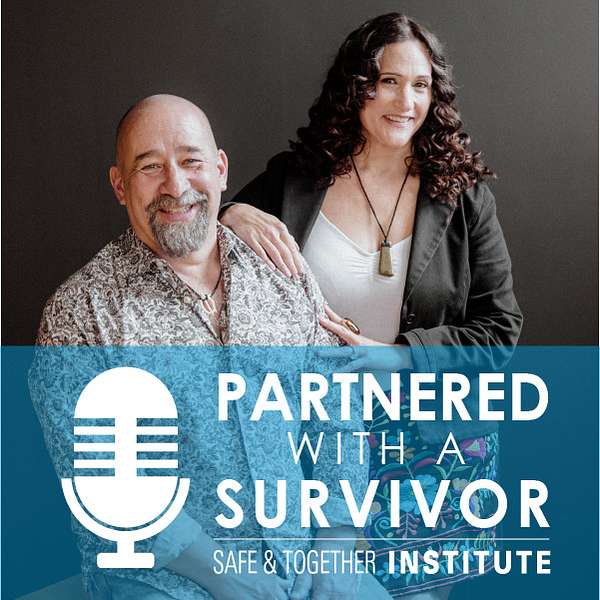
Partnered with a Survivor: David Mandel and Ruth Reymundo Mandel
This podcast is a series of conversations.
What started as a series of intimate conversations between Ruth and David that ranged from personal to professional experiences around violence, relationships, abuse, and system and professional responses which harm, not help, has now become a global conversation about systems and culture change. In many episodes, David and Ruth are joined by a global leader in different areas like child safety, men and masculinity, and, of course, partnering with survivors. Each episode is a deep dive into complex topics like how systems fail domestic abuse survivors and their children, societal views of masculinity and violence, and how intersectionalities such as cultural beliefs, religious beliefs, and unique vulnerabilities impact how we respond to abuse and violence. These far-ranging discussions offer an insider look into how we navigate the world together as professionals, as parents, and as partners. During these podcasts, David and Ruth challenge the notions which keep all of us from moving forward collectively as systems, as cultures, and as families into safety, nurturance, and healing.
We hope you join us.
Have an idea for a podcast? Tell about it here: https://share.hsforms.com/1l329DGB1TH6AFndCFfB7aA3a1w1
Partnered with a Survivor: David Mandel and Ruth Reymundo Mandel
Season 7 Episode 2: 7 Years of Partnership: Survivor Leadership, Systems Change & What Comes Next
What happens when David turns the tables on Ruth and interviews her—seven years into their shared body of work?
In this special anniversary episode, David marks seven years since Ruth joined the Safe & Together Institute by stepping into the interviewer role. This is a founder-level conversation about vision, values, the hard work of scaling, and how systems actually change when lived experience is treated as critical professional expertise—not an add-on.
Ruth traces her journey from working with medical practitioners to helping transform Safe & Together from a training organization into a systems-change engine. She shares the deeper vision behind that shift: embedding domestic abuse–informed, trauma-informed, child-centered practice into the real operating conditions of systems through values-aligned leadership, business rigor, and strong operations. A central theme is supporting frontline workers—how poor practice, rigid forms, siloed communication, and unrealistic mandates make ethical work harder, and how better systems design can reduce moral injury and make good practice more sustainable.
Ruth also introduces the Credible Expert approach, embedding diverse, system-literate survivors as compensated contributors to design, strategy, and decision-making. Together, they offer an unflinching critique of “reduce removals” initiatives and explain what meaningful reform actually requires.
Looking ahead, they introduce SafetyNexus, a technology platform designed to coach practitioners, map perpetrator patterns, strengthen documentation, and streamline workflows—without replacing professional judgment—while centering survivor governance from the start.
This episode is both a milestone and an invitation to keep building systems that save lives and save money.
Please follow us, share this episode, and send us your comments.
Now available! Mapping the Perpetrator’s Pattern: A Practitioner’s Tool for Improving Assessment, Intervention, and Outcomes The web-based Perpetrator Pattern Mapping Tool is a virtual practice tool for improving assessment, intervention, and outcomes through a perpetrator pattern-based approach. The tool allows practitioners to apply the Model’s critical concepts and principles to their current case load in real
Check out David Mandel's new book Stop Blaming Mothers and Ignoring Fathers: How to Transform the Way We Keep Children Safe from Domestic Violence.
Visit the Safe & Together Institute website.
Start taking Safe & Together Institute courses.
Check out Safe & Together Institute upcoming events.
And we're back.
David Mandel :We're back. Yeah. Hi. Hi. Welcome back to America.
Ruth Reymundo:Okay, yes. We're here in the United States again in Connecticut. And we just want to well, you should say who you are, because I'm about to, you know, roll forward.
David Mandel :Yeah. David Mandel, CEO and founder of the Safety Dealer Institute, and uh you are Ruth Raimundo Mandel, and I am your co your partner, co-owner, and the founder, co-founder of Safety Nexus. And we're going to be talking about you today, by the way, just previewing this. We were talking about you today. And this is the podcast partner with the Survivor. Yeah. And just before we go into land acknowledgement, just wanted to say we really appreciate people listening. And you know, if if you like this, please follow us, share this with other people. Kind of getting this out of the way at the beginning so people who are new to the show can can kind of be thinking about that and and send us in comments. So we really love the engagement with the listeners and and all over the world. So we are the last time we recorded a show, we were in the Azores.
Ruth Reymundo:We were in São Miguel.
David Mandel :Sao Miguel. And and Ruth acknowledged the Gounche people.
Ruth Reymundo:From the Canary Islands.
David Mandel :Yes. You know, and traditional owners. And you know, we are back in Connecticut. It's winter and it's snow. We're looking outside our window and there's snow outside. And we just want to acknowledge the traditional consodiant of the land, the Tonksis Musako people. And any Indigenous elders, past president, emerging who are listening into this show.
Ruth Reymundo:Yes. So you you asked me to do this show this morning. You know, a lot of times it's me being like, hey, let's do this thing. But this morning you were like, hey, do you want to do a thing? So what what explain to listeners what you wanted to do.
David Mandel :Well today? I don't know if it's today or or Oh, it's not today. Today, okay, but this month, January. Yeah. This January is the seventh anniversary of you joining the Safe and Together Institute and us working together.
Ruth Reymundo:Right. We're going to claim glasses, our tea and coffee. You have coffee? I have coffee.
David Mandel :And and just an aside, this is the 20th anniversary year of the institute itself, and we'll talk about that at some point over the year. But I really, you know, we've done shows before about, you know, for instance, how your being part of the organization has shaped my work and our work together. We've done different things. We obviously talked about our collaboration together. But uh when I saw your post this morning on LinkedIn, I saw your post on Facebook. And if you're not following us on LinkedIn, I would encourage you to follow both of us and the Institute on LinkedIn and Safety Nexus, by the way. I was like, I would really love to have a conversation with you about your journey. And we've talked even before about you doing us doing a show about your artwork and your healing journey. And and today for me, this I want this to be a celebration of of and an exploration of the the shit last seven years, your experience and our but ours together. And then you're looking forward to the future about for the Institute and Safety Nexus and your role in it. But that's just for me, it felt really important to talk about this. Because I do think it's such it's been such a transformative experience for me and our partnership, our personal partnership and our business and work partnership. They're s both so central to my life. But I think there's so much in here that may be, and I'll I'll I'll suggest it as an invitation and an offering, that may be really valuable for other people. And and I don't I don't I so I don't see this as really a personal exercise as you know, I'd see it just as I see it that, but also as a as a really exploring some really critical issues to being life partners, business partners, deep listening to credible experts to lived experience and what that means in this sector, in this work.
Ruth Reymundo:Okay, so basically, you're the interviewer and I'm the interviewee. Yes. So you're gonna have to start us off with questions because I don't know where to start from all of that.
David Mandel :Well, I I I think that I would love to talk about your experience of coming to work at the Institute and and how that the origin story really of your involvement from your perspective. And I'll I'll comment on it, but I would love to hear your perspective.
Ruth Reymundo:Well, I remember when I we we when I first met you and and we were, you know, starting a relationship, and not a business relationship, never intended it to be a business relationship, but I had been working with practitioners in the medical field to help them to bring holistic practices into their very highly structured insurance form-based, uh non-holistic workflows and their interactions with their patients. And was really passionate about it. And in the course of doing that work, realized how practitioners are terrible business people. They really are. They really struggle to do both and and shouldn't actually have to. We should be able to support people who are doing healing and critical care work in their in their business structures and in their sustainability because they're a vital piece of our community health and well-being. And so I I invested in learning more about how to coach people who were fundamentally practitioners delivering care, delivering interventions for people who were sick, and learned a lot about business and assisting those people in better business-based practices that led to their sustainability. And so when we met, I really, I really, I really saw immediately that you had created a powerful, meaningful, and impactful model in the world, and that you had a lot of people who were really dedicated to bringing it about, but they were struggling in this environment of rigidity, of, of mandates, of forms, of the way that organizations' unspoken cultures were impacting their ability to do their job in an abuse-informed and trauma-informed way. And I loved the way that you approached it, not from a finger-pointing place, not avoiding talking about the things that were absolutely having poor impact on victims, survivors, adults, and children, and failing men who are perpetrators and parents, but really landing in concrete solutions and being so supportive and so encouraging of people and acknowledging of the difficulties and environments that they're working in and the and the and the and the moral injury that that was really bringing to them as well. So just naturally, I am a systems thinker and and a business person, and and I have to just say, I, you know, that just is organically in me. I gotta thank my whoever, you know, contributed to me because I have a long line in my family of systems thinkers who were thinking about social problems and trying to create institutional responses to them. That's part of my family legacy.
David Mandel :Absolutely.
R:You know, it's in there deeply apparently, because I just sort of pivoted to that immediately. Right.
David Mandel :So m what's so interesting is listening to you tell a story about, you know, so of your business and your business background is I was thinking about the other things in addition that I admired in you and appreciated in you when we got together before we decided to to work together, which was your ability, your your intelligence and drive and capacity to teach yourself body systems and medical practices and you know, and to to learn all the technical knowledge to the level where you could be teaching doctors and other medical practitioners about these systems and the use of nutrition and to help as part of their practice in addition to their business practices. So there was this admiration and and sort of uh ability to see just just that to get to the level where you could be teaching doctors. And I want to watch you teach. And to see the respect, to see the ability, you stand in front of them. It it it what it did was mirror this capacity, you know, that what was embedded in the model to learn about other systems to the point where you could speak to those folks. And you know, one of the most favorite things is child protection workers would say, Well, you're one of us. And and because they saw in the way I talked, the way I understood their pain points, their mission, they saw a reflection of themselves. And I I saw you practicing in a similar way with medical professionals.
R:Yeah, well, I it's really important as a person who wants to see better outcomes for people, you know, increased health, increased, you know, engagement with with things that bring us health and keep us healthy and keep our families safe and together and stable, that they were supported in their reality and that I always acknowledge that I don't know what I don't know.
David Mandel :Right.
R:I have to rely on the experience and the reporting of the people who are doing the work and the people who are receiving the work in order for us to all have a really honest conversation about how we can do it better. And so really acknowledging what I don't know and that I'm always trying to find relentlessly, without hesitancy, to know what the real challenges are and the real impediments and the real problems and the real hurts and the real harms, for some people I think is very scary. For me, it is not, it's actually scary to not know those. So I'm thinking about the you know, the the next touch point for this conversation is is the business and then in that moment when when when we were like, yay, let's do this together.
David Mandel :So just to paint a picture, because I do think this is really relevant.
R:Right.
David Mandel :The Safety Other Institute started us really focused on live training and coaching. And starting around 2015, we started transitioning to to presenting some of our material through e-learning.
Speaker 2:Right.
David Mandel :And in that focus on technologically shaped delivery continues and is only going to expand. And, you know, what that allowed us to do is start thinking about are we reaching everybody we can reach? Are we disseminating this is why these we can? Are we what are, you know, in in a business term, what are our sales for this? Because before the reach was limited by the number of human beings who worked for us and the the training structures, and those created bottlenecks. And I saw that that sales of the e-learning had the ability to reach every person we touched with with one of those things is a potential for change. So I was really very hungry to say, what can we do? So we start talking and I'll let you tell, you know, you're part of it. But there was a moment I remember sitting in the in our, I still see it. In the kitchen. Yeah, in our kitchen, and I'd say an aha moment. For both of us almost at the same time. Because you were looking around for what's next, and I was like, I need somebody with your business experience to come on to expand the team that was filled with subject matter experts, passionate champions about the model, about social change, but who didn't primarily have business backgrounds or weren't hired for business backgrounds.
Speaker 3:Right.
David Mandel :And and what I want to say on my part was the idea that you could come in and bring value in that area and that we could work together. So a lot of people were like, I would never work with my spouse.
R:Yeah, well, yeah.
David Mandel :The idea of working with you so excited me. Seriously. Yeah. I was so excited. I so like it was like Christmas morning. The idea when it sort of came up. I was like, I think both of us, I won't speak for you, but for me, it was like this like dawning moment of like, I'm looking for this person, I'm looking to add this, I'm looking for it.
R:I don't know who to I don't know how to do it.
David Mandel :Oh my God. And then it was you. And that was so anyway, that was my experience. Can you can you talk about yours?
R:Yeah, I mean, it was it was definitely a dawning revelation rev revelation. It just kind of like hit us both at the same time that that was a possibility. And and I and I do think we were both a little bit naive, but we learned a lot in the process of of implementing that. And and for me, I already very much knew at that point that I was very, and you knew I was extremely supportive. And I had been quietly on the backside supporting you on a lot of levels. Being a coach, being a sounding board, yeah, absolutely partner who just listens to their partner when they're struggling, you know. And I I really I really as a survivor could not I I was like, this has got to go more into the world. And yes, you know, you uh having a team that is passionate and talented is very important, and there's a lot of other pieces that make something becoming deeply embedded in the system's way of functioning. And that's where my systems thinking happens because I don't just see the team on this side, I see the teams on the system side working very very diligently and the impediments that they have to navigate in order to make all of that change happen. And my my one drive was just how do I help support this coming more deeply into people's practice, into systems, into the world. And I knew that that's not possible if you only focus on live training. I knew you could train for a million years and these systems would not change, that there has to be a much more robust theory of change on the other side. And and I told you, I said you're not a training organization. That's now how your stuff is interacting in the environment. Once it hits, you're a systems change organization. You're multiple things. And and I was really excited by the possibility that expanding past just live training focus could really deeply embed the Safe and Together model as values and its concepts and the change that it seeks to make in more deeply into the environments that it was already in and hopefully expand them. And so when I when that realization happened, I was like, of course, I I can help you scale the e-learning. I can help you to to to to get more of these non-life products and these concepts out and into these systems. I can definitely help you do that. There was a lot of learning along the way about how you do that, how you support teams, how you're a leader, how you get values alignment, how you move, you know, from that values alignment to identifying where there's misalignment, and then how you move past that and create the cohesion that needs to happen in order for that really to take hold.
David Mandel :You know, it there's so much in there, and I'm just gonna pick up a couple of examples for the listeners where I want you to get credit, maybe. I don't know if that's the right word, or be seen. No, but I think it's really hard for people on the outside to understand that just what that looks like. And you know, one example is you came in, you know, I said, help us build a system where we can get the e-learning out to more people. That was really the original mandate. It was really very narrow in some sense.
Speaker 2:Yeah.
David Mandel :And then you in your your analysis, you know, you said, well, you need a CRM. You need a whole system. You don't have you're using this this sort of email system, and you need to track contacts and and it was bringing that that that lens to say, okay, this is what you need. So you you you came on board and you analyzed and you saw this, and there were lots of ups and downs around doing that. That are that are still unfolding seven years later for the organization. So so there was nuts and bolts you brought to it. That's my take. I'm giving you my kind of how I want you paint a picture for for the audience, the listeners. And there was also really this strategic advising, this sort of values, ethics-based, business-based, you know, you're you've been always big a big voice for how is this going to land in those systems, forms, and processes? Right. You know, and and so our you know, with if our clients are child protection or child and family agencies or domestic violence agencies, you're always beating the drum for, well, what about their forms? What about their processes? How do we help them be more efficient? But we land it inside their system in a way that makes it more permanent.
R:Not just more permanent, but that makes their job easier.
David Mandel :Yes.
R:That makes conversations between siloed entities more focused, more informed, more evidence-based, more trauma-informed, more domestic abuse-informed, more child-centered, right? Because really, at the end of the day, I watched so many practitioners who were amazingly talented in their delivery of care be absolutely hampered and hamstrung by the way that they had to move through their day. Period. So if I could like follow regional workers. Around for a day. It would be like heaven to me. That sounds so nerdy. I know that. But seriously, if I could go and follow a worker in a remote area around for a day and just see every action that they have to take, to me, that is the best information about how we can then start to ask the questions and collaborate to really support good practice in their context. Oh, I never forget the story of how social workers in rural Africa were leaving social work because new mandates were implemented that completely changed the way that they were supposed to do their job in a way that was absolutely unsustainable. Because they get on a bicycle and they ride out to certain places because they have to, right? Their manner of transportation and their time in taking that transportation is part of the reality of their work and part of the cultural reality and part of all of these different things. So people who come from the top down and create these mandates often are not at all thinking about the ability of the worker to truly do their job in a way that's sustainable, but also that is dignified, that retains the relationship, that really supports the end impact. So for me, that was key to keep all of that in mind. And not just in our minds, but really in our hearts and in our relationships. This is very relational work.
David Mandel :You know, I want to pivot in a moment to your lived experience and how it relates to being at the Institute and Safety Nexus. But before that, I just want to say that, you know, you as a small business co-owner, my partner, and just any person who's in leadership in a small business, you stepped in everywhere anytime you were needed.
Speaker 3:That's the way that's a good idea.
David Mandel :Whether it was marketing, whether it was events, you know, whether it was learning the learnings management system and managing the contractors and the staff there.
R:Right, right, right. And yes, that's that's good, and that's necessary in small business. And as a a person who was always trying to get more like people in the right positions, the right people in the right positions, it's always painful, actually, to have to step in and do more because you know that it's not the best way to support teams. Right. So always, even though I stepped into those spaces, sure, always my end goal was finding the right values and talent-aligned people to be able to truly do that role, succeed in that role, because in order for us to grow and build, that's what we needed. Right.
David Mandel :And I think what we've seen, you know, at the Institute, particularly in the last couple of years, is a real shift where we've brought on talent with different expertise, with specializations in marketing, with business operations, and and that's shifting us in ways that that we only dreamt of before. And lets us focus more on the areas where our time, where your time, whether it's visiting, whether it's business development, whether it's partnerships.
R:And we'll talk more about that, but just it's well I just I have to like I have to give one example because it's just like the shout out of the seven-year mark, which just felt like a dream come true the other day. And this this this truly like is a revealed preference thing where you're just gonna know how super operationally nerdy Ruth is. And that is we the other day we had a staff meeting, and Alan Garza, who is who is now our our you know, technology guru person at the institute who's in Australia, announced all of these streamlined workflows and automations. And Ruth just about had a moment where her soul went up to heaven and gave thanks and then came back down and was like so grateful. Because that was the dream the whole time. The dream was always to be able to provide this stable structure that really gave us information, that shared information, that supported the work, that supported delivery, and that supported content experts. Content experts, experts, survivors, credible experts, cultural experts, professionals who are trying to do the change. They need that support. Trevor Burrus, Jr.
David Mandel :That's right. And and good operations and the automation.
R:You were just the talking about the learning management system, the automation of the trainer certification program, all those things would just be And just to give a shout-out to our teams, this is happening because of talented, amazing people like Shelly Napolitano Flynn, like our COO Annie Dean, like our finance team, and all of the people that have been working in those deliveries, like Kim and Ingrid, and you know, it's just it's amazing to have such dedicated, committed, amazing people. Trevor Burrus, Jr.
David Mandel :That's right. And and their skill and abilities is what we envisioned and we tried to implement and and have been focused enough and dedicated enough that we've filled those seats with the right people.
R:Yeah. And but before that, and I used to say, I used to say to doctors, this is how important values alignment and talent alignment is, and and being able to clearly articulate what your expectations are of people and be able to measure them. And that is, is that I used to tell doctors all the time that the most important hire they were ever going to make was going to be their front office person. That's right. And if they if they brought in the wrong person with misaligned values, that person could totally change their practice. And it was harder to get people who are values unaligned or talent unaligned out of their practice than to bring in that from the first place. So really focusing on matching values and matching skills is so important to being able to support delivery. Right. That is so important.
David Mandel :So I want to pivot to you as a lived experienced person. Because you weren't hired for that.
R:No, I wasn't. Not at all.
David Mandel :I mean, we we had been talking we had been talking about your lived experience and my work for you know as long as we've been together. And it was, you know, there was, you know, a lot of engagement and and amazing conversations you know, through the early part of our relationship and since then obviously, but just leading up to this. But you were hired- I want to make this clear to people because I think it to me it's it's one of the biggest takeaways about systems and organizations and valuing people and seeing them as whole people, which was you were hired in this particular case as a business person who happened to have lived experience. And that that I think obviously shaped your desire to work together. You know, you're you're you're seeing the mission as valuable, right? So it's not disconnected from the beginning. But that you weren't hired for that, but it's become you know, what I would say is, you know, your vision, your strategy, your business acumen now is is coequal to your building structures, and I'm gonna say it this way, around your lived experience, but also the institute's ability to listen to the lived experience of a much broader group of people, yeah, both in terms of survivors, but but targeted communities, minoritized communities.
Speaker 2:Yeah.
David Mandel :And that's really you know, wasn't on the horizon in a formal way, but has evolved. And and and I I I guess I want to acknowledge that. And I want to just say this for listeners and other organizations. Your Ruth is not a unicorn in this way. No, that's it. That our organizations are filled with people who have both this business experience or other experiences, not business, maybe social work, maybe medical, maybe psychological, yeah, and our lived experienced people. But we don't we silo them, we treat them often as well, you're either one or the other. Yeah. And you have to have pick an identity, pick a team.
R:Stay on your side.
David Mandel :Stay in your lane. Stay in your lane. Stay in your lane. And we're uncomfortable when people start who are professionals. Sorry, I'm on my soapbox right now.
Speaker 3:Yeah, do it.
David Mandel :But but um we become uncomfortable when professionals talk about their lived experience. We don't we don't support those structures and we are very binary. And and I I really value you as an individual, but this idea that we can have organizations and and and institutions and an institute where you can be you can have both identities, and they're both valued.
R:Mm-hmm. And seen and and and utilized to to collaborate to to make change. You know, I I I I did not step in intending to be a lived experience person. In fact, the podcast arose more through my learning and springboarding off of your principles. And the principle of partnering with survivors is a foundational principle of the model, the Safe and Together model. And in conversation and contact with you, I really realized how deeply committed you were to that value. And I understood the value of embedding that practice in the expectations of systems and professionals, that they had a responsibility to do certain actions in order to prove that they had done good practice to keep children safe and together with their protective parent and out of institutions, which is very meaningful to me. I really know the trauma and the harm and the danger, the active danger and exploitation that people who are separated from their family and put into care situations, adoptive, foster, institutional care, those children are not necessarily safer and they are more traumatized. And so that value of partnering, I just springboarded off of the conversations that we were having were so rich on the back side. I felt like a lot of the heart and the wisdom and the spirit of the institute and the model was actually being unspoken and wasn't being conveyed. And I really wanted people to hear the deep knowledge, and I wanted to draw more people into the conversation. I wanted more survivors speaking because I do speak multiple languages. I am a Latina, instit formally institutionalized child abuse, child sexual abuse survivor. I speak system. I did not grow up in the normal way most people do. My family bonds were not the same. And my connection with community and my my own family history was hard-earned and still is, you know, when you have those huge gaps and you come from communities where there is no birth certificates or immigration paperwork, and you've been separated as a as a child, you you either do the work to find your family in your community, or you don't. And I I did, I worked really hard to. And what I have to say is that actually the blessings of and the and the and the joy and the connection that has come from doing this podcast, the beautiful humans that we now have connection with, that we support and who they you know they encourage and support us, has really done so much for not just for my learning and my my professional understanding expansion of the terrain of you know care services, but also it has really healed my heart on so many levels. I can't even I can't even really express the the depth and the gratitude of it. You know, and we have so many people that have been on the podcast who have been trained, but you know, in safe and together or not, who I truly can reach into and feel the warmth of their efforts out in the world. And I really think that that's incredibly important when you're doing this kind of work. And especially if you're a person who is traumatized by the system. It's so necessary to to feel that and to know that those people are there.
David Mandel :I think about some of the people that I think you're you're you're talking about, thinking about that are particularly our are couples. You know, again, one of the unexpected, wonderful impacts of working together is, you know, working together as a couple.
Speaker 3:Yeah.
David Mandel :Not all of it's been, you know, without going into details easy or always been clear to people because I think it's not the way a lot of people like I said, I I work I'm in a business coaching program. And, you know, people say, I would never work with my spouse. I mean, there's I think there's layers and layers to this.
R:Right.
David Mandel :You know, where people are like, I couldn't do that, or or or and I love working with you.
R:Yeah. I love creating with you. I I I think it's it's it's such a joy, it's such an honor. It's I have such gratitude for it. It's been there's been times that are really hard. We're not gonna pretend that that's everything's roses. This is a real relationship and a real ongoing negotiation and conversation, you know. And I think both of us have learned a lot. And and I think that in some respects, you know, it's it's also been something that has helped people who don't come from cultures where husbands and wives work together. It maybe it's been a challenge for some of those people, but I think that they've seen the consistency. And that's the only way that I operate. Right. You know, you can judge me all you want. I'm gonna keep doing my thing. And eventually either you're gonna have to acknowledge that I was consistent as heck, or you're gonna have to just hate the fact that I succeeded. I don't know.
David Mandel :Well, but I think that it you know that we we are it's given us connections to other couples like Matt and Sarah Brown or Jack and Lisa Bullman, or I want to who are you know doing a podrigger and flow. Yeah, yeah. You know, but that this growing group of folks that who are doing the work like in the Netherlands, too. Right, that's right.
R:Yeah You know, and and and so many different people who are who are couple teams, whether they're same-sex or they're you know they're not, right doing the work to try to help heal our relationships.
David Mandel :That's right.
R:And male violence in particular. That's right.
David Mandel :So so I think again, that's to me another example of uh uh unintended or unexpected bonus that really has given me a lot of pleasure and really is is is being And to not feel alone in this work.
R:Yeah.
David Mandel :You know, so I I you know, for me, one of the things I just want to say is that you have really anchored and expanded and and been a kind of constant voice for expanding relationships, expanding our ability, capacity to listen. And one of the interesting things is so the model was based on part of what deeply shaped the model was, you know, at my commitment to listening to survivors and listening to their experience, to listen to advocates for survivors, and really saying, okay, there's, you know, how do we take this and bring this knowledge and information to child protection workers, to courts in a way that they can use it in their work. And but I'm just one person, and the institute's become so much bigger. And 20th year, you know, it started in the basement of my house 20 years ago, two file cabinets with a board across it. That's real, you know.
R:And the basement was not cute. It was like some hole in the ground. Exactly.
David Mandel :Yeah, it wasn't like a like a it was like unfinished, there was a pool table in it. Very freaking mechanical. Yeah, anyway, so it's just flooring boxes in the corner.
R:Okay, exactly. If you had this image. If you had this image that was, you know, no.
David Mandel :But it but it's where we're training now 10,000 people a year, and we've got 500 certified trainers, and so a lot of this story is a story of and a lot of your role is a bit about scaling, helping scale. That's why you came on in the beginning to envision scaling, to implement scaling. And and I one of the things I'm so deeply appreciative is you've through the podcast, through your outreach, through your listening, you've been working steadily at building structures and and we've struggled organizationally with capacity and timing, but but you keep holding that and saying, how do we do this at scale? And and you've envisioned something called the credible expert process or program, which we're on the cusp of implementing. Like so can you talk a little but but can you kind of put that in context of your journey and and why that is been something you've kind of landed on as a structure.
R:Well, I took again your your concept of partnering with survivors and the commitment and the values of the Institute, which are to curiosity and and collaboration and constant learning, right? And really a commitment to acknowledging what is, even if it's hard, even if it's confronting, what is Is that's impacting survivors and their children in adverse and harmful and dangerous ways. You know, and that really means being a critical friend, obviously, to systems. But I'm really aware that there are a tremendous amount of survivors out there who are extremely system literate, extremely intelligent, have other skills that are not being utilized, and that they're really being marginalized, and survivors are out there working for free, and institutions are encouraging and allowing that, either through a lack of formal processes to utilize their skills and pay them, compensate them for them. And a lot of times our input is just kind of ancillary to the conversation, or it's a couple of minutes of comment on some program or some potential change to laws or delivery systems. And I didn't really see anything out there that truly utilized survivors' skills and abilities in a truly holistic way and made it central to the conversation, central to the development of strategies and products and programs. And I felt like that was really just a huge loss and waste of human capacity, capital, and knowledge. And really what you need in order to tap into that is you need supports, you need structures, you need clearly articulated pathways towards survivors being able to comment and impact programs and services and training. And and so I really worked on this credible expert program, which is truly just human-centered design. But because of the partnering commitment that you have, and because our partnership has really been one about the conversation and the flow and the communication between you as a professional and me as a system survivor, I wanted to make sure that there was some way to from the very start have comment from culturally informed and lived experienced experts into strategy, into programs, training, and delivery of those. Because that is so vital to not only the services being appropriate for those communities, but to prevent harmful impact. So that was really why I envisioned the Credible Expert Program. We have a huge pool of safe and together trained people all around the world, and all of them have immense talents, and all of them have different perspectives. And many of them and some of them are community members, are are racialized people, are system survivors, have experienced the failings of the system from a very direct standpoint. And they all give us information. They all can can contribute to the to the map of the terrain in order for us to be able to strategize around how to change the terrain. And they're not being utilized or compensated. And that to me is offensive because survivors have had their resources stripped by these systems. So these systems should really pay them.
David Mandel :Well, your reparation. Well, and I think it's even worse than that would be, you know, you still hear from survivors that that they're scared who are professionals, that they're scared if they come out or disclose about their personal experience, that they'll be taken less seriously.
R:Trevor Burrus, Jr.: Professionally diminished.
David Mandel :Professionally diminished. You know, and and so for me, the the learning and the and the conversation has been about what does it mean to build organizations where you assume that a majority, really, because that's what I think it is, to be honest. Yeah. If you look at the Australian child maltreatment study, says that that that 60% of Australians grew up with child maltreatment. That's just child maltreatment, let alone adult domestic abuse. Let's assume the majority of organizations are filled with people who have been abused. Who have been abused. Yeah. Let's just start with that as a baseline and then say what what does that organizational structure look like for health and being trauma-informed? But but what does it mean to, if you're in this kind of business and this kind of sector work, to to both take care of those workers but to give them permission to choose or not choose to share from the lived experience, because that's really critical as well. It's not a we don't, if you're being truly trauma-informed, you're not going to say you must share from your lived experience.
Speaker 3:No, no.
David Mandel :But create these structures where it's valued. And and so I love about the credible expert idea and program and philosophy is that it's non-extractive, it allows for multiple voices to be heard in a meaningful way. And what I want to say is that that while we've been talking about this for years and we found ways to bring multiple survivors' voices into our work through the the podcast and through discussions and that the time is right because we have a product manager now.
Speaker 3:Yay.
David Mandel :You know, and one of the mandates that we've given them is is pilot this this process so that we can scale it. And and as we move into launching Safety Nexus, which we're gonna turn to next.
R:Oh yeah, I was like what are we talking about?
David Mandel :That that the tech is gonna give us a chance to listen to multiple voices, really hear them, and and you know, comment, you know, just to make it concrete, you know, this comment like if the concept of partnering professionals partnering with survivors in a respectful way that sees them in all their strengths and and and all their capacities and things they're doing right, is well, how do you hear from different communities, different survivors about the different patterns of behaviors that have been used, how different systems have helped them and failed them. How does partnering look to you as an Aboriginal survivor when you're dealing with a white practitioner versus an Aboriginal practitioner? Let's hear from you. Like we're I'm really excited that we'll be able to create these these wider pathways and these wider bridges of communication.
R:This is a real ecosystem. Yeah. This is a real living, breathing, human ecosystem that that is not just limited to one system like child protection. These are interlocking, interrelated systems. And many of them are starting to pick up this common language and these common values. And there's real relationships and real people at the forefront who are doing real work in order to do it. And and the honesty and the humility is just simply wanting to have and gather the best information on the the operating and the impact so that we can all collaborate together to make real solutions and have a more tangible, concrete, positive impact in people's lives that they report.
Speaker 3:That's right.
R:And the only and the and so we're gonna pivot to tech.
Speaker 3:Yes.
R:Because one of the things that I really was a big advocate of was technology. Technology is often seen as the enemy. And there's a lot of problems with technology. This is real. And who defines the the language of tech, the the focus of tech? Who asks the questions? What questions are asked, and who are the people that contribute to that focus is extraordinarily important.
David Mandel :I just want to say this because there's so much attention, appropriately so, to deep fakes. You know, we're hearing about programs and AI programs that are, you know, undressing people and creating news.
R:Not people, women.
David Mandel :Women and kids. Women and kids. Women and kids. Not people, women and kids. Women and kids. Women and kids, right? Vulnerable populations, targeted populations. These are real. I mean, I really I really want to, you know, these are deep concerns, whether it's environmental concerns. Surveillance and air tech, you know, all those and and you have been you know consistent in your talking about the value to you as a survivor of technology like social media, yeah, in terms of learning about things that people tried to keep from you.
R:Yes, absolutely.
David Mandel :Building community, yes. The the reality of of fighting back or or or engaging in discussions or battles online and that being a real space, not a fake space, like a lot of people like, well, that's not the real world.
R:Yeah, I know. People who say that just sound like old people. If you're saying that, you just sound like an old person.
David Mandel :But just but you but I really want, you know, again, the lived experience part where you've educated me, where you said, no, as somebody who's being controlled, growing up in a highly controlled environment, religiously controlled, socially controlled, culturally controlled, socially controlled, economically. That that social media became one of your main vehicles for and the internet became a main vehicle for you learning that the world is different. Trevor Burrus, Jr.
R:Yeah. And that I had rights and they were violated. That's right. And that that it helps me to name my experience.
Speaker 2:Right.
R:We you know, as children, when you grow up in an institution and you're being abused and all these adults are collaborating in it, supporting it, ignoring it, walking around it, not seeing it, not naming it, you start to really think that that's the way the world is supposed to be.
Speaker 2:Right.
R:That that's just acceptable to people. And so when you start to learn that not only is that not acceptable, there's words and names for it, there's there's a whole system of thought behind it that deliver it, there's there's political and religious and institutional support for it, but that you can then point to your liberties and rights and where they were violated and where you were harmed and speak about that experience, speak about the experience of being a mixed ethnic Latina person who is family separated. There's real tangible impacts from that, from that cultural separation, that linguistic separation, those traditional separations, mental health and physical impacts to that. And that is so important to name that technology, that the internet, that social media has its dark side, but it also has a tremendous ability to help people speak the words about their experience, be in community with others who have had similar experiences, receive support, learn about what their rights are, and learn about what pathways there are for them to try to find accountability, to try to heal. And that information sharing is something that naturally is done through storytelling in certain communities. And it is a really tangible value to many women in this world and to many people who have been abused or institutionalized and harmed.
David Mandel :Well, I just think about how you use the internet to connect to the diaspora Azorean community and and to learn about your family or or to to learn about your family history and and to connect to people. And so that's a to me is is the internet is is you've really made it clear to me how the internet is not just a vehicle for harm, but it's a vehicle for healing, it's a vehicle for connection and community.
R:And I think it's a vehicle too for for collaboration and understanding and learning across communities and learning across across cultures and regions. And you know, the I think the one thing is that there are people who are naturally focused on all the problems and the and the ills. And I can very much be that way. You know that about me. You are much more focused on the places where we meet and we and we collaborate and we nurture each other, and and that's also part of my focus. How do you nurture people? How do you protect your connections, the connections that are that are really truly meaningful and necessary and sustain our existence and our quality of life and our well-being? And the model really achieved doing that. Well, technology does that too, but it really depends on who makes the technology, who focuses the question, who creates the world. Right. Because right now, the world is not being created equitably, it is being created in a way that is meant to control certain people, it is created in a way that is extending harm, but also on the other side, we haven't fully harnessed the ability for those spaces and that technology to have the right guardrails to be defined and informed by the people who have been targeted.
David Mandel :Right. So this brings us to Safety Nexus, which many of you have heard about. And and you know, if you're not following us on LinkedIn, you know, look for us on the internet. I would encourage you to look up Safety Nexus. But I want to I wanna kind of look towards the future, but but before I kind of open the door to talking about Safety Nexus and technology, and your role in that is is just to say, you know, seven years, well, six years, Safety Nexus has existed as an entity for almost a year, and we're in the development phase. We made a conscious decision to co-found this new company. So Save It Together was was You're the founder of the founder.
R:Creator of the model.
David Mandel :Creator of the model. We talk about that. You've added to it in the ways that we've been talking about in other ways.
R:Right.
David Mandel :You know, we we've evolved into co-owner identity, you know, you've sit on the executive team for Safety Together Institute. You know, you you played so many different roles, you know, and and you're such an influence in in strategic thinking, which I cannot say uh enough about how valuable that is to me into the institute. And so we said, okay, we want to move Safety Together's thinking, the that knowledge into an AI power tool that can be used to map cases, to coach workers, to embed in the systems. We've been asked for this. People said, can you help us write better documentation? Can't we? And we tried to do it in web-based forms, on you know, all the all that jazz before we, you know, we have the perpetrator pattern mapping tool and I've been talking about an app for 10 years, you know, longer, you know, and and so this has been on the radar, but I think it took the advancement of technology, the advancement of the institute, and I think our collaboration, I really want to name that, which is sort of that to have a collaborative partner with the same kind of drive, the same kind of vision, with the this sort of ability to sort of take risks and think forward with shared values and ethics and and say, let's let's let's found another company and it's a sister company to say for the other. Right, exactly. We're raising kids together.
R:What I have to say is we're so just we're we are so lucky, blessed, fortunate, grateful that we have people like Christopher Proudy and Janet Penza on board. You know, they come some really robust tech companies that did scale.
Speaker 3:Yep.
R:They have a tremendous amount of talent across the board, operationally, you know, developmentally, you know, full stack, you know, marketing, everything. Just amazing talent. So I I gotta give a shout out.
David Mandel :Sure. I I I totally agree. And I want people to get a sense that of your the show is about your seventh. Okay. Thank you for recognizing. And throughout the show, recognizing people as you always do. And you know, but one is that just as a as partners, as business partners and life partners, we we continue to extend and choose that. You know, I think and I think it's really I want to kind of underline that for people that that there's a continuous, you know, seven years into the business relationship, you know, 11 or 12 years into our personal relationship. Right. That we're we we want to deepen that. And it's the Safety Next has probably been one of the mo richest, most interesting things that we've done together from my point of view. But that it's it's can you say something about sort of the merging of technology and lived experience a little more? I know you've kind of talked about this a little bit.
R:You know, for me as a person with lived experience, being able to harness technology to support really good practice, to really support workers and not to make decisions for them, but to guide and to engage with them, to deepen their skills, to to give them more direct and concrete support around challenging engagements and really difficult realities that exist within their case files, exist within their daily operations and the and the actions they have to take, is just like gold. I I want that in the world. I want those workers who are now laboring under the burden of so much manual long form work, form you know, work to not only be able to be freed up to do better practice in a very personal way with people, to spend more time with people who have need, to have more time to partner with them, to have more direction and support in order for them to get better domestic abuse informed documentation, for them to have more support and creativity and pathways to engaging with men as parents who are violent to their partners and their children in order to increase safety, but also hopefully healing. So there's a real there's a real focus for me on bringing that ethos of support to the tools that we're we're making. I really want to support. Workers in order for us to be able to increase safety, self-determination, stability, and satisfaction with the care services that people are providing and that government systems are providing. And reduce the the the waste, the inefficiency, the the the liability that comes from doing poor practice, and and a tremendous amount of liability and cost come from doing poor practice. That is true in the medical field, and that is true in the caring field as well, the the child protection, domestic violence response, courts. Both to the worker, to the to the outcomes, to the to the survivors, to the children, and to the operations of these systems themselves.
David Mandel :You know, it's listening to you sort of summarize that or sort of speak to the our vision. I think it is our both our visions for technology, for safety nexus, for moving forward. Uh it's also a reflection of what we've been doing, which is that there is the natural ethos in the Safety Other Institute and in Safety Nexus of creating win-win win solutions, you know, in my mind. And you just here I asked you about lived experience. Really interesting. I asked you about your your point of view of lived experience. And you spoke to the helping social workers be more efficient, more effective, and tied it back to better outcomes for survivors. So you see that's your system's.
R:Oh, I mean that's a primary site of harm for many victims and survivors, is that person, whether it's a police officer or it's a child protection worker, coming into contact with them and not only doing bad but dangerous practices. That's right.
David Mandel :But your your tone, and I think it reflects the tone of the Institute in you as a person, is it's not just finger wagging, don't do that, stop doing that, and you're hurting victims. But it's we want to give you better tools so you can do well in your role. You can be successful in your role in a non-harmful way. You can avoid or reduce moral injury that you experience, you can be more effective, you can work to keep kids safe and together. I mean, for me, I can't tell you how many of So I want to give a really concrete example.
R:Actually, I'm gonna give a really concrete example. Cranky Survivor is coming out a little bit right now. Um and the and that is that here in the United States, the new stance for child protection is that the government wants to reduce removals. Okay, that's what they say, right?
Speaker 3:Right.
R:But we also know that the systems that dump into child protection and the and the concerns that create removals are not being addressed. In fact, they're being exacerbated. So poor police responses, misidentification of victims, which keeps children in the in the tr in the in the in the contact with dangerous parents who are violent and who are abusers and who are criminals, right? If you state as a government entity that you want to reduce removals of children and keep children in their family and kin networks, because not only does that reduce costs, it reduces trauma, it reduces, it reduces all of the needs that you're gonna have for public health crises in the future because of that, that loss of talent, that loss of all of that stuff. But at the same time, you are not doing the things that materially and concretely lead to removals, which is poor police practice, misidentification, not working with perpetrators as parents, removing children because of poverty-related issues, and not supporting families appropriately, then you are talking out of both sides of your mouth. And this is not going to work. And so I'm really clear on being honest about how we have to operate in a in a really material, concrete way within multiple systems in order for us to get that end result.
unknown:Trevor Burrus, Jr.
David Mandel :That's right. And I and I think, you know, while nothing we do can fix everything, right? To have that awareness, to be thinking about it, to be but that ethos that you're bringing, which is we can we can help the helpers be more successful in more ethical ways. We always talk about safety of the being helping workers be more ethical, more efficient, you know, being more effective, and increasing safety.
R:And I'd like to add one more goal that we have to that. Trevor Burrus, Jr. And that is worker retention. Trevor Burrus, Jr.: Child protection and social work has a huge turnover rate. Because the supports for those people and the the the environment is a poor and ineffective and inefficient and morally injurious environment. Trevor Burrus, Jr.
David Mandel :That's right. And I and I you know the shorthand we're using at Safety Nexus right now that's true for Save It Together, is is helping systems better save money and save lives. Yeah. Or save lives and save money, however you want to put it in what order, because you have to have both. You cannot, in systems that are money poor, time poor, you can't make changes that they're gonna cost more money without a return on investment, and that return on investment has to be in save lives, and save lives is not just stopping lethality, but making lives better.
Speaker 3:Right.
David Mandel :And and then also really attending to the needs of the system. And and so I really appreciate you. So to think about kind of a way to wrap up the conversation, you know, I really appreciate you that as somebody who brings together business and lived experience, that you live your values, that if you're tracking the last little bit of what Ruth was saying, that you can feel her her energy both about mistreating survivors or being unfair to them, but also this the well-being of workers. Yeah. And I I really appreciate that you bring both those to your analysis of systems, your your mission. And I'm really honored to be, you know, part of that journey and that evolution because, like I said, you came on to Safe and Together for business. Yeah. And you're living this idea of credible expert because you're you're you're both a lived experience person, you're a business person, you're a strategy person, and I'm really looking forward to to what the future holds in terms of both Safe and Together and Safety Nexus.
R:I am too. I am too. Thank you. I think it's been really amazing and healing to be with a partner, particularly a man, who is so conscientious in acknowledging the work of other people, particularly women in this industry. Absolutely vital because it is it is an industry that is run by women's passion to make this better for everyone, not just for women and not just for children, but for men as well. Because men are suffering from their own violence, their own disconnect, or they're suffering as victims of male violence itself.
David Mandel :Aaron Ross Powell That's right. I don't know. Is there anything by way of wrapping up that you want people we normally do this with our guests. You know, but do you anything that you haven't said that you want survivors to take away from this or professionals? I mean, we may have said it all.
R:Aaron Ross Powell You know, I think probably more than anything else, just sending out into the world a really honest and clear call for all those values-aligned people who want to come from a strength-based place of nurturing and protecting our healthy relationships and keeping kids safe and together with their protective parent and working with the parent who is violent to try to reduce their violence and heal. That that I just want to keep putting the call out that we really truly want to know you, we really truly want to collaborate with you, we really truly want to hear about your context. I envision a world where we have a living, breathing, constant, two-way communication with targeted communities around the world in every regional context. And we know and hear the way that practice and systems are impacting them, and we collaborate with them and professionals within those systems to bring about better results. And I envision a world where we do understand much better the return or non-returns or deficit-based returns that we are getting from investing so much money into these institutions and systems and they're operating and how they're operating currently. And that we demand a better impact. That we demand a tangible, concrete impact based off of survivor survivors reporting. I I hope that world comes about. I really do. I really do.
David Mandel :Well, you've been listening to another episode of Partner with Survivor at David Mandel, CEO, founder of the Safe and Together Institute.
R:And I'm Ruth Raimundo Mandel, co-owner of the Safe and Together Institute and co-founder of Safety Next.
David Mandel :That's right. And please listen, follow, share, subscribe on all your platforms. And with that, we are out.