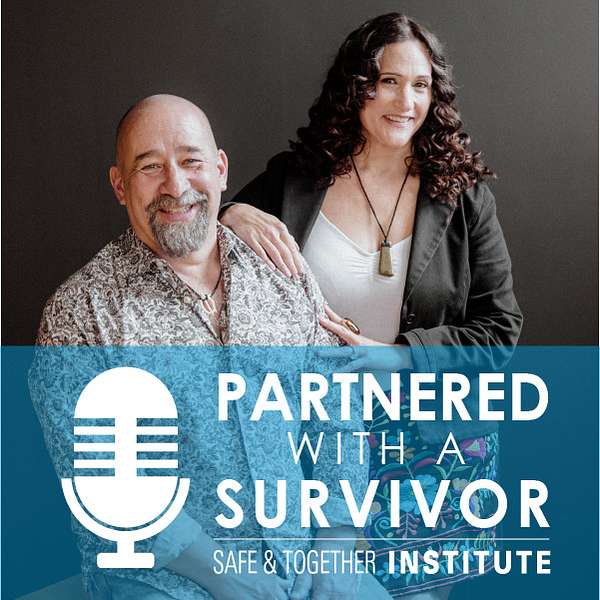
Partnered with a Survivor: David Mandel and Ruth Reymundo Mandel
This podcast is a series of conversations.
What started as a series of intimate conversations between Ruth and David that ranged from personal to professional experiences around violence, relationships, abuse, and system and professional responses which harm, not help, has now become a global conversation about systems and culture change. In many episodes, David and Ruth are joined by a global leader in different areas like child safety, men and masculinity, and, of course, partnering with survivors. Each episode is a deep dive into complex topics like how systems fail domestic abuse survivors and their children, societal views of masculinity and violence, and how intersectionalities such as cultural beliefs, religious beliefs, and unique vulnerabilities impact how we respond to abuse and violence. These far-ranging discussions offer an insider look into how we navigate the world together as professionals, as parents, and as partners. During these podcasts, David and Ruth challenge the notions which keep all of us from moving forward collectively as systems, as cultures, and as families into safety, nurturance, and healing.
We hope you join us.
Have an idea for a podcast? Tell about it here: https://share.hsforms.com/1l329DGB1TH6AFndCFfB7aA3a1w1
Partnered with a Survivor: David Mandel and Ruth Reymundo Mandel
Season 7 Episode 3: How Systems Become Tools of Coercive Control and What Professionals Must Change: An Interview with Valerie Frost
We start with a snow-bright morning and end with a sharper lens. We sit down with advocate and system analyst Valerie Frost to explore how systems built to protect families can become tools of coercive control—and how to change that trajectory with better listening, precise language, and survivor-centered practice. Valerie traces the everyday realities of child welfare, family court, schools, and law enforcement, showing where checklists fail, how jargon shuts doors, and why knowledge inequity forces survivors to learn a foreign language just to get help.
We dig into visible versus invisible harm and why non-physical abuse or coercive control often gets dismissed or misread, leaving anxiety and hypervigilance weaponized against the survivor. From “customer service” logic for public systems to the risks of records, we examine how police calls and protection orders can be turned against survivors, and how both over-engagement with systems and system hesitancy get blamed. The conversation moves from critique to action: validating protective parenting, centering context over compliance, and anchoring assessments in the perpetrator’s pattern rather than the survivor’s reactions.
Valerie shares practical tools—build a dated log, control your narrative with consistent documentation, protect your basics like sleep and hydration—and argues for policy shifts that mandate recognition of coercive control, limit unnecessary information sharing, and reward restraint over surveillance. We also talk about showing up whole: professionals who are survivors, survivors who lead, and creating rooms where the end user defines engagement.
The takeaway is simple and demanding: Systems don’t need more policies as much as they need better listening; survivors have already mapped where harm happens.
If this conversation resonates, subscribe, share it with a colleague or friend, and leave a review so more people can find survivor-centered guidance that actually helps.
Now available! Mapping the Perpetrator’s Pattern: A Practitioner’s Tool for Improving Assessment, Intervention, and Outcomes The web-based Perpetrator Pattern Mapping Tool is a virtual practice tool for improving assessment, intervention, and outcomes through a perpetrator pattern-based approach. The tool allows practitioners to apply the Model’s critical concepts and principles to their current case load in real
Check out David Mandel's new book Stop Blaming Mothers and Ignoring Fathers: How to Transform the Way We Keep Children Safe from Domestic Violence.
Visit the Safe & Together Institute website.
Start taking Safe & Together Institute courses.
Check out Safe & Together Institute upcoming events.
We're back.
R:Hello.
David Mandel :Hi. That was weird. I couldn't even tell when we were recording.
R:I couldn't either.
David Mandel :I think it's AI doing whatever it's going to do. Oh boy. Good morning. Are you warm enough? No. Okay. I knew the answer to that. At least I took my hat off. We're in my office and we're back in New England, and it is probably about 15 degrees Fahrenheit for all our international non-US snow capped, snow-capped bushes and snow capped trees, and quite lovely.
R:I got stuck in a snow avalanche the other day driving. It was magical but concerning.
David Mandel :Okay, it wasn't like a real avalanche, wasn't it?
R:It was it was it was not quite full avalanche.
David Mandel :A Colorado avalanche, right? Just for people who worried. No. Anyway, you joining us for a winterly, winterly day.
R:Yes.
David Mandel :Partner with Survivor episode. I'm David Mandel, CEO and founder of the Safety of the Institute.
R:And I'm Ruth Raimundo Mandel, and I'm the co-owner and this chief business development officer of the institute. And I just wanted to do a little land acknowledgement before we get started that we are sitting on Tunksis Mosako Land, the greater Algonquin nation in the Farmington Valley near the beautiful Farmington River, and are deeply grateful for the nourishment of this land and for how it sustains life. And I'm very excited actually about this podcast episode. You know, one of my favorite things to do is to find lived experienced voices and credible experts who have deep system literacy and deep system awareness and who can really speak to the gaps and the failures and the harms of the institutions that we have to navigate just in our everyday, but also particularly when we're experiencing domestic abuse. And Valerie Frost is one of those people who I've really admired and I've listened to her podcast and read her articles and have affinity for two, because I was little California Latina that was taken by an institution and brought to Kentucky when I was turning about 10, 11 years old. And so I've lived in Kentucky and am really, really concerned with the state of institutional accountability there. So I have taken comfort in knowing that she is there speaking and doing her thing. So, Valerie, thank you for joining us. I'm really excited to have you on. I am excited to be here.
SPEAKER_00:Thank you all for having me.
R:So, really, your analysis of systems is what brought me to your door. And if you were to give a summary of the state of institutions there in your region and what you're hearing from other survivors, because you are now hooked up with other survivors around the globe, would you be able to give like just a little short synopsis of your understanding of the state of things?
SPEAKER_00:Yeah, I can start by sharing about my experience and what brought me to this work, especially at the intersection of domestic violence and child protection. Because if you've if you follow my work, that is the main space that I advocate in is child welfare. But when we talk about child welfare, there's typically three buckets that filter into it mental health, substance use, substance use, and family violence. And those are community factors, those are social determinants of health and root causes that don't get as much specific attention other than the great work that you all are doing. A lot of times people focus on that reactionary piece of, oh no, something has happened or it hasn't happened or whatever. So when I am invested in child welfare, I'm I'm thinking back to all of those things. So I am very much immersed in this space of family violence, interpersonal violence. And I come to this from lived experience and from systems work. As you've mentioned, I wear many hats. And also I wear all the hats all the time. I do not compartment compartmentalize my professionalism or my lived experience. And I've spent years navigating child protection, family court, schools, workplaces, and law enforcement while parenting. That's the most important thing. I am a mom. I'm a mom of three. And I'm trying to keep my children safe and free from coercive control. Um, so what I've learned to answer your question directly, what I've learned often the hard way is that harm doesn't just come from the abuser. It comes from systems that don't understand coercive control and unintentionally become tools of it. So that is something that I see playing out frequently in my life here in this region. But you know, you you bring up Kentucky and you bring up, well, what am I seeing here? And and and what is the state of institutions? It's just, it's surprising to me the more that I speak and I speak from a place of truth, and I refuse to be silenced because silence is a is a tool of power and control. And I will not accept that for myself. The more that I speak up, people coming to me from all over the world, all different countries and continents. And so I could sit here and tell you what is happening in my county. I could tell you what's happening in the Commonwealth, I could tell you the tri-state area, the United States, but it's not isolated to here. This is these are patterns across systems, across humanity, and the way that we value one another, the way that we hold ourselves individually responsible for the collective, and where power and control sit in our culture and our our civilizations.
R:Yeah, it's that's it's uh difficult to know, to have the knowledge and carry it, that so many women and children and men are being failed and harmed and hurt around the world. And I am just grateful for every single advocate, lived experienced, credible expert out there who's sharing their experience because it's filling in the pieces of the puzzle, it's creating a map of the train and the institutional realities and the similarities and the patterns. And I I don't know about you, but what I find is a lot of similarity. So I'd love to hear your experience of that. Yeah.
SPEAKER_00:Yeah. So my my work now, it focuses less on individual failure because and I'm I'm sure you're aware of this. To do individual case advocacy, they they are unique stories. You're going to hear all sorts of situations, but like you mentioned, there there are there are patterns, and this is a broader systemic thing. And that's what I focus more on now is how institutions respond, how survivors are pressured to carry responsibility for the harm they did not cause, and what this means for children and families over time.
R:Right. Yeah, yeah. Very powerful. How does it make you feel hearing this? Because this is just so much of a I love it.
David Mandel :I love I love Valerie, your perspective about being a whole person and bringing your whole person to the work. And and also I love the your analysis, obviously, about systems being targets of perpetrators, enablers of per enablers of perpetrators. I think that that one of the biggest for me as somebody who's been working on the issue of coercive control for you know decades, why it's remained central to my work and the model is as opposed to approaches that focus exclusively on physical violence, coercive control really gives us the language to look at entrapment and the involvement of systems and intersectionalities and vulnerabilities. And I just wonder because it's it's not just the individual behaviors of the perpetrator, it's the failure of the systems or the action of the systems or the professionals or the the decontextualizing the mental health issues from the perpetrator's pattern, or you know, I could go on and on about this. So I'm wondering for you what you you find in your advocacy that have been some of the really successful strategies to communicate this to different professionals. You know, you're out there doing this every day. We could we could all catalog the problems, but you're actually being successful in because and I know you're being successful because you're invited back. You're being asked to talk, you're being asked to speak, you're participating on boards and trainings. And so talk to me about those strategies that you find are successful in that way.
SPEAKER_00:Oh gosh, I reference this so much. The book, it's literally right here on my desk. Your silence will not protect you. Neither will your truth, though. And I want to be clear on that. Speaking truth to power, truth telling is risky. It's not easy. And the strategy, I don't know if strategy is the word yet because that makes me sound like I truly know what I'm doing in all aspects. And I do not, but I want to be cognizant of the listeners and that some, I'm not sure how many are survivors or are professionals, ratio, professionals, also intersectional professionals, because many people in this space also have lived experience. I don't want to diminish the barriers and the obstacles that they face to be heard, because there are many, like you mentioned, there are so many. I will say what I have learned in this space, again, the often the hard way. What I have learned is that these institutions are very siloed and they all have their own jargon. They all have their own language, their own priority, and their own kind of, I don't know if this is an appropriate vocabulary in this instance, like their own dog whistle, I guess. Like there has to be a phrase that you use that, like they're like, oh, I can respond to that per my SOP here. Like this is, I can only respond if this is happening and this. And people in the public, families on the front lines generally, and I don't want to make assumptions, but I believe generally don't understand this. And so they see kind of the generic mission statement of institutions, and they're like, oh no, so I can use that. I if I go to law enforcement, they're there to serve and protect. So they'll protect me. And they don't understand the intake process, the response process. You know, you get into courts, you get into law enforcement. Is it civil? Is it criminal? Does it go to this prosecutor? Does it go to a county attorney? Does it go to whoever? And it's so organizationally nuanced. And people don't have the organizational structure and the chain of command and oh no, I skipped over one person. So now I've offended everyone beneath them. I didn't know that, and I just wrote the director and because I thought they cared the most. That's why they're at the top, right? And so in what I have learned is you have to learn these systems. You have to learn them individually, and you have to learn what they respond to in the language that they use. Otherwise, they simply will not hear you. If you don't say it the way that they can hear, it doesn't mean anything. Right.
R:And this is where this is where who creates the language is so vital because if their SOP is all calibrated towards physical violence and they have no conceptualization, no forms, no tick box, no risk assessment knowledge, of course, of control and systems manipulation, they will not at all see it. So we're just invisible to them at that point. And that's the power of forms, and that's the power of SOPs, and that's the power of language that institutions use.
David Mandel :You know, you had to use these key phrases. But I still remember a conversation with an advocate I had years ago in a training setting that was looking to build cross-systems collaboration. And she came to me at the break and she said, I've got this case and I don't know what's wrong with child protection, why they keep letting this perpetrator back in the house. And she was upset and worried, obviously, and angry. And I said, Well, can you tell me a little bit about where the case is in the child protection process? And she said, What do you mean? I said, Well, do they have court involvement? Because child protection themselves, as an executive agency, doesn't have a lot of power on their own to keep people out of other people's houses or to control where they go and what they do. Their power to do that is through the court. And she goes, What do you mean? I said, Do they have a court order? Have they filed in court? Is there court order through child protection that says this guy can't go in the home or another court order? She goes, No, or I don't know, I think she said, I have no idea. And she was expecting child protection to do things that actually they weren't able to do or in general or weren't in a position to do in this particular case. She just thought, like you did, I write the director, they care the most.
SPEAKER_02:Right.
David Mandel :That child protection's got this power to do this. And there was a lack of literacy. Now, I'm not, I don't want to make it about the advocate. I think this is a large wider systems issue, but there was, like you said, so there was a disconnect between what she thought they should be able to do and what she wanted them to do, and what they were doing or could even do.
SPEAKER_00:Yeah, though so those two separate threads here. I want to go back to the like visible, invisible violence things. I think it's important to discuss like how systems respond when harm doesn't fit their mold, right? And and again at the institutional level. So when harm isn't visible, systems tend to default to disbelief or misattribution. Again, because of it people a lot of times people are very surface level. They're just looking at their checklist. They're looking at their form. We mentioned that. They're just like, okay, is this and this? And if it's not there, now it becomes invisible. And now it's just it unless you are directly impacted by violence and at a point where you're even aware that you even are impacted by it, it's just not urgent to you. It's not clear to you, it's not urgent to you. So survivors can be seen as overreacting, unstable, difficult. And then perpetrators are benefiting, right? Because they appear calm and reasonable. And so non-physical abuse can leave visible consequences, anxiety, exhaustion, hypervigilance. And those consequences are now weaponized because they're treated as evidence against the survivor. But when we talk about, you know, like now the other the other thread here of again using the language and understanding the org chart and the actual functions of each institution. I can speak this from a survivor from a lived experience lens. It's so hard to let go of they're a human being with a pulse and they should care and I can make them care. It is so hard because that's when the institutional betrayal comes in, right? When you're like child protection services is supposed to care, they're human services, they're social services. And when you don't speak their language and they don't respond, because, like you mentioned, it that's a court function, that's a criminal function, that's a civil function, that's whatever. Now it's the compounding hurt and harm of being harmed, and now feeling like the institutions are letting you down. And there is a disconnect between the people who need and deserve to be served and those who are serving. And that disconnect is exasperated by knowledge equity. And that's what I call the knowledge of these org charts and these systems and the jargon is there's an inequity of knowledge.
R:I love that term, knowledge and equity. But even more so, I'd like everybody to pause and imagine a world, just imagine a world where services, in order for you to get what's called services, you have to know how to speak their language, and it's a complete foreign language. And if you don't speak their language, not only are you not going to get that service, but more than likely you're going to have your liberties taken away from you or your children taken away from you. So that's the world that we're existing in, and that's a real thing. And I'd like to give a couple institutional behavioral examples, if you might, if you're okay with that, Valerie. And that would be just for practitioners who are listening on the backside. A great example of what Valerie is talking about is the example of a person who's being coercively controlled who calls the police multiple times to report that their liberties are being impeded upon, but there is no physical violence. And so the police then start to believe that they are unstable, mentally ill, or that they're falsely reporting. And then their perpetrator starts to manipulate that, and their concern is weaponized for their child, perhaps in a schooling situation. And then they have their liberties removed through an involuntary cycle or an arrest because the perpetrator said that they were unstable. These are all things that are commonly happening to people. These are not situations that are uncommon. And I'd really like for practitioners to hear that these are very common things. Valerie, does that sound like what you're talking about? Is that a good behavioral example of that?
SPEAKER_00:Oh gosh, we all know. I I don't want to, well, I don't want to do absolutes, but I think there is common knowledge now of the most surface level thing that survivors hear. Why didn't she leave? Why didn't she just leave? Or now, why didn't you just call the police? Right. So many survivors are told, just leave or call CPS. If you're worried about your child's safety, call them. They're there, or call the police. And there are real risks and trade offs when that you face when you're engaging or you choose not to engage these systems. So the advice to just to call the police, like you're mentioning here, it assumes that systems will respond competently and without bias. And that isn't the reality for many survivors. So for me, every system's interaction carries. Trade-offs, retaliation, escalation, misinterpretation, loss of control over your own narrative. And narratives, that is what carries the most power. Who controls the narrative? Right?
R:That's right. That's right.
SPEAKER_00:So calling for help could trigger surveillance rather than support or create documentation that can later be weaponized. Absolutely. So real safety planning is not about compliance, it is about context. And survivors are constantly weighing short-term relief against long-term consequences, especially when children are involved.
R:Yeah, I thought it's interesting.
David Mandel :You know, from a basic customer service and user point of view, you know, and Valerie were talking about this a little bit before the call started, the show started. But, you know, there's a survey being done that was done, I think, in 2015, 2016, out of the US, out of the National Domestic Violence Hotline, I believe, that said basically most survivors who've called the police or might call the police said they wouldn't, basically. That that they don't think it would make it better for them. And so from a customer service point of view, if your primary customer, domestic violence survivors, because that's your largest percentage of your calls, is saying we don't trust you to make it better. And if we've called you, we won't call you again. And if we haven't called you, we don't think we we will call you, then there's a customer service problem.
R:If you want to just put it in, no one is getting the return on that investment in law enforcement dollars for domestic violence.
David Mandel :No one and and you know, uh a number of years ago, I I I took the concepts of being culturally competent and being trauma-informed and said, what does it mean to have a domestic violence-informed system or put that label on? And the definition of trauma-informed stuck with me, which was that you have that it's reasonable that you should expect that more likely than not, it's not a high standard, it's a preponderance standard, more likely than not that contact with a system will make the situation better for you and your kids. Like it's actually not like that. Said, wouldn't that be wonderful if I could expect that if I come in contact with law enforcement, family court, child protection, that more likely than not, 51% that you will make my situation better as the professional, as a system. Unfortunately, I don't think we're close to that. And and and I and and I think a lot of it is structural.
SPEAKER_02:Yeah.
David Mandel :I think you know what's interesting, and I'm gonna get myself in a little bit of hot water here. I'm gonna, I'm gonna say, I'm gonna say this because I think Valerie and I are both like, yeah, no, but not no way. No, I think it, you know, because I'm talking to to folks who are doing studies on family court in Australia, yeah, and they're doing studies where they're hearing a lot of good results. They're hearing survivors saying we like the outcome. I don't think we hear enough of those stories. I don't say they're preponderant, I'm not saying that that we can trust them. That's my experience is that even when systems get better, that it's a little bit of roulette, and that's not acceptable. But we're not talking about the things, the times it worked for survivors and why. So we can replicate those things. So I I think it's it's I think we're just really doing a bad job really understanding and analyzing and saying systems are risky for survivors, like you're saying. We need to analyze them, we need to understand them.
R:Well, I think I would tweak that a little bit. Sure.
David Mandel :So I told it I got hot water. Did I get in hot water?
R:Did I did I did I if it was me, yeah, I would say that I think that we need to actually represent the reality that we're operating within and the things that are working, what it is that is having an impact, not claiming that that's happening most of the time or the time, but that we do have to focus on the impact of our efforts because there is there is little knowledge within the system, even among professionals, of its operating and its failures. That is still widely not known. And a lot of professional pushback comes when survivors talk about the dire realities, and a lot of ego enters into the system where people become defensive. And and one of the reasons why I love your work is because you actually can really bypass that. So I'd love to hear some of the ways that you've but helped to bypass that when you're working in those professional spaces to talk about those systemic failures and how those people in those systems can do better by survivors, do better by domestic abuse victims, and do better by kids.
SPEAKER_00:Absolutely. There's so, so much here. One, I have to say this because I will say it forever and ever and ever. Engagement is determined by the end user. And that is that customer service that Mr. Mandel, you were talking about. Engagement is determined by the end user. And I'm going to bookmark that and come back to it. I have to say two things on the law enforcement front to educate because my background is teaching. So, first and foremost, I am an educator and I really want more people to be aware of this, of the trade-offs and the risks that 51%. I'm not sure that people know this. I haven't heard it. I'm sure you all are aware. Two things, just highlight real quick, and then I will answer that question. One, when you call law enforcement for domestic violence, even if you are not a parent yet, if you have child protective service involvement later when you become a parent, that report that you made for an EPO protection protection order, that can come up into your uh CPS file with your kids, even if you were not a parent at that time. So that that is one thing. Two, let me not, let me not forget it here. Oh, way that things can be weaponized by abusers is that they can do, and and hopefully that this doesn't get weaponized also. So obviously there's always risks, but I want more survivors to hear this is that when you call law enforcement, that becomes public record, and that your abuser can get a open records request of your law enforcement calls and there's some protection there. So suggestion to professionals, you might want to consider tightening up some protections. If someone has a protection order, then the perpetrator should not be able to get records on them. But to answer your question, how do I bypass that? I'm gonna go back to the bookmark on the engagement as determined by the end user. Because something that I see very frequently is that direct service providers are playing the role of the end user because they are in these professional roles and they're brought in and they're they're given authority. They are seen as credible. And if you look in CPS, that we could have an 18-year-old daycare worker who has a high school diploma and they're put in a position of trust and they're a mandated reporter, and there could be a 39-year-old parent who has six kids, and that 18-year-old, just because they're in that professional role, can create any narrative on that parent, even though they have no kids, a limited worldview, their brain isn't even fully developed yet. And that's what we see a lot. And so when these professionals are brought into these professional spaces, it's they're the organizational culture pressures them to assimilate into institutional protection. And so what they're doing is they're looking up at leadership, even though they're supposed to be serving the customer, the end user. And so leadership and and all chain of command above is looking at that direct service provider as the end user, as the voice, as the person who controls the narrative on what's happening with families on the front lines. And families on the front lines are invisible. They are not heard in the same way, they're not respected. When they, when their voice gets inserted, there they there's like a recoil. Like they're too emotional, they're biased, they don't understand our processes and procedures, we don't want to hear it. The same exact thing can come from the direct service provider. And it's, oh, this is a pattern, this is a problem. Oh, oh, thank you so much for bringing this to us. And in the work that I do, I try to break that wall. That is what I am doing every day. When I show up at these spaces, I continue to show up, to show up, to know that I'm not really wanted all the time. And that if I speak the truth, it is going to bring discomfort. But that is a good thing. That's a signal.
SPEAKER_02:Yeah.
SPEAKER_00:If these meetings are comfortable, then we're not doing the work. There needs to be discomfort. There needs to be different perspectives and different voice. And so every day I'm just swallowing it. Like I'm going to be so uncomfortable today. I may be uncomfortable. I may, someone may not like me, but it's not, I'm not even here for me. I'm here for the people that aren't here. And so this isn't personal. And if you make it personal, that's really a personal problem for you. I have to keep showing up. I have to keep showing up and showing up with authority that I know I have authority because I have lived experience. And just to make a little plug, I have to do it, you all doing a TEDx talk in February, and this is exactly what I'm talking about, is that you don't need permission to show up. You don't need permission. You have your truth, you have your lived experience, and you don't need to go to school and get a degree to now have permission to speak. If you are living it, you know it. And so every day that I do that, every day that I don't run away because it's embarrassing, because someone didn't like what I said, that is breaking that wall and showing people that the end user does exist. The real end user exists. And the real end user is credible. And the real end user can change things because the way that things have been set up, where the direct service provider has been the end user, is not working. It hasn't been working. And there is a disconnect of customer service because the end user is not being engaged. And we need to engage the end user.
R:Yeah, you know, there's so much in this, Valerie. It is real that in the services industry, particularly human services industry, the medical industry has done a little bit better because people actually shell out money as end users, and that's the only reason that they're concerned about them. But we all know, and it should be widely acknowledged among professionals, uh, that the overarching attitude is that professionals and systems understand our needs, that we are unworthy, and that if we weren't uh bad, ignorant parents or mothers or women, we wouldn't be experiencing domestic abuse. And so I feel like there's a lot yet to be done within the industry to accept what is instead of what people want it to be. And that takes a lot of bravery and humility, but it's also strategic. It's also very real to just accept that this is the overarching reality between systems that the person who's experiencing the interventions, experiencing the quote unquote services, uh, is the end user, and that we have we have uh basically made them invisible, unworthy, and a person that should just comply with our perception of them rather than listening to their experience, rather than gathering the patterns of behaviors of the person who's creating the violence, rather than asking them what they need and and and filtering that through your organizational capacity. And if you don't have that capacity, working within your community to fit those needs when you see that need arising over and over and over again. So there's a lot that that needs to be done inside professional and institutional hearts and minds to just accept that they are not perfect, that they are not providing the preponderance of their end users, the type of help that those people would say is beneficial to them, and that we need to do better.
David Mandel :Valerie, I'm I'm wondering you know, we talk a lot about at the institute about how systems need kind of right built into what we're saying and what you're saying, that that systems have an obligation to the end user, to survivors, to their kids, and to themselves. I very much believe this actually to take a partnering stance with survivors, right? We'll talk about that all the time. You know, what's embedded in that is a sense of dignity, a sense of respect, a sense of self-determination, believing in in the the the that you're not a problem, not pathologizing, all that stuff that's there's that comes along with that. And then we kind of break that down into a bunch of different steps, and we kind of teach and train professionals in this. And one is is to validate to the opposite of pathologizing might be to validate what that person's doing right. Do you have either an experience where you felt like the system did that for you, or where, you know, or if it failed so objective abjectly, where you would have felt like it would have been really important if they had validated and seen whether it was a child protection worker or an educator or a family core. Is it can you can you talk about either that where you felt validated or where you what what they could have done to close that gap?
SPEAKER_00:I so I will say transparently with institutions, it's been difficult to see that. And I and I can't say that that is true in all instances because that would not be fair. We've had so many serve direct service providers, and I've mentioned them here. We've had so many who have championed our family and been very protective and been part of my family's safety net. But going back to I mentioned the institutional betrayal, whenever that occurs on a systemic level, it just shatters the trust. It fractures the relationship in such a way that it erases the good in its own institution. It's hard to see those individual workers who were there for you and supported you when the broader system really and truly is mimicking what the perpetrator was doing. They're silencing you, they're isolating you, they're gaslighting you, they're shifting your own reality, they're controlling you through compliance. And then that that good, you know, because even in interpersonal violence, there are ups and downs, right? So the ups, they go away whenever that is is crushing. But I can give you a tangible example just to be to be really helpful. Cause I I literally just posted about it. Had the kids at the grocery store. And for all parents, I know that sentence you felt that. Had the kids at the grocery store. My friend asked me a few weeks ago, do you do like the grocery pickup or do you actually brave going in the store with your kids? And I'm like, half and half, you know, I try to avoid going in because it's right for who knows what at the checkout with the candy there. But I mentioned this as a concrete example. So I have a I have a three-year-old and they there was a rubber ducky on an end cap. And it's like, you know, kids, they want attention, all behavior is communication, right? So they saw that that they might have wanted my attention, they might have been bored, whatever, whatever's going on, right? And so what they decided to communicate through fixating on the ducky. They wanted me to buy it. They're now they're throwing this whole thing. I want it, buy the ducky on it. And so for six aisles, they I've got this three-year-old who's starting to kick me, who's crying, who's whining about the duck. And and because I have, and I'm gonna coin this, I've I've been starting to throw it out there. I'm calling it CPS PTSD now. Because I have that, my thought was okay, if child protective services walked onto this scene right now, because they tend to freeze you in a moment, they're gonna say that I am inadequate as a parent. I'm not handling this behavior or whatever else. But then we got to the actual checkout, which is to me, that's the biggest, that's the biggest place of liability, right? That's where the candy is. Uh, we get a checkout, everything's fine, regulated, all of that. They're excited, they're seeing the things that we bought go down the thing. So now they're all, you know, and they're getting the stickers and and they're all happy. And, you know, my son makes a comment to the checkout person, and he's really proper and formal. So he's like, Oh, miss, how's your day? I hope you have a wonderful day, whatever. And so the checkout person tells me as we're leaving, you have really polite children. And so, and that's the thing, is that there just needs to be a balance. A lot of these institutions, they they can freeze you into one thing, they don't get the context. Again, I talk about this so much. Power, we talk about power and privilege. Power is the ability to control someone else's narrative. And when you don't get history, context, information, the back, when you don't look at their future potential, because you know what? Every day is not my best day. I don't know about you all, I'm not perfect yet. So every day's not my best day. But if you see me and you don't understand me and you don't understand what I came from and my resilience, and you don't understand my skills and my talent and where I could be and my potential, and you freeze me in that moment, that's when you can create a disservice. And I would say that for any institution. Education, if you react to a moment, law enforcement, if you react to that one call without understanding the dynamics and looking further, just businesses in community, you just look at one thing and you can do a disservice. But it's the people who we talk about, we've been talking about engagement. Engagement is a relationship. When you have a relationship and you know someone and you know a family and you invest in that relationship, because when you have friendships and family, you you learn, oh, this person likes this sports team. Let me learn something about that sports team. Let me see when their next game is, right? I could ask them a question about it. When you have a relationship and you really understand people, it gives you context to where you can have more of those moments where you are truly being responsive.
David Mandel :Yeah. I I I mean, I just want to put an underline for my professional colleagues under Valerie, what you just said, because I want to say to them, you know, today, what did you reflect back to a client, particularly a domestic violence survivor, about what they're doing right? What are you reflecting back to them about how you understand the context and the the hill they had to climb to get the kids to the doctor, get them out the door? What kind of obstacles did the perpetrator throw in their way that they overcame to do that, or or the system did? It's not, it's it's not, I as I say, it's not rocket science. It's it's about doing exactly, Valerie, what you're saying, which is considering context, yeah, seeing the person in front of you, seeing what they're what they're trying, and trying to trying to really decode and understand. And it isn't hard in my experience to say, wow, given what you described to me about what he's done to you. Or what the system's done, it's amazing how your kids are still on track with school. Or I hear how focused you are on their kids' needs, or how you well you're communicating and advocating for your kid with the school system, the teacher. Like that doesn't mean you're perfect, doesn't mean you succeeded at everything you tried to do. But professionals, if you're out there, your job is to communicate to that end user, to the survivor, to that person, you're not a problem.
SPEAKER_02:Right.
David Mandel :You know, these are the ways you're you're amazing and successful and incredible. And in fact, let's counter the narrative. You're talking about Valerie's narratives, let's counter the narrative that the perpetrator is probably giving you. Maybe your mother's giving you, maybe your church is giving you, maybe the the CP last CPS worker gave you. I'm here to counter that narrative, not in a naive way, not in a sort of, oh, let's all be nice, but I see you. And so that's my my shout out or my my call out to my professional colleagues. That's what what the job is to do that.
R:There's there's I don't know, there's so much going around in my head right now because I know that there's a lot of people that live on the polarities of the response. And that is, is you can have a person, a victim who's experiencing coercive control, who calls the police a lot because they've been told to call the police, that the police will arbitrate their conflict, even though they are only looking for violence and they don't have the ability to do that, right? We've told people call the police. So there's those people picking up the phone, calling CPS, calling the police, right? And then on the other side side of that polarity, and the system responds poorly to them. Okay, it blames them. It looks at them like they're a problem. Outreach to the system is often seen and taken as instability on the part of survivors and victims of domestic abuse and child abuse. And then on the other side of that, you have the person who is really system hesitant, who will not call, who will not go, who will not engage because they know the liabilities and the dangers. And then the system asks, why didn't you engage us? So I'm so sorry. I feel like I'm being gaslit here on a level. And that we need to really acknowledge that the system is not responding with, wow, you must be very alarmed for your safety if you're calling me multiple times. Can you tell me about what you're experiencing? That's not even happening at the most basic level with law enforcement, or on the other side of that, wow, I see that you grew up in an institution and were a foster child, and yet you called the law enforcement. That must have really meant that you were terrified for yourself. Those are not statements that professionals are even trained to make. And so I just really want to kind of close the loop about this in regard to partnering, you know? Like on both ends of the spectrum, victims, survivors, people experiencing ongoing abuse and coercive control are blamed on either side of the spectrum.
SPEAKER_00:I gosh, I mean, we were just talking about kind of that inner self-awareness for the professionals themselves or the direct service providers. And that's that's so needed again. And and what I would add, you know, what I was saying was was just a relationship. Yeah. So easy just to be to have a checklist in front of you and show up to your nine to five. It's harder, but it's better for people that you are trying to serve if you are in human services social services to be a human and see their humanity. But what we're talking about now are still those systemic and policy reforms that could better prevent the cross-system harm that myself, my children, and people like me have endured. So I think, you know, there's definitely a role that child welfare education and workplace policies do play in prevention. And I would say, you know, policy has to start with mandatory recognition recognition of coercive control and specialized responses across systems, not just child welfare, but schools, courts, and workplaces. So equally important is policy that limits unnecessary information sharing, requires context for reports, and centers protective capacity rather than default suspicion. And prevention doesn't happen through more surveillance. I want I want to say that again. Prevention does not happen through more surveillance. Yeah, it happens through better understanding, restraint, and accountability focused on behavior, not victims.
R:Yeah, yeah. You're speaking our language.
David Mandel :Yeah, you are. So I'm wondering about you spoke about the whole person and and humanity, and and you show up in your life, I assume, and the work you do as as a whole person, you know, you said as a mother, you know, as a survivor, as a professional. And I imagine that invites other people to meet you that way, you know, including professionals. Can you talk a little bit about that? Because Ruth and I have spent a lot of time talking about how do we our systems are filled with professionals who are also survivors, but there's often this very rigid divide between the two where they're what I've experienced is professional colleagues who are survivors being scared to disclose, feeling like it will diminish their the perception of others by their professionalism or make them more vulnerable. Can you talk about the bridge that you build by disclosing or talking about yourself the way you do?
SPEAKER_00:I'm gonna answer that directly, but I'm also gonna put myself in hot water for a second too here. Okay, yeah, there you go.
David Mandel :The water feels good.
SPEAKER_00:Okay, because I know and I see that you all do acknowledge and specifically name lived experience. And, you know, that's still kind of a buzzword, a new concept, all of that. And this is not to take away from anyone's experience at all, but to really broaden understanding and get some more thought. What I see is that there are intersectional professionals who are still operating with an institutional lens. And there are also impacted people for safety reasons lean toward an institutional lens because they think that's the only pathway to credibility, or because they're they're trying to get a foot in there, they're trying to get a seat at the table. And so on both ends, actually, just because you have lived experience does not actually mean you're safe automatically or that you are aware automatically, and that you're a professional does not mean that you are unsafe automatically. I think the the key for me and what I'm trying to find when I am thinking very intentionally about my smaller inner circle of trusted people is are you able to think through a community lens? Are you able to think through the real end user? And that is something that we are conditioned. You think about elementary school when you're sitting behind a desk or you're lining up in a line, we're conditioned to think in systems thinking, the way that you sit in a cafeteria and your schedules. Everyone is gonna, it is harder, it is more innovative and creative to break out of the mold and to do something different. So, what I would say is just answer the question directly now. This was a great moment for me. It was really validating. I was doing a training on engagement, on engagement a few months ago. And when I did the introduction, I said, please introduce yourself by the role that you want to show up as today. Because so often in professional trainings, you are told that you are not told, but it's implied that you're showing up as your organization or your agency, but that many people have wear multiple hats. They do have that professional role. They are someone who just is a really strong advocate in their community and they have a lot of community pride. They are a parent. They are all they're they're a leader. They people look up to them to make decisions and they have all this authority that, you know, being a leader is not actually easy. That was a lot of responsibility, right? And so I said, look, in this training today, show up as whatever that you want to show up in this training and absorb this knowledge through the lens of. And it could be one thing, it could be more than one thing, it could be all the things. Because me personally, I choose to show up as my whole self everywhere. I am a professional. I have professional expertise. I have degrees, I have knowledge, I have years that I have dedicated. I have, what is it? So many hours make you an expert. I've exceeded the hours. I'm there. But I'm also a person and a human being who has had many experiences over my lifetime. And I am a mother, and I'm a person who has been impacted by systems, and I partner with systems. I'm all the things, and I will not show up in one space at any given time. But I I gave space for that and I said, What is your comfort level? And there was someone from an organization who said, Thank you. Thank you for that. I have never been to a training where I have been given this option, you know, and I actually do want to show up in a different role today. And this makes me feel safe.
R:That's great. I love that. I love the the the values and the community ethos that you bring to your work, really. And and I I have maybe I'll get myself in hot water now since everybody else has.
SPEAKER_00:From that, I can't control.
R:I love what you said about how not every professional is going to be do poor practice or be a threat to you. They may be a great benefit and a great support and great advocate. And not every lived experience person is going to be a good advocate or do good practice or create space for you. And that's very real because one of the things that I pay attention for is that that communal spirit, that ability to hold multiple voices, to seek out multiple inputs and not be the singular thing. That's why I'm always saying that safe and together is a great model. And does everybody have to use it? No, they should use what works uh in their region and for their community and for them. And if some of the things that we have work for them, we are really happy about that because we want to support their community and their well-being and the outcomes in their particular place. So that's the spirit that that we bring to this. So I just love that. I would love to hear because we've said a lot to professionals, but I would love to hear what you would have to say to survivors. What it what what would you what information would you want to relay? Because this goes all over the world. What what what support, what knowledge, what awareness would you like, or just affirmation would you like to bring to survivors?
SPEAKER_00:Oh gosh, I have a couple of things. And again, I just mentioned that being a leader does come with responsibility. And it's not fun. I know a lot of people envy and may envy might look up to you, and they're like, oh, I don't want to be there. I want to be the person at the top. Once you get up there and you realize that people are listening to you and leaning on you, then it becomes with a comes with a new challenge. But I would say uh one tool for the tool belt. And and you know, again, take it or leave it. If you need it, take it. If you don't, leave it. When you are involved in anything, you're involved with a system, you're experiencing coercive control, you know, physical balance, anything, get a calendar, a digital paper, whatever. Get a calendar, please write stuff down. That is a tool that I would say that I wish, you know, somebody, someone may have told me early on, it's hard to keep up with. Please stick with it. Do not rely on your memory. Do not, that is something that will help you speak the language of institutions. When you can take all the emotion out and just say, on this date, this happened. On this date, this happened, and it will help you identify patterns and it will help you make a timeline. And that is a very strong tool. And do it if you haven't done it and you're halfway in, you'll you this stuff will never end for many people. Coercive control, it will go on. We know post-separation abuse. You don't know when it'll end. So just do it today, start today. Another thing I would say to survivors, and this is not, I will tell you, I've heard this to me and it is cringe, like self-care, self-care. Uh, when you're in survival mode, please that is so hard to hear. But I will say, if you can, please, please, please try to take care of the basics because that will give you strength to have power. Drink water. Try to sleep no matter how bad it is. Please try to drink water and sleep. If you can take a vitamin, just focus on that because it will help you communicate your message clearer. It'll help you to compose yourself when you have to. I'm not saying censor yourself. I'm not saying, you know, play the game. I'm not into all that stuff, but just try to look and appear as healthy. It'll help you think, you know. So those are two things I would just say tools for the tool belt. But just on a broader thing, I just I loved what you said. I loved what you said about not mimicking the system because that is something that people do in engagement often is mimic the system. And the system likes to have these cookie-cutter, one size fits all approaches. And so, survivors, I'm sorry if you think I have all the answers. I have one person with lived experience. That's why I am here on this podcast sharing with other people who have knowledge and experience, because there's not one person that has all the answers, and no one can tell you this is what you do step by step by step. You have to do what is best for you in your situation and what is realistic in your jurisdiction in your area, because I cannot tell you something that has worked for me here. It could vastly backfire for you, depending on what judge you have, depending on what your law enforcement knowledge is. And I would hate to hold that. Um, so please take care of yourself. Please try to do things that may seem opposite of what your body is telling you to do. If you feel like you are down and you feel like I'm too much of a burden on other people, I shouldn't share this with them. Talk more. Go out more. Even if you are scared of people, which is so reasonable. It is so reasonable to have fear of other people and who you can trust. The more people you talk to, you will find people that you can trust. So just try. And and I will say this this is the number one thing that has worked for me. I control my own narrative. So if my perpetrator says, oh, Valerie isolates her children, she doesn't go out, she doesn't do this. I have an entire Google drive of pictures of every single day of my children's life almost at this point at different venues around different people. You cannot control my narrative because I control it. I make posts every single day. I know social media is something that institutions retaliate against. That is a real thing. But if you go on my social media, you see pictures of me every day, you see where I am every day. So nobody can say, well, she's not a good worker, she's not diligent, she's not dedicated. Well, my narrative that I'm showing you and being transparent about tells a different story. So these are just some tools. Again, I don't want to tell people exactly what to do because I understand the realities of some people have less options, some people have different options, and I want you to do what is best for you. And I hope the best for you. And you do not deserve to be unsafe.
unknown:Yeah.
R:That that made me so emotional. Just the amount of work that we have to do.
SPEAKER_02:Yeah.
R:The amount of work we have to do to protect ourselves from from the systems that say they're supposed to help us. I mean, is just it's immense. It's immense, it's an immense labor.
David Mandel :Yeah, it's immense energy. It is, and it's a fundamental thing that professionals I would like them to remember is that whatever your personal good intent is, whatever your desire to help is, that you cannot assume that that the person in front of you feels safe with you because of their experience with systems, yeah, and that they're often strategizing as much or more about you, potentially, they even are about the perpetrator.
R:And so that's my kind of don't be the energy sucker of the viber.
David Mandel :You know, and you have so much potential to actually to be an assist, to be a support. So that's my message to professionals. So, Valerie, thank you so much for sharing your experience, sharing your your your multiple identities and perspectives and points of view, you know, as a bother knowledge, as a bother, a lived experienced person, as a professional, highly educated, experienced with systems, both professionally and unfortunately personally as well. Yeah, you know that you've interacted with them. So thank you for for coming on the show, partner with a survivor.
R:So I don't know. I can't, you're gonna have to do the closing.
David Mandel :I have to do the closing anyway. Oh my gosh.
SPEAKER_00:Like a parting word or anything. Are we gonna do that?
David Mandel :We'll give you, we'll give you, we'll give you, we'll give you what what's what's you get the last word, then I'll wrap us up. Yeah, so go ahead.
SPEAKER_00:Okay. Oh gosh. Well, now I asked for more work. Gosh, what I would I think uh to close us out. I think the most important thing is systems don't need more policies, they need better listening. Survivors are already telling us where harm happens. And the question is whether institutions are willing to hear it without becoming defensive.
unknown:Yeah.
David Mandel :That's that's beautiful. So thank you, Valerie. And you've been listening to another episode of Partner with Survivor. I'm David Mandel.
R:And I'm Ruth Ramundo Mandel.
David Mandel :And please, if you like this show, share with other people, follow us on whatever platform you're on, check out our website, safetyether.com. And with that information, we we are out of the way.