
Using AI as Your Personal Podcast Analyst
Most podcasters are sitting on a treasure trove of data.
Episode titles. Descriptions. Publish dates. Download numbers. Transcripts. Listener feedback. Years of conversations, topics, formats, experiments, and decisions.
The problem is that most of that data is hard to see all at once.
You can look at your stats and see which episodes have the most downloads. You can scroll through old episode titles. You can remember which conversations felt strong when you recorded them. But that does not always tell the full story.
Older episodes naturally have more time to collect downloads. Some titles underperform because they are unclear. Some topics work better than you realized. Some segments may feel important to you, but not connect as strongly with listeners.
That is where AI can help. Not as a replacement for your creativity. Not as a shortcut around doing the work. But as a mirror.
A good AI analysis can reflect your own show back to you in ways that are hard to see when you are the one making it.
I tried it with Buzzcast, and within an hour I was seeing patterns in our show that I had missed for years.
Starting with Buzzcast
This started with a simple question.
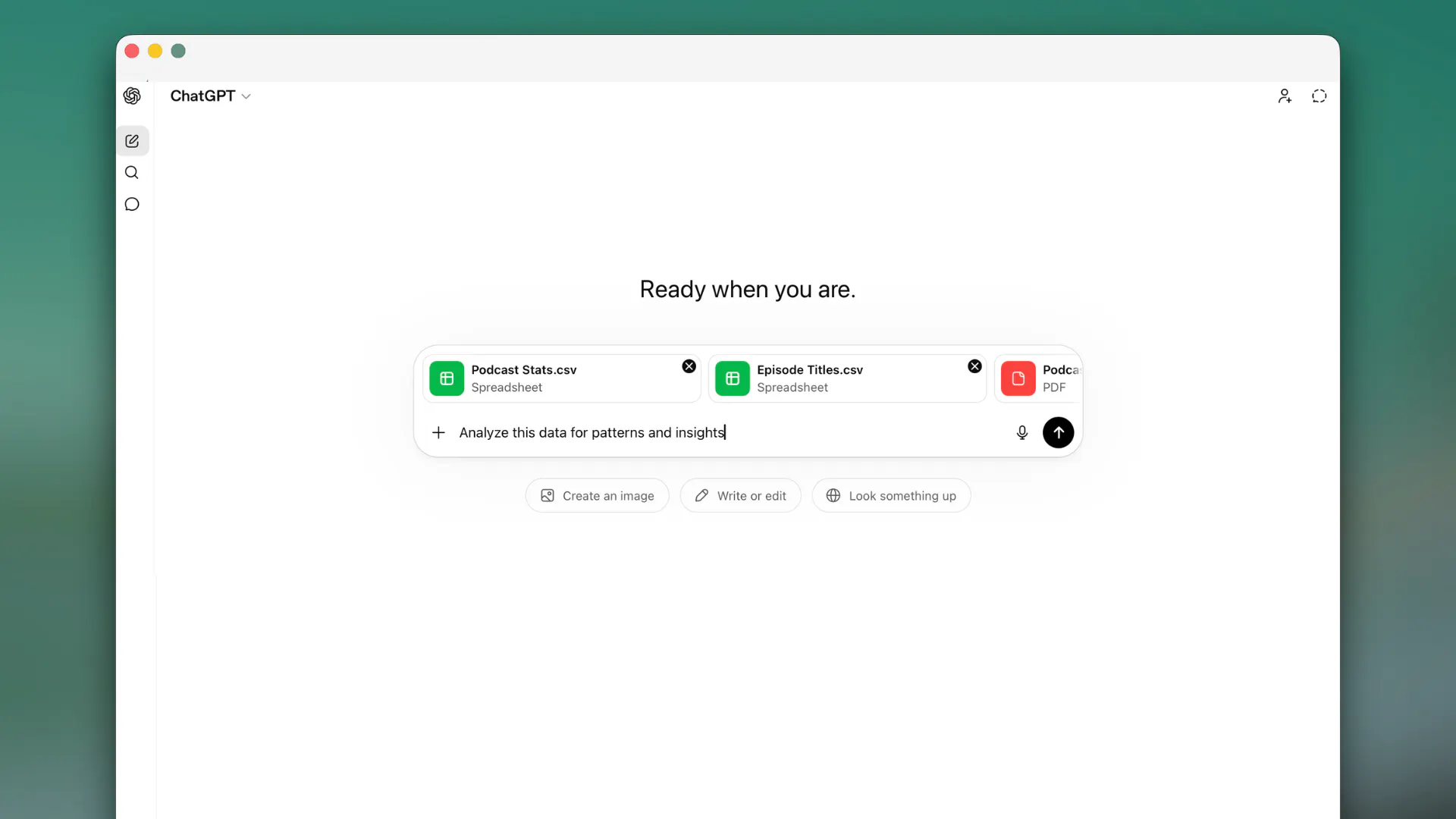
I was looking at Buzzcast episode titles and wondering if there were patterns in the titles that performed best. So I copied our episode titles, publish dates, durations, and download numbers from Buzzsprout and dropped them into ChatGPT.
Nothing fancy. No perfectly formatted spreadsheet. Just the basic information from our episode list.
Then I asked a simple question:
Look at my podcast episode titles, durations, and downloads. What patterns do you see?
It did a surprisingly good job. Not perfect. Not magical. But good enough to make me wonder what else might be hiding in our own data.
Buzzcast has been around for years. We have hundreds of episodes, full transcripts, listener feedback, and enough history to start seeing real patterns.
I kept going.
I downloaded our transcript file, added it to the conversation, and asked ChatGPT to connect the episode data with the actual content of the episodes.
Now it was not just looking at titles and downloads. It could see what we actually talked about.
The first lesson: explain your data
Podcast stats need context.
If you give AI a list of episodes and download numbers, it might assume the most downloaded episodes are the strongest episodes. But that is not always true.
Older episodes have had more time to collect downloads. A back catalog episode might pick up a few downloads every day for years. That does not mean it was a stronger episode than something you published three weeks ago.
So I told ChatGPT exactly that.
Please keep in mind that newer episodes naturally have fewer downloads because episodes accumulate downloads over time. Back catalog episodes will continue to accumulate a few downloads every day, even if they aren’t very strong.
That one instruction made the analysis much better.
It started accounting for episode age. It compared newer episodes more fairly against older episodes. It looked for patterns beyond raw download totals.
That was the first real unlock. A few years ago, this kind of analysis would have required a programmer or Excel expert and a lot of manual work. Now you can give the tool a plain-English correction and ask it to adjust.
That does not mean you should trust every answer blindly. You still need to look at the results and use your judgment. But it means the starting point is much easier than it used to be.
What AI helped us see
One useful thing it did quickly was categorize the show. It looked across Buzzcast episodes and grouped our conversations into broad categories. Some were obvious. Some were not.
Tactical podcasting advice. Industry news. Creator economics. Event recaps. Platform drama.
The first few made sense. We talk a lot about practical podcasting advice and industry news. That is core to the show. But some of the other categories were more eye-opening.
If “event recaps” show up as a major category, maybe we are spending more time on event recaps than we realized. If “platform drama” shows up as a recurring theme, maybe we are going down that road more often than we should.
That is the mirror.
AI did not decide what Buzzcast should be. It showed us what Buzzcast already was. Then we could ask the better question: is that what we want the show to be?
That is where this kind of analysis becomes useful. It is not just about finding what performed well. It is about noticing where your attention is going and deciding whether that still matches the purpose of your show.
For us, Buzzcast exists to help podcasters keep podcasting. So when the analysis showed that our strongest episodes often answered the question, “How do I make my show better?” that felt right.
That is something we should lean into.
Your back catalog matters
One of the biggest takeaways from this experiment is that your back catalog is more valuable than you think.
Every old episode is still an entry point into your show.
Someone might find it in a podcast app. They might find it through Google. They might hear another listener mention it. They might discover your show through one episode, enjoy it, and then start scrolling through everything else you have published.
When that happens, your old titles matter. Your descriptions matter. Your topics matter.
A lot of podcasters publish an episode and move on. That is understandable. You always have the next episode to make. But your back catalog keeps working.
AI can help you look back through old episodes and ask useful questions:
- Which older episodes still have strong discovery potential?
- Which episodes have good content but weak titles?
- Which topics seem to have the longest shelf life?
- Which episodes would be most useful to a new listener?
- If someone discovered my show today, which back catalog episodes should be easiest to find?
- That is a very different way of looking at old content. Your back catalog is not just an archive. It is part of your discovery engine.
Titles are a good place to start
Episode titles were the easiest place for us to begin.
When ChatGPT looked at Buzzcast titles and performance, a few patterns stood out. Clear, practical titles performed well. Titles that promised immediate value performed well. Titles with a clear impact performed well.
That does not mean every episode needs to sound like a listicle. You do not want to turn your podcast into clickbait. But clarity matters.
A clever title that only makes sense after someone listens is usually not doing enough work. A vague title might be meaningful to you, but it gives a potential listener very little reason to press play.
Good titles help people understand why the episode matters.
That is especially true in the back catalog. If someone is scrolling through old episodes, they are making quick decisions. They are asking, “Is this for me?
Your title needs to help them answer that question.
A simple prompt can get you started:
Look at my podcast episode titles and downloads. What title patterns perform best?
Then follow up:
- Which titles are too vague?
- Which episodes might perform better with clearer titles?
- Which titles communicate the strongest listener benefit?
- Rewrite these titles to be clearer, but keep them honest and natural.
The goal is not to trick people into listening.
The goal is to make the value easier to see.
Transcripts unlock deeper analysis
Titles and download numbers can teach you a lot. Transcripts take it much further.
Once AI could look at our actual episode transcripts, it started identifying patterns in the conversations themselves. What kinds of segments showed up most often. Which topics created stronger discussions. How episodes were structured. How we moved from one idea to another.
It also noticed something I had not expected.
Some episodes that looked average by downloads had generated a lot of listener feedback in the next episode. That became another signal of engagement.
An episode might not be your biggest download spike, but it might generate the most listener response. It might lead to more Fan Mail. It might answer a question your audience has been quietly wrestling with. It might become the episode people recommend to friends. That is worth paying attention to.
For Buzzcast, the strongest episodes often combined a few things: an industry topic, practical advice, and a deeper discussion about why it matters.
That was helpful because it gave us a structure we could use again. Not a rigid formula. Just a pattern.
When we cover something, we should explain what happened, give podcasters something useful to do with it, and then zoom out to why it matters.
That feels like Buzzcast at its best.
AI can help you understand your role
This was probably the most surprising part of the analysis.
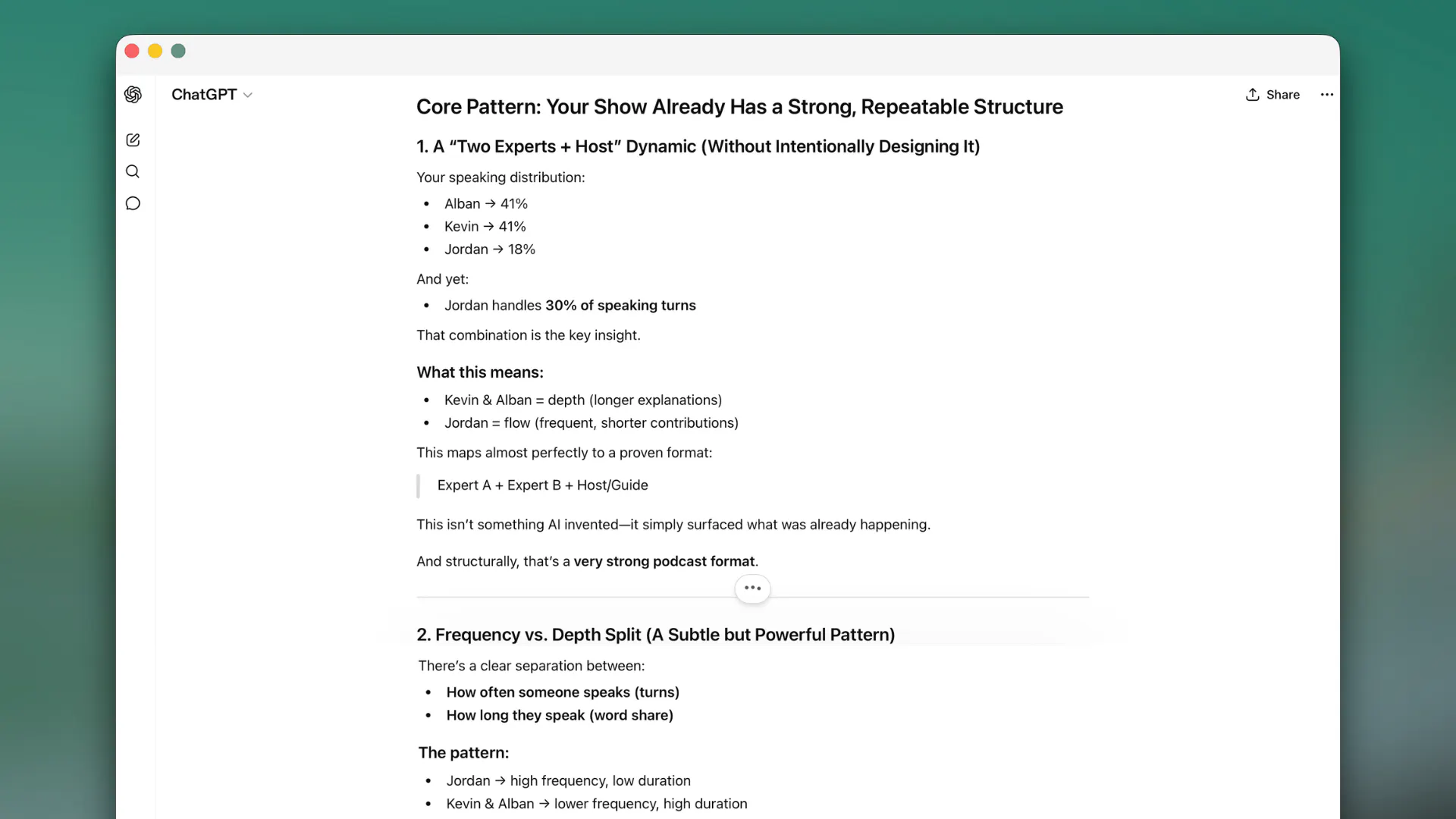
I asked ChatGPT to analyze the speaking distribution across our transcripts.
That sounds like a novelty stat, and at first it was. It told us how much each host talks, how often each person takes a turn, and how those patterns have changed over time. Some of it was just fun.
But then it got more useful.
I started asking what role each of us seemed to play in the show.
It described Jordan as the listener’s voice. She asks clarifying questions, keeps the conversation moving, and notices when the listener might need more context.
It described me as the big-picture voice. I tend to zoom out, connect ideas, and explain why something matters.
It described Alban as more analytical and technical. He gets into how things work, what tradeoffs exist, and what is happening under the surface.
That felt accurate and it reminded me that each of us has a job to do on the show.
If I do not bring the big-picture perspective, Jordan and Alban probably will not bring it in the same way. If Jordan does not bring the listener perspective, Alban and I may keep talking past the point where a listener needs clarification. If Alban does not bring the practical and technical analysis, we may miss important tradeoffs.
That is useful.
AI did not tell us to become different people. It helped us see the roles we already play so we can be more intentional about them.
This could be helpful for any show with multiple hosts, guests, or recurring segments.
You could ask:
- Analyze the speaking distribution across my podcast transcripts.
- What role does each host appear to play?
- Where do the best conversations happen?
- Are there places where one host dominates too much?
- Are there recurring moments where the conversation loses momentum?
- What should each host lean into more?
Some of the feedback may feel right. Some may feel off. Both can be useful.
If it feels right, you have something to lean into. If it feels wrong, you have something to examine.
Use AI for future planning, but only after it understands the past
Once I had worked through the older episodes, title patterns, transcripts, and performance data, I started asking about future episodes.
That order matters.
If you start by asking AI for new episode ideas, you will probably get generic ideas. Some might be fine, but they will not be deeply connected to your show.
The better approach is to let it study your show first. Give it your titles. Give it your stats. Give it your transcripts. Correct the assumptions it gets wrong. Ask follow-up questions. Make sure the analysis feels grounded in reality.
Then ask it to help you plan.
Based on my best-performing episodes, transcript patterns, and audience engagement, suggest new episode ideas that would fit my show.
Then keep pushing:
- Which of these are too generic?
- Which ideas best match what my audience already responds to?
- Which topics have we not covered recently?
- Which older topics are worth revisiting from a new angle?
- Give me five episode ideas that answer the core question my audience seems to care about most.
The results were much better after the AI had context.
It knew what Buzzcast was about. It knew which topics had worked. It knew which structures seemed strongest. It knew the roles we naturally play as hosts. That made the suggestions more useful.
Again, not perfect. You still need taste. You still need judgment. You still need to know your audience.
How to try this with your podcast
You do not need to make this complicated.
Start with whatever data you already have. Copy your episode list. Export your stats if you want more detail. Download your transcripts if you have them. Put the information into ChatGPT or another AI tool with a large enough context window.
Then start simple.
Look at my podcast episode titles, publish dates, durations, and downloads. What patterns do you see?
Then add context:
Newer episodes naturally have fewer downloads because they have not been available as long. Please account for that when comparing episode performance.
Then go deeper:
- What topics perform best?
- What titles seem clearest?
- Which episodes may be underperforming because of weak titles?
- What do my strongest episodes have in common?
- What does my back catalog suggest I should do more of?
- What recurring segments or formats seem to work best?
- Based on the transcripts, what makes this show distinct?
If you do not know what to ask, say that.
I want to use this data to become a better podcaster, but I do not know what questions to ask. Based on the data I provided, what should I look at first?
That is a perfectly good prompt. You do not have to be an AI expert. You just have to be curious and willing to keep asking better questions.
The point is to become a better podcaster
The encouraging part of this was not that AI could do something flashy. It was that AI helped us see our own show more clearly.
It helped us notice what was working. It helped us see what we might be overdoing. It helped us think about titles, structure, back catalog, host dynamics, and future topics with a little more intention.
Most podcasters do not have a research team. They do not have a full-time analyst. They do not have someone combing through years of episodes looking for patterns. But now you can get some of that help.
You still have to make the show. You still have to bring the perspective. You still have to care about the listener.
AI can point out patterns. You decide what to do with them.
And if it helps you understand your show better, serve your listeners better, and make the next episode stronger, that's worth exploring.
Keep Podcasting!
Kevin Finn
Buzzsprout Co-Founder

Kevin Finn
Kevin Finn is the co-founder of Buzzsprout and co-host of Buzzcast.